


Leadership, Trust and Integrity Lessons from A Guide for the Married Man
- BY Subhashis Banerji
- July 29, 2026
- 0 Comments
- 321 Views
Reading Time: 13 minutes
Leadership, Trust and Integrity Lessons from A Guide for the Married Man
What a 1967 Satire About Infidelity Teaches Us About Leadership, Trust, Integrity and Human Nature
Although inspired by the 1967 film A Guide for the Married Man, this article is not about infidelity. It is about the universal human dynamics of deception, trust, reputation, leadership, culture, and integrity that influence every aspect of modern life.
A 1967 comedy taught me more about leadership than many business books.
Not because it was about leadership.
Because it was about deception.
Timeless lessons on deception, trust, reputation, culture and leadership from the classic film A Guide for the Married Man.
Introduction: Why a 1967 Comedy Offers Powerful Leadership Lessons for 2026
In 1967, director Gene Kelly released A Guide for the Married Man — a star-studded comedy that packaged infidelity as a clinical “how-to” manual complete with rules, tactics, and a smug in-house expert.
On the surface, it was a light-hearted farce about marital indiscretion.
Beneath the humor lay something far more profound: one of the sharpest satirical dissections of deception, hypocrisy, and the exhausting cost of double lives ever committed to film.
The movie pretends to offer a blueprint for successful concealment. Then it systematically demonstrates why such a blueprint can never work — not because people are unintelligent, not because plans are flawed, but because human systems are too complex for airtight manipulation.
Strip away the marital plot, and what remains is a near-perfect anatomy of what happens when any system — a marriage, a team, a company, a career — is built on managing appearances instead of managing truth.
Whether you are a junior professional navigating workplace politics or a senior executive safeguarding enterprise value, the dynamics that ruin a personal relationship in satire are the exact same dynamics that destroy careers, teams, and corporate cultures in reality.
This is not a guide to infidelity. This is a guide to recognizing the systemic dishonesty that infiltrates boardrooms, teams, and personal lives — and what to do about it.
Seven Human Behaviors That Quietly Destroy Trust, Relationships and Organizations
Part I: Seven Human Behaviors That Quietly Destroy Trust, Relationships and Organizations
The film’s “rules” and vignettes brilliantly illustrate what happens when deception evolves from a single act into an entire operating system. Here is how these dynamics play out across personal, professional, social, and relationship spheres:
Deception: How Small Lies Become Large Personal and Professional Failures
What the Satire Reveals:
The film’s first “rule” is simple: “Never be where you say you’ll be.” It sounds tactical. It is actually the moment the entire structure becomes unstable — because now every future statement needs to be checked against a lie already told.
The movie mocks meticulous planning: wrong cars, dim booths, scripted calls, staged alibis. At first, the deception appears manageable. Then it multiplies. One lie requires another. One cover story requires supporting evidence. One hidden truth demands additional concealment.
In Your Personal Life:
Small lies about “working late” create invisible barriers between you and loved ones. When conversations require “scripts” or calculated evasion, authentic connection dies. What begins as a shortcut eventually becomes a burden that drains emotional intimacy.
In Your Professional Life:
We see the same pattern in manipulated reports, hidden mistakes, inflated forecasts, political narratives, and selective transparency. Misrepresenting data, overpromising to clients, or hiding operational friction turns work into exhausting performance art.
In Your Social Life:
Deception reduces friends to tactical assets (alibis or lookouts) rather than spaces for genuine human connection. You become isolated precisely when you need support most.
The Core Truth: Truth is simple. Deception requires administration. The first small deception isn’t the risky one — it’s the one that requires the next ten to hold up.
Trust Erosion: The Hidden Cost of Dishonesty in Life, Leadership and Business
What the Satire Reveals:
One of the most powerful themes of the film is that trust rarely disappears overnight. It erodes gradually through micro-doses — a story that doesn’t quite add up, a reaction that’s a beat too rehearsed, a strange answer, an inconsistent explanation, a subtle behavioral shift.
The film shows wives sensing something “off” even without proof. By the time trust is visibly gone, it has usually been leaking for months.
In Your Personal Life:
Minor inconsistencies plant seeds of permanent doubt. Once suspicion enters a household, peace is replaced by constant vigilance. Trust is built in drops and lost in buckets.
In Your Professional Life:
Teams that detect hidden agendas stop sharing critical feedback. Innovation grinds to a halt because psychological safety vanishes. Employees may remain, but they stop investing emotionally. Quiet quitting rises. The most dangerous thing about trust erosion is that it often becomes visible only after significant damage has already occurred.
In Your Social Life:
Transactional interactions undermine long-term loyalty. When trust evaporates from friendships, you are left isolated when genuine challenges arise.
The Core Truth: Trust takes years to build and seconds to destroy. The restoration cost is often higher than the original investment.
Reputation Management vs Character: Why Authenticity Always Wins
What the Satire Reveals:
Characters become obsessed with looking innocent rather than being innocent. Appearance becomes more important than authenticity. Image becomes more important than integrity.
The “Immediate Normalcy Pivot” requires husbands to walk through their front doors and instantly assume the role of doting family men. They overcompensate by acting “extra normal” after indiscretions — a performance of perfection that is exhausting to maintain and, eventually, impossible to sustain.
In Your Personal Life:
Overcompensating with a public façade of “perfection” while internal relationships crumble creates a gap between performance and reality that is unsustainable. The effort required to maintain a false front drains the authenticity from every relationship.
In Your Professional Life:
Many executives mistake reputation management for authentic leadership. They craft careful personas, stage-manage interactions, and prioritize appearances over substance. Leaders do the same with town halls or LinkedIn posts that feel inauthentic.
The satire reveals how forced facades leak through micro-expressions and inconsistencies. A polished reputation can open doors; only character keeps them open.
In Your Social Life:
Focusing on “looking respectable” as high-society performance rather than practicing genuine empathy and respect creates brittle relationships that collapse under scrutiny.
The Core Truth: Reputation management is not the same thing as integrity. One is a costume. The other doesn’t need one.
Rationalization: How Good People Justify Poor Decisions
What the Satire Reveals:
The film’s protagonist justifies secrecy as kindness — “She’s better off not knowing.” The reasoning sounds convincing. “I’m protecting others. No one will be hurt. It’s only temporary.”
Human beings possess an extraordinary ability to become their own defense attorneys. Rationalization is dangerous precisely because it doesn’t feel like lying to the person doing it — it feels like being merciful, strategic, or pragmatic. That is exactly how it survives contact with a conscience.
In Your Personal Life:
Framing selfish choices as “protecting” others (e.g., claiming secrecy spares feelings) creates a paternalistic dynamic that strips others of agency and fosters resentment.
In Your Professional Life:
Leaders rationalize toxic decisions as “for the greater good” or “business reality.” They justify ethical shortcuts with excuses like “Everyone does it” or “It’s just business.”
In Your Social Life:
Blaming external circumstances or manufacturing domestic conflict to justify bad behavior becomes a pattern that alienates genuine support systems.
The Core Truth: The greatest ethical failures rarely begin with bad intentions. They begin with convincing rationalizations.
Emotional Manipulation: The Fastest Way to Destroy Trust and Relationships
What the Satire Reveals:
The “Push-Pull Game” and “Staged Bust-Up” are textbook manipulation tactics — withholding affection, manufacturing conflict, pre-emptive accusations, and controlling emotional supply to achieve desired outcomes.
The satire is that this “works” right up until it doesn’t. Manipulation is a withdrawal-only account: it buys short-term control at the cost of long-term connection.
In Your Personal Life:
Using tactics like gaslighting or keeping a partner on the defensive and off-balance destroys genuine intimacy. Volatile bonds are created instead of secure ones. Love-bombing followed by cold withdrawal creates emotional addiction, not lasting connection.
In Your Professional Life:
Management by chaos — keeping employees uncertain about their standing to enforce compliance and dependence. Emotional manipulation appears as gaslighting, favoritism, or pitting people against each other — breeding fear-based cultures that drive talent away.
In Your Social Life:
Influence built on manipulation creates compliance. Influence built on trust creates commitment. The difference is enormous.
The Core Truth: Power over others is not leadership. Influence built on trust is the only durable form of power.
Organizational Hypocrisy: When Culture and Values Stop Matching
What the Satire Reveals:
The “Bro Code” subplot — a network of husbands alibiing for each other — is really a study of a corrupt peer system: loyalty repurposed as cover, not care. Everyone knows. Nobody speaks. Everyone participates. Nobody accepts responsibility.
The film satirizes networks of men covering for each other — and it critiques 1960s suburban camaraderie, framing it not as genuine friendship but as a self-serving cartel designed to protect male privilege.
In Your Personal Life:
Professing deep commitment to family values while actively living a double life creates hypocrisy that damages every relationship.
In Your Professional Life:
Organizational hypocrisy is the gap between stated values and actual behavior. When companies espouse “transparency” while rewarding secrecy, or “diversity” while promoting homogeneity, they create cultural toxicity.
Translate this to modern organizations: cliques that protect insiders, tolerance of misconduct at senior levels, “rules for thee but not for me.” This undermines fairness and destroys psychological safety.
In Your Social Life:
Enabling harmful behaviors within a group that crumbles under public scrutiny. Cultures do not fail because people are unaware — they fail because people collectively choose not to act.
The Core Truth: A culture is what a company rewards when no one is grading it. If the unspoken rule is “protect each other from the truth” rather than “tell each other the truth,” you have built the Bro Code with an org chart. It feels like loyalty. It behaves like collusion.
The Psychological Cost of Living Two Lives: Stress, Burnout and Loss of Integrity
What the Satire Reveals:
The ultimate punchline: even the “expert” teaching the rules collapses into hypocritical rage when personally affected. Paul, the master of discretion, loses all composure when he sees his own wife with another man. His “perfect system” falls apart under the weight of genuine emotion.
The final collapse isn’t caused by getting caught. It is caused by the effort — years of split attention, rehearsed stories, and internal vigilance — finally outweighing whatever the double life was protecting.
In Your Personal Life:
Sustaining a lie requires 24/7 vigilance, resulting in chronic stress, detachment, and loss of identity. The film’s husbands are paranoid, exhausted, and hollow. You cannot fragment yourself without consequence.
In Your Professional Life:
High cognitive load. Exhausting mental energy on maintaining cover stories leaves zero bandwidth for strategic, creative leadership. Leaders living double lives (work persona vs. reality, public image vs. private behavior) face burnout, paranoia, decision fatigue, and eventual exposure.
In Your Social Life:
Paranoia that the architect of deception will ultimately be exposed by the very chaos they cultivated. The compartmentalization that prevents you from being fully present anywhere.
The Core Truth: Compartmentalization has a maintenance cost, and the invoice always arrives. The greatest prison is often the one created to protect a secret.
Part II: How Leaders Can Turn These Lessons into Competitive Advantage
To lead effectively — from individual contributor to C-suite — you must invert the satire of 1967 into an operational code for modern business. Here is how leaders across all levels can apply these insights:
Leadership: Why Authenticity Creates More Influence Than Control
The Satirical Trap:
Treating leadership like a chess game where people are managed through technical scripts and calculated timing. Leaders don’t lose people by making hard calls; they lose people by making hard calls look easy when everyone can tell they weren’t.
The instinct to project constant certainty is the corporate version of “acting normal” — and teams read the gap the same way a spouse does.
The High-Impact Solution:
- Practice radical clarity. Share both wins and bad news early. Admit mistakes early, share context transparently, and model vulnerability.
- Replace secrecy with transparency. Share context, admit uncertainty, and invite feedback.
- True authority comes from consistency between your words and actions, not from “reputation management.”
- Model vulnerability. When leaders admit mistakes, they create psychological safety for others.
- Measure what matters. Focus on outcomes, not appearances. Reward integrity, not cleverness.
For Junior Leaders: Your integrity is your only durable asset. Build it from day one by being honest about what you know and what you don’t.
For Mid-Level Leaders: Your influence depends on trust. Cultivate it relentlessly by following through on commitments and admitting when you cannot.
For Senior Executives: Your legacy is defined by the culture you create. Make it one of honesty, courage, and authenticity. Authentic leaders reduce complexity; deceptive leaders create complexity.
The 2026 Leadership Principle: The most effective leaders are not the ones who know everything; they are the ones who create environments where others can know and grow.
Corporate Culture: Building Trust Instead of Silence
The Satirical Trap:
Protecting self-serving internal cartels that hide mistakes and shield toxic behavior. A culture that quietly rewards covering for each other over telling each other the truth is running the same script as the film’s suburban husbands.
The High-Impact Solution:
- Audit your value-action gap. Where does your organization say one thing and do another?
- Reward whistleblowers. Construct systems where bad news travels upward fast. Psychological safety flourishes when fairness replaces favor-currying.
- Eliminate “performative” rituals. Town halls, all-hands, and reviews should be substantive, not theatrical.
- Celebrate honesty. Create mechanisms for safe feedback and genuine dissent.
- Reward truth-telling over smooth storytelling.
For Junior Professionals: Speak up when you see misalignment. Your voice matters more than you think.
For Mid-Level Leaders: Create psychological safety in your teams. When people feel safe to speak truth, you get better decisions.
For Senior Executives: The culture you tolerate is the culture you create. If you tolerate dishonesty, you reward it.
The 2026 Cultural Principle: Cultures that survive are cultures that are real. The era of polished facades is ending. A culture is what a company rewards when no one is grading it.
Executive Integrity: Why Transparency Is a Strategic Advantage
The Satirical Trap:
Convincing yourself that withholding critical truths from stakeholders is “for their own protection.” The film’s “secrecy as kindness” is revealed as cowardice dressed as virtue.
The High-Impact Solution:
- Own failures immediately. The cover-up is always worse than the crime.
- Treat stakeholders as adult partners. Transparency in times of crisis builds enduring institutional value far faster than polished spin.
- Codify ethical decision-making. Create a framework for evaluating tough choices.
- Hold yourself to higher standards. Your integrity is your most valuable professional asset.
- Integrity is not the absence of mistakes — it is the absence of a gap between the private version of events and the public one.
For Junior Leaders: Start building a reputation for honesty now. It compounds over time.
For Mid-Level Leaders: When you make a mistake, own it immediately. Your team will respect you more, not less.
For Senior Executives: The moment you need two different accounts of the same decision, the countdown has started, whether the audience is a board, a newsroom, or a spouse.
The 2026 Integrity Principle: In an era of AI and information transparency, integrity is not just moral — it is strategic.
Stakeholder Trust: How Credibility Becomes Your Greatest Asset
The Satirical Trap:
Believing meticulously staged performances can cover for systemic operational failures. Stakeholders — employees, customers, investors, partners — detect inauthenticity faster than ever.
The High-Impact Solution:
- Communicate proactively. Don’t wait for stakeholders to ask — share what they need to know.
- Deliver consistently. Trust is built through predictable reliability.
- Admit when you don’t know. Honesty about uncertainty builds more trust than false certainty.
- Prioritize radical transparency where possible. Rebuild trust through consistent actions, not scripted apologies.
- Build trust through reliable execution and auditable processes. High-value stakeholder relationships depend on predictability and shared risk.
Trust compounds the same way debt does — slowly, then all at once.
For Junior Professionals: Your word is your bond. Keep it.
For Mid-Level Leaders: Communicate regularly and honestly with your stakeholders. No surprises builds trust.
For Senior Executives: Trust is your most valuable organizational asset. Protect it like you would any other strategic resource.
The 2026 Trust Principle: Stakeholders are not audiences for your performance. They are partners in your success.
Personal Branding: The Power of Authenticity in a Transparent World
The Satirical Trap:
Living a bifurcated life — one persona for public visibility, another behind closed doors. A personal brand built entirely on performance is structurally identical to the film’s “reputation management” — and it has the same failure mode.
The High-Impact Solution:
- Know your core values. Your brand is not what you say; it is what you consistently do.
- Share your journey. Include your failures, your doubts, and your evolution.
- Be the same person everywhere. Consistency across contexts builds credibility.
- Focus on substance over optics. Share real lessons from failures.
- Cultivate a personal brand based on behavioral consistency. When your personal values, public statements, and private choices align, your influence scales effortlessly.
The brands that survive scrutiny are the ones with nothing hidden behind them to protect.
For Junior Professionals: Start building your brand with integrity from day one.
For Mid-Level Leaders: Your authenticity is your differentiator. Don’t dilute it.
For Senior Executives: The most magnetic leaders are integrated — the same person at work, home, and online.
The 2026 Branding Principle: The most trusted voices are not the most curated; they are the most consistent.
Workplace Politics: Winning Through Trust, Not Manipulation
The Satirical Trap:
Allowing circular rhetoric, legalistic evasion, or manufactured outrage to dictate team decisions. Every office has its own “alibi network” — the coalition that covers for each other’s shortcuts, missed commitments, or credit-taking.
The High-Impact Solution:
- Standardize decision-making with clear KPIs. Documented choices and transparent criteria neutralize manipulative workplace games instantly.
- Build genuine alliances. Relationships based on shared values, not mutual convenience.
- Name the game. Acknowledge political dynamics openly to defuse their toxicity.
- Focus on outcomes. Politics is energy spent on positioning. Focus on results instead.
- Use influence ethically. Address issues directly and focus on shared purpose.
Short-term manipulative wins create long-term enemies and isolation.
For Junior Professionals: Build alliances based on trust and shared goals, not convenience.
For Mid-Level Leaders: Name political dynamics openly to defuse them.
For Senior Executives: The best political strategy is to have no hidden agenda.
The 2026 Political Principle: In a networked, transparent world, the best political strategy is to have no hidden agenda.
Part III: The Leadership Trust Framework for Sustainable Success
To summarize how these principles function collectively, here is a comprehensive framework tracing their impact across three critical dimensions:
| Dimension | The Illusion (The Satirical Trap) | The Reality (The High-Impact Solution) |
| Logistics & Operations | A meticulous leader can design a perfect, undetectable system of concealment. | Human error, random chance, and the sheer volume of details make detection mathematically inevitable. Systems built on deception demand continuous, soul-crushing effort just to avoid exposure. |
| Psychology & Leadership | Compartmentalization allows a leader to enjoy freedom without altering their primary relationships or responsibilities. | Sustaining a lie requires turning into an active emotional aggressor, replacing intimacy with paranoia, and exhausting the cognitive bandwidth needed for strategic leadership. |
| Sociology & Culture | Midcentury social norms and camaraderie provide an unshakeable protective network. | The “bro code” is a brittle, hypocritical cartel that crumbles the moment real consequences arrive. Cultures that normalize silence breed systemic failure. |
Part IV: The Ultimate Lesson About Leadership, Trust and Human Nature
The film’s final brilliance is that it completely dismantles its own premise. The “master teacher” of discretion is destroyed by the one thing his system never accounted for: genuine emotion.
Systems built on managing perception instead of managing truth don’t fail because someone catches you. They fail because they were never actually stable — you just hadn’t tested them yet.
The healthiest version of leadership, culture, and personal brand isn’t the one with the best cover story. It’s the one that doesn’t need one.
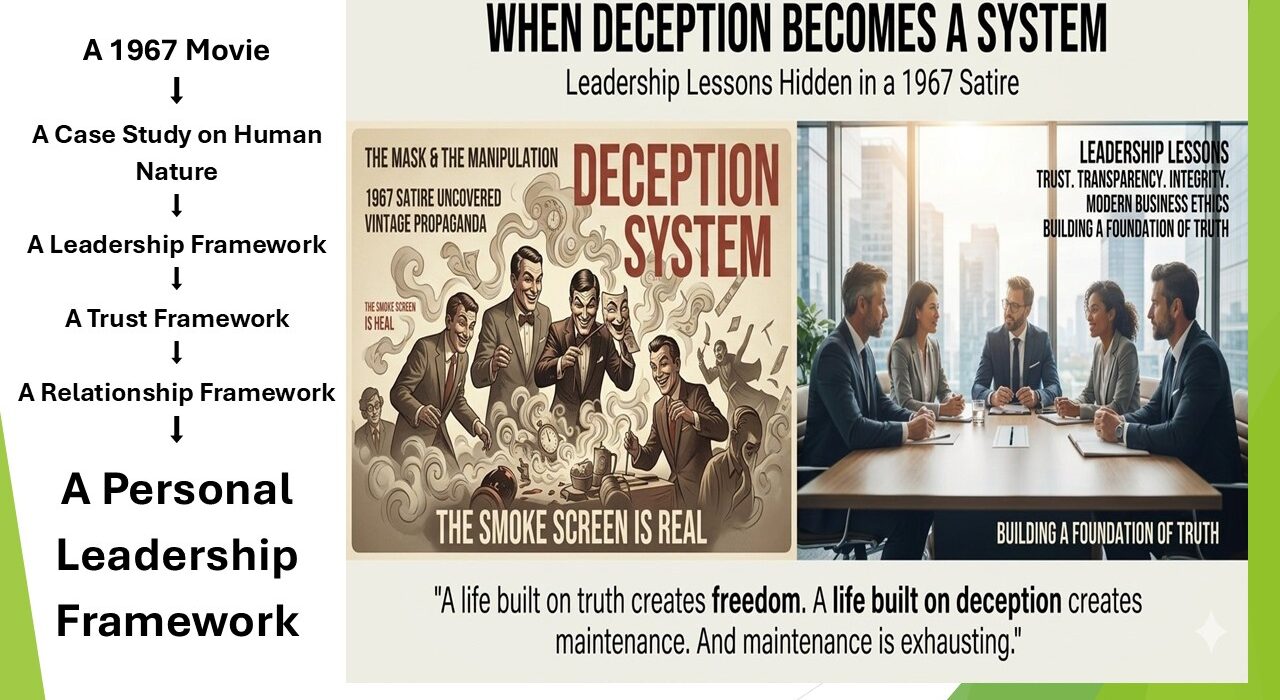
A life built on truth creates freedom. A life built on deception creates maintenance. And maintenance is exhausting.
Perhaps that is why the most successful leaders, professionals, and relationships are not those that appear perfect. They are those that have the courage to remain authentic when deception would be easier.
Conclusion: Why Integrity Remains the Ultimate Competitive Advantage
A Guide for the Married Man is a 1967 comedy about infidelity. But its satirical genius lies in its exposure of systems that still govern our professional lives.
The rules it mocks — deception as strategy, trust as optional, manipulation as acceptable — are the very rules we too often accept in the workplace.
But the film’s ultimate lesson, delivered through Paul’s spectacular collapse, is this:
No system built on dishonesty survives contact with real emotion.
In 2026, as AI transforms work, as transparency becomes inescapable, and as authenticity becomes the only differentiator that matters, the leaders who thrive will be those who embrace the opposite of the “Guide’s” advice:
| The Satirical “Rule” | The Authentic Alternative |
| Deception as strategy | Honesty as policy |
| Trust as optional | Trust as foundational |
| Control over others | Influence through integrity |
| Performance over substance | Authenticity over image |
| Rationalization as shield | Accountability as strength |
| Manipulation for power | Connection through respect |
| Fragmentation for survival | Wholeness for sustainability |
For the junior professional: Your integrity is your only durable asset. Build it from day one.
For the mid-level leader: Your influence depends on trust. Cultivate it relentlessly.
For the senior executive: Your legacy is defined by the culture you create. Make it one of honesty, courage, and authenticity.
The 1967 “Guide” showed us what not to do. Now it is our turn to write the guide for what works.
Leadership Integrity Checklist: 12 Actions You Can Start Today
Immediate Actions (This Week)
- □
Audit your personal integrity gap. Where is there a disconnect between what you say and what you do?
- □
Identify one rationalization you have been using. Replace it with honest self-assessment.
- □
Have one difficult conversation you have been avoiding. Address it directly and honestly.
- □
Review your team’s psychological safety. Are people comfortable speaking truth to power?
Short-Term Actions (This Quarter)
- □
Create feedback mechanisms for your team. Reward truth-telling, not just positive news.
- □
Standardize decision-making processes. Use clear KPIs and documented criteria.
- □
Eliminate one “performative” ritual. Replace it with substantive discussion.
- □
Share a failure story from your career. Normalize vulnerability and learning.
Long-Term Actions (This Year)
- □
Align your personal brand with your actual values. Close the authenticity gap.
- □
Build genuine alliances based on shared purpose. Not convenience or protection.
- □
Codify ethical decision-making frameworks. Make integrity operational.
- □
Create a culture where bad news travels fast. Reward transparency, not spin.
Discussion Question: Where Have You Seen These Patterns at Work?
What patterns from the “Guide” have you observed in professional settings? How have you navigated the tension between performance and authenticity? Share your experiences in the comments.
If this analysis resonated with you:
- ♻️ Repost to help your network navigate the path from performance to authenticity
- 💾 Save this for future reference when facing ethical or cultural challenges
- ✍️ Follow me for more deep dives into leadership, ethics, and organizational health
“The best way to find yourself is to lose yourself in the service of others.” — Mahatma Gandhi
Subhashis Banerji [Author]
Leadership assessor, strategist, and writer. I help professionals and organizations make smarter decisions by learning to read patterns, not promises.
📘 Read all my articles here:
👉 https://successunlimited-mantra.net/ & https://successunlimited-mantra.com/index.php/blog PLUS on https://relationshipandhappiness.com/
💼 Connect with me on LinkedIn: https://www.linkedin.com/in/subhashis-banerji-21b1418/
Related posts:
- When Feedback Becomes a Threat: How Leaders Can Transform Toxic Feedback into Growth, Motivation and High Performance
- How Average Employees Become Toxic Leaders: The Hidden Link Between Insecurity, Power and Office Politics
- How Companies Manipulate Indian Consumers: 75+ Hidden Tricks, False Advertisements & Psychological Sales Tactics
- Even Monkeys Fall From Trees: Why Even Experts Make Mistakes — And How to Turn Failure Into Growth



– Please read our Comment Policy