


How Companies Manipulate Indian Consumers: 75+ Hidden Tricks, False Advertisements & Psychological Sales Tactics
Reading Time: 13 minutes
Contents
hide
1
How Companies Manipulate Indian Consumers: 75+ Hidden Tricks, False Advertisements & Psychological Sales Tactics
How Companies Manipulate Indian Consumers: 75+ Hidden Tricks, False Advertisements & Psychological Sales Tactics
A Consumer Survival Guide to Shrinkflation, Skimpflation, Dark Patterns, Planned Obsolescence & Advertising Manipulation in India
How Businesses in India Exploit You & How to Fight Back
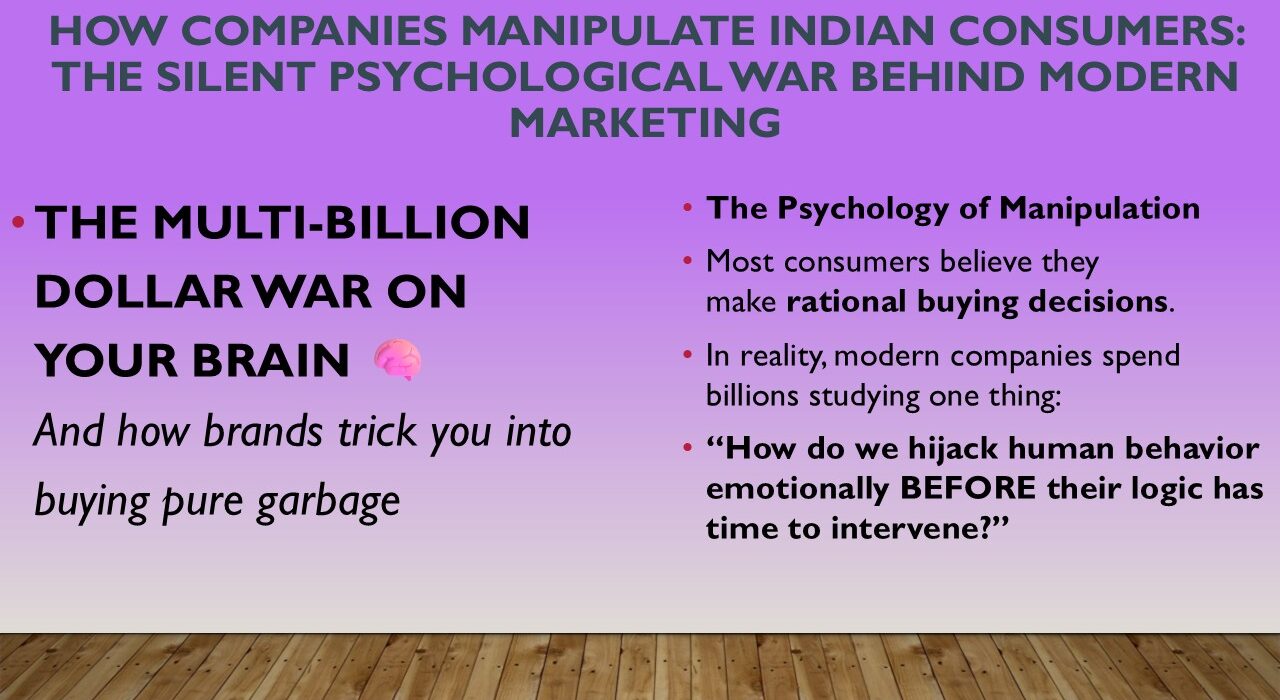
Modern consumerism in India is no longer a simple exchange of money for goods. It has evolved into a sophisticated battlefield where companies deploy shrinkflation (less for the same price), skimpflation (lower quality for the same price), psychological manipulation, celebrity-driven deception, engineered obsolescence, and dark patterns—all designed to influence your behavior without your conscious awareness.
What we are witnessing today is not merely inflation. It is something far more insidious: a systematic erosion of value, quality, comfort, durability, and trust—hidden beneath glossy packaging, aspirational branding, emotional storytelling, and relentless advertising. Consumers are increasingly being conditioned to pay more, receive less, tolerate lower standards, and still feel grateful—because marketing has perfected the illusion of progress, status, convenience, and modern living.
In India, this phenomenon is supercharged by a massive aspirational middle class, aggressive consumerism, rising lifestyle anxiety, and historically weak enforcement of consumer protection laws. While regulators like the Central Consumer Protection Authority (CCPA) and ASCI have begun cracking down, the scale of exploitation remains staggering. Companies ruthlessly exploit our aspirations—for health, beauty, fitness, status, convenience, luxury—while simultaneously weaponizing our deepest fears: aging, obesity, disease, social rejection, insecurity, and the dread of “falling behind.”
Celebrities, influencers, pseudo-experts, fake scientific jargon, bogus discounts, and emotionally charged storytelling are not incidental—they are psychological weapons designed to bypass rational thinking and trigger impulse buying. The result is a widening, often invisible gap between marketing promises and product reality.
Consider the everyday examples millions of Indians experience but rarely analyze deeply:
- A so-called “family sedan” like the new Maruti Dzire—glossy ads show happy families, yet four average-height adults cannot sit comfortably for 30 minutes. Cabin space and ergonomics were sacrificed for design and cost.
- Indian Railways AC 2-tier—once reasonably comfortable, now squeezes in extra berths while shrinking toilets so much that passengers brush against dirty walls just to use them.
- Airlines like IndiGo—seating density so aggressive that average passengers feel physically compressed, while overpriced onboard meals marketed as “delightful” deliver tiny portions of mediocre quality.
- Diabetes medicines—sold in odd 14-tablet strips instead of practical monthly packs, forcing repeat pharmacy visits and increasing dependency.
- A small juice pack like Frooti—visually satisfying on screen, but barely fills your mouth.
- Water purifier companies—create fear around municipal water while selling filters with rapidly expiring cartridges and recurring costs. RO systems waste shocking amounts of water in a water-stressed nation—yet are marketed as symbols of health-conscious living.
- Garment manufacturers—quietly reduce fabric quality and sizing consistency while charging premium prices through branding.
- Everyday products—soaps, snacks, detergents, packaged foods—routinely resized, reformulated, bundled, diluted, or repackaged to confuse your sense of value.
None of this is accidental. It is engineered consumer psychology.
Modern advertising no longer primarily sells products. It sells aspiration, insecurity, identity, social validation, emotional comfort, convenience, and perceived status. The health, beauty, obesity, muscle-building, immunity, fairness, and wellness industries are especially notorious for exaggerated or outright false claims. In most cases, ingredients highlighted prominently in advertisements are either missing entirely, present in negligible quantities, hidden behind proprietary blends, or substituted with cheap, substandard alternatives—while you pay a king’s ransom for products that are ineffective, unnecessary, or sometimes even harmful.
Not all companies operate this way. Many still prioritize quality, ethics, and long-term trust. But the growing dominance of manipulative marketing makes consumer awareness more important than ever before.
This is not just an article. It is a consumer survival manual for navigating a marketplace optimized to manipulate perception rather than deliver genuine value.
In the sections ahead, we will systematically break down:
- 45+ ways consumers are being duped across transportation, food, health, beauty, fashion, electronics, finance, real estate, and digital platforms.
- 45+ examples of misleading and manipulative advertisements—including celebrity-driven falsehoods.
- Critical red flags to spot before you buy anything.
- A fully implementable action plan to ensure you never again buy a lemon at the price of the moon.
75+ Ways Indian Consumers Are Being Cheated, Manipulated & Overcharged Across Industries
These tactics involve quantity reduction, quality degradation, hidden costs, forced repeat purchases, and design flaws.
How Car Companies, Airlines & Railways Reduce Comfort While Charging More
- Maruti Suzuki Dzire / Compact Sedans – Cabin space shrunk to fit under 4 meters for lower GST (12% instead of 24%+). Four people of 5’10” cannot sit for 30 minutes. Marketed as “spacious family car.”
- Indian Railways AC 2-Tier – Berths increased from ~46 to 52, reducing width. Toilets so narrow that a normal person touches all walls and washbasins, accumulating dirt and germs.
- IndiGo & Low-Cost Airlines – Seat pitch reduced to 28–29 inches (standard was 31–32). Average Indian finds it difficult to sit comfortably. Overpriced, poor-quality food marketed as “palate delight.”
- ARA Mileage Trap – Advertised 25 km/l under ideal lab conditions. Real bumper-to-bumper mileage is often 40% lower.
- Safety as a Premium Feature – Base variants sold with weaker structural shells, no electronic stability control, or fewer airbags. Safety becomes a paid upgrade.
- Structural Sheet Metal Thinning – Reduced gauge thickness to save cost and weight. Cars dent easily under minor pressure.
- Dynamic Rail Pricing (“Suvidha”) – Tickets cost as much as airfare, but service, toilet cleanliness, and food quality remain identical to standard trains.
- Airline Seat Selection Extortion – Families auto-assigned middle seats unless they pay premium for window/aisle seats.
- Bus “Sleeper” Seats Too Short – Average Indian adult cannot stretch legs fully.
- SUV Ads Showing Off-Road Capability – Reality: 2WD, low ground clearance, city-centric suspension.
- “5-Seater” Cars Uncomfortable for 5 Adults – Rear middle seat is a hard, raised hump with no headrest.
- Exaggerated “Luxury Interiors” – Cheap hard plastics marketed as premium with clever lighting in showrooms.
Shrinkflation in Food: How Brands Reduce Quantity, Quality & Nutrition While Raising Prices
- Diabetes Medicines in 14-Tablet Packs – Instead of standard 10 or 30-day supply. Forces multiple strips per month, breaking mental math of daily cost.
- Frooti & Small Juice Packs – 150ml or 160ml volume that doesn’t fill your mouth. Per-liter cost astronomically higher than larger bottles.
- “Slack Fill” Packaging (Chips) – 60% nitrogen gas, 40% product. Giant bag visually tricks brain into expecting more.
- Premium “Probiotic Dahi” – Same basic cultures as home-set curd, but sold at 200% markup.
- Frozen Dessert vs. Ice Cream – Vegetable oil instead of dairy fat. “Frozen Dessert” in tiny font; giant images of fresh milk on front.
- Edible Oil Blending – “Pure” olive/mustard oil blended with 70–80% cheap palm or rice bran oil. Fine print on back.
- Hollow-Bottom Jars (Peanut butter, jam, cosmetics) – Inverted dome bottom makes jar look massive, but actual volume drastically reduced.
- Biscuit Count Reduction – Parle-G, Britannia quietly remove 2–4 biscuits every couple of years while keeping ₹10 price.
- Soap Multipack Discount Illusion – 5–6 soaps bundled, but each bar reduced from 100g to 85g inside the wrap.
- “Natural” Fruit Juices with 10% Fruit – “Reconstituted juice water” with 10% pulp and massive liquid sugar.
- Tea Powder Adulteration – Leather flakes, iron filings, artificial colorants mixed in loose tea.
- Honey with Rice Syrup – Cheap C3/C4 inverted sugar or rice syrups that bypass traditional purity tests.
- Maggi Noodles – Weight reduced from 80g to 55g; “tasty and healthy” claim despite past lead issues.
- Parle-G / Good Day / Marie Gold – Fewer pieces or less weight per pack (e.g., 10 to 8 biscuits).
- Lays / Haldiram Snacks – ₹15/₹25 packs lighter; air-filled for perceived volume.
- Vim Soap Bar – 155g reduced to 135g at same price.
- Cadbury Dairy Milk / KitKat – Smaller grammage, same wrapper size to suggest same quantity.
- Cooking Oil Pouches – “1 Litre” often 950ml or 900ml.
- “Healthy” Breakfast Cereals – Loaded with sugar, marketed to children emotionally.
- Protein Bars – Mostly sugar syrup and palm oil, minimal real protein.
How Electronics & Appliance Brands Trap Consumers Through Planned Obsolescence & Hidden Costs
- HUL Water Filter (Chlorine Trap) – Adds unnecessary chlorine (municipal supply already has it). Filter gets “locked” in 10–15 days, forcing ₹500–1500 replacement of carbon & fabric filters.
- RO Water Purifiers – Waste 3–4 liters of water for every 1 liter purified (up to 75% wastage). Marketed as “pure health” without disclosing waste ratio.
- Appliance Installation Extortion – AC or TV bought online cheap, but authorized technician forces premium copper pipes, stands, extended warranties at inflated prices.
- Inbuilt Obsolescence (Smartphones) – Software updates intentionally slow processor or drain battery, coercing upgrades.
- “No-Cost EMI” Illusion – Interest loaded into upfront price, or charged as “processing fee,” or GST charged on interest.
- Smart TV Bloatware – Non-removable apps and banner ads on home screen. Your TV becomes a billboard.
- Ink Cartridge Scam – Printers cheap, but replacement cartridges cost more than printer. Microchips refuse to print even when ink remains.
- Aluminum Wiring in Compressors – Instead of copper in ACs/refrigerators. Burnouts just after warranty expires.
- Fake BEE Star Ratings – Old inventory sold with outdated ratings. A legacy 5-star appliance performs like modern 3-star.
- Proprietary Screws & Fasteners – Prevent local repair shops from opening devices. Forces expensive company service centers.
- “Free” Water Demo Trap – TDS meters calibrated to show tap water as “poisonous.” Scares you into buying ₹20,000 RO system you don’t need.
- Printers Cheaper Than Cartridges – Business model traps customer later.
- Non-Removable Laptop Batteries – Forced expensive servicing or replacement.
- Cheap Plastic Gears Inside Expensive Appliances – Shortened lifespan by design.
- Soldered Laptop RAM – Prevents future upgrades.
- Earbuds Designed for Non-Repairability – Disposable electronics culture.
Fashion & Personal Care Tricks: Smaller Sizes, Lower Quality & Misleading Branding
- Readymade Garments Smaller Than Standard – Save a few mm of fabric per garment. “XL” has dimensions of standard “Medium.”
- Thread Count Fraud (Bedsheets) – “1000 Thread Count” by counting plies within a spun yarn, not actual woven threads.
- Shampoo Foam Illusion – Excessive Sodium Laureth Sulfate (SLS) creates massive lather. Strips natural oils, forcing conditioner purchase.
- Shaving Cartridge Monopoly – Razor handle cheap; proprietary replacement blades exorbitant.
- 99% Germ-Kill Fallacy – Tested in sterile lab over minutes, not your 5-second hand wash. The 0.1% left are often the most resistant bacteria.
- Fairness Cream Matrix – Relabeled to “Glow” or “Brightening” after backlash, but same bleaching agents (hydroquinone, steroids) that damage skin.
- Deodorant Gas Rip-off – 70% pressurized gas, 30% perfume liquid.
- Fake Pockets in Women’s Apparel – Non-functional pocket slits to save inner lining fabric.
- “Herbal” Face Wash Lie – 98% synthetic chemicals; neem extract <0.5% at bottom of ingredient list.
- Diaper/Sanitary Pad Odd Counts – Packs of 13, 17, 22 instead of multiples of 5 or 10. Disrupts per-unit cost calculation.
- Hair Oil with Mineral Oil Base – 80–90% petroleum-derived mineral oil, marketed as almond/amla/olive oil.
- “Chemical-Free” Soap Fallacy – Soap requires saponification – a chemical reaction between fats and Sodium Hydroxide (lye).
The Supplement & Wellness Industry Scam: False Claims, Fake Science & Fear-Based Marketing
- Protein Powders with Amino Spiking – Fake protein count inflation using cheap amino acids.
- Fat Burners with Stimulants – Temporary sensation mistaken for fat loss. Often harmful.
- “Immunity Boosters” – Vague, unverified claims. No scientific backing.
- Height Increase Products – Biologically impossible after growth plates close.
- Testosterone Boosters – Mostly zinc and ashwagandha; weak evidence, overpriced.
- Detox Teas – Mostly laxatives causing water loss, not fat loss.
- Slimming Belts / Vibration Machines – Pseudo-science; cannot melt subcutaneous fat.
- Ayurvedic “Miracle Cures” – Unverified disease claims (diabetes, cancer, kidney stones).
- Gym Supplements with Undeclared Substances – Serious health risk; failed lab tests common.
- Collagen Supplements – Negligible absorption evidence; stomach digests into basic amino acids like any protein.
Financial & Digital Dark Patterns: Fake Discounts, Hidden Charges & Subscription Traps
- “Zero Cost EMI” – Interest hidden in inflated product price.
- Insurance Products with Misleading Returns – Complex fine print; ULIPs sold as investment miracles.
- Food Delivery Inflated Menu Pricing – Higher than restaurant dine-in rates.
- App Subscriptions Difficult to Cancel – Dark-pattern design, hidden cancellation links.
- E-commerce Fake Discounts – MRP artificially inflated; “80% off” on base price that never existed.
45+ Misleading Advertisements in India That Manipulate Consumers Into Buying Useless or Harmful Products
These ads use celebrities, pseudo-science, fear, and aspiration to sell useless or harmful products at exorbitant prices.
False Health & Fitness Claims: Weight Loss, Muscle Gain & Immunity Scams
- “Lose 10 kg in 10 days” – Biologically impossible without amputation.
- “Fat melts while sleeping” – No cream or pill can selectively burn fat.
- “Build muscle without exercise” – Contradicts basic physiology.
- “Height increase after 25” – Growth plates fused; false hope marketing.
- “Diabetes-curing herbal supplements” – Prompt vulnerable patients to stop insulin/metformin.
- Testosterone boosters featuring muscular models – Most contain only zinc and herbs.
- Detox foot patches turning black – Chemical reaction between sweat and wood vinegar, not “toxins.”
- Memory-boosting tonics for kids – Sugar syrup with microscopic, non-therapeutic Brahmi.
- Cholesterol-free vegetable oils – Cholesterol only exists in animal fats. All plant oils are inherently cholesterol-free.
- “Immunity” biscuits – Refined flour and sugar with a trace of zinc or vitamin C.
- Green tea for weight loss – Metabolic effect microscopic; models lose inches only in ads.
- “Organic” jaggery as diabetic-friendly – Jaggery is sucrose; spikes blood sugar like white sugar.
- Mass gainers packed with sugar – Cheap maltodextrin (higher glycemic index than sugar), minimal whey.
- Energy drinks for mental focus – Caffeine + sugar load leads to insulin crash.
- Ayurvedic obesity cure oils – Cellulite cannot be rubbed away from outside.
Beauty Industry Manipulation: Fairness Creams, Hair Fall Products & Anti-Aging Myths
- 7-day charcoal whitening toothpaste – Charcoal is abrasive; strips enamel, exposes yellow dentin.
- Anti-hair fall shampoos with Bollywood actresses – Shampoo stays 60 seconds; cannot alter genetic hair fall.
- “Stem cell” face creams – Stem cells cannot survive in a jar; plant cells cannot communicate with human cells.
- Beard growth oils – Beard density controlled by genetics (DHT sensitivity). No oil creates new follicles.
- Dark circle eraser roll-ons – Cold roller gives temporary vasoconstriction; cannot erase genetic dark circles.
- Sunscreen with “100% protection” – No sunscreen blocks 100% of UV rays.
- Pore-vanishing toners – Pores have no muscles; cannot open or close. Only cleared of debris.
- “Split-end repair” serums – The only cure for split ends is scissors. Silicones temporarily glue hair.
- Stretch mark removal creams – Stretch marks are dermal tears; topical creams cannot repair collagen.
- Vitamin C serums in clear bottles – Vitamin C oxidizes instantly in light/air. Brown liquid is useless.
- “Natural” black hair dyes – Replace ammonia with ethanolamine or PPD, causing severe allergic reactions.
- Acne-curing face washes – Over-washing irritates skin, triggers more oil production.
- Fairness creams promising “whiter in weeks” – Contain steroids and hydroquinone; cause permanent skin damage.
Fake Technology Claims & Lifestyle Marketing Tricks Consumers Should Stop Believing
- Alkaline water ionizers (₹1 lakh+) – Claim to cure cancer. Stomach acid neutralizes alkalinity instantly. Body regulates its own pH.
- Radiation-blocking mobile stickers – If they blocked radiation, phone would lose signal.
- Fuel-saving devices for cars – Empty plastic shell with LED light. No scientific basis.
- Mosquito repellent machines with “natural oils” – Active ingredient is synthetic pesticide (Transfluthrin).
- Air purifiers with fake “plasma” tech – Cheap fan + substandard filter; no true HEPA.
- “Orthopedic” pillows – Standard memory foam marked up 300% with no medical certification.
- Unbreakable tempered glass screen protectors – Break under minimal stress to create illusion of “saving” phone.
- “Biodegradable” garbage bags – Conventional plastic with additives that break into toxic microplastics faster.
- Smart scales with 14 biometrics – Use formulas based on age/weight to guess metrics, not actual measurement.
- Flame-retardant wires surviving blowtorch – Internal copper still melts under short-circuit overload.
- RO ads creating irrational fear of tap water – Unnecessary RO sold where TDS <500 ppm.
- ACs claiming unrealistic power savings – Star ratings manipulated with old standards.
- “German technology” with no German origin – Just a marketing phrase.
- Real estate “10 minutes from airport” – Measured at midnight with no traffic.
- Fake green landscape visuals – Brochures show lush gardens; reality is concrete and dust.
- Edtech promising guaranteed jobs – No refund when placement fails.
- Influencers selling “passive income systems” – Their real income comes from selling courses, not the system.
Consumer Red Flags: How to Identify Fake Marketing, Misleading Claims & Psychological Sales Tactics
Train your brain to spot these warning signs instantly.
Psychological Manipulation Tactics Used in Advertising
- Celebrity Endorsement – The celebrity does not use the product. Especially common with supplements, fairness creams, protein powders, and luxury investments.
- Emotional Manipulation – “If you love your family…” Fear-based selling targeting parents, spouses, or insecurity.
- Unrealistic Claims – “Instant results,” “miracle cure,” “zero effort,” “guaranteed success.” If it sounds too good to be true, it is.
- Excessive Urgency – “Only today,” “last few left,” “sale ends in 04:12 mins.” Artificial scarcity triggers FOMO.
- Overfocus on Packaging – Premium box often hides mediocre product. The front is marketing; the back is legal truth.
- Aspiration Selling – “Successful people use this.” Links product to status, not function.
- Insecurity Exploitation – Targets dark skin, hair loss, aging, obesity, masculinity, social status. These industries thrive on insecurity.
Product Warning Signs That Most Consumers Ignore
- Asterisks (*) in the Headline – Giant claim: “FREE WATER FOR LIFE*” Hunt for microscopic asterisk pointing to “under laboratory conditions” or “results vary.”
- Pseudo-Scientific Buzzwords – “Dermatologically tested” (means applied to skin, not proven effective). “Bio-optimized,” “quantum-tech,” “cell-activating,” “toxin-flushing.” These have no legal or scientific meaning.
- Tiny Font Ingredients – Something is being hidden.
- No Clear Manufacturing Source – Especially dangerous for supplements.
- Proprietary Blends – Hides actual quantity of each ingredient.
- No Third-Party Testing – Very risky for health products.
- “Before & After” Lighting Trick – “Before” shot: harsh yellow lighting, frowning, slouched posture. “After” shot: ring lights, professional makeup, spray tan, smiling.
- Hiding True Cost Per Unit – “Just ₹99!” but no weight/volume shown.
Pricing Tricks Companies Use to Make Consumers Spend More
- Massive Discount from Absurd MRP – Fake anchor pricing. MRP was never actually charged.
- Very Low Introductory Pricing – Trap for expensive repeat purchases (e.g., printers, razors).
- Subscription Locking – Recurring extraction model. Cancellation is deliberately difficult.
- “No-Cost EMI” without full disclosure – Interest hidden in processing fees or upfront price loading.
Smart Consumer Buying Guide: How to Avoid Fake Marketing, Bad Products & Hidden Traps
What to Look For While Buying – How to Avoid Being Sold a Lemon at the Price of the Moon
Step 1: Analyze Products Logically Instead of Emotionally
Ask four questions before any purchase:
- What problem does this solve?
- Is it solving it efficiently?
- What is the hidden compromise (space, quality, lifespan)?
- Who benefits more – me or the seller’s repeat purchase model?
Step 2: How to Read Labels, Ingredients & Product Claims Properly
The front is marketing; the back is legal truth regulated by FSSAI (food), CDSCO (cosmetics), or BIS (electronics).
- Ingredient Order: Must be listed in descending order of weight. If “Neem & Aloe Face Wash” lists Water, Sodium Laureth Sulfate, Glycerin as first three, and Neem Extract is 18th – you are buying chemical soap, not neem.
- True Weight/Volume: Compare price per 100g or per liter. Do not trust pack size.
- Certification Marks: Look for genuine BIS (ISI), Agmark, FSSAI, Hallmark. Use BIS Care app to verify license numbers.
Step 3: Avoid Impulse Buying Triggered by Advertising
Advertising works by impulse, excitement, urgency. Say: “Give me your brochure. If I want it, I will call you tomorrow.” After 24–72 hours, your logical brain will see through the manipulation.
Step 4: Test Real-World Comfort Before Buying Cars, Flights or Travel Tickets
- Car test drive: Take three adults of your family. Sit them in the back seat. Turn AC to max. Sit there static for 15 minutes. Check knee touch, headroom, under-thigh support.
- Flight seats: Before booking, plug flight number into SeatGuru to see actual legroom pitch and check if seat is near galley/toilet.
- Railway berths: Check coach layout diagrams. Avoid modified 2-tier/3-tier economy with extra berths.
Step 5: How to Find Genuine Reviews Instead of Paid Promotions
- Avoid sponsored influencers. Search for “unbiased review,” “tear-down,” “long-term ownership.”
- Websites: Team-BHP (cars), consumer forums, Reddit (r/IndiaInvestments, r/IndianSkincareAddicts).
- Negative reviews first: Most truth is in 2-star and 3-star long-form reviews.
- ASCI complaints: Search “product name + ASCI complaint” to see past misleading ads.
Step 6: Calculate Real Product Value Using Per-Unit Pricing
Always calculate:
- ₹ per kg, per liter, per 100g, per tablet, per use.
- Break bundles: 5 soaps for ₹200 seems cheap, but each soap is 75g instead of 100g. Compare to single 100g soap price.
Step 7: Buy Repairable Products to Avoid Planned Obsolescence
Avoid products that are:
- Impossible to open (soldered RAM, glued batteries)
- Impossible to upgrade (non-removable batteries, proprietary screws)
- Dependent on proprietary consumables (ink cartridges, special filters)
Ask: “Can a local repair shop fix this? Where can I buy spare parts?”
Step 8: Understand How Modern Companies Maximize Repeat Purchases
Many industries today optimize for:
- Repeat purchase (printers, filters, cartridges)
- Planned replacement (software updates slowing phones)
- Emotional dependency (fairness creams, hair oils)
- Recurring subscription (apps, OTT, cloud storage)
- Margin extraction (premium branding without premium quality)
They do NOT optimize customer wellbeing, durability, or honesty.
Step 9: Consumer Rights in India – How to File Complaints Against Misleading Ads & Fraud
- Consumer Protection Act, 2019 – Empowers you to file complaints for misleading ads, defective products, unfair trade practices.
- National Consumer Helpline: 1800-11-4000 or online at consumerhelpline.gov.in
- CCPA (Central Consumer Protection Authority) – Can impose penalties for false advertisements. Coaching institutes have been fined over ₹1 crore for misleading success claims.
- ASCI – File complaint against misleading ads at https://www.ascionline.in/contact-us/
- Consumer Court – For claims up to ₹1 crore (District Forum), ₹1 crore to ₹10 crore (State Commission), above ₹10 crore (National Commission).
Step 10: How to Become Immune to Advertising Manipulation
- Treat all ads as entertainment, not information. An ad’s job is to make you feel inadequate and then sell you a solution.
- Celebrities are actors reading a script. They have zero accountability for product performance.
- If a product needs a face to sell it rather than lab data, the product is weak.
Final Takeaway: How Smart Consumers Protect Themselves in a Manipulative Marketplace
The modern consumer economy often rewards perception over substance, branding over engineering, and marketing over integrity. The best defense is:
✅ Skepticism
✅ Delayed buying
✅ Technical understanding of specifications
✅ Label reading
✅ Independent verification
✅ Knowing your legal rights
✅ Voting with your wallet – support transparent, durable, honest brands
You are not a consumer to be harvested. You are a citizen with rights. Exercise them.
Subhashis Banerji [Author]
Leadership assessor, strategist, and writer. I help professionals and organizations make smarter decisions by learning to read patterns, not promises.
 Read all my articles here:
 https://successunlimited-mantra.net/ & https://successunlimited-mantra.com/index.php/blog PLUS on https://relationshipandhappiness.com/
 Connect with me on LinkedIn: https://www.linkedin.com/in/subhashis-banerji-21b1418/



– Please read our Comment Policy