


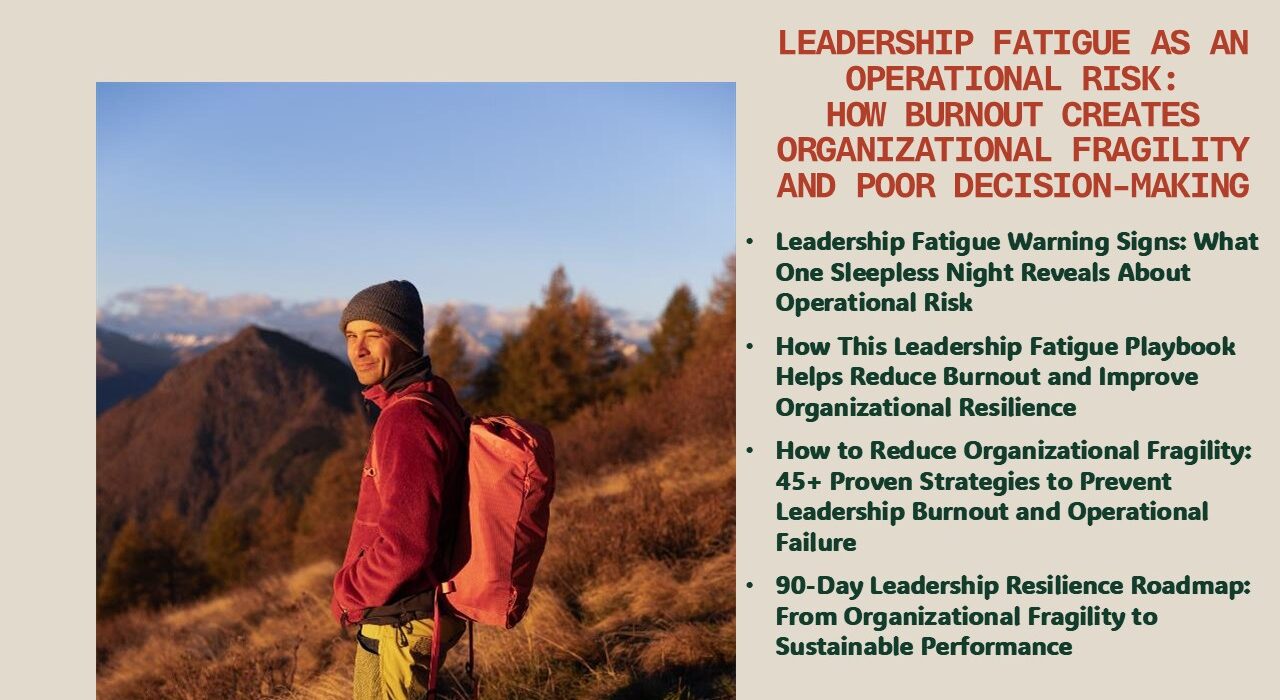
Leadership Fatigue as an Operational Risk: How Burnout Creates Organizational Fragility and Poor Decision-Making
Reading Time: 14 minutes
Leadership Fatigue as an Operational Risk: How Burnout Creates Organizational Fragility and Poor Decision-Making
Why Leadership Burnout Weakens Organizations (And How to Build Resilience Before Failure Happens) –How to Stop Parking on Bricks When the Wheels Fall Off
Leadership Fatigue Warning Signs: What One Sleepless Night Reveals About Operational Risk
I woke up after almost no sleep – barely an hour before the alarm. Groggy, disoriented, I went through my morning routine, started the car, put it in gear… and nothing happened. Someone had stolen all four wheels overnight. My car was resting on bricks.
That jarring moment is not just a personal inconvenience. It is a perfect metaphor for modern leadership.
When leaders are exhausted – whether from a single sleepless night or chronic overwork – their judgment is impaired, their ability to spot missing “wheels” collapses, and organizations lurch into crisis over fixable problems. Fatigue turns small failures into expensive disasters. And when an organization relies on sleep‑deprived heroes to keep the wheels on, it is not resilient – it is fragile.
This playbook is your complete guide to moving from groggy to responsive, from hero‑driven chaos to systemic agility. It answers three essential questions:
- Why does leadership fatigue take root in an organization? (30+ causes)
- Why does it happen to an individual leader? (30+ triggers)
- How do we handle organizational fragility and build a playbook for agile, energetic, enthusiastic, and effective leadership? (45+ strategies)
No theory alone. No blame. Just a fully implementable action plan – ready for you to copy, paste, and execute.
How This Leadership Fatigue Playbook Helps Reduce Burnout and Improve Organizational Resilience
By reading and applying this playbook, you will:
- Turn fatigue from a personal failing into a systemic risk – then mitigate it like any other operational threat.
- Stop celebrating heroism and start rewarding sustainable, high‑performance systems.
- Replace single‑point decision dependency with redundant, rested leadership.
- Reduce costly late‑night errors by 60‑80% using simple checklists, handoffs, and second sign‑offs.
- Build an organization that does not collapse when the obvious is missing – whether that is a rested leader, a critical document, or a set of wheels.
| Section | Content |
| Part 1 | 30+ organizational causes of leadership fatigue – structural, cultural, operational, strategic, emotional. |
| Part 2 | 30+ individual triggers – physical, cognitive, emotional, behavioural, external. |
| Part 3 | 45+ strategies divided into six modules: governance, operations, culture, capacity, measurement, and implementation. |
| Conclusion | A clear call to action – your next steps starting tomorrow. |
You will find the “car on bricks” metaphor woven throughout, because it reminds us: a car does not fail because the engine is weak. It fails because a foundational dependency (the wheels) is missing. The same is true for leaders and organizations.
How Leadership Fatigue Creates Organizational Fragility: Root Causes, Risks, and Hidden Costs
Part 1: Why Leadership Fatigue Takes Place in an Organization (30+ Causes)
Leadership fatigue is rarely because leaders are weak. It is almost always a symptom of systemic design gaps. Below are all the unique causes, organized into five families.
- Structural & Architectural Causes
- Single‑point‑of‑failure (SPOF) roles – Irreplaceable contextual knowledge or sign‑off authority vested in one person.
- Excessive centralized decision‑making – Every critical path requires one exhausted leader.
- Poor succession planning & no deputies – No one else can take over when the leader is drained.
- Role ambiguity & overlapping responsibilities – Leaders waste energy navigating who does what.
- Weak accountability structures & unclear RACI – Circular approvals and redundant alignment meetings.
- Frequent organizational restructuring – Permanent reorganization destroys institutional memory and trust networks.
- Matrix confusion – Multiple reporting lines that demand political consensus for minor approvals.
- Shadow hierarchies – Informal power structures that add unspoken political load.
- Fragmented governance – Decision rights are ambiguous, causing delays and frustration.
- Undefined escalation hierarchy – Leaders don’t know when or to whom to hand over.
- Extreme span of control – More than 10 direct reports makes meaningful mentorship impossible.
- Operational debt – Legacy systems, broken processes, or technical debt requiring constant manual intervention.
- Workload & Operational Causes
- Chronic understaffing – Leaders absorb the work of missing roles.
- Constant firefighting mode – Long‑term strategy permanently sidelined for daily emergencies.
- Too many simultaneous priorities – Everything is urgent, nothing is important.
- Unrealistic timelines & aggressive growth targets – Leaders push themselves and teams beyond limits.
- Long decision queues – Backlogged approvals drain mental energy.
- Poor resource allocation – Starving support functions forces strategic leaders into tactical work.
- Excessive meetings – Back‑to‑back calendars with no time to think.
- Information overload – Hundreds of uncurated emails, messages, and reports daily.
- Continuous change fatigue – Pivoting every quarter based on macroeconomic noise.
- High‑stakes regulatory/compliance pressure – Navigating expanding frameworks without automated tooling.
- Frequent crises without post‑incident learning – Same fires, different week.
- Ineffective middle management – Every minor dispute escalates to executive desks.
- Vendor & third‑party friction – Broken supply chains shift operational burden back to leaders.
- Cultural & Behavioural Causes
- Normalized “hero culture” – Celebrating all‑nighters and last‑minute saves instead of fixing root causes.
- Always‑on responsiveness – Expectation to reply to Slack, WhatsApp, or email across time zones within minutes.
- Fear‑driven management – Leaders make defensive decisions to avoid blame.
- No psychological safety – Admitting overload or asking for help is seen as a weakness.
- Low trust culture – Leaders hoard information and re‑check everything.
- Micromanagement norms – Leaders are expected to dive into every detail.
- Perfectionism expectations – Zero tolerance for honest mistakes, forcing hypervigilance.
- Rewarding overwork – Performance reviews value hours logged over strategic impact.
- Politics and turf wars – Emotional energy spent defending teams against internal attacks.
- Performative presenteeism – First to arrive, last to leave – regardless of output.
- Outcome blindness – Visible effort is rewarded more than quiet, stable results.
- Gratuitous inclusivity – Everyone invited to every meeting, draining calendars under the guise of collaboration.
- Strategic & Governance Causes
- Poor strategic clarity – Vague anchors make leaders chase moving targets.
- Frequent shifting priorities – Mission creep without killing legacy initiatives.
- Weak scenario planning – No “what if” for fatigued or missing leaders.
- Reactive planning – No long‑term resilience buffers.
- Misaligned KPIs – Metrics pit departments against each other (e.g., Sales vs. Risk).
- Lack of resilience buffers – No redundancy budget for people or systems.
- Disjointed global governance – Leaders attend late‑night calls for one market and early‑morning calls for another without compensation.
- Fragmented tool ecosystems – Context‑switching across 10+ disconnected platforms.
- No deputisation frameworks – Vacation becomes “remote work with a view”.
- Emotional & Systemic Causes
- Continuous conflict management – Leaders act as full‑time mediators.
- Ethical pressure – Forced to execute policies that conflict with personal values.
- Stakeholder overload – Managing board, investors, customers, and regulators simultaneously.
- Emotional contagion – Tired leaders tire teams; anxious teams drain leaders.
- Unresolved organizational trauma – Past failures create hypervigilance.
- Weak crisis preparedness – No runbooks, no backups, no calm.
Key insight: Organizational fatigue is a design flaw, not a character flaw. Fix the system, and the leaders will recover.
Part 2: Why Leadership Fatigue Happens to an Individual (30+ Triggers & Reasons)
This is where your “car on bricks” morning lives. Individual fatigue is the depletion of physiological, cognitive, and emotional reserves. Below are all unique triggers, grouped into five domains.
- Physical & Physiological Triggers
- Acute sleep debt – One hour of sleep before an alarm, as in your story.
- Chronic sleep deprivation – Consistently less than six hours, compounding cognitive decline.
- Fragmented sleep from on‑call interruptions – Pager goes off every 90 minutes.
- Circadian disruption – Night shifts, red‑eye flights, or erratic late/early schedules.
- The alarm‑start reflex – Waking abruptly from deep sleep, leaving the brain in prolonged grogginess (sleep inertia).
- Poor nutrition – Reliance on caffeine, sugar, and processed catering.
- Dehydration – Coffee instead of water accelerates cognitive slowdown.
- Sedentary routines – 10‑12 hours at a desk without movement or sunlight.
- Chronic illness or pain – Dismissing back pain, eye strain, or headaches.
- Travel fatigue & jet lag – Red‑eye to the incident site, expected to lead immediately.
- Hormonal stress – Cortisol and adrenaline spikes followed by crashes.
- Medication side effects – Antihistamines, beta‑blockers, etc.
- Seasonal affective disorder or vitamin deficiencies – B12, iron, magnesium, and vitamin D.
- Digital blue‑light poisoning – Reviewing spreadsheets or emails right before trying to sleep.
- Cognitive Triggers
- Decision fatigue – Dozens of high‑stakes choices daily, draining executive function.
- Constant context switching – From a confidential HR dispute to a million‑dollar budget review in 15 minutes.
- High uncertainty & ambiguity – Making major calls with incomplete, contradictory data.
- Cognitive overload – Tracking dozens of open loops in one’s head.
- Multitasking pressure – Reviewing legal contracts while listening to an operational briefing.
- Lack of focus time – No uninterrupted blocks for deep strategic thought.
- Repeated interruptions – Notifications every few minutes.
- Excessive digital notifications – Email, Slack, Teams, WhatsApp, SMS.
- Information ambiguity – Uncurated data that requires hours to interpret.
- Memory strain – Forgetting handoffs, action items, or decisions.
- Analysis paralysis – Too much data, too little structure.
- Emotional & Psychological Triggers
- Compassion fatigue – Empathy depletion from constantly supporting struggling teams.
- Burnout – Emotional exhaustion, cynicism, reduced efficacy.
- Fear of failure – Hypervigilance about making a mistake.
- Imposter syndrome – Hiding lack of confidence behind hyper‑exertion.
- Continuous conflict exposure – Unresolved friction with peers, reports, or board members.
- Emotional suppression – Not processing feelings to “stay professional”.
- High responsibility without support – Accountable for outcomes but lacking authority or budget.
- Guilt‑driven leadership – “If I don’t fix it, who will?”
- Isolation at the top – No trusted peer group to talk honestly with.
- Grief or personal loss – Life stress bleeding into work.
- Value mismatch friction – Enforcing corporate policies that clash with personal ethics.
- The “always‑on‑stage” burden – Maintaining an energetic, confident exterior when depleted.
- Chronic invalidation – Effort met with apathy or hyper‑criticism.
- Identity and work conflation – Self‑worth tied entirely to professional metrics.
- Behavioural & Lifestyle Triggers
- Inability to say no – Calendar owned by other people’s priorities.
- Poor delegation – “It’s faster if I do it myself.”
- Perfectionism – Spending hours on trivial formatting instead of core mechanics.
- Workaholism – No off switch, even during vacation.
- Avoiding recovery breaks – Working through lunch and weekends.
- Late‑night decision‑making – Approving high‑impact items after 16 hours awake.
- Constant availability – Checking work email in bed, during dinner, at kids’ events.
- Poor work boundaries – No transition ritual between firefight and pillow.
- Over‑commitment – Saying yes to every new initiative.
- Lack of reflection – No time to debrief, learn, or reset.
- Caffeine/alcohol/sugar cycles – One drink to wind down, disrupting REM sleep.
- External & Environmental Triggers
- Family pressure – Sick child, aging parent, financial stress at home.
- Financial stress – Personal money worries despite a high position.
- Health anxiety – Own illness or that of a loved one.
- Social expectations – Comparison to other leaders on social media or in the industry.
- Reputational pressure – Fear of public failure or board scrutiny.
- Commuting or environmental stressors – Long drives, noisy open offices, poor air quality.
- Major life transitions – Divorce, relocation, bereavement.
- Accumulated minor frustrations – “Death by a thousand cuts.”
Your story in focus: One sleepless night + alarm‑start reflex + disorientation + missing wheels = a perfect case of individual fatigue meeting organizational fragility. The solution is not to “try harder” – it is to redesign the system so that a tired leader is never the only person who can notice missing wheels.
How to Reduce Organizational Fragility: 45+ Proven Strategies to Prevent Leadership Burnout and Operational Failure
This is your implementation‑ready playbook. It is divided into six modules, covering governance, operations, culture, individual capacity, measurement, and a phased roadmap. Every strategy is drawn from the combined sets, with duplicates removed and unique points preserved.
Governance and Decision-Making Systems That Reduce Leadership Dependency and Burnout Risk
| # | Strategy | What It Looks Like |
| 1 | Shadow deputisation – Every leadership role has a fully context‑trained deputy authorized to make high‑impact decisions at any time. | Published the deputy roster and monthly shadow training. |
| 2 | The 14‑hour decision window – No solo high‑impact sign‑off if the leader has been awake >14 hours. | Policy with automated check‑in. |
| 3 | Two‑key sign‑offs for high‑risk actions – Dual approval required for emergency rollbacks, large deployments, or irreversible changes outside business hours. | Cryptographically enforced in change management tools. |
| 4 | Mandatory second signature or decision checklist for late decisions – If a decision is unavoidable, a second person or a structured checklist (risks, rollback, stakeholders) is required. | Digital checklist with timestamp. |
| 5 | Decentralize authority – Push decision rights as close to the problem as possible. | Pre‑approved boundaries and escalation rules. |
| 6 | Dynamic authority escalation matrix – Automatically lowers approval thresholds during verified crises. | “Crisis mode” switch in the runbook. |
| 7 | Automated RACI guardrails – Project tools reject tasks without a single, clear Accountable owner. | Jira/Asana workflow rule. |
| 8 | Asynchronous‑first board reviews – Routine ops reporting via memos; synchronous time reserved for strategic debate. | Board packet 48 hours in advance. |
| 9 | Three‑down succession drills – Quarterly simulation where top three leadership tiers are unavailable. | Frontline managers run incident response. |
| 10 | Radical level‑skipping context distribution – Monthly open briefings from top leaders to frontline managers. | 30‑minute “context sharing” session. |
| 11 | Establish clear decision thresholds – Publish a matrix: “I decide alone / I decide after consulting / I escalate.” | One‑page decision authority chart. |
| 12 | Pre‑signed emergency delegation certificates – Time‑limited, pre‑approved authority for deputies. | Stored in a secure, accessible location. |
| 13 | Document tacit knowledge – Wikis, recordings, decision logs. | Mandatory post‑incident documentation. |
| 14 | Build redundancy in critical roles – At least two people can do any mission‑critical task. | Cross‑training KPIs. |
Operational Systems That Reduce Cognitive Load and Improve Decision Quality Under Fatigue
| # | Strategy | What It Looks Like |
| 15 | Mandatory 5‑minute written shift handoff – Three sections: [Open Issues] → [Decisions Made] → [Next Actions + Owners]. | Shared channel template. |
| 16 | No‑critical‑decision windows – Policy: avoid high‑impact decisions after 14‑16 hours awake. If unavoidable, second sign‑off. | Automated calendar blocks. |
| 17 | Automated alert de‑noising – ML filters suppress non‑actionable alerts. | Only wake humans for true anomalies. |
| 18 | Automated playbooks for routine failures – Restart, retry, or ignore without human intervention. | Runbook automation (e.g., PagerDuty, Opsgenie). |
| 19 | Shared situational dashboards – Single real‑time source of truth for incident state. | Any rested person can pick up context in <2 minutes. |
| 20 | Pre‑mortem friction ritual – Before any major initiative, map how it could fail if key leaders are exhausted or missing. | 30‑minute pre‑mortem meeting. |
| 21 | Standardized decision checklists for off‑hours – Calls out risks, rollback plan, stakeholders, timing. | Laminated or digital checklist. |
| 22 | Incident swarm teams instead of single hero – Rotate who leads, who documents, who handles comms. | Pre‑defined swarm roles. |
| 23 | Micro‑task slicing frameworks – Break large goals into independent sprints that different rotated leaders can handle. | Agile slicing workshop. |
| 24 | Executive calendar sanity audits – Flag any calendar with >4 hours of back‑to‑back meetings without a 30‑min break. | Weekly automated report. |
| 25 | Forced 15‑minute rest break every 4 hours during long incidents – Non‑negotiable, with backup stepping in. | Incident commander enforces. |
| 26 | Third‑party SLA automation – Monitor vendor performance; auto‑trigger mitigation paths before human leaders need to act. | Vendor risk dashboard. |
| 27 | Zero‑flame incident triage – Isolate and self‑heal routine infrastructure failures without waking operators. | Self‑healing scripts. |
How to Optimize Meetings, Communication, and Tools to Prevent Leadership Fatigue
| # | Strategy | What It Looks Like |
| 28 | 25/50‑minute meeting rule – Standard 30 and 60‑minute invites become 25 and 50 minutes, building decompression windows. | Calendar default changed. |
| 29 | Dictated quiet hours for Slack/Teams – No push notifications between 8 PM and 7 AM unless marked as priority emergency. | Technical block in collaboration tools. |
| 30 | Bullet‑only briefing memos – Ban prose‑heavy updates; lead with executive summary and data table. | Memo template enforced. |
| 31 | “No agenda, no attendance” mandate – Leaders and team members can decline any internal meeting without an agenda 24 hours in advance. | Cultural policy + calendar integration. |
| 32 | Visual project status boards – Kanban systems replace manual status updates. | Jira, Trello, or Asana with auto‑reporting. |
| 33 | Single‑channel incident communication – Move crisis comms out of scattered email into one timestamped channel. | Dedicated Slack channel with pinned summary. |
| 34 | Intent‑based communication prefixes – [ACTION REQUIRED], [DECISION NEEDED], [INFO ONLY] in all digital headers. | Team training and Slack templates. |
| 35 | Automated action item extraction – AI tooling transcribes meetings and pulls action items with owners. | Otter.ai, Fireflies.ai, or native integration. |
| 36 | Meeting‑free deep work blocks – Organization-wide “no internal meetings” windows (e.g., Tuesday/Thursday mornings). | Protected on calendars. |
| 37 | Predictable core collaboration hours – Schedule meetings only within a 6‑hour window each day. | Global time‑zone alignment. |
How to Build a Workplace Culture That Prevents Burnout Instead of Rewarding Overwork
| # | Strategy | What It Looks Like |
| 38 | Remove heroism from performance rubrics – No bonus or promotion for “saved us at 3 AM.” | Rewrite competency models. |
| 39 | Celebrate the smooth handoff – Reward leaders who pass complex incidents to a rested backup cleanly. | Monthly “handoff award” or shout‑out. |
| 40 | Explicit executive rest modelling – Senior leaders share out‑of‑office blocks and visibly log off. | CEO sends “I’m offline until tomorrow” message. |
| 41 | The “sub‑hero” operational rubric – Score teams on how quiet, stable, and predictable operations are – not on spectacular saves. | OKRs include “unplanned work %”. |
| 42 | Psychological safety retrospectives – Anonymous section in post‑incident reviews: “Did you feel safe escalating exhaustion?” | Retro template with mandatory anonymity. |
| 43 | Proactive burnout interventions – HR auto‑outreach if calendar metrics show >3 consecutive weekends worked. | Automated flag for people leaders. |
| 44 | Post‑incident learning matrix includes human factors – Track how many errors occurred past a leader’s normal working hours. | RCA template with fatigue checkbox. |
| 45 | Change incentives from availability to reliability – Reward system health, not personal heroics. | Bonus tied to incident frequency, not response speed. |
| 46 | Normalize asking for relief – Any leader can hand off without shame or explanation. | Policy statement + leadership modelling. |
| 47 | Safe harbour for incomplete handoffs – Better to hand off messy than stay tired. | “Handoff without penalty” rule. |
| 48 | Train leaders to recognize their own impairment – Use the “car on bricks” story as a case study in workshops. | Fatigue awareness module. |
| 49 | Reward prevention, not only crisis solving – Celebrate avoided incidents and well‑designed redundancy. | Monthly “anti‑fragility” award. |
| 50 | No retaliation for handing off – Explicit protection in employee handbook. | Whistleblower‑style non‑retaliation clause. |
Leadership Recovery Strategies: How Executives Can Rebuild Energy, Focus, and Decision-Making Capacity
| # | Strategy | What It Looks Like |
| 51 | Mandatory digital sunset blocks – 45‑minute screen‑free window before sleep. | Calendar reminder, no company email after 10 PM. |
| 52 | Structured cognitive offloading – End each day by writing down all open loops, tasks, and worries into a trusted system. | A notebook or a digital tool (e.g., Todoist, Notion). |
| 53 | Hydration and movement resets – Physical cues in executive offices (standing desks, timed water dispensers). | Pomodoro with water break. |
| 54 | Peer co‑pilot support networks – Pair leaders from different departments for monthly check‑ins without political risk. | Cross‑functional buddy system. |
| 55 | Professional coaching for sustainable high performance – External coaches focused on boundaries and energy management. | Company‑sponsored coaching. |
| 56 | Strategic macro‑nutrition management – Provide clean, high‑protein food during late‑night incidents. | Replace pizza with balanced meals. |
| 57 | Controlled mindfulness interventions – Box breathing or 2‑minute resets during high‑stress moments. | Pre‑incident training. |
| 58 | Recovery days after long on‑call shifts – After a 4+ hour night call, the next day is off, no questions asked. | Policy with automated time‑off. |
| 59 | Leadership rotations – Move leaders between high‑intensity and lower‑intensity roles every quarter. | Rotational assignment calendar. |
| 60 | Energy‑based scheduling – Match tasks to chronotypes (morning people do deep work early; night owls do late triage). | Self‑select work blocks. |
| 61 | Protect vacations – No work emails during PTO; deputy fully authorized. | OOO responder with deputy contact. |
| 62 | Sleep‑positive leadership norms – Executive talks about his/her CPAP or recovery sleep. | Destigmatize sleep. |
| 63 | Strategic retreats & purpose re‑alignment – Quarterly offsites focused on meaning, not metrics. | Facilitated sessions. |
| 64 | Reflection rituals – 10 minutes at the end of the week: “What drained me? What energized me?” | Personal journal or team share. |
How to Audit Organizational Fragility and Measure Leadership Fatigue Risk
| # | Strategy | What It Looks Like |
| 65 | “Missing wheel” chaos audit – Quarterly simulation where a core asset, leader, or vendor is completely missing. | Find hidden, fragile dependencies. |
| 66 | Continuous fatigue metric tracking – Dashboard: incident response time by hour of day, number of high‑impact decisions after long awake periods, % of single‑person approvals. | Weekly ops review. |
| 67 | Include human factors in every postmortem – Explicit question: “Did fatigue or circadian factors contribute?” | RCA template field. |
| 68 | External friction penetration testing – Third parties intentionally test how information flows down management layers during a mock crisis. | Annual exercise. |
| 69 | Process simplification marathons – Biannual review to delete old bureaucratic processes. | “Kill a rule” day. |
| 70 | Deputisation readiness scorecards – Quarterly evaluation: “How easily can this team run when the primary leader is absent?” | 1‑5 score per department. |
| 71 | Micro‑rest rotations – Leaders in high‑intensity roles get a mandatory 3‑day operational break every quarter. | Scheduled, non‑negotiable. |
| 72 | Structural redundancy investments – Treat backup capabilities as insurance, not waste. | Budget line for cross‑training. |
| 73 | Set KPIs for automation coverage – % of routine incidents resolved without human intervention. | Monthly automation report. |
| 74 | Anonymous pulse surveys on energy/enthusiasm – “I have the energy I need to do my best work.” Trended over time. | Weekly 2‑question survey. |
| 75 | Benchmark against industry resilience standards – Use SRE, NIST, or other frameworks. | Annual gap assessment. |
| 76 | Simulate crises with fatigued vs. rested conditions – Run the same scenario twice: once after a normal night, once after simulated sleep loss. Compare decision quality. | Learning exercise, not punitive. |
| 77 | Celebrate organizational anti‑fragility wins publicly – “We avoided an outage because the handoff worked.” | Company‑wide shout‑out. |
90-Day Leadership Resilience Roadmap: From Organizational Fragility to Sustainable Performance
Use this three‑phase rollout to avoid “playbook paralysis.” Start small, iterate, and scale.
| Phase | Timeframe | Focus | Key Deliverables |
| Phase 1: Stabilization | Days 1–30 | Stop the immediate drain. | • Implement 5‑minute written handoffs. • Enforce 14‑hour decision window policy. • Run one “missing wheel” mini‑audit. • Add fatigue checkbox to postmortems. |
| Phase 2: Redundancy | Days 31–90 | Build operational depth. | • Train shadow deputies for every critical role. • Automate 30% of routine alerts. • Launch peer co‑pilot network. • Remove one hero‑celebrating KPI. |
| Phase 3: Automation & Culture | Days 91+ | Lock in resilience. | • Deploy automated alert de‑noising. • Tie executive bonuses to system health metrics. • Run quarterly chaos audits. • Publish energy/enthusiasm pulse score. |
Pro tip: Start with one strategy from each module in Phase 1. For example:
- Governance: 14‑hour decision window (Strategy #2)
- Operations: Written handoffs (Strategy #15)
- Culture: Executive rest modelling (Strategy #40)
- Individual: Digital sunset block (Strategy #51)
- Measurement: Fatigue metric dashboard (Strategy #66)
Final Takeaway: Why Leadership Fatigue Must Be Managed Like Any Other Operational Risk
Your car on bricks was a wake‑up call – literally. You were groggy, disoriented, and the obvious (missing wheels) was invisible. That is exactly what happens in organizations every day: exhausted leaders make flawed decisions, miss critical signals, and cascade small failures into expensive crises.
But fatigue is not a personal failing. It is an operational risk – one you can design for, mitigate, and monitor.
Immediate Next Steps to Reduce Leadership Burnout and Strengthen Organizational Stability
- Pick three strategies from this playbook – one easy (e.g., written handoffs), one medium (e.g., 14‑hour decision window), one hard (e.g., remove heroism from performance reviews). Implement them within one week.
- Share your car‑on‑bricks story with your leadership team. Ask: “Where are we parking on bricks? What obvious dependency is missing?”
- Run a 30‑minute fragility audit – List every role, process, or tool that would fail if the primary person was exhausted or unavailable. Pick one to fix immediately.
- Measure one fatigue metric – For example, track the number of high‑impact decisions made after 8 PM. Review it in your next ops meeting.
- Model rest – Send an email tonight: “I am offline until tomorrow 9 AM. For urgent matters, contact [deputy name].”
You now have a complete, implementable playbook. No more heroism. No more all‑nighters as a badge of honour. No more organizations collapsing when the wheels fall off.
From groggy to responsive. From fragile to agile. From parking on bricks to driving with confidence.
Start tomorrow. Your leaders – and your bottom line – will thank you.
“A car on bricks does not fail because the engine is weak. It fails because a foundational dependency is missing. Organizations are no different.”
Now go build a system that doesn’t collapse when the obvious is missing.
CTA
If your organization relies on exhausted leaders to keep moving, resilience is not your strength—it may be your hidden risk. Start redesigning systems before fatigue becomes failure.
Subhashis Banerji [Author]
Leadership assessor, strategist, and writer. I help professionals and organizations make smarter decisions by learning to read patterns, not promises.
 Read all my articles here:
 https://successunlimited-mantra.net/ & https://successunlimited-mantra.com/index.php/blog PLUS on https://relationshipandhappiness.com/
 Connect with me on LinkedIn:
https://www.linkedin.com/in/subhashis-banerji-21b1418/


– Please read our Comment Policy