

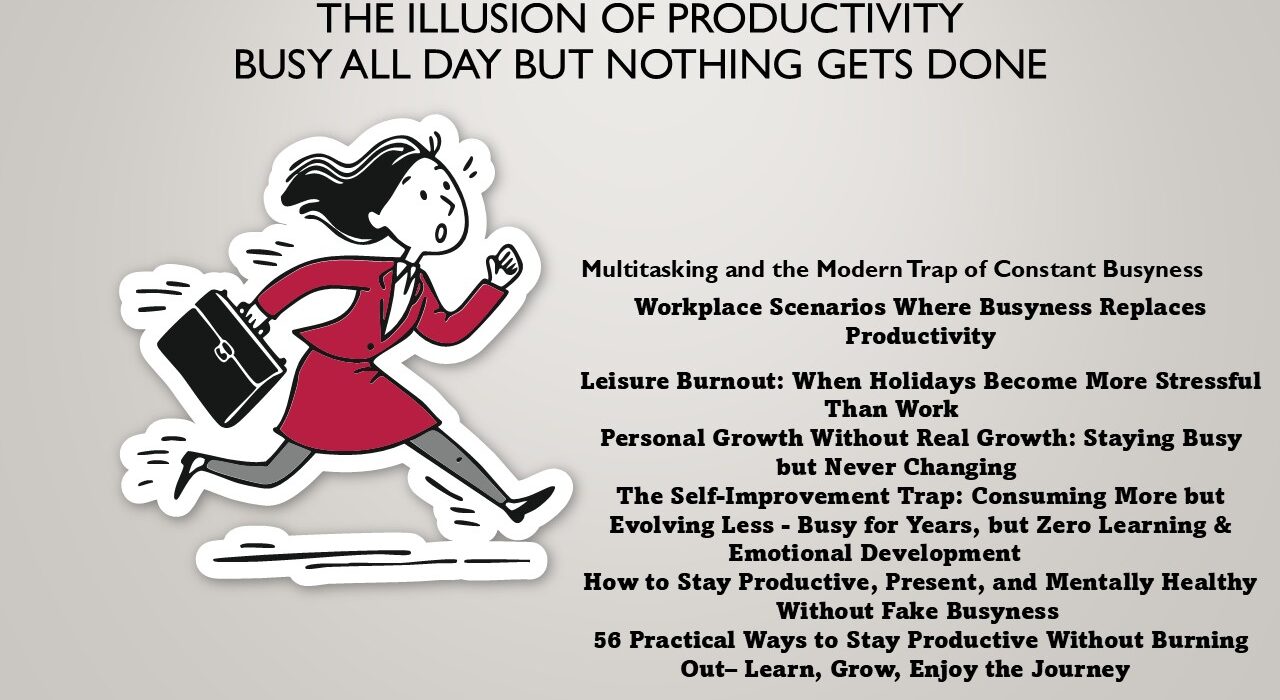
Why Multitasking Makes You Busy But Not Productive
Reading Time: 10 minutes
Why Multitasking Makes You Busy But Not Productive
Recently, I came across a hilarious yet painfully accurate image of modern life:
A man is holding a laptop in one hand, a wine glass in the other, and an unlit cigar in his mouth.
But here’s the problem:
- He cannot use the laptop because one hand is occupied.
- He cannot drink the wine because the cigar is in his mouth.
- He cannot light the cigar because both hands are full.
He is completely occupied… yet absolutely nothing meaningful is happening.
And that perfectly summarizes modern life.
Today, millions of people are busy every minute of the day — attending meetings, replying to notifications, multitasking endlessly, consuming information constantly, and chasing “productivity.”
Yet at the end of the day, very little actually gets completed.
We are overstimulated, overconnected, mentally exhausted… and strangely unfulfilled.
This article explores one of the biggest hidden traps of modern life:
Being fully engaged, occupied, and exhausted — while making almost no real progress at work, in relationships, during vacations, or even in personal growth.
Workplace Productivity Traps: Busy at Work but Achieving Almost Nothing
50 Workplace Scenarios Where Busyness Replaces Productivity – Fully Engaged, Occupied, but Achievement ≈ Zero
Endless Meetings and Communication That Produce No Results
- Sitting in a 2‑hour “urgent” meeting where no decisions are made, only re‑discussed.
- Attending back‑to‑back “alignment” calls with laptop open, replying to chats, missing key decisions.
- Staying on a 2‑hour call “just in case” someone asks you a question that never comes.
- Having five 15‑minute meetings to talk about when to have the real meeting.
- Participating in meetings where your presence adds no value.
- Writing a 5‑page summary of a 10‑minute meeting.
- Repeating the same status updates to different stakeholders.
- Forwarding emails endlessly without decisions being made.
- Daily stand‑ups that turn into long status meetings.
- Group brainstorming sessions that go in circles without action items.
Perfectionism and Busywork That Destroy Productivity
11. Spending three hours color‑coding a spreadsheet that no one will read.
12. Rewriting the first paragraph of a report 20 times instead of finishing it.
13. Perfecting slide designs, fonts, colors, and logos before core content is ready.
14. Creating a “perfect” PowerPoint template for a project that hasn’t started.
15. Editing the same document repeatedly for minor tweaks.
16. Waiting for “perfect conditions” before starting.
17. Micromanaging tiny details that don’t matter.
18. Delaying submission because “it can still improve”.
19. Re‑checking work 10 times due to fear of criticism.
Multitasking, Notifications, and Digital Distractions at Work
20. Jumping between 15 browser tabs (email, Slack, reports, news) while on a call, responding to none properly.
21. Instantly responding to every Slack/Teams message the second it pops up.
22. Constantly checking notifications while trying to finish a report.
23. Keeping 25+ browser tabs open “for reference” and spending the day clicking through them.
24. Switching between Excel, PowerPoint, and Word for the same project without progress.
25. Trying to reply to emails while listening to a podcast “for ideas”.
26. Watching webinars while doing other work, retaining nothing.
27. Taking work calls during another meeting.
28. Working with all notifications enabled – email, chat, calendar, social.
29. Starting multiple projects enthusiastically but completing none.
Fake Urgency: Looking Busy While Avoiding Meaningful Work
30. Taking on low‑value tasks (printing, stapling, filing) to avoid a difficult, high‑stakes project.
31. Cleaning out the physical filing cabinet or digital cloud storage during peak work hours.
32. Spending the morning rearranging files and folders rather than opening one to work.
33. Constantly changing priorities without completing anything.
34. Working late daily but finishing nothing meaningful.
35. Saying “I’m swamped” while avoiding high‑impact tasks.
36. Treating every small issue like a crisis.
37. Updating trackers and status reports more than doing actual work.
38. Creating elaborate project plans and Gantt charts that never get used.
39. Documenting processes instead of improving them.
40. Building five different models for a simple decision that only needs one.
Endless Research, Approval Loops, and Administrative Overload
41. Spending a full day “researching” software tools instead of doing the work the tool is for.
42. Endless email threads discussing minor issues without resolution.
43. Chasing signatures for a document not due for a month.
44. Trying to fix a printer or router for three hours instead of calling IT.
45. Manually copying data that could be automated with a 5‑minute formula search.
46. Reviewing the same document 10 times with minor tweaks from different people.
47. Preparing for a presentation that hasn’t been officially scheduled yet.
48. Spending hours choosing the “perfect” template or resource online.
49. Answering every minor query immediately, derailing deep work.
50. Over‑researching a topic so thoroughly that the project never starts.
Workplace Image Management vs Real Performance
51. Trying to impress everyone instead of delivering outcomes.
52. Spending more time networking internally than building competence.
53. Pretending to multitask for appearance sake.
54. Overcommitting to gain approval.
55. Participating in endless brainstorming with no execution.
56. Constantly seeking validation from seniors.
57. Being “busy” helping others avoid their responsibilities.
58. Attending optional events only for visibility.
Why Modern Vacations Leave You More Exhausted Than Relaxed
Leisure Burnout: When Holidays Become More Stressful Than Work
Digital Overload: Unable to Disconnect Even on Vacation
- Spending the entire sunset trying to get the perfect photo for social media instead of watching it.
- Checking work emails “just for a second” every time you sit down for a meal.
- Editing a “vacation reel” while sitting at a beautiful café.
- Posting every meal and location online, then monitoring likes/comments.
- Spending three hours of tropical holiday trying to get Wi‑Fi to work.
- Carrying a laptop “just in case”.
- Being mentally at work while physically on holiday.
- Scrolling through work email every 20 minutes “just in case”.
Checklist Tourism and the Pressure to “Maximize” Every Vacation
- Planning every hour of the vacation itinerary with back‑to‑back activities.
10. Trying to visit 15 landmarks in a 48‑hour city break.
11. Waking up at 4 AM to beat the crowds, leaving you exhausted by noon.
12. Spending more time commuting between spots than enjoying them.
13. Planning activities in 30‑minute increments with no buffer time.
14. Theme park sprint – running from ride to ride to “maximize value” until your feet bleed.
15. Spending 6 hours on a bus to see a landmark for 20 minutes.
16. Treating vacation like a checklist competition (must‑see, must‑eat, must‑shop).
Travel Stress, Decision Fatigue, and Vacation Burnout
17. Spending the first two days of vacation re‑organizing your suitcase.
18. Lugging four heavy suitcases through cobblestone streets.
19. Spending your beach time booking train tickets for the next leg.
20. Managing 10 people’s conflicting dinner preferences until you have a headache.
21. Group trips with constant decision‑making and compromises.
22. Spending half a day looking for a misplaced charging cable.
23. Spending 10 hours of your vacation trying to find a slightly cheaper return flight.
Social Exhaustion During Holidays and Family Vacations
24. Going to parties or events every evening without downtime.
25. Attending family gatherings continuously during holidays.
26. Dragging yourself to a “highly rated” museum when you actually wanted to sleep.
27. Mediating arguments between travel companions all day.
28. Calling relatives back home out of obligation during your limited relaxation time.
29. Trying to please everyone on a group trip.
Fake Relaxation: Why Many Holidays Feel Mentally Draining
30. Drinking excessively to “de‑stress”, then feeling worse.
31. Binge‑watching Netflix late into the night during holidays.
32. Sleeping irregularly and ruining your body rhythm.
33. Eating junk continuously under “holiday mode”.
34. Returning home at 11 PM Sunday and unpacking immediately – no wind‑down.
35. Planning the chores you have to do when you get home while you’re still away.
36. Mistaking constant stimulation (screens, noise, crowds) for relaxation.
Personal Growth Without Real Growth: Staying Busy but Never Changing
The Self-Improvement Trap: Consuming More but Evolving Less – Busy for Years, but Zero Learning & Emotional Development
Passive Learning Addiction: Consuming Knowledge Without Action
- Watching motivational videos daily without implementing a single idea.
- Reading dozens of self‑help books but changing nothing.
- Buying 20 online courses and only finishing the “Introduction” video of each.
- Highlighting entire books with zero application.
- Listening to growth podcasts at 2x speed while distracted, retaining 0%.
- Attending three webinars a week but never implementing a single tip.
- Collecting certificates in skills you never actually practice.
- Reading book summaries instead of engaging with full, complex ideas.
- Subscribing to 50 “insight” newsletters that just clutter your inbox.
- Following hundreds of “growth” influencers passively without action.
The Illusion of Self-Improvement and Intellectual Growth
11. Feeling intelligent because you know the terminology (e.g., “cognitive dissonance”, “growth mindset”).
12. Talking about growth more than actually growing.
13. Mistaking awareness (knowing what’s wrong) for transformation (changing it).
14. Posting inspirational quotes instead of living them.
15. Confusing information overload with wisdom.
16. Seeking constant motivation instead of building discipline.
17. Becoming addicted to “starting fresh” every Monday or New Year.
18. Chasing a new method every month (bullet journal → Notion → Trello → Obsidian).
19. Believing busyness equals progress.
Emotional Avoidance Disguised as Productivity
20. Avoiding difficult conversations for years.
21. Repeating the same toxic patterns in relationships or work.
22. Blaming circumstances continuously instead of owning your part.
23. Escaping emotions through entertainment, food, or work.
24. Staying busy to avoid self‑reflection.
25. Never spending quiet time alone without a screen.
26. Refusing feedback due to ego.
27. Defending weaknesses instead of improving them.
28. Living reactively (responding to pings, crises, demands) instead of consciously.
29. Staying emotionally immature despite professional success.
Spiritual Busyness Without Inner Transformation
30. Reading philosophy or Stoicism but becoming easily angered by minor traffic.
31. Talking about mindfulness while living chaotically.
32. Joining multiple communities but building no depth in any.
33. Starting journals repeatedly but quitting after three days.
34. Overanalyzing life without taking action.
35. Seeking enlightenment without self‑discipline.
How to Stay Productive, Present, and Mentally Healthy Without Fake Busyness
56 Practical Ways to Stay Productive Without Burning Out– Learn, Grow, Enjoy the Journey
Shift from Constant Activity to Meaningful Results
- The One Thing Rule: Ask, “What is the one thing I can do today that makes everything else easier?” Do that first.
- The Rule of 3: Set only 3 “Must‑Achieve” tasks per day. Everything else is a bonus.
- Define “Done”: Before starting, write down what finished looks like – to avoid over‑polishing.
- Done > Perfect: Set an 80% quality threshold and ship it.
- The 10‑Minute Rule: Commit to just 10 minutes on a hard task – you’ll likely continue.
- The “So What?” Test: Ask “So what?” about every meeting. If no clear answer, don’t go.
- Parkinson’s Law: Give yourself less time for a task (e.g., “finish this report in 45 min”).
- No “Zero” Days: Do one tiny thing toward a goal every single day (read 1 page, do 1 push‑up).
- The “Who Cares?” Filter: Before stressing, ask: “In 5 years, will anyone care about this detail?”
- Process over Results: Focus on showing up for the work, not just the “win”.
Practical Work Habits to Eliminate Fake Productivity
11. Single‑Tab Browsing: Close all tabs except the ONE needed for the current task.
12. Phone Prison / Drawer: Physical separation – out of sight, out of mind.
13. Batching: Check emails only 3 times a day (e.g., 10 AM, 2 PM, 4 PM).
14. The No‑Meeting Day: Block one full day a week for deep, uninterrupted work.
15. Stand‑Up Meetings: Keep meetings to 15 minutes and stay standing to force brevity.
16. The 2‑Minute Blitz: If it takes <2 minutes, do it now. If >2 minutes, schedule it.
17. No‑Email Mornings: First 90 minutes: no email, no Slack – just your deep task.
18. Default “No” to Unscheduled Calls: Ask for an agenda before accepting.
19. The “Parking Lot”: Keep a notepad for distracting ideas – address them later.
20. Use a Timer (Pomodoro): 25 min work + 5 min break – artificial urgency works.
21. Decline “Informational” Meetings: Ask for a bullet‑point summary instead.
22. The “Someday” Folder: Move non‑urgent ideas there; review once a quarter.
23. Draft Fast, Edit Later: Get the “ugly” version out first – then refine.
24. Automate the Mundane: Use Zapier, Power Automate, or simple macros for repetitive data.
25. The “Done” List: Keep a list of what you actually achieved today, not just what’s left.
How to Truly Relax and Recover During Vacations
26. The “3‑3‑3” Rule: 3 big things, 3 medium, 3 small. Ignore the rest.
27. Schedule “Do Nothing” Time: Literally block 2 hours on vacation to sit and stare.
28. No Photo First 5 Minutes: Enjoy a new view with your eyes only before reaching for the phone.
29. The Unplug Hour: One hour of zero technology every day on vacation.
30. Paper Maps: Use a physical map occasionally to engage with your surroundings spatially.
31. Stay Put: Spend three days in one city rather than one day in three cities.
32. Buffer Days: Take one day off after the vacation before going back to work.
33. The “Towel Day”: One day where the only goal is bed → pool → bar → bed.
34. Stop “Should‑ing”: Delete “I should see this museum.” Do only what you want.
35. Pre‑Vacation Clean: Clean the house before you leave so you return to peace.
36. Analog Entertainment: Bring a physical book or deck of cards.
37. Accept the Weather: If it rains, enjoy the rain. Don’t waste energy wishing for sun.
How to Achieve Real Personal Growth Instead of Passive Consumption
38. Teach It to a Child / The Feynman Technique: Explain a concept in plain English to a 6‑year‑old. If you can’t, you didn’t learn it.
39. Output > Input: For every 1 hour of input (reading/watching), spend 1 hour doing output (writing/practicing).
40. The 20‑Hour Rule: Spend 20 hours deliberately practicing one skill before buying new gear/courses.
41. Weekly “Idiot” Question: Ask one “stupid” question to a mentor or expert.
42. Reflective Journaling (not diary): Write “What did I learn?” and “What will I do differently?” – not just events.
43. The 5‑Minute Retro: End each day: 1 win, 1 learning, 1 action for tomorrow.
44. The 1% Rule: Aim to be 1% better at a specific skill each day, not a massive overhaul.
45. Active Reading: Take notes in the margins; argue with the author.
46. Set “Anti‑Goals”: List what you want to stop doing this year.
47. Public Accountability: Tell one person your goal and ask them to check in monthly.
48. Embrace Boredom: Let your mind wander without a phone – this is where creativity starts.
How to Enjoy Life While Still Growing and Achieving
49. Celebrate Small Wins: Treat yourself for finishing a difficult task, not just the whole project.
50. Curiosity over Judgment: When you fail, ask “That’s interesting, why did that happen?” instead of “I’m a failure.”
51. Find the Flow: Identify tasks where you lose track of time – do more of those.
52. Gamify the Grind: Turn boring tasks into a game (beat your own time, score points).
53. The “Evening Unwind” Ritual: Make tea and sit in silence for 10 minutes – no phone, no TV.
54. Track Energy, Not Time: Do creative work when energy is high (morning), admin work when low (afternoon).
55. The “Don’t Break the Chain” Calendar: Mark an X every day you do your one priority habit.
56. Laugh at the Cigar: When you realize you are multitasking and doing nothing – put the glass down, light the cigar. One thing at a time.
Final note from the action plan:
Start with only 3‑5 tips from the section that hurts most (work, leisure, or growth).
Apply them for two weeks. Then add another 3‑5.
The goal is not to be busy – but to be present, progressing, and still smiling at the end of the day.
In the end, a meaningful life is not built by staying constantly occupied.
It is built by being present, focused, emotionally alive, and intentionally engaged in what truly matters.
Otherwise, we become like the man with the laptop, wine glass, and cigar — exhausted, overloaded, and fully occupied… while nothing meaningful actually gets done.
Subhashis Banerji [Author]
Leadership assessor, strategist, and writer. I help professionals and organizations make smarter decisions by learning to read patterns, not promises.
 Read all my articles here:
 https://successunlimited-mantra.net/ & https://successunlimited-mantra.com/index.php/blog PLUS on https://relationshipandhappiness.com/
Connect with me on LINKEDIN: https://www.linkedin.com/in/subhashis-banerji-21b1418/


– Please read our Comment Policy