


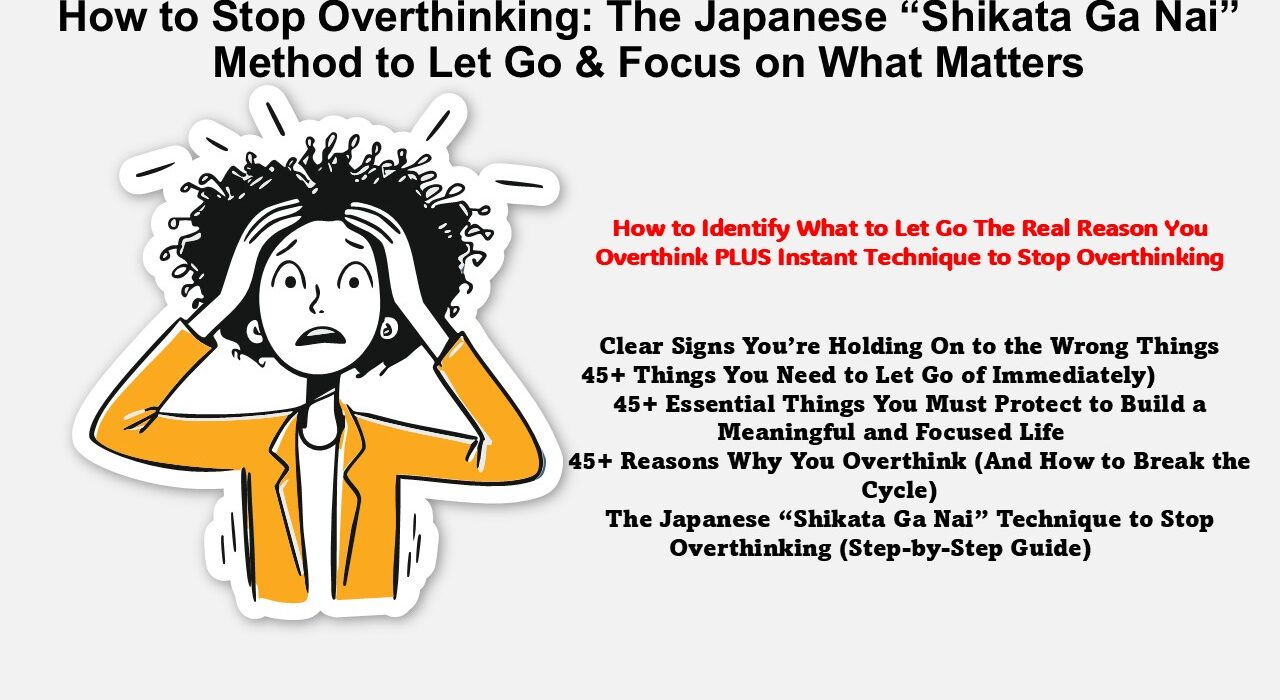
How to Stop Overthinking: The Japanese “Shikata Ga Nai” Method to Let Go & Focus on What Matters
Reading Time: 10 minutes
Contents
hide
1
How to Stop Overthinking: The Japanese “Shikata Ga Nai” Method to Let Go & Focus on What Matters
How to Stop Overthinking: The Japanese “Shikata Ga Nai” Method to Let Go & Focus on What Matters
A Practical Guide to Letting Go of Stress, Ending Overthinking, and Building Mental Clarity
The Core Principle Behind Overthinking (And Why Most People Stay Stuck)
If it drains your energy without improving your life → let go.
If it feels difficult but builds your life → hold on.
Overthinking is not intelligence—it is misdirected control + fear.
Shikata ga nai (“it cannot be helped”) is not resignation. It is the most active form of peace.
How to Identify What to Let Go (Clear Signs You’re Holding On to the Wrong Things)
Use these filters before you read the list. A thing is a candidate for letting go if:
- It consistently causes more stress, resentment, or anxiety than benefit.
- It’s tied to the past or hypothetical futures, not present reality.
- Holding it prevents you from focusing on what truly matters.
- You feel lighter or freer when you imagine releasing it (even briefly).
- It no longer aligns with your current values, goals, or identity.
- It’s a “should” imposed by others/society, not a genuine “want.”
- Evidence shows it’s harming your health, relationships, or progress, yet you rationalize keeping it.
- The 5 brutal questions (from Set 1):
- Does this give me energy or drain it?
- Is this within my control?
- Is this helping my future—or feeding my ego?
- Would I choose this again today?
- If I drop this, does my life become simpler or worse?
*If 3+ answers are negative → LET GO.*
45+ Things You Need to Let Go of Immediately to Reduce Stress and Overthinking
Mental & Emotional Patterns That Trigger Overthinking
- Need to be liked by everyone
- Fear of missing out (FOMO)
- Regret over past decisions
- Replaying conversations (mental replay loops)
- Imaginary future scenarios (catastrophizing)
- Comparing your journey with others (comparison is the thief of joy)
- Needing constant validation / external approval
- Over-attachment to outcomes
- Perfectionism (especially in non‑critical areas)
- Fear of judgment
- Fear of failure
- Fear of uncertainty / need for certainty before action
- Needing to be right in every argument
- Guilt over saying “no” or guilt over self-care
- Resentment (drinking poison and expecting the other to die)
- Limiting beliefs (“I’m not good enough,” “I can’t”)
- Self-criticism loops / negative self-talk
- Rumination on past conversations or mistakes
- Imposter syndrome
- Emotional suppression (anger, grief left unprocessed)
Ego Attachments That Keep You Stuck in Overthinking
- Old version of yourself (who you were 5 years ago)
- Titles and labels as identity
- “What people think of me” as your compass
- Being right in every argument
- Defending bad decisions (ego protection)
- Your “story of struggle” as core identity
- External success as self-worth
- Trying to prove yourself (to anyone)
- Ego battles / needing to win
- Approval addiction
- Victim mentality
Toxic Relationships That Drain Your Energy and Increase Anxiety
- One‑sided relationships (you give, they take)
- People who disrespect your time
- Toxic friendships / family ties that drain
- Guilt‑driven obligations
- Trying to fix everyone (“fixer” mentality)
- Holding grudges
- Needing closure from others
- Staying where you’re not valued
- Emotional dependence on others
- Fake harmony (avoiding necessary conflict)
- Toxic loyalty to people who harm you
- People‑pleasing habits
- Gossip and unnecessary drama
- Seeking closure externally (closure is moving on)
- Relationships based only on obligation
The Illusion of Control: Why You Overthink What You Can’t Control
- Trying to control others’ behavior
- Trying to control outcomes fully
- Wanting certainty before action
- Overplanning everything
- Fear of uncertainty
- Trying to control time
- Waiting for the “perfect moment”
- Holding onto failing plans (sunk cost fallacy)
- Overanalyzing decisions
- Trying to predict everything
- Fear of change
- Desire for perfect timing
Hidden Habits That Quietly Fuel Overthinking and Stress
- Constant social media scrolling
- Saying yes when you mean no
- Delaying hard decisions
- Overconsumption of information
- Avoiding discomfort
- Living on autopilot
- Multitasking constantly (reduces focus)
- Mental clutter
- Busyness as a badge of honor
- Procrastination out of fear
- Impulse spending to fill emotional gaps
- Poor posture (affects neurochemistry)
- Digital notifications and distractions
- Over‑apologizing
- Unfinished projects that no longer inspire you
- “I’ll sleep when I’m dead” attitude
- Work‑related guilt during weekends
Physical & Mental Clutter That Increases Anxiety and Overthinking
- Physical clutter (messy space = messy mind)
- Old clothes that don’t fit your body or life now
- Digital clutter (apps, tabs, old files)
- Email newsletters you delete unread
- A grueling schedule with no margin
- “More is better” mindset (shift to “better is better”)
- Scarcity mindset
- Unrealistic body image standards
- Old failures and mistakes (as emotional baggage)
- Jealousy and envy
- Fear of looking foolish
- Over‑attachment to money as identity
- Desire for revenge
How to Identify What Truly Matters (What You Should Hold On to in Life)
A thing is worth holding onto if:
- It consistently brings deep fulfillment, peace, or growth.
- It aligns with your core values and long-term vision.
- Releasing it would cause genuine regret or loss of identity.
- It strengthens your best self and relationships.
- Evidence from your life shows it reliably supports well‑being.
- It energizes rather than drains you.
- It reflects who you truly are, not who you “should” be.
- The 5 anchor questions (from Set 1):
- If I lose this, does my life collapse or weaken?
- Does this compound over time?
- Does this align with my core values?
- Would my older self thank me for keeping this?
- Does this build long‑term stability?
If YES → PROTECT IT AGGRESSIVELY.
45+ Essential Things You Must Protect to Build a Meaningful and Focused Life
Inner Strength and Mental Clarity You Must Protect
- Self‑respect (the foundation of every healthy relationship)
- Emotional discipline
- Self‑awareness
- Inner peace (protect this more than your bank account)
- Clarity of purpose
- Personal values (the compass that guides decisions)
- Integrity (doing right when no one watches)
- Patience (trusting the timing of your life)
- Courage (to speak truth, to act)
- Resilience (the bounce‑back in every fall)
- Your voice (speaking your truth, even if it shakes)
- Authenticity (the courage to be imperfect)
- Self‑compassion (being your own best friend in hard times)
- A sense of wonder (magic in the mundane)
- Your gut instinct (subconscious intelligence)
- Hope (belief that tomorrow is worth working for)
- Forgiveness of self (the ultimate liberation)
Habits and Mindsets That Drive Long-Term Growth
- Long‑term thinking
- Consistency (small acts done daily = massive results)
- Learning mindset / lifelong learning
- Discipline over motivation
- Focus / deep work ability
- Delayed gratification
- Adaptability
- Decision‑making ability
- Accountability (to yourself and others)
- Curiosity (keeps the mind young)
- Critical thinking (questioning narratives)
- Creative expression (writing, art, building)
- Solitude (learning to be happy in your own company)
- Perspective (zooming out when life feels heavy)
Relationships That Truly Matter for a Fulfilling Life
- True friendships (that withstand time and distance)
- Family bonds (chosen or biological – the healthy ones)
- Mentors (both giving and receiving)
- Honest conversations / deep conversations
- Respectful boundaries
- Gratitude toward people (and practice of gratitude)
- Trust
- Presence in relationships (listening deeply)
- Showing up consistently
- Empathy (bridge between hearts)
- Shared laughter (shortest distance between two people)
- Kindness to strangers
- Legacy (the impact you leave on hearts)
Core Life Foundations: Health, Time, and Energy Management
- Physical health (mobility, moving because you love your body)
- Sleep hygiene (pillar of mental health)
- Financial discipline / financial literacy (freedom)
- Time management (your only non‑renewable resource)
- Simplicity / order in environment
- Routine (anchors the day)
- Energy management (not just time management)
- Mental clarity
- Connection to nature (grounding in earth’s rhythm)
- Breathwork (regulating the nervous system)
- Hydration & sunlight (basic, essential)
- Nutritional mindfulness (fuel for the soul)
- Playfulness and joy
Deeper Life Anchors: Purpose, Meaning, and Spiritual Stability
- Meaningful work / craft
- Contribution (to something beyond yourself)
- Spiritual grounding (any form that serves you)
- Silence and reflection
- Acceptance of reality (Shikata ga nai as practice)
- Humility
- Faith in process (trust that life unfolds)
- Ability to let go itself (meta‑skill)
- Personal rituals that ground you (morning/evening)
- Moral compass
- Gratitude for what you have (not just what you want)
- Rooted traditions (positive cultural or personal)
- Childlike wonder
45+ Reasons Why You Overthink (And How to Break the Cycle)
Core Psychological Reasons Behind Overthinking
- Need for certainty (intolerance of uncertainty)
- Fear of failure
- Fear of judgment
- Lack of action (thinking as substitute for doing)
- Too many choices (paradox of choice)
- Perfectionism
- Past mistakes and regret
- Low self‑trust
- Desire to control outcomes
- Avoidance of discomfort / emotional pain
- Fear of making the wrong choice
- Fear of regret
- Fear of rejection
- Fear of loss
- Fear of being blindsided
Common Thinking Patterns That Lead to Overthinking
- Catastrophizing (worst‑case scripting)
- Rumination (repetitive replay)
- Analysis paralysis
- Negativity bias (brain holds bad news like Velcro)
- “What if” thinking
- Overgeneralization
- Mental simulations (rehearsing conversations)
- Doubting decisions / second‑guessing
- Replaying past events
- Over‑identification with thoughts (“I think it, so it’s true”)
- The Zeigarnik effect (unfinished tasks loop in memory)
- Default mode network overactivity (brain’s idle gear = worry)
Lifestyle Factors That Increase Stress and Overthinking
- Too much information (information overload)
- Social media comparison
- Lack of physical activity
- Poor sleep / sleep deprivation
- Lack of structure or clear goals
- Idle time (mind fills the vacuum)
- Digital overload (notifications, news cycles)
- Multitasking culture
- No clear priorities (everything feels equally important)
- Caffeine + chronic stress (physiological anxiety read as “thinking”)
- Decision fatigue
Emotional Triggers That Cause Chronic Overthinking
- Anxiety disorders / hypervigilance
- Insecurity / low self‑confidence
- Unprocessed trauma (body looking for danger)
- Emotional suppression (using logic to avoid feeling)
- Lack of closure (unfinished emotional business)
- Loneliness (inner monologue replaces outer conversation)
- Childhood conditioning (grew up “walking on eggshells”)
- Cultural emphasis on productivity (guilt for a quiet mind)
- Identity built around “being a thinker”
- The “specialness” trap (my problems are uniquely unsolvable)
- Distrust of life (not believing things can just work out)
- Hormonal imbalances / biological predisposition (e.g., ADHD loops)
The Japanese “Shikata Ga Nai” Technique to Stop Overthinking (Step-by-Step Guide)
Shikata ga nai = “It cannot be helped.”
It is not defeat. It is wisdom. You stop fighting reality, so you can act where action matters.
9 Core Principles of “Shikata Ga Nai” to Stop Overthinking
- Accept what you cannot control.
- Separate action from worry.
- Limit mental replay.
- Ground yourself in the present.
- Focus on small, meaningful steps.
- Let go of perfection (wabi‑sabi).
- Create mental boundaries.
- Simplify your life.
- Trust the flow of life.
7-Day Action Plan to Stop Overthinking and Regain Mental Clarity
Day 1: The Circle Test
Draw two circles: Circle of Control (your thoughts, actions, responses) and Circle of Concern (weather, economy, past, future). Every overthink = ask “In my control?” If no → say aloud “Shikata ga nai.” Say it 50 times.
Day 2: The 90‑Second Rule
Emotion waves through the body in 90 seconds if you stop fueling it. Place hand on chest, breathe 4 in / 6 out, say “I feel [X]. Shikata ga nai.” Wait 90 seconds without adding new thoughts.
Day 3: The “Action or Acceptance” Interrupt
Keep a 2‑column note: “Can I act right now?” → Yes = take one tiny action within 2 minutes. No = close the note and physically stand up.
Day 4: Wabi‑Sabi Reframe
For one day, intentionally do things “badly”: send email with a typo, leave dishes for 3 hours, say “I don’t know.” Notice nothing explodes.
Day 5: The Mental Boundary Ritual
Write worry on paper, say “This thought is real but not a demand,” fold it into a “Shikata ga nai Box.” Set a 6 PM worry timer. Before then, tell thoughts “Not now.”
Day 6: Small Moves Only (Kaizen)
When stuck, ask only: What is the smallest, easiest, next physical action? Do that. Then stop.
Day 7: The Replay Funeral
Write one replay conversation/mistake. Read aloud: “This happened. Shikata ga nai. I cannot change it.” Physically burn/shred/soak the paper. Say: “I release you. I take the lesson.”
Daily System to Stop Overthinking (Proven Mental Framework)
Step 1: Control Triage (use daily)
Divide everything into:
- Control → Act immediately
- Influence → Try, then release
- No Control → Drop instantly
Step 2: Action Rule (anti‑overthinking weapon)
Ask: “What is the next physical action?” Not thinking. Not planning. Action.
Example: Call (not think about calling). Write (not plan writing).
Step 3: 24‑Hour Rule
If something is bothering you: Act within 24 hours OR consciously drop it. No middle zone.
Step 4: Thought Detachment
Instead of “I am worried” → “I am noticing a thought of worry.” This creates distance.
Step 5: Limit Thinking Time
Set 10–15 min “thinking window.” After that → forced action or disengagement.
Step 6: Simplify Decisions
Reduce options, inputs, opinions. More options = more overthinking.
Step 7: Embody Acceptance
Say consciously: “This is outside my control. It is what it is.” Not emotionally first – logically. Emotion follows logic with repetition.
Step 8: Build a “Default Mode”
When stuck → automatically do: Walk | Write | Act | Disengage. No idle rumination allowed.
Advanced Techniques to Master Letting Go and Mental Peace
The “Can I?” Filter (Set 2)
Every thought → ask: Is this within my circle of influence?
If yes → pick one small physical action.
If no → say aloud: “Shikata ga nai.”
Embrace the “Finished” Moment
At the end of a task (conversation, workday), physically wash your hands. As water runs, visualize mental replay going down the drain.
Wabi‑Sabi Thinking (advanced)
When you make a mistake, view it as a “gold‑filled crack” (Kintsugi). It makes your life story more interesting and resilient.
The “Passing Clouds” Observation
Sit quietly. Label thoughts as “worry,” “planning,” “memory.” Let them drift like clouds. You are the sky, not the storm.
Move the Body to Quiet the Mind (Samu)
When overthinking strikes, do a repetitive physical task: clean a shelf, garden, walk precisely. Clarity comes through the hands.
Daily Acceptance Ritual (Set 3)
Morning or night: list 3 things outside your control. Consciously say “Shikata ga nai” for each. Feel the release.
Action Filter (Set 3 – 5‑4‑3‑2‑1 grounding)
For every worry, write: “Can I act now?”
- Yes → small step.
- No → Shikata ga nai + 5‑4‑3‑2‑1 senses technique (5 things you see, 4 hear, 3 feel, 2 smell, 1 taste).
Replay Limit (Set 3)
Set a 5‑minute timer for processing past events. When timer ends, declare: “The moment has ended.”
Simplification Audit (Set 3)
Quarterly, review commitments, possessions, digital subscriptions. Prune ruthlessly.
Flow Trust Anchor (Set 3)
End each day noting one thing that unfolded better than you planned. Builds evidence for trust.
Progress Over Perfection Rule (Set 3)
Adopt “Done is better than perfect.” Set “good enough” thresholds for most tasks (80% is fine).
Instant Technique to Stop Overthinking in the Moment (Use anytime, anywhere)
When spiraling right now:
- Name the loop – say “I am overthinking about [X].”
- Hand on heart + deep breath (4 in, 6 out).
- Ask: “Right now, in this moment, is there physical danger?” (99% no).
- Say: “Shikata ga nai. I cannot solve this with more thinking.”
- Move your body – stand, stretch, walk 30 steps.
- 5‑4‑3‑2‑1 senses – name 5 things you see, 4 you hear, 3 you feel, 2 you smell, 1 you taste.
The loop is broken. You are back in reality.
The Real Reason You Overthink (And How to Finally Stop)
You don’t overthink because life is complex.
You overthink because you are trying to control what must be accepted
and delaying action where control actually exists.
Shikata ga nai is not passivity. It is wise redirection of energy to what you can influence.
Let go, because some things – Shikata ga nai.
Hold tight, because the other things – your peace, your people, your breath, this moment – are everything.
Start this week: Pick 5 things from the “Let Go” list and 3 things from the “Hold” list. Use the 7‑day protocol. Notice the mental space that opens. Peace grows from consistent, gentle practice.
Subhashis Banerji [Author]
Leadership assessor, strategist, and writer. I help professionals and organizations make smarter decisions by learning to read patterns, not promises.
 Read all my articles here:
 https://successunlimited-mantra.net/ & https://successunlimited-mantra.com/index.php/blog PLUS on https://relationshipandhappiness.com/
Connect with me on LINKEDIN: https://www.linkedin.com/in/subhashis-banerji-21b1418/


– Please read our Comment Policy