


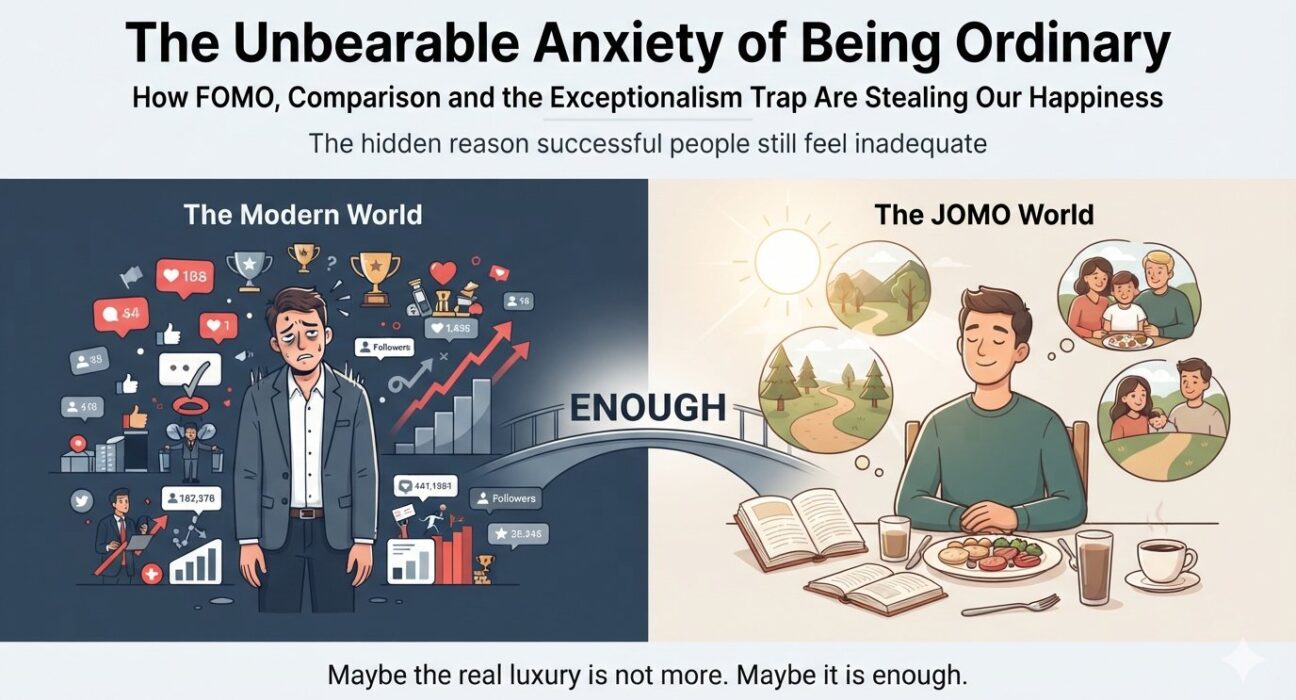
The Unbearable Anxiety of Being Ordinary: How FOMO, Comparison and the Exceptionalism Trap Are Stealing Our Happiness
Reading Time: 23 minutes
Contents
hide
1
The Unbearable Anxiety of Being Ordinary: How FOMO, Comparison and the Exceptionalism Trap Are Stealing Our Happiness
1.3
Why Most People Secretly Fear an Ordinary Life
1.5
Escaping the Comparison Trap: A Practical Guide to Mental Freedom
1.6
JOMO: The Surprisingly Powerful Alternative to FOMO
The Unbearable Anxiety of Being Ordinary: How FOMO, Comparison and the Exceptionalism Trap Are Stealing Our Happiness
Introduction: What If Nothing Is Wrong With You?
Have you ever had the strange feeling that your life is going reasonably well—and yet somehow it still doesn’t feel enough?
You have a job. A family. Responsibilities. Food on the table. A roof over your head. People who care about you. Perhaps even achievements that your younger self would have celebrated.
And yet, somewhere in the background, a persistent voice whispers:
“You should be doing more.”
Someone your age is earning more.
Someone else is travelling more.
Someone else has built a larger business.
Someone else has a better body, a bigger house, more followers, greater influence, or a seemingly perfect life displayed in carefully edited squares on a screen.
So you keep running.
Not because you are unhappy.
But because you are afraid of falling behind.
This is one of the great psychological traps of modern life.
For most of human history, people compared themselves with a relatively small group of neighbors, colleagues and community members. Today, technology has created an endless global comparison machine. We no longer compare our ordinary Tuesdays with other people’s ordinary Tuesdays. We compare our entire lives with the most polished moments of millions of strangers.
The result is a quiet epidemic of inadequacy.
Despite unprecedented prosperity, convenience, education, opportunity and connectivity, anxiety, loneliness, burnout and dissatisfaction continue to rise across much of the world.
The question is no longer whether people are succeeding.
The question is why so many successful people feel as if they are failing.
Perhaps the problem is not that we lack enough achievement.
Perhaps the problem is that we have forgotten the value of enough.
This article explores one of the most important yet least discussed psychological challenges of our age: the growing anxiety of being ordinary in a culture that treats exceptionalism as mandatory.
Drawing upon the Harvard Study of Adult Development, Positive Psychology, Self-Determination Theory, Behavioral Economics, Neuroscience, Stoicism, Buddhist Psychology and the work of some of the world’s most respected researchers, we will examine:
- Why ordinary life has become psychologically difficult to accept
- Why FOMO has become one of the defining emotions of modern society
- How social comparison silently fuels anxiety, stress and dissatisfaction
- Why minimalism and contentment feel increasingly counter-cultural
- How to build a life guided not by visibility, validation and status—but by meaning, relationships, fulfillment and peace
Because the greatest question of the twenty-first century may not be:
“How do I become extraordinary?”
It may be:
“How do I live an ordinary life extraordinarily well?”
The Hidden Crisis Nobody Talks About: Why Being Ordinary Suddenly Feels Like Failure
Why Most People Secretly Fear an Ordinary Life
Your Brain Was Never Designed for Instagram, LinkedIn and Constant Comparison
The Status Imperative
From an evolutionary perspective, status meant:
- Better access to resources
- Better mating opportunities
- Greater safety
- Higher survival chances
For thousands of years, higher status equaled higher survival probability. Our brains still carry this ancient programming. Even when basic needs are met, many people unconsciously pursue prestige, recognition, visibility, influence, and validation rather than genuine happiness.
As Dr. Robert Sapolsky (Stanford neurobiologist) explains: “We’re the only species that experiences chronic stress from purely psychological threats. Our ancestors worried about literal lions; we worry about metaphorical lions—comparisons, status, and perceived inadequacy.”
Social Comparison Theory
Psychologist Leon Festinger’s foundational 1954 paper, A Theory of Social Comparison Processes, established that human beings evaluate their own worth largely by measuring themselves against others, especially when objective standards are absent. There is no absolute ruler for “a good career” or “a good life”—so we borrow one from whoever is nearest, or now, whoever is loudest on our feed.
Festinger’s theory predicted “upward comparison” (comparing yourself to people who seem better off) would be common and would generate dissatisfaction. Seventy years later, social media has turned upward comparison from an occasional neighborhood event into a permanent, algorithmically optimized condition.
The Dopamine-Comparison Loop
Neuroscience reveals that the ventral striatum and prefrontal cortex activate when we perceive ourselves as “ahead” of others, releasing dopamine. However, this system evolved for tribal contexts of 150 people, not global networks of billions. Today, algorithms curate the top 0.01% of global experiences and serve them directly to our screens, triggering constant upward comparison.
Why “Enough” Never Feels Like Enough
The Hedonic Treadmill
Coined by psychologists Philip Brickman and Donald Campbell (1971)—later popularized through lottery-winner studies—the hedonic treadmill principle demonstrates that humans rapidly adapt to improvements in their circumstances and return to a baseline level of satisfaction.
Examples: New car, promotion, bigger house, luxury vacation. After a short period, happiness returns to baseline. Then, “What’s next?” This creates perpetual striving.
This explains why “enough” keeps moving: the promotion, the new car, or the bigger house delivers a temporary high before the baseline reasserts itself, and the goalposts shift again. A minimalist or ordinary life, almost by design, refuses to keep feeding the treadmill—which is precisely why it feels so unnatural to a mind wired for escalating comparison.
Loss Aversion & Choice Overload
Daniel Kahneman and Amos Tversky (Thinking, Fast and Slow) demonstrated that human decision-making is heavily biased by loss aversion—the pain of losing is psychologically twice as powerful as the pleasure of gaining.
Barry Schwartz further articulated in The Paradox of Choice that an abundance of options creates deep regret: selecting one path means “losing” hundreds of other potential lives, directly triggering dissatisfaction with whatever path is chosen.
Dopamine Prediction Errors
Every notification or highlight reel activates the brain’s mesolimbic dopamine pathway. Dopamine is the neurotransmitter of anticipation, not satisfaction. It compels us to keep searching, scrolling, and monitoring out of fear that a reward is occurring elsewhere without us.
How Society Quietly Turned Ambition Into an Addiction
The Protestant Work Ethic Transformed
Historian Max Weber identified how Protestantism linked hard work with divine favor. Today, this has morphed into a secular religion where productivity equals worth. Sociologist Hartmut Rosa (author of Resonance) describes this as “dynamic stabilization”—a system where we must constantly accelerate just to maintain our position.
Conspicuous Consumption & the Veblen Effect
Thorstein Veblen introduced the concept of conspicuous consumption in The Theory of the Leisure Class (1899). Modern culture has evolved from consuming physical luxury goods to consuming experience and identity. As noted in the provided text, every hobby must become a side hustle, every meal a photograph, and every job a “calling.” Minimalist or ordinary living strips away these external signals of success, leaving people feeling socially invisible.
The Commercialization of Insecurity
In Scarcity: Why Having Too Little Means So Much, Sendhil Mullainathan and Eldar Shafir demonstrate how a scarcity mindset consumes cognitive capacity (bandwidth). Modern markets thrive on manufacturing psychological scarcity—convincing us that without constant growth, personal branding, and optimization, we are falling behind. Contentment is fundamentally unprofitable to a consumption-driven economy.
Advertising and status-goods markets are structurally dependent on manufactured discontent. A minimalist who is content with less is, economically speaking, a market failure. This is not a conspiracy theory—it’s simply how growth-dependent consumer economies are built.
The Comparison Machine: How Social Media Rewired Human Happiness
Dr. Jonathan Haidt (The Anxious Generation) demonstrates that between 2010-2015, teen mental health declined precipitously, correlating directly with smartphone adoption and social media use. The mechanisms:
- Social comparison frequency increased 40% among adolescents
- Sleep disruption from blue light and notification anxiety
- Replacement of in-person interaction with curated digital presence
The Infinite Reference Group
Historically, your comparison group was your street, your school, your office. Today, an Instagram or LinkedIn feed pulls in the highlight reel of thousands of people simultaneously—the reference group is infinite and permanently updating. Researchers on the “comparative trap” and problematic social media use have found that upward social comparison indirectly drives compulsive, maladaptive digital behavior largely through FOMO—meaning comparison lights the fuse, and FOMO is the explosion.
The Availability Heuristic
Nobel laureate Daniel Kahneman demonstrated that we overestimate the frequency of events we can easily recall. Exceptionally visible success stories (startup billionaires, viral influencers) dominate mental availability, distorting our perception of normal life paths.
Survivorship Bias
We see the winners, not the 99% of entrepreneurs who fail, the 95% of actors who don’t make it, or the millions of “ordinary” professionals who build meaningful lives without fanfare.
The Prosperity Paradox: Why More Money Often Doesn’t Mean More Happiness
The Easterlin Paradox
Economist Richard Easterlin (USC) established that beyond a basic threshold (~$75,000 annually in the US), additional income does not correlate with increased happiness. Yet the “treadmill” persists because:
- Relative income matters more than absolute
- We adapt to improvements, requiring more for same satisfaction
- Social comparison widens reference groups
The “Deferred Life Plan”
Psychologist Abraham Maslow warned that self-actualization cannot occur while constantly seeking external validation. Yet modern culture promotes what philosopher Byung-Chul Han (The Burnout Society) calls the “achievement-subject”—individuals who exploit themselves voluntarily, believing freedom means unlimited self-optimization.
Real-World Evidence: The Backlash Against Minimalism’s Own Icons
Even minimalism’s most famous advocates have been used as evidence for this dynamic. When Marie Kondo, the tidying guru behind The Life-Changing Magic of Tidying Up, admitted in 2023 that her own home had become messier after having three children and that she had “kind of given up” on strict tidiness, it made global headlines—not because it was scandalous, but because people were fascinated that even the high priestess of minimalism found an ordinary, imperfect life easier to live than to preach. It revealed how much cultural weight we put on curated perfection, even in the pursuit of “less.”
The “Formula” Fallacy
Malcolm Gladwell (Outliers) popularized the 10,000-hour rule, but subsequent research shows:
- Deliberate practice explains only 12% of performance differences
- Opportunity, luck, and timing matter enormously
- Many fields show diminishing returns after basic competence
The Philosophical Roots: Status Anxiety
The philosopher Alain de Botton built an entire book, Status Anxiety (2004), around a simple observation: in societies where hierarchy was fixed by birth, people didn’t torture themselves comparing their life to a duke’s—the gap felt natural and unbridgeable. But in an officially “equal” and meritocratic society, everyone is theoretically capable of becoming anyone, so any gap between you and someone more successful becomes a personal verdict rather than an accident of fate. Ordinary life stops looking like a stable, respectable outcome and starts looking like proof you didn’t try hard enough.
Summary: Why Ordinary Living Lacks Takers
| Factor | Mechanism | Implication |
| Evolutionary Status Drive | Ancient brain equates status with survival | Lower status feels threatening |
| Hedonic Treadmill | Rapid adaptation to improvements | Goalposts constantly shift |
| Social Comparison Theory | Self-worth evaluated against others | Upward comparison creates dissatisfaction |
| Consumer Capitalism | Manufactured discontent drives consumption | Contentment is unprofitable |
| Social Media Amplification | Infinite reference group | Permanent comparison opportunity |
| Visibility-Value Disconnect | Attention rewarded over contribution | Ordinary feels invisible |
| Identity-Achievement Confusion | “I am what I achieve” | Ordinary feels like failure |
The Science of FOMO: Why Missing Out Feels So Painful -WHAT TRIGGERS FOMO
The Formal Psychological Definition
The most cited academic study on this topic is Przybylski, Murayama, DeHaan and Gladwell’s 2013 paper in Computers in Human Behavior, “Motivational, Emotional, and Behavioral Correlates of Fear of Missing Out.” Their research grounded FOMO in Self-Determination Theory (Deci & Ryan): FOMO spikes when a person’s core psychological needs—autonomy, competence, and relatedness—are unmet. People low in life satisfaction and low in mood are more susceptible; FOMO is less a technology problem than an unmet-needs problem that technology happens to amplify.
The Three Hidden Needs That Drive FOMO
FOMO emerges when three fundamental psychological needs are threatened:
- Need for Belonging (Relatedness)
- Everyone else seems included
- You feel excluded
- Social bonding events trigger anxiety even when unenjoyable
- Creates perceptions of missed bonding and fears of future exclusion
- Need for Significance (Competence)
- Others appear successful
- You feel insignificant
- Triggered by seeing others’ achievements, promotions, milestones
- Need for Progress (Autonomy)
- Others appear ahead
- You feel behind
- Career, relationship, and personal development comparisons
Neurological and Psychological Mechanisms
Loss Aversion and FOMO
Behavioral economists Daniel Kahneman and Amos Tversky’s Prospect Theory (1979) demonstrated that losses feel roughly twice as painful as equivalent gains feel good. FOMO exploits this asymmetry directly: the brain doesn’t process a missed party or a missed deal as “an opportunity I chose not to take,” it processes it as a loss, which triggers disproportionate distress compared to any pleasure the event would have actually delivered.
The Amygdala and Social Exclusion
Neuroscience on social rejection (Eisenberger, Lieberman et al.’s work on social pain) has found that social exclusion activates brain regions overlapping with physical pain processing, including the anterior cingulate cortex, while threat and anxiety responses more broadly recruit the amygdala. Being—or feeling—left out isn’t a metaphorical wound; the brain treats it as a genuine threat signal, which is why a single “you weren’t invited” moment can dominate a day.
Situational and Environmental Triggers
| Trigger Category | Specific Trigger | Mechanism |
| Social Belonging | Missing events with valued groups | Fear of exclusion, weakened relationships |
| Upward Comparison | Highlight reels of others’ achievements | Perceived inadequacy |
| Scarcity Cues | “Limited offer,” “Only 2 left,” “Invite-only” | Heightened value perception |
| Choice Overload | Abundance of options | Decision paralysis, regret |
| Identity Threat | Success-as-identity | Others’ success feels like personal failure |
| Information Overload | Knowing every opportunity exists | Feeling of missing countless possibilities |
| Algorithmic Amplification | Curated success content | Distorted perception of normalcy |
| Perfectionism | Catastrophizing missed opportunities | Anxiety from any imperfection |
How Companies, Platforms and Algorithms Profit From Your Anxiety
Modern platforms and marketers deliberately manufacture FOMO:
- Countdown timers
- “Only 2 left” notifications
- “X people are viewing this”
- Disappearing Stories
- Live-only content
- “You were mentioned” notifications
This is a direct commercial application of scarcity psychology, a principle formalized by Robert Cialdini in Influence: The Psychology of Persuasion (1984)—humans assign more value to things that appear limited or about to disappear, independent of their actual worth.
Research identifies key individual factors that increase FOMO susceptibility:
- Low life satisfaction
- Social anxiety
- High need to belong
- Anxious attachment style
- External factors like information overload at work
- Elevated concerns about social costs (seeming like a worse group member)
The FOMO Trigger Mechanisms Summarized
text
FOMO TRIGGER MECHANISMS
│
┌─────────────────────────┼─────────────────────────┐
▼ ▼ ▼
Unmet Psychological Loss Aversion & Deliberately
Needs (SDT) Scarcity Psychology Engineered Scarcity
(Kahneman/Tversky) (Cialdini/Platforms)
│ │ │
└─────────────────────────┼─────────────────────────┘
▼
PERMANENT COMPARISON STATE
│
▼
ANXIETY + DISSATISFACTION
Escaping the Comparison Trap: A Practical Guide to Mental Freedom
Ancient Wisdom That Modern Psychology Now Confirms
The Stoic Dichotomy of Control
Epictetus, in the Enchiridion, opened with the idea that some things are within our power (our judgments, choices, desires) and some are not (other people’s opinions, possessions, status). Marcus Aurelius’s Meditations repeatedly returns to the same discipline: stop expending energy on things outside your control, including how impressive you appear to others.
Practically, this becomes a daily filter question: “Is this decision being driven by what I actually want, or by how it will look?”
Daily Stoic Practice:
- Morning: Prepare for external events
- Throughout day: Check intentions
- Evening: Review actions and thoughts
The “Pause and Name It” Habit
When you feel a pang of envy or urgency, name the mechanism out loud:
- “This is loss aversion”
- “This is manufactured scarcity”
- “This is upward social comparison”
- “This is my ego being threatened”
Naming a cognitive bias measurably reduces its grip (a well-established finding in emotion-regulation research on “affect labeling,” e.g., Lieberman et al., 2007).
The Buddhist Psychological Approach
Mindfulness-Based Stress Reduction (MBSR), developed by Dr. Jon Kabat-Zinn, establishes that mindfulness reduces:
- Rumination (repetitive negative thinking) by 30%
- Emotional reactivity
- Self-referential processing (over-focus on self)
Technique: The “Noticing” Practice
- Notice the urge to compare (“I should have x like they do”)
- Notice bodily sensations (tightness, heat)
- Notice thoughts (“I’m falling behind”)
- Notice these as mental events, not truth
- Return to present moment
Digital Minimalism: Taking Back Control of Your Attention
Cal Newport’s Framework (Digital Minimalism, 2019)
Newport argues the fix isn’t willpower but redesign. Platforms aren’t neutral—they’re built by teams optimizing for your attention, so casual “I’ll just be more mindful” resolutions rarely survive contact with the product.
Step 1: The 30-Day Digital Declutter
- Stop optional technologies
- Discover what you truly miss
- Reintroduce only technologies that add value
Step 2: The Three-Tier Permission
- Essential: Work, basic communication
- Valuable: Meaningful connection, learning
- Optional: Entertainment, distraction
Step 3: Structured Screen Time
- Schedule specific times for checking
- Use physical boundaries (phone in another room)
- Create screen-free zones (bedroom, dining)
The “Content Diet” Approach
Like food, consume with intention:
| Category | Description | Examples |
| Nutritious | Educational, inspiring, connecting | Meaningful articles, family updates |
| Neutral | Entertainment, information | News, general content |
| Toxic | Comparison-inducing, fear-mongering | Envy triggers, anxiety content |
7 Evidence-Based Ways to Stop Comparing Yourself to Others
1. Digital Curation (Choice Architecture)
Audit digital feeds. Unfollow or mute accounts that induce envy or inadequacy. Treat input channels as deliberate cognitive nutrition.
- Who adds genuine connection? Keep
- Who triggers comparison? Unfollow or mute
- Who offers value without cost? Maintain
2. Identity Decoupling (Ego Diminution)
Remove status labels from self-descriptions. Stop framing work or lifestyle with compensatory modifiers like “just a teacher” or “just middle class.”
Healthy Belief: “I have worth because I am human.”
Unhealthy Belief: “I have worth only if I outperform others.”
3. Financial Guardrails (Intentional Friction)
Implement a mandatory 72-hour cooling-off period for non-essential purchases intended for social display or status signaling.
4. Private Mastery (Intrinsic Motivation)
Pursue at least one skill, hobby, or project entirely in secret—no social posts, no monetizing, no audience. Reclaim hobbies as personal sanctuaries.
Real-Life Precedent: In Walden, Henry David Thoreau famously withdrew to a cabin to demonstrate that simplifying physical needs unleashes mental freedom. He observed that many people spend their lives acquiring luxuries that only serve to trap them in “lives of quiet desperation.”
5. The “Compare-and-Despair” Audit
For one week, note every time you feel envy or inadequacy:
- Identify the trigger (social media, conversation, advertisement)
- Challenge: “Is this comparison legitimate? What am I not seeing?”
6. The “Status-Cost” Assessment
For each status symbol, calculate:
- Acquisition cost
- Maintenance cost
- Opportunity cost
Ask: “Does this actually improve my life or just signal to others?”
Reducing Ego Investments
The “No-Broadcast Zone”
Deliberately keep some good things in your life completely private—not posted, not mentioned. This single habit directly interrupts the show-off reflex because it removes the audience.
The “Three-Second Rule”
Before checking social media, pause three seconds and ask:
- “Why am I checking?”
- “What will I gain?”
- “What might I lose?”
Declutter Environment and Commitments
- Marie Kondo’s The Life-Changing Magic of Tidying Up (spark joy)
- Francine Jay’s The Joy of Less (creates mental space)
- Say “no” selectively (Tanya Dalton’s JOMO strategies)
Cognitive Behavioral Techniques
Dr. Aaron Beck (founder of CBT) identified cognitive distortions that fuel comparison:
| Distortion | Antidote |
| All-or-Nothing Thinking | Reality rarely binary |
| Mental Filter | Notice positive data |
| Should Statements | Replace with preference |
| Personalization | Consider other factors |
| Magnification | Reality-check significance |
What If Success Means Something Completely Different? -Reframing Success
Define Your Own Success
Most people inherit success definitions. Instead define:
Success means:
- Healthy body
- Loving family
- Meaningful work
- Financial stability
- Peace of mind
Once defined, comparison reduces dramatically.
Replace Performance Metrics with Process Metrics
Instead of tracking followers, promotions, or comparisons, track consistency:
- Did you show up for the people and work that matter today?
- Did you act in alignment with your values?
- Did you give your best effort?
The “Enough” Line (Vicki Robin)
Financial planner and author of Your Money or Your Life, Vicki Robin, popularized the exercise of defining “enough” concretely (income, possessions, hours worked) so that “more” stops being the automatic default goal.
Understand The Ego-Defense System
text
DEFENSE AGAINST SHOW-OFF, EGO, AND COMPARISON
│
┌─────────────────────────┼─────────────────────────┐
▼ ▼ ▼
Philosophical Digital Cognitive
Practices Minimalism Reframing
(Stoicism, Buddhist) (Curated Inputs) (CBT, Gratitude)
│ │ │
└─────────────────────────┼─────────────────────────┘
▼
REDUCED COMPARISON SUSCEPTIBILITY
│
▼
LOWER ANXIETY + STRESS
JOMO: The Surprisingly Powerful Alternative to FOMO
LIVING FOR HAPPINESS, INTIMATE RELATIONSHIPS, AND FULFILLMENT
Why Missing Out Might Be the Best Thing That Happens to You
JOMO (Joy of Missing Out) is the intentional choice to miss non-essentials for deeper presence and contentment. It counters FOMO by embracing selectivity. Recent academic work has moved to formally validate JOMO as distinct from simply “not using social media.” A 2024 scale-development study describes JOMO as encompassing solitude, self-care, and deliberate disconnection.
The Important Nuance
A Washington State University study (led by psychologist Chris Barry, 2023) found a nuance worth knowing: people who report high JOMO often also report social anxiety or loneliness, and only a small minority (roughly 10% in their sample) showed genuine, anxiety-free enjoyment of missing out. The honest lesson: JOMO is healthy when it’s a chosen disconnection aligned with your values, not when it’s an avoidant retreat from people. The goal isn’t isolation—it’s intentional presence.
The Harvard Happiness Study’s Most Important Discovery
The Harvard Study of Adult Development, running continuously since 1938 and detailed by its current director Robert Waldinger and Marc Schulz in The Good Life (2023), is the longest longitudinal study of adult wellbeing ever conducted. Its central, repeatedly-confirmed finding: the quality of close relationships is the single strongest predictor of health and happiness in later life—stronger than wealth, fame, or career achievement.
This is not a soft claim; it is drawn from decades of physical health data, not just self-reported mood.
Key Findings from the Harvard Study:
- Close relationships are the #1 predictor of happiness
- Loneliness is comparable to smoking 15 cigarettes daily
- Quality of relationships at 50 predicts health at 80
- Social integration reduces mortality risk comparable to quitting smoking
- Loneliness is associated with 26% increase in mortality risk
The Complete JOMO Framework
text
THE JOMO FRAMEWORK
│
┌─────────────────────────┼─────────────────────────┐
▼ ▼ ▼
Radical Contentment Relational Depth Radical Presence
(Voluntary Simplicity (Harvard Study, (Flow, Mindfulness,
& “Enoughness”) SDT Relatedness) Stoic Presence)
│ │ │
└─────────────────────────┼─────────────────────────┘
▼
FULFILLMENT + INNER PEACE
The PERMA Model of Wellbeing
Martin Seligman’s PERMA framework (from Flourishing, 2011) breaks wellbeing into five measurable pillars:
| Element | Description | JOMO Application |
| Positive Emotion | Experiencing joy, gratitude, hope | Savor ordinary moments, gratitude practice |
| Engagement | Loss of self in activity (Flow) | Deep focus on meaningful work |
| Relationships | Genuine connections | Invest in fewer, deeper bonds |
| Meaning | Belonging to something larger | Contribution to others and community |
| Accomplishment | Mastery for its own sake | Personal growth, not comparison |
Notice: Only one of five pillars—Accomplishment—has anything to do with achievement or visible success, and even that pillar is about mastery, not comparison. A JOMO life can be audited against this model directly.
Self-Determination Theory as the Blueprint
Psychologists Edward Deci and Richard Ryan’s Self-Determination Theory identifies three ingredients of genuine, sustainable wellbeing:
- Autonomy
- Acting from your own values
- Not from external pressure or validation
- Feeling choice and volition
- Competence
- Mastery, not comparison-based achievement
- Feeling effective in your pursuits
- Skill development for intrinsic satisfaction
- Relatedness
- Real connection with others
- Feeling cared for and caring for others
- Belonging without performance
A JOMO-oriented life is essentially a life deliberately engineered to maximize these three inputs instead of external validation.
The Lost Art of Knowing When You Have Enough
Define Your “Enough”
Establish a fixed boundary for material and social goals. In The Psychology of Money, Morgan Housel stresses that the hardest financial and psychological skill is getting the goalpost to stop moving.
The “Satisfaction Curve”
Research shows satisfaction follows a concave curve:
- Too little: Basic needs unmet
- Optimal: Enough for comfort, security, growth
- Too much: Complexity, maintenance, anxiety increase
The Philosophy of Enough
Based on the work of Dr. David Myers (The Pursuit of Happiness):
- Enough Money: The point where more doesn’t increase well-being
- Enough Stuff: The point where maintenance exceeds benefit
- Enough Achievement: The point where striving reduces peace
- Enough Attention: The point where visibility doesn’t equal fulfillment
Why Ordinary Moments Often Create Extraordinary Happiness – The Flow Optimal Experience Lifestyle
Mihaly Csikszentmihalyi’s Flow (Flow: The Psychology of Optimal Experience)
Flow is a state of deep absorption in an activity for its own sake. Flow occurs not in grand spectacles, but in focused, ordinary tasks—cooking a simple meal, gardening, or executing daily work duties with quiet competence.
Elements of Flow:
- Clear goals
- Immediate feedback
- Challenge matched to skill
- Deep concentration
- Loss of self-consciousness
- Timelessness
- Intrinsic reward
Identify Flow Activities:
- Work that engages you
- Hobbies that absorb you
- Relationships that require presence
The Practical JOMO Action Plan
Phase 1: Audit and Awareness (Week 1-2)
The FOMO Record
| Time | Trigger | Feeling | Urge | Action Taken | Alternative |
The “Why” Investigation
For each major activity or possession, ask:
- Do I enjoy this intrinsically, or for what it signals?
- Would I do this if no one could see it?
- Does this bring me closer to or farther from what I value?
The Comparison-to-Contentment Ratio
Track for one week:
- Minutes spent comparing
- Minutes spent in contentment
- Aim for increasing contentment time
Weekly Relationship Audit
Once a week, ask: who did I give real, undistracted attention to this week? Schedule the next instance the way you’d schedule a client meeting.
Phase 2: Strategic Pruning (Week 3-4)
The Substantive Filter
Apply to activities, relationships, and possessions:
- This is genuinely meaningful → Keep
- This is socially expected → Question
- This is for appearance → Eliminate
- This is habitual → Evaluate
The Cost-Benefit Assessment
| Activity | Time Cost | Energy Cost | Meaning Value | Joy Value | Net Value |
| Social Media | |||||
| Status Pursuits | |||||
| Meaningful Work | |||||
| Relationships | |||||
| Hobbies |
The Two-Week Exposure Experiment
- Identify one major comparison trigger
- Remove or significantly reduce exposure for two weeks
- Document changes in anxiety, satisfaction, and presence
- Decide to continue or modify
Define Your Own Scorecard
Write down 3-5 metrics of a fulfilling life that have nothing to do with external comparison:
- “Had dinner with family four nights this week”
- “Read for 30 minutes”
- “Helped someone without being asked”
Review it instead of your feed.
Phase 3: System Architecture (Week 5-6)
Creating The JOMO Environment
Physical space:
- Remove visual reminders of lack (magazines, advertisements)
- Create space for what matters (family photos, meaningful items)
- Reduce clutter that signals “not enough”
Digital space:
- Email: Unsubscribe from promotional lists
- Social Media: Mute comparison triggers
- News: Curate for essential, not sensational
Social space:
- Define “enough” with loved ones
- Establish communication boundaries
- Create presence-focused time
The Presence Practice
Daily:
- Morning: Set intention (what matters today)
- Hourly: Check in with attention (where is it?)
- Evening: Review (what was meaningful?)
One Undocumented Pleasure Per Week
Do one enjoyable thing with zero intention of photographing, posting, or mentioning it. This retrains the brain to seek experience over evidence of experience.
Phase 4: Deepening Fulfillment (Week 7+)
The Meaningful Relationships Investment
Action Steps:
- Identify 3-5 core relationships
- Schedule regular dedicated time
- Practice active listening (full attention, no devices)
- Express appreciation explicitly
- Share vulnerably
The Intrinsic Motivation Cultivation
Application:
- Pursue activities that satisfy SDT needs intrinsically
- Reduce activities done solely for external validation
- Notice when motivation shifts from internal to external
Protect Unstructured Time
Block time with no agenda and no content consumption. Research on mind-wandering and default-mode-network activity (Killingsworth & Gilbert, 2010, on “a wandering mind is an unhappy mind”) shows structured presence and engagement outperform passive scrolling for mood, but unstructured, unmonitored downtime is also essential for creativity and processing.
Practice “Enoughness” Statements
Write a one-line definition of what would make your career, income, and lifestyle feel sufficient—and revisit it whenever ambition starts to feel like anxiety instead of motivation.
The Fulfillment Calendar
Design weekly schedule around values:
Sample Week:
| Day | Morning | Afternoon | Evening |
| Monday | Reflection (15 min) | Focused work | Family dinner |
| Tuesday | Exercise | Deep work | Reading |
| Wednesday | Gratitude | Creative work | Partner time |
| Thursday | Mindfulness | Service/mentoring | Friend call |
| Friday | Nature time | Relationship building | Movie night |
| Saturday | Hobby | Adventure/experience | Community |
| Sunday | Rest | Planning | Presence with loved ones |
The Happiness Portfolio
Based on Dr. Daniel Gilbert’s (Stumbling on Happiness) and Dr. Martin Seligman’s (PERMA model) research:
| Element | Description | Action |
| Positive Emotion | Experiencing joy, gratitude, hope | Gratitude journal, savoring |
| Engagement | Loss of self in activity | Flow activities, skills |
| Relationships | Genuine connections | Quality time, vulnerability |
| Meaning | Belonging to something larger | Values, contribution |
| Accomplishment | Mastery, achievement for own sake | Growth goals |
The Legacy Mindset
Nobel laureate Dr. Daniel Kahneman identifies two selves:
- Experiencing self: Lives in the moment
- Remembering self: Creates the story of life
To build a meaningful remembered life:
- Create meaningful peaks (special experiences)
- Ensure satisfactory endings (closure, integration)
- Avoid prolonged negative experiences
The Obituary Exercise
Write what you’d want said about you at the end:
- What mattered most?
- What relationships?
- What contributions?
- What character?
Then: Live in alignment with that vision.
Arthur Brooks on Redefining Success Mid-Life
Harvard professor Arthur C. Brooks, in From Strength to Strength (2022), studied why many high achievers become unhappier even as their external metrics keep climbing, and found that shifting from “striver” values (achievement, status) to “transcendent” values (relationships, service, wisdom, meaning) was the reliable route back to satisfaction—and that this shift could be made deliberately, not just accidentally through crisis.
Real-World Evidence: The “Quiet Quitting” and “Soft Life” Movements
Around 2022, the “quiet quitting” trend among younger professionals—doing one’s job well without chasing constant visibility or overwork—and the parallel “soft life” movement, particularly popularized by younger Black women in the US and Nigeria choosing ease, low stress, and boundaries over hustle-culture achievement, were both widely reported as a generational pushback against performative exceptionalism. Whatever one thinks of the labels, both were real, large-scale, documented social responses to the exhaustion of constant self-optimization—evidence that the appetite for JOMO is not fringe; it’s mainstream and growing.
The Ordinary Life Manifesto: A Blueprint for Fulfillment in an Age of Comparison
Daily Practices to Imbibe
Morning Intention
- Upon waking: “What matters today?”
- Set one small, meaningful intention
- Recite: “I have enough, I am enough”
- No social media first hour after waking
Midday Pause
- Check in: “Where is my attention?”
- Note: “Is my current activity aligned with values?”
- Breathe: Three conscious breaths
Evening Reflection
- Journal: “What was meaningful today?”
- Gratitude: “What went well?”
- Intention: “What matters tomorrow?”
Daily Non-Negotiables:
- 10 minutes gratitude journaling
- 30 minutes device-free family time
- One meaningful conversation
- No social media first hour after waking
Weekly Practices to Integrate
The Life Audit
- Energy: Where is my energy going?
- Attention: What consumes my attention?
- Time: Where does time actually go?
The Connection Hour
- Dedicate time to a core relationship
- Full presence (no phones)
- Deep listening
The Sabbath Practice
- One day of no work/status pursuits
- Focus on rest, connection, play
- Notice: what do I miss? what do I not?
Weekly Review:
- One digital detox evening
- One long walk without phone
- One meal with loved ones
- Review priorities
Monthly Practices to Adopt
The “Enough” Reflection
- Where am I seeking more than enough?
- Where could “enough” release anxiety?
- What could I give away?
The Comparison Detox
- One day with no social media
- Notice the quality of present moment
- Re-enter with awareness
Monthly Actions:
- Remove unnecessary commitments
- Declutter possessions
- Audit social media follows
- Evaluate goals against values
Annual Practices to Remember and Practice
The Life Review
- What was genuinely meaningful?
- What was performed for others?
- What do I want differently?
The Values Check
- Are values still aligned with actions?
- Have values changed?
- What commitments need revision?
The “Enough” Declaration
- What is enough for me now?
- What am I releasing?
- What am I committing to?
What 2,500 Years of Human Wisdom Teach Us About Happiness
Taoism: The Value of “Wu Wei”
Lao Tzu taught that water, though soft, overcomes hard rock through persistence, not force. The ordinary, consistent, gentle power often achieves more than dramatic effort.
Application: Focus on consistent small actions rather than heroic gestures.
Epicureanism: The “Limit of Desire”
Epicurus distinguished between:
- Natural and necessary: Food, shelter, friendship
- Natural but unnecessary: Luxury, excess
- Unnatural and unnecessary: Status, fame, empty praise
Happiness Formula: Remove unnecessary desires, and satisfaction naturally follows.
The Bhagavad Gita: Action Without Attachment
Krishna teaches: “You have the right to work, but never to the fruit of work.” Focusing on effort rather than outcome reduces anxiety and comparison.
Modern Application: Pursue excellence for its own sake, not for recognition.
Marcus Aurelius’s Stoic Anchor
As written in Meditations, remind yourself daily: “Perform every act of your life as though it were your last, free from all carelessness, all passionate aversion to the commands of reason, all hypocrisy, self-love, and dissatisfaction with your own lot.”
The Wisdom of “Enough”
As the philosopher Simone Weil wrote: “The love of truth and the love of neighbor are not two loves. They are one love. The same love that illuminates the mind also warms the heart.” When we stop performing for applause and start living for what matters, we discover that the ordinary life, fully lived, is itself extraordinary.
What Science Actually Says About Happiness, Success and Fulfillment
The Gallup World Poll
- The top 10% of the world in income are not significantly happier than the next tier
- Countries with smaller gaps between rich and poor have higher overall well-being
- Social relationships explain 70% of happiness variance
The Harvard Grant Study
- 80 years of following 268 men
- The #1 predictor of happiness: warm relationships
- Intelligence, wealth, and social class mattered much less
The Lancet Study
- Social integration reduces mortality risk comparable to quitting smoking
- Loneliness is associated with 26% increase in mortality risk
The JOMO Research
- JOMO scales validate solitude, self-care, and deliberate disconnection
- Only about 10% show genuine, anxiety-free JOMO
- JOMO is healthy when chosen, not when avoidant
Your 90-Day Plan to Escape FOMO and Build a Meaningful Life
The Ten-Point JOMO Implementation Plan
- Reclaim Your Vocabulary
- Delete “just” when describing your role, work, or lifestyle
- Stop framing with compensatory modifiers
- Audit Your Attention
- Track attention for one week
- Shift from broad online audiences to deep personal connections
- Create a “content diet” of nutritious, neutral, and toxic inputs
- Set Hard Boundaries
- Define your personal measure of “enough” in wealth, status, and achievement
- Implement financial guardrails (72-hour rule for status purchases)
- Create screen-free zones and times
- Honor Consistency
- Recognize that steady, quiet, and reliable contributions form the foundation of families, communities, and self-respect
- Track process metrics over performance metrics
- Practice Private Mastery
- Pursue at least one skill or hobby in secret
- No audience, no monetization, no performance
- Invest in Relational Depth
- Identify 3-5 core relationships
- Schedule regular dedicated, tech-free time
- Practice active listening and vulnerability
- Create the “No-Broadcast Zone”
- Keep some good things completely private
- Retrain the brain to seek experience over evidence of experience
- Practice Gratitude with a Twist
- Instead of listing what you acquired, list what you deliberately chose not to chase today
- Example: “Skipped an unnecessary networking event to read a book”
- Define Your Own Scorecard
- Write 3-5 metrics that have nothing to do with external comparison
- Review it instead of your feed
- Protect Unstructured Time
- Block time with no agenda and no content consumption
- Essential for creativity, processing, and presence
The JOMO Framework Visualized
text
┌─────────────────────────────────────────────────────────────────┐
│ THE ORDINARY LIFE MANIFESTO │
├─────────────────────────────────────────────────────────────────┤
│ │
│ ┌─────────────┐ ┌─────────────┐ ┌─────────────┐ │
│ │ RADICAL │ │ RELATIONAL │ │ RADICAL │ │
│ │ CONTENTMENT │ │ DEPTH │ │ PRESENCE │ │
│ │ │ │ │ │ │ │
│ │ • Enough │ │ • Harvard │ │ • Flow │ │
│ │ • Voluntary│ │ Study │ │ • Mindfulness│ │
│ │ Simplicity│ │ • SDT │ │ • Stoic │ │
│ │ • Gratitude│ │ Relatedness│ │ Presence │ │
│ └─────────────┘ └─────────────┘ └─────────────┘ │
│ │
│ ┌─────────────────────────────────────────────────────────┐ │
│ │ │ │
│ │ HAPPINESS ● INTIMATE RELATIONSHIPS ● FULFILLMENT │
│ │ │ │
│ └─────────────────────────────────────────────────────────┘ │
│ │
│ ┌─────────────────────────────────────────────────────────┐ │
│ │ │ │
│ │ DAILY: Gratitude + Presence + Connection │ │
│ │ WEEKLY: Audit + Sabbath + Deep Time │ │
│ │ MONTHLY: Declutter + Values Check │ │
│ │ ANNUAL: Life Review + Enough Declaration │ │
│ │ │ │
│ └─────────────────────────────────────────────────────────┘ │
└─────────────────────────────────────────────────────────────────┘
Why an Ordinary Life May Be the Ultimate Luxury of the 21st Century
Conclusion: The Most Important Person You Are Competing Against Does Not Exist
If there is one lesson that emerges repeatedly from psychology, neuroscience, philosophy, behavioral economics and the longest-running studies on human happiness, it is this:
Most human suffering is not caused by what we lack.
It is caused by what we believe we should have become.
The modern world has created an impossible standard.
We are expected to be successful but humble.
Ambitious but balanced.
Productive but relaxed.
Connected but independent.
Exceptional but effortless.
And when reality inevitably fails to match these contradictory expectations, many people conclude that something is wrong with them.
Nothing could be further from the truth.
The real problem is that millions of people are competing against a fictional opponent.
Not a real person.
Not even a real standard.
But a constantly shifting collection of highlight reels, social expectations, cultural myths and manufactured comparisons.
A race against an illusion can never be won.
The deepest irony is that many of the things people spend their lives chasing are not the things they later remember most fondly.
When people look back on their lives, they rarely wish they had attended more networking events, accumulated more status symbols or spent more time proving themselves to strangers.
They remember conversations.
Friendships.
Family dinners.
Acts of kindness.
Shared laughter.
Moments of presence.
People they loved and who loved them back.
The evidence is overwhelming.
The Harvard Study.
Positive Psychology.
Self-Determination Theory.
Stoicism.
Buddhist philosophy.
Modern neuroscience.
Different languages.
Different cultures.
Different centuries.
Yet all pointing toward remarkably similar conclusions:
A good life is not built through endless comparison.
A good life is built through meaningful connection, purposeful contribution and grateful presence.
The future does not require us to abandon ambition.
It requires us to redefine it.
Perhaps true success is not becoming more visible.
Perhaps it is becoming more alive.
Perhaps wealth is not having more.
Perhaps wealth is wanting less.
Perhaps greatness is not standing above everyone else.
Perhaps greatness is becoming fully present for the people and responsibilities that matter most.
The challenge is not to escape ordinary life.
The challenge is to recognize its hidden magnificence.
Because the most meaningful lives are rarely the loudest.
The strongest foundations are rarely the most visible.
And the people who hold families, communities, organizations and civilizations together are often those who never appear on magazine covers or social media rankings.
In the end, the goal is not to win the comparison game.
The goal is to stop playing it.
The moment you stop measuring your life against someone else’s carefully edited story is the moment your own life finally begins.
And perhaps that is the deepest form of freedom:
To know what matters.
To choose it deliberately.
To live it fully.
And to discover that “enough” was never a compromise.
It was the destination all along.
Foundational Texts
- The Anxious Generation – Dr. Jonathan Haidt
- Digital Minimalism – Cal Newport
- The Burnout Society – Byung-Chul Han
- Stumbling on Happiness – Dr. Daniel Gilbert
- Flow – Dr. Mihaly Csikszentmihalyi
- The Good Life – Robert Waldinger and Marc Schulz
- Status Anxiety – Alain de Botton
- Flourishing – Martin Seligman
Practical Guides
- Dopamine Nation – Dr. Anna Lembke
- Daring Greatly – Dr. Brené Brown
- The Power of Now – Eckhart Tolle
- Essentialism – Greg McKeown
- The Art of Happiness – Dalai Lama and Howard Cutler
- The Subtle Art of Not Giving a Fck* – Mark Manson
- The Joy of Missing Out – Tanya Dalton
- From Strength to Strength – Arthur C. Brooks
Philosophical Works
- Meditations – Marcus Aurelius
- The Enchiridion – Epictetus
- Letter on Happiness – Epicurus
- Tao Te Ching – Lao Tzu
- Bhagavad Gita – (various translations)
- Walden – Henry David Thoreau
Research References
- The Harvard Study of Adult Development – Dr. Robert Waldinger
- The Paradox of Choice – Dr. Barry Schwartz
- Authentic Happiness – Dr. Martin Seligman
- Thinking, Fast and Slow – Dr. Daniel Kahneman
- The Pursuit of Happiness – Dr. David Myers
- The Psychology of Money – Morgan Housel
- Scarcity: Why Having Too Little Means So Much – Sendhil Mullainathan and Eldar Shafir
- Influence: The Psychology of Persuasion – Robert Cialdini
“The greatest wealth is to live content with little.” – Plato
“It is not the man who has too little, but the man who craves more, that is poor.” – Seneca
“Enough is not a compromise. Enough is civilization’s greatest achievement.”
“The love of truth and the love of neighbor are not two loves. They are one love. The same love that illuminates the mind also warms the heart.” – Simone Weil
Subhashis Banerji [Author]
Leadership assessor, strategist, and writer. I help professionals and organizations make smarter decisions by learning to read patterns, not promises.
 Read all my articles here:
 https://successunlimited-mantra.net/ & https://successunlimited-mantra.com/index.php/blog PLUS on https://relationshipandhappiness.com/
 Connect with me on LinkedIn: https://www.linkedin.com/in/subhashis-banerji-21b1418/



– Please read our Comment Policy