

Psychological Safety at Work: The Leader’s Playbook
- BY Subhashis Banerji
- October 29, 2026
- 0 Comments
- 49 Views
Reading Time: 30 minutes
Contents
hide
2
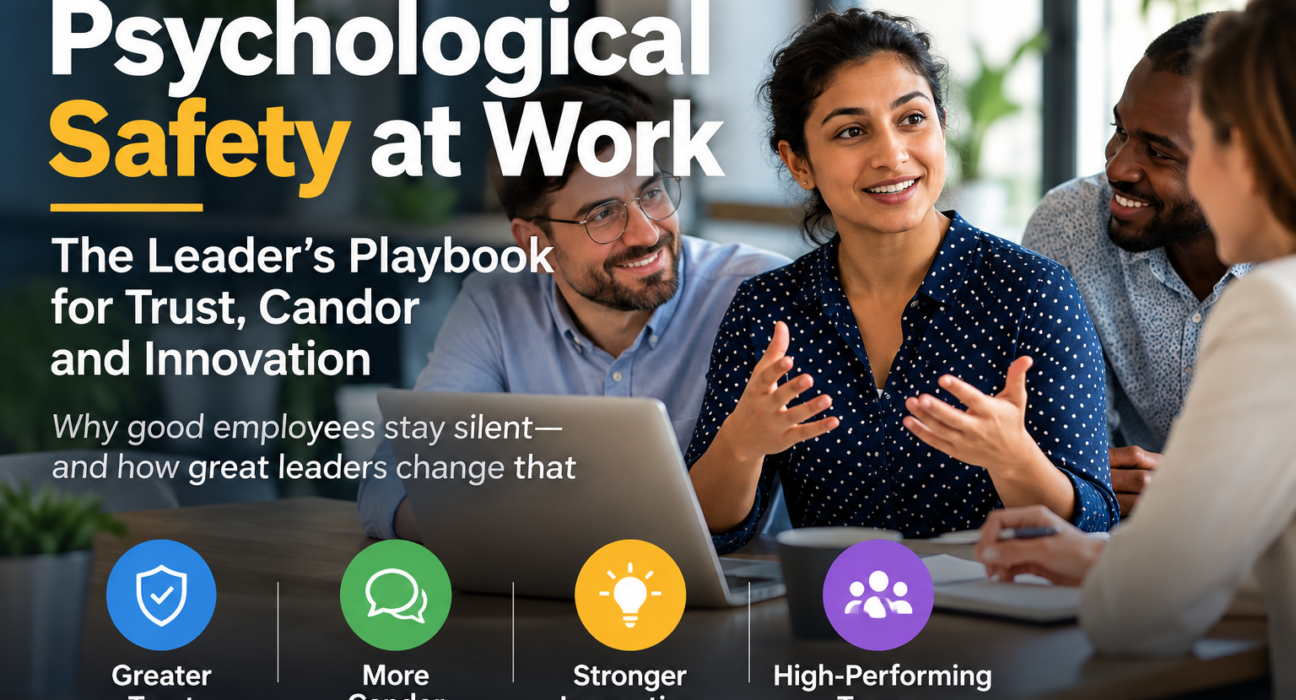
Psychological Safety at Work: The Leader’s Playbook for Trust, Candor and Innovation
2.5
The Five Dysfunctions of a Team: Why Trust and Candor Matter
Psychological Safety at Work: The Leader’s Playbook
Psychological Safety at Work: The Leader’s Playbook for Trust, Candor and Innovation
Psychological Safety at Work: Why Good Employees Stay Silent—and How Great Leaders Change That
Three people in the room knew the launch would fail. Not one of them said so.
The deadline was unrealistic. A critical dependency remained unresolved. The customer data was incomplete. Yet the meeting ended with reassuring nods, confident updates and a plan that looked perfectly reasonable on paper.
Three months later, the project collapsed—and a valuable client relationship collapsed with it.
The leadership team called it an execution failure. But the real failure had happened much earlier, when three capable people decided that telling the truth was riskier than remaining silent.
What do your employees know that they are afraid to tell you?
That question lies at the heart of psychological safety at work—the shared belief that people can ask questions, admit mistakes, challenge assumptions and raise uncomfortable concerns without being humiliated or unfairly punished.
Amy Edmondson’s landmark 1999 study of 51 work teams helped establish psychological safety as an important construct in research on team learning and workplace effectiveness.. Google’s Project Aristotle subsequently highlighted it as the most important of five dynamics identified in its research on effective teams. Neither finding means that safety alone guarantees success; both underline the importance of how people work together. Read Edmondson’s original research.
Here is the uncomfortable paradox: the more a leader demands loyalty, confidence and agreement, the less reliable the information reaching that leader may become. When disagreement carries a personal cost, employees learn to protect themselves. Problems surface late, promising ideas disappear, mistakes recur and meetings become performances rather than genuine conversations.
Psychological safety offers a different way to lead. It does not mean being perpetually agreeable, lowering performance standards or excusing poor conduct. It means creating the conditions for candor, learning and respectful challenge while maintaining clear expectations and accountability.
People do not merely need permission to speak. They need evidence that speaking up is worth the risk. That idea runs through this entire guide.
In this comprehensive leadership playbook, you will discover:
- What psychological safety means—and the common myths that undermine it.
- What Google’s Project Aristotle, Amy Edmondson’s research and other established frameworks can teach us about effective teams.
- What the Chernobyl disaster and Alcoa’s safety transformation reveal about information flow, leadership and organizational culture.
- Timothy R. Clark’s four stages of psychological safety, from belonging to challenging established thinking.
- 15 practical ways to build trust, invite dissent, give feedback and respond constructively to bad news.
- Eight communication frameworks and ready-to-use scripts for difficult conversations.
- Edmondson’s seven-question psychological safety scale, with guidance on scoring, interpretation and responsible use.
- A practical 90-day action plan, progress measures, leadership mistakes to avoid and recommended reading.
Most importantly, you will learn how to translate psychological safety from an abstract corporate value into observable leadership behaviors.
Because employees do not judge psychological safety by what a leader says in a town hall. They judge it by what happens when someone challenges a decision, admits an error, questions a deadline or delivers news nobody wants to hear.
Before you read further, ask yourself one question:
What is the last uncomfortable truth someone told you—and how did you respond?
Your answer may reveal more about your team’s culture than its values statement ever could.
Key Takeaways
- Safety and accountability must coexist. The objective is candor with respect, not comfort without standards.
- Leaders shape the consequences of speaking up. Their responses to disagreement, mistakes and bad news influence what employees communicate.
- Trust is demonstrated through follow-through. Thanking employees matters, but examining concerns and acting on valid information matters more.
- Measure the climate responsibly. Use an appropriate psychological safety instrument, protect confidentiality and discuss team-level findings.
- Begin with a 90-day experiment. Establish a baseline, introduce a few repeatable behaviors and measure whether the team’s information flow improves.
What Is Psychological Safety at Work? Definition, Examples and Myths
Amy Edmondson’s Definition of Psychological Safety
Harvard Business School professor Amy Edmondson introduced the construct of team psychological safety in her 1999 study of 51 work teams in a manufacturing company. She defined it as a shared belief held by members of a team that the team is safe for interpersonal risk taking. Her research showed that psychological safety is associated with learning behavior—asking questions, seeking feedback, discussing errors—and that learning behavior in turn mediates the relationship between psychological safety and team performance.
In practical terms, employees should be able to:
- Ask a question without being ridiculed for not knowing something.
- Admit a mistake without automatically becoming the target of blame.
- Raise a concern without fear of retaliation.
- Disagree with a senior colleague respectfully.
- Request help before a problem becomes a crisis.
- Offer an unconventional idea without being dismissed prematurely.
- Give and receive constructive feedback.
- Acknowledge uncertainty rather than pretending to have all the answers.
Psychological Safety vs. Comfort: What It Is—and What It Is Not
Psychological safety is often misunderstood as being nice, avoiding conflict, or lowering performance expectations. This misconception is not merely academic—it leads leaders to create comfortable teams that still fail, because difficult issues remain undiscussed.
| Psychological safety IS | Psychological safety is NOT |
| Candor with respect | Being nice all the time |
| High standards plus high safety (the “learning zone”) | Lowering the bar or avoiding accountability |
| A shared team climate influenced by leaders, colleagues and team norms | A personality trait or a perk |
| Permission to disagree, then commit | Consensus on everything |
| Freedom to raise concerns | Freedom from all consequences |
| Learning from honest mistakes | Excusing negligence or misconduct |
| Asking for help | Avoiding personal responsibility |
| Challenging decisions constructively | Disrespecting authority |
A useful way to understand the relationship between psychological safety and performance standards is this: safety without accountability can encourage complacency, while demanding standards without sufficient safety can create anxiety and silence. Effective teams need both. You need both. The central principle is simple: make it safe to speak and learn, while keeping expectations for performance and conduct clear.
Consider a simple example.
Low psychological safety: An employee notices an error in a report prepared by the department head. The employee remains silent because challenging the boss could be dangerous.
High psychological safety: The employee says, “I may be missing something, but this figure differs from the source data. Could we verify it before the report goes out?”
The second employee is not being disloyal or difficult. The employee is protecting the quality of the decision. The leader’s response determines whether this behavior is repeated or suppressed.
Psychological Safety Research: What the Evidence Actually Shows
The research on psychological safety is substantial, but it is worth knowing exactly what each source does and does not show.
Google’s Project Aristotle identified psychological safety as the most important of five team dynamics. It describes Google’s own teams and does not show that psychological safety alone guarantees performance. This guide uses it for its framework, not for any specific percentage, because Google has not published such figures.
Timothy Clark’s four stages are a practitioner framework, distinct from both Google’s research and Edmondson’s original model. The STATE method comes from the book Crucial Conversations, and the SBI model comes from the Center for Creative Leadership. Kim Scott’s Radical Candor explicitly warns against the “praise sandwich.” Treat all of these as useful frameworks, not scientifically guaranteed techniques.
Edmondson’s 1999 study of 51 work teams found that psychological safety was associated with learning behavior, which in turn explained team performance. A 2017 meta-analysis by Frazier and colleagues, drawing on 136 independent samples representing more than 22,000 individuals, found that psychological safety is related to learning, engagement and performance, and that it adds explanatory power for task performance and organizational citizenship behaviors beyond related ideas such as positive leader relations and work engagement. Edmondson and Lei’s 2014 review traces the concept’s history and its renaissance in organizational research.
A note on cause and effect: these are statistical relationships. They show that psychological safety is associated with better learning and performance. They do not prove that it directly causes every outcome, and results for engagement, innovation, retention or financial performance can also reflect leadership quality and other factors. This guide draws on that body of work, not on unverifiable anecdotes.
Why Psychological Safety Matters for Leadership and Team Performance
Google Project Aristotle: Five Dynamics of Effective Teams
Google’s Project Aristotle asked a different question than its earlier Project Oxygen (which studied what effective managers do): what makes a team effective? The researchers tested many statistical models on hundreds of variables, covering who was on each team and how the team worked together. According to Google’s re:Work guide, team dynamics mattered more than team composition.
Google’s Project Aristotle identified five important team dynamics, with psychological safety ranked first in Google’s account of the findings. The other four—dependability, structure and clarity, meaning, and impact—also contribute to team effectiveness:
| Dynamic | The question the team asks | What a leader can do |
| Psychological safety | Can we take risks without feeling insecure or embarrassed? | Ask for dissent; thank people for bad news |
| Dependability | Can we count on each other to deliver quality work on time? | Make commitments visible; follow up |
| Structure and clarity | Are roles, plans, and goals clear? | Co-create a RACI chart and team charter |
| Meaning | Is this work personally important to us? | Match work to strengths; connect it to purpose |
| Impact | Do we believe our work matters and creates change? | Share user and customer stories |
Google’s research found that psychological safety was the most important of these five dynamics. Importantly, the findings did not suggest that psychological safety alone guarantees success. Dependability, clarity, meaning, and impact also matter.
A caution about the evidence: Google has published the findings and approach of Project Aristotle in summary form on its re:Work site, but not the underlying data, effect sizes or confidence intervals. It is best treated as gray literature. Its value lies in the framework it provides and its consistency with peer-reviewed research, not in specific numbers.
How to apply the lesson: At your next team meeting, ask employees to rate each of the five dynamics from 1 to 5. Discuss the lowest-scoring area and agree on one improvement.
The Five Dysfunctions of a Team: Why Trust and Candor Matter
Patrick Lencioni’s The Five Dysfunctions of a Team describes a cascade: absence of trust leads to fear of conflict, which leads to lack of commitment, avoidance of accountability, and inattention to results. Psychological safety addresses the root. Without the willingness to be vulnerable—to admit mistakes, ask for help, or challenge a peer—the subsequent dysfunctions are almost inevitable.
Lencioni’s model is not a research study but a practitioner framework. Its value lies in its diagnostic clarity: if your team avoids conflict, the first question is not “How do we encourage debate?” but “What makes it unsafe to disagree?”
Employee Silence at Work: The Hidden Costs for Leaders
Employees do not always remain silent because they lack ideas or commitment. Sometimes they are making a rational assessment of the personal consequences of speaking.
They may think:
- “The boss has already made up their mind.”
- “I will be labeled negative if I raise this.”
- “Someone else will probably point it out.”
- “It is not worth damaging my relationship with the senior team.”
- “If I admit the mistake, my performance rating may suffer.”
- “Nothing changes when we raise concerns anyway.”
Over time, this creates a dangerous pattern. Leaders receive less reliable information precisely when they need it most. The consequences can include delayed risk detection, weak decisions, preventable rework, suppressed innovation, and employee disengagement.
A useful diagnostic question for leaders is: What do my employees know that I do not know because they are reluctant to tell me?
That question can reveal more about leadership effectiveness than a dozen presentations about organizational values.
How Meaning, Strengths and Psychological Safety Drive Engagement
Gallup’s research on engagement has consistently found that people who use their strengths every day are significantly more likely to be engaged at work. Google’s “meaning” dynamic points to the same insight: work must matter personally to the person doing it. Psychological safety enables employees to bring their strengths to the table—and to ask for help when a task falls outside their strengths. A team where people feel safe to say “I’m not the right person for this” is a team that can allocate work more effectively than one where everyone pretends to be equally capable of everything.
Chernobyl and Alcoa: Leadership Lessons in Silence, Safety and Openness
Chernobyl: How Information Failures Amplified Risk
The 1986 Chernobyl disaster is usually told as a story of operator error. The fuller picture, set out in the International Atomic Energy Agency’s INSAG-7 report, is that reactor design flaws, weak regulation, and an inadequate “safety culture” all contributed. The Soviet system treated information about reactor problems and earlier incidents as state secrets. The people running the plant did not know what the designers and officials knew. Psychological safety and information flow are important lessons, but they are not a complete explanation: the accident also involved reactor design flaws, operating decisions, regulatory weaknesses and wider institutional conditions.
When people believe that raising a concern will be punished, inconvenient information remains hidden. When institutions protect reputations instead of investigating evidence, warning signals can be missed or mishandled.
Leadership insight: Silence is not compliance. When information cannot move up, down, or sideways, risk accumulates where nobody can see it.
Practical actions for high-risk environments:
- Make it easy to report hazards and near misses.
- Investigate the system conditions that allowed a problem to occur.
- Escalate unresolved safety concerns through established channels.
- Protect good-faith reporting while investigating deliberate violations fairly.
- Ensure that seniority does not override evidence.
In high-risk work, psychological safety is not a substitute for technical competence, formal controls, or regulatory compliance. It helps those safeguards work as intended.
Alcoa: How Paul O’Neill Made Employee Safety a Leadership Priority
When Paul O’Neill became CEO of Alcoa in 1987, the company’s lost-workday injury rate was already low by industry standards, at 1.86 per 100 workers. He still set a goal of zero, and he treated an injury-free workplace as a precondition of doing business, not a priority to be traded against cost.
O’Neill’s real lever was not a rulebook. It was a signal to every worker that bad news was welcome and would be acted on. According to published accounts based on Charles Duhigg’s The Power of Habit, the lost-workday rate had fallen to about 0.2 per 100 workers by the time O’Neill retired in 2000. Over the same period, annual net income rose from about $200 million to about $1.48 billion, and market value grew from about $3 billion in 1986 to about $27.5 billion in 2000.
The wider lesson is that employees often see inefficiencies and hazards that senior executives cannot see from their offices. When workers can report those problems and expect action, the organization gains access to valuable frontline knowledge.
Treat these figures as context, not proof of cause. Many factors shape a company’s financial results, and the case does not show that safety leadership alone produced Alcoa’s growth. Published sources also describe the injury rate in slightly different ways (lost-workday cases or lost days per 100 workers) and report values between 0.12 and 0.23, so the numbers are approximate. The lesson is about leadership and information flow, not a financial formula.
Takeaway: Make one thing non-negotiable, make reporting safe, and respond fast. Trust follows.
Westrum’s Three Organizational Cultures: How Information Flows
Sociologist Ron Westrum developed an influential typology of organizational cultures based partly on how information flows and how organizations respond to problems. His work distinguishes three broad patterns:
| Pathological | Bureaucratic | Generative |
| Power-oriented | Rule-oriented | Performance-oriented |
| Low cooperation | Modest cooperation | High cooperation |
| Messengers punished | Messengers neglected | Messengers trained |
| Failure leads to scapegoating | Failure leads to justice | Failure leads to inquiry |
| New ideas crushed | New ideas create problems | New ideas implemented |
| “Who’s at fault?” | “Did we follow the process?” | “What can we learn?” |
These are broad patterns, not labels to apply mechanically to every department. Westrum’s important insight is that leadership priorities influence information flow. Employees learn from what leaders reward, ignore, punish, and investigate.
The leadership test: When someone brings you bad news, do you first investigate the problem, or do you first make the messenger regret speaking? Your response teaches the organization what it is safe to communicate.
The Four Stages of Psychological Safety: Timothy R. Clark’s Model
Timothy R. Clark’s model, from The 4 Stages of Psychological Safety, describes a developmental progression in which people experience four progressively broader forms of safety. The model is a useful leadership framework. It should not be confused with Google’s five team-effectiveness dynamics or presented as the same research model as Edmondson’s work.
Progress is not always linear; changes in membership, pressure, or leadership can require revisiting earlier stages.
Stage 1: Inclusion Safety—Creating a Sense of Belonging
People need to feel accepted as legitimate members of the team, regardless of whether they are new, junior, different in background, or less influential than others.
Leadership practices:
- Welcome new employees and explain how the team works.
- Prevent ridicule, exclusion, and discriminatory behavior.
- Invite contributions from remote, quieter, and less senior colleagues.
- Rotate meeting facilitators to give quieter members structured airtime.
- Use brief personal check-ins: “One thing outside work you’re looking forward to this week?”
Example: During a project meeting, the manager invites a newly appointed analyst to explain what they have noticed before the senior specialists offer their views. The objective is not to force everyone to speak about personal matters. It is to ensure that professional participation does not depend on status or social connections.
Stage 2: Learner Safety—Making Questions and Mistakes Acceptable
People must be able to ask questions, request help, acknowledge uncertainty, and learn from mistakes.
Leadership practices:
- Admit when you do not know something: “I don’t know—let’s figure it out together.”
- Respond to reasonable questions with patience.
- Use post-project reviews to identify what can be improved.
- Publicly thank people who flag early errors or near-misses: “Thanks for flagging that error. Let’s fix it together, then write down what we learned.”
- Distinguish honest errors from reckless or deliberate misconduct.
Example: A new employee makes a mistake in a client report. Instead of saying, “How could you be so careless?”, the manager asks, “Let’s understand how this happened. Was the process clear, were the checks adequate, and what will prevent a recurrence?” The manager can still require correction, retraining, and appropriate accountability.
Stage 3: Contributor Safety—Helping Employees Add Value
Employees need opportunities to apply their skills, exercise judgment, and take meaningful responsibility.
Leadership practices:
- Give people ownership of defined outcomes.
- Match assignments to capabilities while supporting development.
- Ask employees to propose solutions, not merely identify problems.
- Use “Yes, and…” phrasing to build on emerging ideas.
- Recognize contributions with specific, credible feedback.
Example: An experienced customer-service employee identifies a recurring complaint. Rather than simply acknowledging the observation, the manager asks the employee to lead a small improvement project with defined measures and support. Contribution becomes meaningful when employees have both responsibility and the resources to act.
Stage 4: Challenger Safety—Encouraging Respectful Dissent
At this stage, people can challenge assumptions, established practices, and leadership decisions respectfully, even when their views are unpopular.
Leadership practices:
- Invite employees to identify weaknesses in proposals: “What’s the downside of this plan that we’re not seeing?”
- Ask, “What evidence would change our minds?”
- Appoint a rotating “devil’s advocate” in strategy sessions—but avoid making it a ritual in which one person is expected to oppose everything.
- Respond to dissent on its merits rather than treating it as disloyalty.
- Reward dissent that saves time or money: “Your pushback on the vendor choice just saved us a costly mistake. Thank you.”
Example: A senior executive proposes a major technology investment. A team member raises concerns about implementation costs and customer adoption. The executive responds, “Let’s examine those assumptions before we commit. What evidence do we need?” That is challenger safety in action.
15 Practical Ways to Build Psychological Safety in the Workplace
The most effective interventions are not elaborate slogans or occasional workshops. They are repeated behaviors that employees experience in everyday work.
1. Model Humility and Admit What You Don’t Know
Leaders establish the emotional climate of the team through their reactions to uncertainty and challenge. If the leader must always be right, employees learn to protect the leader’s image. If the leader can acknowledge uncertainty, employees learn that learning is more important than appearing infallible.
Try saying:
- “I may be missing something. What do you see?”
- “I was wrong about that assumption.”
- “What evidence supports the alternative?”
- “Who has a different perspective?”
Do not manufacture vulnerability or use self-deprecation as a performance. Acknowledge genuine uncertainty, correct mistakes openly, and explain what you have learned.
2. Ask Questions That Encourage Honest Feedback
“Any questions?” is often a weak invitation, particularly when the most senior person has just presented a strongly held position.
Use more specific questions:
- “What is the biggest risk we have not discussed?”
- “Which assumption in this plan is least certain?”
- “What would someone who disagrees with us say?”
- “What might prevent this from working in practice?”
- “What information would help us make a better decision?”
Then allow people time to think. A short period of silence can be productive. Resist the temptation to answer your own question immediately.
3. Thank Employees Who Speak Up—and Follow Through
Employees watch what happens after someone speaks up. If the leader becomes defensive, dismisses the concern, or attacks the employee’s competence, others learn to remain silent.
A better response is: “Thank you for raising this. Let’s understand the evidence and decide what action is appropriate.”
You do not have to agree with every concern. You do need to examine it fairly. Where the concern is unfounded, explain why. Where it is valid, act on it. Where further investigation is needed, give a realiztic timeline and report back. A thank-you without follow-through is not enough.
4. Address the Problem Without Blaming the Person
When a project fails, leaders often move too quickly from the event to a judgment about the individual.
Blame-oriented: “You have demonstrated that you cannot manage a project.”
Learning-oriented: “The project missed two critical milestones. Let’s examine the assumptions, dependencies, decisions, and follow-up that contributed to the delay.”
The second response is not an excuse for poor performance. It begins with observable facts and makes it easier to identify corrective action. A useful review distinguishes among:
- An honest mistake made despite reasonable care.
- A capability gap requiring training or support.
- An unclear process or conflicting instruction.
- A foreseeable risk that was not addressed.
- Reckless conduct or a deliberate violation.
Different causes require different responses. Treating all failures identically is neither fair nor effective.
5. Make Constructive Disagreement Part of Decision-Making
Healthy teams do not eliminate disagreement. They learn to use it productively.
Before a major decision, ask team members to identify:
- The strongest argument in favor of the proposal.
- The strongest argument against it.
- The assumptions that remain untested.
- The evidence that would change the decision.
- The risks of doing nothing.
For consequential decisions, collect written views before the most senior person states their preference. This can reduce the tendency to conform to authority.
6. Design Meetings Where Every Voice Counts
Meeting design can either distribute voice or concentrate it.
Practical interventions include:
- Circulate the agenda and decision questions in advance.
- Give participants a minute or two to write their views before discussion.
- Invite input from people who have not yet spoken.
- Prevent interruptions and personal attacks.
- Ask the most senior person to speak later when appropriate.
- Record dissenting evidence and unresolved risks.
- Explain the final decision and the reasons behind it.
For example, a team considering a new customer strategy could begin with three minutes of silent idea generation. Each participant then contributes one idea before open discussion. This reduces the advantage enjoyed by the fastest or most confident speaker and can help surface less obvious insights.
7. Use Constructive Feedback to Build Trust
Feedback is essential to performance, but employees may interpret even useful feedback as a threat when trust is weak.
The Situation–Behavior–Impact (SBI) framework provides a practical way to make feedback more specific.
Situation: “During yesterday’s client presentation…”
Behavior: “…you moved to the next slide before the client finished explaining the concern.”
Impact: “…we may have missed important information about their requirements.”
Invitation: “How did you see that moment, and what could we do differently next time?”
SBI is a feedback framework, not a guarantee that the conversation will feel safe. Tone, timing, fairness, and the relationship also matter.
Kim Scott’s Radical Candor adds the principle: care personally and challenge directly. Note that Scott explicitly warns against the “praise sandwich,” because people learn to brace for the bad news in the middle. Be specific and kind instead, and offer help: “This needs clearer data. I’ll connect you with our analytics lead.”
When receiving feedback, leaders should model the behavior they expect: “Thank you for telling me. I had not realized that my interruptions were having that effect. I’ll make a conscious effort to listen fully.”
8. Separate Intent from Impact in Difficult Conversations
A person can have good intentions and still create a harmful impact.
Instead of arguing about intentions, acknowledge both sides:
“I understand that your intention was to move the meeting forward. The impact was that two colleagues did not have a chance to explain their concerns. How can we preserve efficiency while giving people room to contribute?”
This approach does not assume that every negative reaction is justified. It creates space to examine the behavior, its consequences, and a better way forward.
9. Manage Your Reactions Under Pressure
Leaders cannot create safety if employees must constantly manage the leader’s anger, impatience, or defensiveness.
Before responding to difficult information:
- Pause briefly.
- Separate the facts from your interpretation.
- Ask one clarifying question.
- Lower your conversational intensity.
- Avoid sarcasm and public humiliation.
- Return to the issue after emotions have settled if necessary.
A useful sentence is: “I want to understand this properly. Let me ask a few questions before we decide what happened.”
Self-regulation does not mean suppressing all emotion. It means choosing a response that helps solve the problem rather than escalating it.
10. Conduct Blameless Reviews While Maintaining Accountability
A retrospective or after-action review examines what happened, why it happened, and what the team should change.
A useful structure is:
- What did we expect to happen?
- What actually happened?
- What assumptions or conditions influenced the outcome?
- What went well?
- What made success difficult?
- What will we change next time?
- Who owns each action, and by when?
“Blameless” does not mean that deliberate misconduct, negligence, or repeated disregard of clear responsibilities is exempt from consequences. It means the review begins with understanding and evidence rather than reflexive scapegoating.
11. Explain Decisions, Evidence and Trade-Offs
Employees are more likely to accept a decision—even one they opposed—when they understand how it was reached.
Explain:
- The objective.
- The criteria used.
- The alternatives considered.
- The important trade-offs.
- The reason for the final choice.
- The evidence that might trigger a review.
For example: “We selected Supplier A because its reliability and support capability outweighed Supplier B’s lower initial price. We recognize the cost difference, so we will review total operating costs after six months.”
Transparency must respect confidentiality, privacy, legal obligations, and commercially sensitive information.
12. Give Employees Meaningful Ownership and Authority
Inviting ideas while retaining every decision and every responsibility at the top creates frustration.
Delegation should clarify:
- The outcome required.
- The boundaries within which the employee can act.
- The resources available.
- The decisions requiring escalation.
- The measures of success.
- The support the manager will provide.
Instead of saying, “Come to me before doing anything,” a manager might say: “You can make routine customer-service decisions up to this limit. Escalate safety, legal, or high-value exceptions. We’ll review the results next Friday.”
13. Protect Good-Faith Reporting and Provide Safe Escalation Channels
Some matters require more than an ordinary team discussion. Harassment, discrimination, fraud, safety violations, and other serious concerns may need formal reporting, investigation, or independent escalation.
Leaders should:
- Explain available reporting channels.
- Follow applicable law and organizational policy.
- Avoid retaliating against good-faith reporters.
- Maintain appropriate confidentiality.
- Investigate fairly and promptly.
- Communicate what can be shared about the outcome.
An open-door policy is not sufficient if employees believe that the person they must approach is implicated in the problem. Psychological safety must be supported by credible processes, not just the goodwill of individual managers.
14. Close the Feedback Loop: From Employee Voice to Action
One of the fastest ways to destroy trust is to ask employees for feedback repeatedly and then do nothing with it.
Use a simple response process:
You said: Employees reported that project priorities changed without explanation.
We found: Several teams were receiving conflicting instructions.
We will do: Publish a single weekly priority update and identify the decision owner.
We will review: After four weeks, assess whether conflicting instructions have decreased.
Not every request can be accepted. Leaders should explain what can change, what cannot, and why. Employees do not need every suggestion implemented. They need evidence that their contributions receive serious consideration.
15. Recognize Candor, Early Warnings and Responsible Risk-Taking
Recognition shapes organizational behavior. If leaders reward only visible successes, employees may conceal failed experiments and difficult problems. If they also recognize early risk detection, responsible experimentation, and learning, they encourage behavior that protects long-term performance.
Recognize the behavior specifically:
- “Your early escalation gave us time to correct the issue before it reached the customer.”
- “Your analysis challenged our original assumption and improved the decision.”
- “The experiment did not deliver the expected result, but the evidence helped us avoid a larger investment.”
Do not celebrate failure indiscriminately. Celebrate responsible learning, early detection, and honest reporting—not preventable harm or reckless decisions.
Difficult Conversation Scripts: Eight Frameworks Leaders Can Use
Psychological safety is built in moments of interaction. Leaders need language they can use when emotions are high, opinions differ, or mistakes have occurred. These frameworks are practical tools drawn from respected books and training programs, not scientifically guaranteed techniques. Use them with genuine curiosity and adapt them to your context.
The STATE Method: How to Raise Concerns Without Escalating Conflict
The STATE framework from Crucial Conversations is a useful structure for discussing difficult issues.
- S — Share your facts: Begin with observable information.
- T — Tell your story: Explain the concern or interpretation you have formed.
- A — Ask for others’ paths: Invite the other person’s perspective.
- T — Talk tentatively: Acknowledge that your interpretation may be incomplete.
- E — Encourage testing: Invite disagreement and alternative explanations.
Example: “I noticed that the client has requested the revised proposal three times, and we have not sent it yet. I’m concerned that this may affect confidence in our responsiveness. I may not have the full picture. What is preventing us from completing it, and what would help us resolve the issue?”
Why it works: It starts with facts rather than accusations. It makes the concern explicit. It acknowledges uncertainty. It invites the other person to contribute. It shifts the conversation toward action.
Avoid using the framework as a scripted technique to manipulate people. Its value comes from genuine curiosity and a willingness to revise your own interpretation.
The SBI Feedback Model: Situation, Behavior and Impact
The Situation–Behavior–Impact model, popularized by the Center for Creative Leadership, grounds feedback in observable reality rather than personality traits.
Example: “In yesterday’s demo (Situation), you skipped the security features (Behavior). Clients left confused about our compliance posture (Impact). What happened?”
Then offer support: “This needs clearer data. I’ll connect you with our analytics lead.”
Observation, Interpretation and Request: A Practical Conflict Framework
A useful conflict-resolution habit is to distinguish three things that people often combine:
Observation: “You interrupted me twice during the presentation.”
Interpretation: “I felt that my contribution was being dismissed.”
Request: “Could you let me finish my point before responding in the next meeting?”
This makes the conversation more specific and easier to resolve.
Defensive vs. Learning Responses: What Leaders Can Say Instead
| Defensive response | More constructive response |
| “That is not my problem.” | “Let’s clarify who owns this issue.” |
| “You should have known better.” | “What information or support was missing?” |
| “We have always done it this way.” | “What evidence supports the current approach?” |
| “Are you questioning my decision?” | “Which part of the decision concerns you?” |
| “There is no time to discuss this.” | “What is the minimum check we need before proceeding?” |
| “Who is responsible for this mess?” | “What happened, and what corrective action is required?” |
These alternatives do not remove the need for difficult decisions. They make it easier to obtain the information needed to make those decisions well.
De-Escalation Techniques for Difficult Workplace Conversations
From Chris Voss’s Never Split the Difference:
- Late-Night FM DJ voice: Lower your pitch and slow your speech. “Let’s pause and regroup.”
- Accusation audit: Defuse a stalemate by naming the other person’s likely objection: “You probably think I’m overreacting, and that I’m not listening.”
From Crucial Conversations:
- Contrasting: “I don’t want you to think this is about blame. I do want us to find what went wrong.”
- Mutual purpose: “We both want this launch to succeed. Let’s work out how.”
How to Manage Emotions During Difficult Conversations
- Name the feeling before the fix: “You seem stressed. Let’s talk about that first.”
- Name your own: “I’m frustrated because the deadline moved again.” It depersonalizes the moment.
- Reset before high-stakes meetings: Slow breathing—in for 4 seconds, hold 4, out for 6.
Resolve Workplace Conflict Through Shared Understanding
From Difficult Conversations (Stone, Patton, and Heen):
- Look for your contribution: “How did each of us contribute to this?” The shift from blame to shared accountability is the difference between defensiveness and problem-solving.
- Identify shared goals first: “We both want this launch to succeed. Let’s figure out how to get there.”
Build Trust Through Direct, Respectful Communication
From Kim Scott’s Radical Candor:
- Care personally: “I noticed you’ve been quiet lately. How are you doing, honestly?”
- Establish mutual purpose: “We both want this project to succeed—let’s align on the risks.”
How to Measure Psychological Safety: Edmondson’s Seven-Item Scale
What you don’t measure, you may misjudge. Amy Edmondson’s seven-item scale from her 1999 paper is widely used to measure team psychological safety. Ask team members to rate each statement from 1 (strongly disagree) to 7 (strongly agree). Items 1, 3 and 5 are reverse-scored, so for those, a high rating means lower safety.
| # | Statement | Scoring |
| 1 | If you make a mistake on this team, it is often held against you. | Reverse |
| 2 | Members of this team are able to bring up problems and tough issues. | Normal |
| 3 | People on this team sometimes reject others for being different. | Reverse |
| 4 | It is safe to take a risk on this team. | Normal |
| 5 | It is difficult to ask other members of this team for help. | Reverse |
| 6 | No one on this team would deliberately act in a way that undermines my efforts. | Normal |
| 7 | Working with members of this team, my unique skills and talents are valued and utilized. | Normal |
How to Score and Interpret a Psychological Safety Survey
- Reverse-score items 1, 3 and 5 by subtracting each response from 8. Then calculate the average of the seven items for each respondent and aggregate the responses to obtain the team-level result.
- Report results only in a way that protects confidentiality; do not share identifiable individual scores or results for groups so small that respondents could be recognized.
- Compare against your own last survey, not a universal benchmark. The trend matters more than the number.
- Share the results back within two weeks and name one change you will make. A survey with no follow-up teaches people that speaking up is pointless.
- Re-run quarterly, and pair it with a short pulse (two or three items) between rounds.
A note on use: the seven statements above are the items from Edmondson’s 1999 paper. Cite the paper when you use them, and if you reword any item, label the result as an adapted version rather than the original instrument. Anonymity, appropriate aggregation (do not report results for groups so small that individuals could be identified), confidentiality and visible action after the survey are essential. A high average can conceal serious problems affecting particular groups, and a low score is a signal to investigate, not proof of a particular cause.
Three Quick Wins to Improve Psychological Safety at Work
- Speak-up prompt: Ask, ‘What is one thing you feel hesitant to say in this team?’ Then listen without interrupting or defending your position.
- Meeting ground rules: No interruptions, no “stupid” questions, every voice heard.
- Structured retrospective after every project: What worked, what didn’t, what we’ll change.
Measure Behavior and Business Outcomes, Not Just Survey Scores
Survey responses are only one source of evidence. Combine them with operational indicators such as:
- Time between identifying a risk and escalating it.
- Number of recurring issues that remain unresolved.
- Percentage of retrospective actions completed.
- Frequency of avoidable rework.
- Participation patterns in meetings.
- Time taken to resolve reported issues.
- Relevant safety, quality, and customer measures.
Interpret these indicators carefully. For example, an initial increase in reported near misses may indicate better reporting rather than deteriorating safety. A lower number of reported concerns may mean fewer problems—or greater reluctance to speak. Look for patterns across multiple indicators and investigate the context.
Psychological Safety Toolkit: Practical Exercises for Teams
The long list of team practices circulating in psychological safety playbooks can overwhelm. Pick one or two a month from the groups below. Tools named are examples; check each one’s current free tier.
| Group | Try this | Example tool |
| Speaking up | Ask a naïve question (“What might I be missing?”); assign a devil’s advocate; use “I’m curious…” instead of “You’re wrong” | Shared agenda doc |
| Listening | Paraphrase back before responding; pause three seconds after someone speaks; round-robin starting with the most junior person | Video-call “raise hand” feature |
| Inclusive airtime | “No repeats” rule (nobody speaks twice until everyone has spoken once); anonymous idea collection; silent brainwriting before discussion | Google Forms, Miro |
| Learning from failure | Blameless retrospectives; pre-mortems (“How might this fail?”); a monthly “best lesson from a mistake” | Retrium or a simple retro template |
| Decisions and roles | Explain decisions (“We chose X because Y; we considered Z”); build a RACI chart; swap roles for a day | Notion or Google Sheets template |
| Norms and contracts | Co-create a team charter (“We assume positive intent”); track meeting participation equity | Mural or a whiteboard |
| Feedback loops | Quarterly start/stop/continue survey; 15-minute weekly appreciation round; end one-to-ones with “What could I do better?” | Google Forms |
| Small wins and joy | A wall of weekly wins; specific micro-praise; a channel for lighthearted posts | Slack or Teams channel |
| Boundaries and recovery | Share workloads openly; protect no-meeting and no-email windows; try walking meetings | Trello or Asana board |
| Purpose and legacy | Share impact stories from real users; ask “What do we want to be remembered for in five years?” | Impact-mapping template |
Build your own tracker. Copy the groups into a spreadsheet, add a column for the practice you chose, a column for status (tried, working, needs change), and a column for who owns it. Review it monthly in your team meeting.
The 90-Day Psychological Safety Action Plan for Leaders
The following implementation plan translates the research and leadership practices into a manageable program. Start small, one team, and expand once you see results.
Days 1–30: Diagnose and Align
Objective: Understand the team’s current experience and identify the behaviors that most need to change.
Actions:
- Conduct the psychological safety pulse check (Edmondson’s seven-item scale).
- Review recent project failures, delays, recurring complaints, and unresolved concerns.
- Ask employees, “What is difficult to say in this team?”
- Examine meeting dynamics: Who speaks? Who is interrupted? Whose ideas are explored?
- Identify two leadership behaviors that may be discouraging candor.
- Agree on three or four practical team norms.
Suggested team norms:
- Challenge ideas without attacking people.
- Raise risks early.
- Ask for help before a problem becomes critical.
- Explain decisions and follow through on commitments.
Deliverable: A short baseline assessment and two priority improvement actions.
Sign it’s working: People name real problems in the workshop.
Days 31–60: Train and Empower
Objective: Make psychological safety visible in daily work.
Actions:
- Train managers to ask open questions and respond constructively to challenge.
- Teach the STATE method and SBI feedback.
- Introduce silent brainstorming or structured round-robin input in selected meetings.
- Run one after-action review on a completed project.
- Start peer coaching pairs to practice active listening and emotional regulation.
- Clarify decision rights and escalation routes.
- Recognize an employee who raised a useful concern or identified a risk.
Do not attempt to launch every intervention at once. Select the practices most relevant to the team’s problems and embed them into existing routines.
Deliverable: Evidence that the team is practicing at least three new behaviors consistently.
Sign it’s working: Bad news reaches you earlier.
Days 61–90: Embed and Scale
Objective: Convert isolated improvements into sustainable team habits.
Actions:
- Repeat the pulse check using the same questions.
- Compare the results and discuss meaningful changes.
- Review whether concerns are being resolved more promptly.
- Check whether actions from retrospectives have been completed.
- Add safety behaviors (inviting dissent, acting on feedback) to manager reviews.
- Recognize one “Voice of Courage” each month.
- Identify practices that have worked and those that need adjustment.
- Assign ongoing ownership for maintaining the improvements.
- Document what is working so practices outlast individual leaders.
Deliverable: A brief progress review, an updated action plan, and named owners.
Signs of progress: Team members raise substantive concerns more readily, reported issues receive timely responses, and agreed improvement actions are completed. Interpret survey trends alongside these behavioral indicators.
Psychological Safety Scorecard: Measuring Progress Over 90 Days
| Measure | Baseline | Day 90 target |
| Employees’ confidence in raising concerns | Measure in month 1 | Improve against baseline |
| Retrospective actions completed on time | Measure in month 1 | Improve against baseline |
| Time to acknowledge a reported concern | Measure in month 1 | Reduce avoidable delays |
| Clarity of roles and decisions | Measure in month 1 | Improve against baseline |
| Evidence of follow-through on employee feedback | Record examples | Demonstrate consistent follow-through |
Targets should be set after the baseline is known. Do not invent percentage improvements merely to make the program look successful.
Rules of thumb: Change one habit at a time, announce what you will do before you do it, and report back on what changed because of what people told you.
Seven Leadership Mistakes That Undermine Psychological Safety
Even well-intentioned leaders can undermine safety through inconsistent behavior.
Mistake 1: Inviting Feedback and Becoming Defensive
A leader asks for honest opinions but reacts badly when someone provides one.
Correction: Thank the person, clarify the evidence, and respond after considering the issue. If you disagree, explain why without attacking the individual.
Mistake 2: Confusing Psychological Safety with Niceness
A team avoids difficult conversations because members do not want to upset one another.
Correction: Make respectful challenge an explicit expectation. Unresolved performance problems do not disappear because everyone is polite.
Mistake 3: Punishing the Messenger
The employee who reports a delay, defect, or customer complaint becomes the focus of criticism.
Correction: First establish what happened, what was known at the time, what decisions were made, and how the problem can be prevented or corrected.
Mistake 4: Celebrating Candor but Ignoring It
Employees are thanked for speaking up, but their concerns disappear into an administrative void.
Correction: Assign an owner, agree on the next step, and report back—even when the organization cannot grant the requested change.
Mistake 5: Calling Every Failure “Learning” Without Accountability
The organization holds endless discussions about mistakes but does not address reckless behavior or repeated failure to meet clear expectations.
Correction: Combine learning reviews with explicit standards, proportionate consequences, and corrective action.
Mistake 6: Measuring Safety Through Participation Alone
A meeting in which everyone speaks is not necessarily psychologically safe. People may participate because they are required to, while avoiding the issues that matter most.
Correction: Examine the quality of disagreement, the treatment of bad news, follow-through, and employees’ actual willingness to raise concerns.
Mistake 7: Expecting Employees to Trust Leaders Immediately
Trust cannot be demanded through a presentation or a new set of organizational values.
Correction: Demonstrate reliability repeatedly. Keep commitments, explain decisions, protect good-faith reporting, and correct your own mistakes.
Eight Recommended Books on Psychological Safety and Team Trust
The following books offer complementary perspectives on psychological safety, trust, communication, feedback, and team performance.
| Book | Core idea | Try this week |
| The Fearless Organization, Amy Edmondson | The definitive guide: safety means candor and accountability, not niceness | Host a failure forum where the team shares lessons from a recent mistake |
| Dare to Lead, Brené Brown | Vulnerability is the base of courage; “clear is kind” | Start a meeting with a check-in: “What’s one thing you’re carrying into this room?” |
| Radical Candor, Kim Scott | Care personally and challenge directly | Ask your team, “What could I do better?” and wait through the silence |
| The Five Dysfunctions of a Team, Patrick Lencioni | Absence of trust is the root dysfunction | Run a personal-histories exercise: where did you grow up, and what was hard about it? |
| The Culture Code, Daniel Coyle | Belonging cues (eye contact, attentiveness, follow-up) signal safety | Respond to the next idea with curiosity before judgment |
| Leaders Eat Last, Simon Sinek | Leaders protect their team’s “circle of safety” | Shield your team from one unrealiztic demand this week and tell them you did |
| The 4 Stages of Psychological Safety, Timothy R. Clark | A staged roadmap from inclusion to challenger safety | Audit airtime: who spoke least in your last meeting? |
| Mindset, Carol Dweck | A growth mindset treats challenges as learning | Replace “We can’t fail” with “What will we learn if this doesn’t work?” |
If you read only one book on this topic, start with Amy Edmondson’s The Fearless Organization.
Free Research and Resources on Psychological Safety
Google re:Work — Understand Team Effectiveness
Explore Google’s research on psychological safety, dependability, structure and clarity, meaning, and impact.
Amy Edmondson’s foundational research
Read the original 1999 study connecting team psychological safety with learning behavior: Administrative Science Quarterly, 44(2), 350–383.
Ron Westrum’s organizational culture research
Explore how organizational culture and information flow influence responses to problems and opportunities: BMJ Quality & Safety, 13(suppl 2).
Google re:Work — broader leadership and team resources
Browse resources on management, feedback, team effectiveness, and workplace practices. Check the current site for available guides and materials.
DORA — Generative organizational culture
Research linking generative cultures to better software delivery and organizational performance.
Use these resources as starting points, then adapt the principles to your own team’s responsibilities, risks, culture, and operating environment.
Psychological Safety at Work: Frequently Asked Questions (FAQ)
What is psychological safety at work?
Psychological safety at work is a shared belief that the team is safe for interpersonal risk-taking. Amy Edmondson introduced the idea in a 1999 study of 51 work teams. In practice, people can ask questions, admit mistakes, raise concerns and disagree respectfully without fear of being punished or humiliated.
Is psychological safety the same as being nice?
No. Psychological safety means candor with respect, not comfort. It works best alongside high standards and clear accountability. Edmondson’s point is that safety without standards breeds comfort, while standards without safety breed anxiety and silence. Teams need both to learn and perform.
How do you measure psychological safety in a team?
Use Edmondson’s seven-item survey from her 1999 paper. Team members rate each statement from 1 to 7, items 1, 3 and 5 are reverse-scored, and you report the team average, never individual scores. Repeat it quarterly and compare against your own baseline, not a universal benchmark.
What did Google’s Project Aristotle find?
Project Aristotle studied what makes Google teams effective. It found that team dynamics mattered more than team composition and identified five dynamics: psychological safety, dependability, structure and clarity, meaning, and impact. Psychological safety ranked first and underpins the other four.
How long does it take to build psychological safety?
There is no fixed timeline, because trust is built through repeated behavior. A 90-day plan can establish a baseline, introduce new habits and show early results, such as bad news reaching you sooner. Sustaining it takes consistent follow-through after that.
Conclusion: Psychological Safety Begins with What Happens After Someone Speaks Up
Psychological safety at work is not created by a mission statement, a leadership workshop or a promise that every opinion matters. It is created through repeated experiences in which people discover that telling the truth is safer—and more useful—than remaining silent.
When an employee flags a risk, the leader investigates rather than attacks. When a colleague admits a mistake, the team examines what happened and how to prevent a recurrence. When someone challenges a senior executive’s preferred solution, the argument is evaluated on its evidence rather than the seniority of the person making it.
That is how trust becomes a working reality.
But psychological safety is not an excuse for weak performance. The strongest teams combine interpersonal safety with clear goals, dependable execution, defined responsibilities and accountability. They make it possible to speak honestly while remaining responsible for what they do next.
Your 90-Day Challenge: Turn Psychological Safety into a Leadership Habit
You do not need to transform the entire organization this week. Start with one team and three commitments.
In the next seven days: Ask your team, “What is one thing you have been hesitant to tell me?” Listen without interrupting or defending your position. Agree on how you will examine the concern and when you will report back.
In the next 30 days: Establish a baseline using an appropriate psychological safety survey. Review meeting behavior, unresolved risks and the way the team handles mistakes. Select two leadership behaviors to improve.
By day 60: Introduce structured dissent, more inclusive meetings and constructive project reviews. Give employees clear ownership of improvement actions.
By day 90: Repeat the assessment, examine the changes and ask whether concerns are being raised earlier, feedback is receiving a response and agreed actions are being completed.
Do not judge progress by whether everyone agrees with you or whether the number of reported problems declines. An increase in reported concerns may initially indicate that employees feel safer speaking up. Examine the quality of reporting, the organization’s response and the operational evidence together.
The Leadership Question That Changes Everything
Return to the three people in the opening story. They knew the launch was in danger, but the information never reached the people who could act on it.
Imagine what might have happened if the first person had been able to raise the concern, the second had challenged the deadline and the third had questioned the quality of the customer data. The project might have been delayed, redesigned or rescued before the damage became irreversible.
That is the business value of psychological safety: not an absence of disagreement, but earlier access to the information needed to make better decisions.
Your next leadership test will not be whether you invite people to speak. It will be what you do when they tell you something you would rather not hear.
Over to you: What is one leadership behavior that would make it easier for people on your team to speak honestly?
Share your experience in the comments, and use the seven-question assessment and 90-day plan in this guide to turn your answer into action.
Sources and Further Reading
- Edmondson, A. (1999). Psychological safety and learning behavior in work teams. Administrative Science Quarterly, 44(2), 350–383.
- Edmondson, A. and Lei, Z. (2014). Psychological safety: The history, renaissance, and future of an interpersonal construct. Annual Review of Organizational Psychology and Organizational Behavior, 1, 23–43.
- Frazier, M. L., Fainshmidt, S., Klinger, R. L., Pezeshkan, A., and Vracheva, V. (2017). Psychological safety: A meta-analytic review and extension. Personnel Psychology, 70(1), 113–165.
- Google re:Work. Understand team effectiveness.
- Gallup. Employee engagement and strengths research.
- International Atomic Energy Agency. INSAG-7: The Chernobyl Accident: Updating of INSAG-1 (1992).
- Westrum, R. (2004). A typology of organizational cultures. BMJ Quality & Safety, 13(suppl 2).
- DORA. Generative organizational culture research.
- Duhigg, C. (2012). The Power of Habit. Random House. Alcoa figures are drawn from published summaries: the Carnegie Council interview with Charles Duhigg (2012), Mitratech’s Alcoa and a Culture of Safety, and Business Insider’s How Changing One Habit Quintupled Alcoa’s Income.
- Clark, T. R. (2020). The 4 Stages of Psychological Safety. Berrett-Koehler.
- Patterson, Grenny, McMillan, and Switzler. Crucial Conversations (STATE method, contrasting, mutual purpose).
- Stone, Patton, and Heen. Difficult Conversations.
- Voss, C. Never Split the Difference.
- Scott, K. Radical Candor.
- Brown, B. Dare to Lead.
- Lencioni, P. The Five Dysfunctions of a Team.
- Coyle, D. The Culture Code.
- Sinek, S. Leaders Eat Last.
- Dweck, C. Mindset.
Acknowledgement: This article draws on published research and established frameworks associated with Amy Edmondson, Google’s Project Aristotle, Timothy R. Clark, Ron Westrum, and the authors listed above. Interpretations and practical recommendations have been synthesized and rewritten for this article.
Subhashis Banerji [Author]
Leadership assessor, strategist, and writer. I help professionals and organizations make smarter decisions by learning to read patterns, not promises.
📘 Read all my articles here:
👉 https://successunlimited-mantra.net/ & https://successunlimited-mantra.com/index.php/blog PLUS on https://relationshipandhappiness.com/
💼 Connect with me on LinkedIn: https://www.linkedin.com/in/subhashis-banerji-21b1418/
Related posts:
- How to Deal with Difficult People: The Ultimate Field Guide to Influence, Negotiation, Conflict Resolution and Relationship Success
- When Feedback Becomes a Threat: How Leaders Can Transform Toxic Feedback into Growth, Motivation and High Performance
- How Average Employees Become Toxic Leaders: The Hidden Link Between Insecurity, Power and Office Politics
- How to Communicate Big Ideas: 20 Practical Strategies


– Please read our Comment Policy