


How Average Employees Become Toxic Leaders: The Hidden Link Between Insecurity, Power and Office Politics
Reading Time: 9 minutes
Contents
hide
1
How Average Employees Become Toxic Leaders: The Hidden Link Between Insecurity, Power and Office Politics
How Average Employees Become Toxic Leaders: The Hidden Link Between Insecurity, Power and Office Politics
Why Insecure Employees, Career Politics and Toxic Cultures Create Authoritarian Leaders in Organizations
The Uncomfortable Truth: Why Some Employees Rise by Loyalty Instead of Competence
Before we talk about dictatorships, let’s talk about your workplace.
Almost every professional has encountered at least one person who leaves everyone scratching their head:
- The mediocre manager who keeps getting promoted.
- The insecure boss who cannot tolerate disagreement.
- The underperformer who somehow becomes the CEO’s favorite.
- The bureaucrat who enforces every rule with zeal but contributes very little real value.
- The employee who takes credit, blocks talent, silences criticism, and builds a network of loyal followers.
Most people assume these individuals succeed because they are politically brilliant. In reality, many succeed because they have discovered a shortcut.
Part I: Competence Creates Confidence. Position Creates Dependency
The most secure professionals derive confidence from what they can do.
- A capable engineer can change companies and still succeed.
- A skilled doctor can rebuild practice.
- A strong sales leader can create results almost anywhere.
Their confidence comes from competence.
By contrast, some individuals know, consciously or unconsciously, that their current role exceeds what their capabilities alone would justify.
The most insecure professionals derive confidence from where they sit. They therefore become intensely dependent on the person, system, or network that gave them power.
The result is predictable:
- They stop focusing on their performance.
- They start protecting their position.
And when protecting position becomes the priority, toxic behavior follows naturally.
| The High Performer Asks: | The Mediocre Careerist Asks: |
| “How can I become better?” | “Whom should I attach myself to?” |
That single difference explains a surprising amount of organizational dysfunction.
Part II: The Five-Step Journey from Average Employee to Toxic Boss
This is the exact journey an average employee takes to become a ruthless, authoritarian boss.
Stage 1: Feeling Threatened by Better People
The individual feels overshadowed by more capable colleagues. Every talented person becomes a threat. Every criticism feels like an attack.
Stage 2: Trading Competence for Connections
Instead of building expertise, the individual builds political alliances. Career growth becomes dependent on relationships rather than results.
Stage 3: Learning That Loyalty Pays Better Than Performance
The individual begins publicly supporting authority figures. Agreement becomes a strategy. Visibility replaces value creation.
Stage 4: Building a Circle of Dependence
Once promoted, the person starts recruiting similar loyalists. Independent thinkers are excluded. Conformists are rewarded.
Stage 5: When Fear Becomes a Management Tool
The final stage occurs when criticism is actively punished. Information is controlled. Opposition is sidelined. Fear becomes the primary management tool. At this stage, the employee has completed the transformation into a toxic boss.
Part III: Which Type of Professional Are You?
In most organizations, people fall into three broad categories:
- Builders (People who create value)
They solve problems, improve systems, help customers, develop talent, and build capability. Their focus is contribution. - Maintainers (People who seek stability)
They avoid conflict, follow instructions, and keep their heads down. They are not dangerous, but they rarely challenge bad systems. - Career Politicians (People who seek influence before competence)
These individuals discover that advancing through competence is difficult. Instead, they learn to advance through visibility, loyalty, and political usefulness.
They become experts at:
- Managing perceptions
- Taking credit
- Aligning with powerful people
- Silencing critics
- Demonstrating loyalty publicly
In healthy organizations, this behavior is contained. In unhealthy organizations, it is rewarded. And once it is rewarded, it spreads.
The Surprising Truth: The Most Dangerous Employee Is Often Highly Ambitious
Contrary to popular belief, the most dangerous employee is often not the incompetent one. It is the moderately competent but highly ambitious individual who discovers that loyalty pays better than performance.
Such people become what political scientist Erica Frantz calls “loyal losers”—individuals whose careers depend entirely on the survival of the system that promoted them. Once that happens, they stop protecting the organization. They start protecting the people who protect them. That is the moment when toxic leadership begins.
Part IV: The Hidden Promotion System That Rewards Loyalty Over Competence
Why do smart organizations accidentally promote toxic leaders? Because they frequently reward:
- Visibility over contribution
- Confidence over competence
- Activity over results
- Agreement over challenge
- Short-term outcomes over long-term culture
As a result, toxic leaders often appear highly effective during promotion decisions. They attend every meeting. They cultivate senior stakeholders. They project certainty. They claim victories. Unfortunately, the damage they create becomes visible only years later—after talent has left, trust has collapsed, and innovation has disappeared.
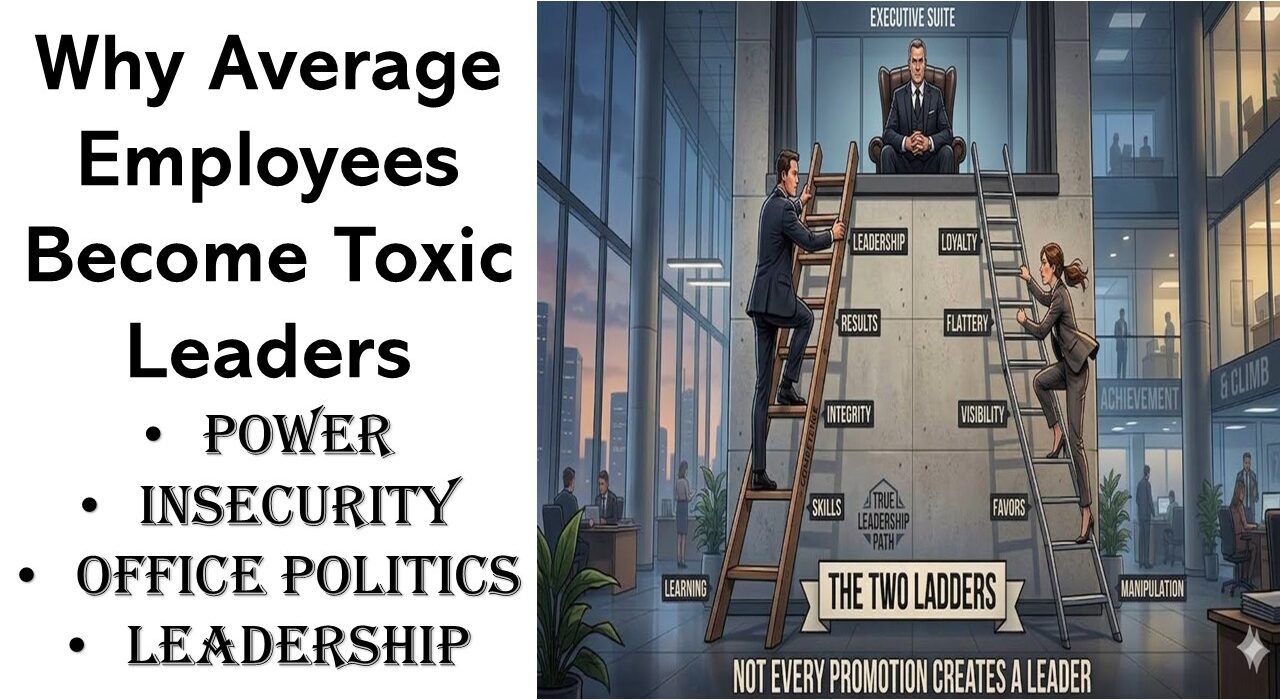
Political scientists Scharpf and Glassel distil this strategy into a single concept: the second ladder. Here is how it works:
- Set up a parallel promotion track — outside normal meritocratic institutions — staffed by loyalists.
- Resource it generously — make it visibly more lucrative than the conventional path.
- Signal impunity — make it clear that those who do the dirty work will be protected, not prosecuted.
- Lower the entry bar — specifically recruit those who would not qualify for the standard path.
The “genius”if that word can be used—is that this system self-selects for loyalty over competence. The people it recruits have the most to lose if the regime falls, and the least to gain from defecting.
Part V: 7 Warning Signs Your Workplace Is Becoming Toxic
Whether in politics, bureaucracy, corporations, or institutions, watch for these signs:
| Warning Sign | What It Looks Like |
| Loyalty over Performance | Promotions go to obedient people, not capable ones. High performers who maintain independence stagnate. |
| Fear of Speaking Truth | Meetings feel like performances. Honest feedback is punished or filtered. |
| Critical Thinkers Are Marginalized | Those who challenge the consensus are quietly sidelined, transferred, or excluded. |
| Double Standards | Friends of leadership enjoy protection while critics face punishment. Rules apply unequally. |
| Fear Replaces Trust | Employees spend more time managing perceptions than creating value. Anxiety replaces energy. |
| “Loyalty” is mentioned more than “competence” | The culture explicitly values allegiance over ability. |
| You spend more time managing perceptions than creating value | The emotional atmosphere is heavy with dread, not purpose. |
If you checked 3+ boxes, your organization is at serious risk.
Part VI: The Enron Lesson – How Toxic Cultures Destroy Great Organizations
Enron’s collapse wasn’t caused by a few bad apples. It was caused by a culture where mediocre performers advanced by enforcing policies that inflated stock prices.
- Jeff Skilling promoted loyalty over competence.
- Whistleblowers were silenced.
- The “rank and yank” system rewarded appearances over substance.
- When the house collapsed, the loyalists had already cashed out.
This is not unique. It happens in organizations everywhere—from corporate boardrooms to local community groups and religious institutions.
Part VII: Your Personal Survival Guide for Toxic Bosses, Office Politics and Workplace Manipulation
Understanding this mechanism empowers us to resist it. Here is your practical resistance toolkit.
For Employees: 10 Practical Strategies to Protect Your Career and Integrity
Strategy #1: Build Real Competence Instead of Political Influence
Audit your own mediocrity honestly. Identify real skill gaps instead of seeking shortcuts. Mediocre performers who invest in genuine competence become less recruitable for dirty work.
Action: List three areas where you are weak. Create a 90-day plan to upskill.
Strategy #2: Establish Non-Negotiable Ethical Boundaries
Set 3-5 red lines (e.g., “I will not falsify records,” “I will not participate in retaliation”).
Action: Write them down. Revisit them when pressure builds.
Strategy #3: Build Career Independence and Exit Options
You are most susceptible to the second ladder when you feel trapped.
Action: Cultivate skills and networks outside your organization. Build an “exit portfolio.” A person who can leave is a person who can say “no.”
Strategy #4: Document Everything
Autocrats thrive in gray areas. Keep a paper trail of your achievements, metrics, and communications.
Action: Save emails. Record meeting minutes. Track your contributions quantitatively.
Strategy #5: Create Strong Professional Networks
Dictatorships survive by isolating people.
Action: Build relationships across departments. A wide network makes it difficult for a toxic manager to discredit you.
Strategy #6: Find Ethical Mentors and Accountability Partners
The Argentine officers who stayed clean had peers who shunned the Battalion 601.
Action: Find a person of integrity. Make a pact. Use a “safe word” when pressured.
Strategy #7: Use the Three-Question Ethical Decision Test
When asked to implement a policy that feels unjust, ask:
- Is this strictly legal, or just ‘not technically illegal’?
- If printed on the front page, would I defend it to my mother?
- Who bears the cost—and are they in the room?
Action: If you cannot answer clearly, ask for the request in writing. This halts unethical orders.
Strategy #8: Become an Expert, Not a Loyal Follower
Autocrats hate experts because experts have standards.
Action: Double down on your technical skills. Make yourself valuable for your actual work.
Strategy #9: Increase Visibility Beyond Your Immediate Boss
Action: Volunteer for cross-departmental presentations. Let executive leadership know your worth.
Strategy #10: Build Everyday Courage
Practice small acts of ethical courage regularly.
Action: Reflect weekly: “Did I choose the path that builds real capability, or the one that just looks good?”
What to Protect, Document, and Avoid
| What to Document | What to Protect | What to Avoid |
| Achievements (quantified) | Reputation (don’t burn bridges) | Complaining without solutions |
| Performance reviews | Mental health (set boundaries) | Taking sides in political battles |
| Emails and instructions | Skills (keep learning) | Sending emotional emails |
| Professional network (external) | Options (always be interview-ready) | Isolating yourself |
Part VIII: The Leadership Playbook – How Great Leaders Prevent Toxic Cultures
If you are leading a team, the responsibility lies on you to prevent a “second ladder” from forming.
Principle #1: Reward Dissent and Independent Thinking
Action: Ask “What am I missing?” and reward the person who gives you the uncomfortable truth.
Principle #2: Prevent Power Concentration
Action: Rotate high-stakes roles. Cross-train your team. Transparency prevents fiefdoms.
Principle #3: Create Safe Channels for Honest Feedback
Action: Implement blind evaluation systems where subordinates safely rate managers.
Principle #4: Maintain Fair and Transparent Standards
Action: Never lower the bar for specific subgroups. Insist on clear, competence-based criteria.
Principle #5: Make Ethics and Integrity Visible
Action: Celebrate “clean” successes. Share stories of people who advanced ethically.
Principle #6: Hire Courageous Thinkers, Not Yes-Men
Action: Interview for courage. Ask candidates about a time they disagreed with a boss.
Part IX: Beyond the Workplace – What Citizens, Governments, Institutions and Organizations Can Learn
The antidote to the loyal loser is not the moral superhero. It is the well-designed institution and the culture that makes integrity the path of least resistance.
- Recognize authoritarian tactics: Watch for lowered standards, budget spikes, and impunity signals.
- Defend institutions: Support journalism, judicial independence, and civil service integrity.
- Use simulations: Play games like SHASN to experience the seduction of power in a safe environment.
- Study history: Read Ordinary Men, The Anatomy of Fascism, or How Democracies Die.
Part X: Are You Accidentally Becoming a Toxic Leader?
Ask yourself honestly:
- Do I seek competence or visibility?
- Do I welcome criticism or resent it?
- Do I promote people who challenge me?
- Would my team describe me as fair or merely powerful?
- If my title disappeared tomorrow, what value would I still bring?
Toxic Leadership Risk Assessment: A 2-Minute Self-Test
| Statement | Score 1–5 |
| I become defensive when challenged. | |
| I prefer agreement over debate. | |
| I feel threatened by high performers. | |
| I reward loyalty more than competence. | |
| I dislike employees who question me. | |
| I take criticism personally. | |
| Total Score |
- 0–10 = Healthy Leadership Tendencies
- 11–20 = Moderate Risk (Proceed with caution)
- 21–30 = Toxic Leadership Warning Zone
The One Question Every Leader Must Answer
If your authority disappeared tomorrow, would people still follow you?
That question separates genuine leaders from accidental autocrats.
- True leaders build capability. Toxic leaders build dependency.
- True leaders create successors. Toxic leaders create followers.
- True leaders become stronger when challenged. Toxic leaders become dangerous when challenged.
Part XI: The Final Lesson – Why Integrity Outlasts Power
The most important insight from this research is also the most unsettling: the people who enable atrocity are usually not exceptional in their malice. They are exceptional in their ambition and their willingness to subordinate conscience to career.
This removes the reassuring distance between “monsters” and “people like us.” It suggests that moral collapse under institutional pressure is predictable, measurable, and recruitable.
But it also contains genuine hope.
If the second ladder works by exploiting ordinary human desires for advancement, then institutions that meet those desires through legitimate means reduce the supply of people willing to climb it. When enough people insist on merit, transparency, and dignity, the second ladder loses its appeal.
The true resistance is not just at the ballot box; it is in the daily, boring, unglamorous decision to be a little bit better than your job requires. It is refusing the shortcut even if it means retiring a rank lower.
The mediocre autocrat thrives in darkness and distorted incentives. Shine light on the mechanism. Build real skills. Guard your moral boundaries.
Power reveals character, but it also shapes it. Choose the harder, cleaner path—not just because it is right, but because in the long run, it is the only one that does not hollow you out.
Don’t be the officer who takes the shortcut to the top. Be the person who sleeps well at the bottom. Because in the end, the pensions of the torturers are paid in the currency of their own ruined humanity—and that is a debt you never want to incur.
Subhashis Banerji [Author]
Leadership assessor, strategist, and writer. I help professionals and organizations make smarter decisions by learning to read patterns, not promises.
 Read all my articles here:
 https://successunlimited-mantra.net/ & https://successunlimited-mantra.com/index.php/blog PLUS on https://relationshipandhappiness.com/
 Connect with me on LinkedIn: https://www.linkedin.com/in/subhashis-banerji-21b1418/



– Please read our Comment Policy