


The Ultimate Real Leverage Blueprint: Build Wealth, Influence, Passive Income, and Freedom That Lasts
Reading Time: 17 minutes
Contents
hide
1
The Ultimate Real Leverage Blueprint: Build Wealth, Influence, Passive Income, and Freedom That Lasts
The Ultimate Real Leverage Blueprint: Build Wealth, Influence, Passive Income, and Freedom That Lasts
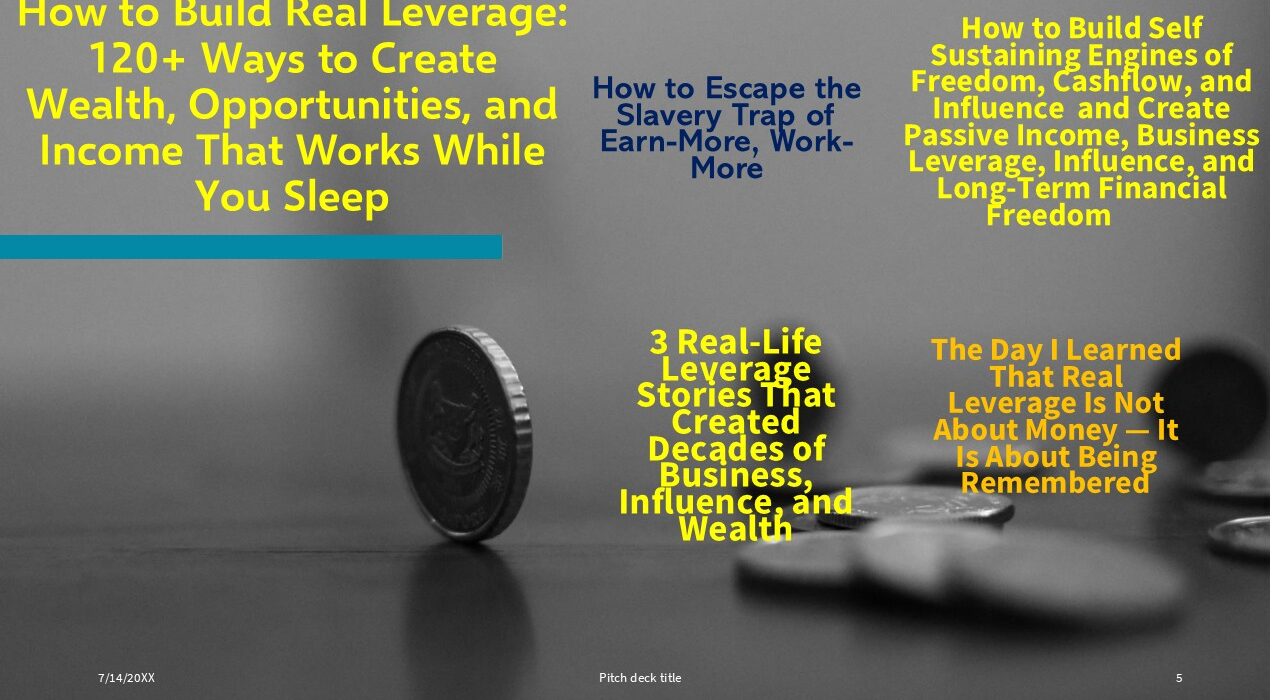
120+ Ways to Create Wealth, Opportunities, and Income That Works While You Sleep to Build Real Leverage
How to Break the Slavery‑Trap and Build Self‑Sustaining Engines of Freedom, Cashflow, and Influence
A Note to the Reader:
Escape the Earn-More, Work-More Trap and Create Passive Income, Business Leverage, Influence, and Long-Term Financial Freedom
This is not a collection of productivity Tips. It is a complete operating system for escaping the “show‑up‑or‑it‑dies” cycle. Every concept, example, and action step comes from decades of real‑world application – including three of my own survival‑to‑abundance stories from 3 Decades of my consulting one especially from the 2008 financial slowdown which impacted me very badly as well, a remote power plant bid against McKinsey, and a 12‑year FMCG partnership.
Read slowly. Implement one pillar at a time.
What Is Real Leverage? The Hidden Formula Behind Passive Income, Wealth, and Freedom
The Complete Definition of Real Leverage and Why Most People Never Build It
Real Leverage is the strategic creation and deployment of assets, systems, relationships, reputation, intellectual property, processes, platforms, or capabilities that generate sustained value, cashflow, opportunities, influence, access, trust, or results independently of your daily presence, continuous personal effort, or constant focus.
Unlike “business school leverage” (debt, OPM, operational efficiency that still demands your daily oversight) or incremental leverage (scaling your personal output while remaining the bottleneck), real leverage breaks the “show‑up‑or‑it‑dies” cycle. It turns your past efforts, relationships, knowledge, or creations into self‑sustaining engines. If stopping your direct involvement causes immediate collapse, it is not real leverage – it is a high‑effort activity disguised as progress (a slavery‑trap).
12 Characteristics of Real Leverage That Create Wealth, Opportunities, and Freedom
|
# |
Characteristic |
What It Means |
|
1 |
Autonomy |
Works when you are not there, not focusing, or even asleep. |
|
2 |
Delayed rewards |
You work today; rewards may arrive months or years later (e.g., 15‑month gap story). |
|
3 |
Non‑linear returns |
One action can create 10x, 100x, or 1000x outcomes – not proportional input/output. |
|
4 |
Compounding |
The value grows over time rather than decays. |
|
5 |
Residual / recurring value |
Income, impact, or influence continues (or accelerates) after the original effort. |
|
6 |
Freedom multiplier |
Frees your time and energy while producing results. |
|
7 |
Durability |
Survives market shifts, personal downturns, illness, or distraction (with minimal maintenance). |
|
8 |
Creates unpredicted opportunities |
Most benefits arrive from directions you could not have planned. |
|
9 |
Optionality |
Produces more choices, freedom, and alternatives – not fewer. |
|
10 |
Reduces dependency on constant effort |
You no longer “earn by the hour”. |
|
11 |
Escalating ceiling |
Unlike incremental improvement (5‑10% yearly), real leverage breaks the ceiling entirely. |
|
12 |
Asymmetric yield |
A concentrated investment of high‑value energy yields permanent, self‑generating returns. |
The 4 Most Powerful Types of Real Leverage: Trust, Reputation, Systems, and Assets
- Trust Leverage – People trust you even when you are absent.
- Reputation Leverage – Your name enters rooms before you do.
- System Leverage – Processes keep producing outcomes without continuous intervention.
- Asset Leverage – Money, IP, technology, and platforms continue producing value.
120+ Powerful Examples of Real Leverage to Build Wealth, Influence, and Long-Term Success
Real-Life Leverage Examples for Career Growth, Relationships, Passive Income, and Leadership Influence
Each example is a distinct, real‑world lever you can build. No duplicates – only unique, actionable forms.
Professional Leverage: 40 Ways to Build a Career That Grows Without Constant Effort
|
# |
Example of Real Leverage |
|
1 |
Proprietary training frameworks, methodologies, or workbooks sold repeatedly. |
|
2 |
Published books or e‑books with royalties and authority (global sales 24/7). |
|
3 |
Recorded masterclasses, video libraries, or evergreen webinars licensed to companies. |
|
4 |
Franchise or licensing model of your service/process (others pay to operate under your brand). |
|
5 |
Personal brand / content engine (blog, YouTube, newsletter) attracting inbound clients. |
|
6 |
Automated onboarding systems for clients (self‑service, no live delivery). |
|
7 |
Referral partner networks that send qualified leads without your pursuit. |
|
8 |
Joint venture agreements with revenue share (partner’s audience buys from you). |
|
9 |
Certification programs you created and others deliver (train‑the‑trainer). |
|
10 |
Software / SaaS products – turning a manual workflow into a monthly subscription tool. |
|
11 |
Speaking career with bureaus booking you (you only show up to speak). |
|
12 |
Alumni networks from your programs (past participants refer new business). |
|
13 |
White‑label solutions for other firms (they sell your IP as theirs). |
|
14 |
Evergreen sales funnels (ad → lead magnet → email sequence → booking link). |
|
15 |
Strategic partnerships with larger players (they distribute your offering). |
|
16 |
Case study portfolio that sells itself (prospects read and decide). |
|
17 |
Membership / community site with recurring fees (paid Slack, Discord, or forum). |
|
18 |
Patent or trademarked processes (legal monopoly on a method). |
|
19 |
Automated reporting / delivery dashboards (clients see results without your update). |
|
20 |
Industry templates (standardized contracts, strategy toolkits) sold on marketplaces. |
|
21 |
AI agents or custom‑trained models handling triage, assessments, or FAQs. |
|
22 |
Ghostwritten content engines (writers produce thought leadership in your voice from old recordings). |
|
23 |
Subscription newsletters (paid, deep‑dive industry analysis scaling to thousands). |
|
24 |
Digital toolkits / resource bundles (e.g., “First 90 Days HR Playbook”) sold via e‑commerce. |
|
25 |
Niche job boards (companies pay to post; runs with minimal moderation). |
|
26 |
Affiliate tech stacks (tracking links for tools you recommend → lifetime recurring commissions). |
|
27 |
Annual research reports / industry benchmarks (corporate sponsors pay for visibility). |
|
28 |
Stock footage / asset libraries (templates, media generating royalties per download). |
|
29 |
Podcast syndication (episodes continue pulling downloads, ads, sponsorships for years). |
|
30 |
An executive team / COO who makes daily decisions without escalating to you. |
|
31 |
Course marketplaces (Udemy, Coursera – platform handles marketing). |
|
32 |
Brand assets (distinct, trademarked brand commanding premium over your individual name). |
|
33 |
Standard Operating Procedures (SOPs) so thorough that a junior team runs the business. |
|
34 |
Assessment or diagnostic tools (free/low‑cost tool grades a company’s strategy and pitches your services automatically). |
|
35 |
White papers & frameworks that peers cite and clients buy as standalone philosophy. |
|
36 |
Automated lead funnels (content‑to‑conversion pipeline booking high‑ticket calls while you sleep). |
|
37 |
Train‑the‑trainer certification (other consultants deliver your program under your brand). |
|
38 |
Evergreen content vaults (searchable database clients pay subscription to access). |
|
39 |
Licensing IP to other organizations (recurring fee for using your training content or software). |
|
40 |
“Signature problem‑solving capability” – a unique, non‑commoditizable skill that attracts inbound offers. |
Relationship Leverage: How Trust, Reputation, and Networks Create Lifelong Opportunities
Personal Relationship Leverage: Build Trust and Support That Lasts a Lifetime
|
# |
Example |
|
1 |
The lifelong “favors bank” – showing up for friends during their dark hours; unspoken safety net. |
|
2 |
Family values intergenerational playbook (children learn financial/emotional principles to manage themselves). |
|
3 |
Shared digital legacy (cloud folder of household systems, contacts, legal plans). |
|
4 |
Unconditional mastermind (close friends meeting quarterly to hold each other accountable). |
|
5 |
Extended‑family childcare network (support flows naturally without transactional tracking). |
|
6 |
Mentoring a prodigy (investing deeply in a young relative who later looks out for your interests). |
|
7 |
Ritualized check‑ins (fixed annual traditions keeping deep bonds alive with zero daily maintenance). |
|
8 |
Character, integrity, reliability, empathy – traits that make people trust you in your absence. |
|
9 |
Marriage / partner as co‑creator of stability and shared financial assets. |
|
10 |
Godparent / mentor roles for the next generation. |
Professional Relationship Leverage: How Career Opportunities Compound Through Trust
|
# |
Example |
|
11 |
The executive sponsor – a senior leader who champions your name in closed‑door rooms when you are absent. |
|
12 |
The gatekeeper alliance – genuine respect for executive assistants of high‑value targets. |
|
13 |
Alumni networks (former company or university) – instant warm introductions. |
|
14 |
Cross‑industry peer group (non‑competing professionals exchanging raw market insights). |
|
15 |
The “fixer” reputation – being the person who connects talent to capital; first phone call for major deals. |
|
16 |
Co‑branded introductions (introducing two high‑level peers who build a venture – you become foundational ally). |
|
17 |
Legacy mentorship ecosystem (former interns now VPs and directors eager to return the favor). |
|
18 |
Trust, credibility, consistency, responsiveness, reputation for delivery, fairness. |
|
19 |
Mentorship (mentees become clients or referrers – your HR Director stories). |
|
20 |
“Giver” reputation in industry circles leading to unsolicited opportunities. |
|
21 |
Board or advisory positions with equity or influence. |
|
22 |
Long‑term client relationships turning into advocates. |
|
23 |
Media contacts cultivated over years. |
|
24 |
Investor networks from past successes. |
|
25 |
Past colleagues who rise in ranks and bring you along. |
Business Relationship Leverage: Strategic Partnerships, Referrals, and Growth Networks
|
# |
Example |
|
26 |
Strategic joint ventures (partner already owns your target audience). |
|
27 |
Channel partners / distributors who sell your service as an add‑on. |
|
28 |
The super‑advocate client (they actively sell your services to their entire network unprompted). |
|
29 |
An advisory board (5‑6 brilliant minds giving strategic direction for minor equity). |
|
30 |
Cooperative marketing alliances (bundling with complementary provider for large tenders). |
|
31 |
Vendor ecosystem loyalty (treating suppliers exceptionally – they prioritize your urgent orders). |
|
32 |
Trusted subcontractor bench (freelancers who deploy immediately to fulfill client needs perfectly). |
|
33 |
Referral partners, strategic alliances, vendor relationships, client goodwill. |
|
34 |
Industry connectors, board relationships, influencer relationships. |
|
35 |
Joint venture agreements with revenue share. |
|
36 |
Supplier / vendor alliances with preferred terms. |
|
37 |
Alumni/peer groups from past projects. |
Social Leverage: Building Communities, Influence, and Long-Term Goodwill
|
# |
Example |
|
38 |
Hub‑node status – hosting a legendary annual dinner; center of the local ecosystem. |
|
39 |
High‑value club memberships (exclusive social/country clubs where deals are done implicitly). |
|
40 |
Philanthropic board positions (serving alongside ultra‑high‑net‑worth individuals). |
|
41 |
Local “open door” policy – supporting community leaders early, creating lasting goodwill. |
|
42 |
Online aligned micro‑communities (private group for top experts to share uncensored advice). |
|
43 |
Unsolicited endorsement – publicly praising a rising star’s work, creating a fierce lifelong ally. |
|
44 |
Safe‑space reputation – completely discrete, making you the ultimate confidant for high‑level leaders. |
|
45 |
Alumni guild chairmanship – leading a chapter, placing you in contact with every successful graduate automatically. |
|
46 |
Hospitality asset – reputation for impeccable hosting; an invitation to your space is never turned down. |
|
47 |
Community leadership (NGOs, clubs) creating visibility and trust. |
|
48 |
Neighborhood or hobby‑based networks. |
|
49 |
Online communities you moderate. |
|
50 |
School/college old‑boy networks. |
Financial Leverage: 40+ Ways to Build Passive Income and Financial Freedom
|
# |
Example of Real Leverage |
|
1 |
Dividend‑yielding blue chips (quarterly cash flow irrespective of market volatility). |
|
2 |
Real estate syndication (limited partner – firm manages property, mails you checks). |
|
3 |
Peer‑to‑peer lending portfolios (automated micro‑loans generating monthly interest). |
|
4 |
Triple‑net lease (NNN) properties (tenant pays taxes, insurance, maintenance). |
|
5 |
Real Estate Investment Trusts (REITs) – liquid, pay 90% of taxable income as dividends. |
|
6 |
High‑yield corporate bonds (consistent coupon payments). |
|
7 |
Automated index fund compounding (systematic monthly deployment, dollar‑cost averaging). |
|
8 |
Silent business equity (non‑voting share of a profitable business run by a manager). |
|
9 |
Royalties from creative IP (books, music, photography licensing). |
|
10 |
Mineral, water, or oil rights (resource companies pay leasing royalties). |
|
11 |
Venture capital LP positions (professional managers screen, invest, return exits). |
|
12 |
Franchise silent ownership (capital to experienced operator – split net margins). |
|
13 |
Automated crypto staking (lock tokens in validated protocols for yield). |
|
14 |
Tax liens investing (buy municipal liens paying legally mandated high interest). |
|
15 |
Annuities (guaranteed steady income after lump sum). |
|
16 |
ATM / vending machine routes (owned, with outsourced restocking/maintenance). |
|
17 |
Farmland leasing (own land – lease to corporate farmers for crop share or fixed rent). |
|
18 |
Equipment leasing (heavy machinery or medical equipment leased to industrial companies). |
|
19 |
Private equity secondary markets (discounted pre‑IPO shares from early employees). |
|
20 |
Storage unit facilities (unstaffed, keypad access, automated billing, remote security). |
|
21 |
Intellectual patent auctions (acquire defensive patents – collect licensing fees). |
|
22 |
Litigation funding (provide capital for commercial lawsuits – percentage of payout). |
|
23 |
Master Limited Partnerships (MLPs) – high‑yield energy infrastructure. |
|
24 |
Automated Forex grid bots (algorithmic arbitrage across currency fluctuations). |
|
25 |
Revenue‑share loans (growth capital to SaaS – 2‑4% monthly top‑line revenue until cap). |
|
26 |
Precious metals leasing (deposit gold/silver – industrial users pay interest in physical metal). |
|
27 |
Covered calls writing (automated algorithms write out‑of‑money options for monthly premiums). |
|
28 |
Niche website portfolios (display ad or affiliate revenue run by freelance editors). |
|
29 |
Renewable energy infrastructure bonds (solar/wind grids with government‑backed PPAs). |
|
30 |
Trademark royalty structuring (IP holding company + operating company – profits as low‑tax royalties). |
|
31 |
Dividend portfolios (reinvested). |
|
32 |
Rental real estate (residential/commercial with property manager). |
|
33 |
Royalty streams (books, music, IP). |
|
34 |
Index funds / ETFs for compounding. |
|
35 |
Business equity with professional managers. |
|
36 |
Bonds ladders. |
|
37 |
Content monetization (ads, affiliates). |
|
38 |
Subscription box models (fulfilled by 3PL). |
|
39 |
Parking lots. |
|
40 |
Solar/wind farm shares. |
|
41 |
Long‑term organizational contracts (e.g., 60% annual revenue from one conglomerate for 10 years). |
|
42 |
Recurring training budgets unlocked via relationships. |
Influence Without Authority: How to Build Credibility, Thought Leadership, and Industry Influence
|
# |
Example of Real Leverage |
|
1 |
Open‑source standard setting – free framework the entire industry adopts; you become de facto rule maker. |
|
2 |
Published case studies (exhaustive analyses peers copy your methodology). |
|
3 |
The clear‑thinking manifesto (viral post that names an industry frustration – your vocabulary becomes standard). |
|
4 |
Curating the definitive newsletter (weekly best insights – you become gatekeeper of “important”). |
|
5 |
Creating an industry award (annual award – you judge and rank peers). |
|
6 |
Hosting the elite roundtable (closed‑door dinners for industry leaders – you are gravitational center). |
|
7 |
The definitive benchmark dataset (rare industry data every executive relies on for board decks). |
|
8 |
Writing the industry glossary (standardizing vocabulary for a new niche). |
|
9 |
High‑traffic resource repository (central library of free templates newcomers use to learn). |
|
10 |
The “unbiased reviewer” persona – trusted objective voice reviewing tools without corporate bribes. |
|
11 |
Foresight research papers (annual trend predictions that prove accurate – you become oracle). |
|
12 |
Public GitHub / template repositories (code or workflows developers import globally – design defaults). |
|
13 |
Pro‑bono advisory for key ecosystem players (brief, brilliant unbilled guidance – rising stars echo your views). |
|
14 |
The “last line of defense” reputation – called only when a crisis has defeated every other consultant. |
|
15 |
Memetic concepts (catchphrases or mental models like “slavery‑trap” that peers repeat in meetings). |
|
16 |
Authoring white‑paper blueprints (structuring how regulatory challenges should be met before legislation). |
|
17 |
The concierge introduction (constantly matching talent with capital without fee – immense social obligation). |
|
18 |
Keynote speech recordings (viral, timeless TEDx or summit talk people share to inspire teams). |
|
19 |
Systemic constructive critique (deeply respectful breakdowns of why major strategies failed – earns broad respect). |
|
20 |
The unshakable calm persona (total equanimity during industry panics – others look to you). |
|
21 |
Open office hours (1 hour/week of free consultation – creates army of grassroots supporters). |
|
22 |
The “voice of the employee” (articulating workplace realities so leadership relies on your notes to gauge morale). |
|
23 |
High‑value infographics (complex supply‑chain maps executives print and hang on walls). |
|
24 |
Curating mastermind circles (putting top minds into self‑managed pods – ongoing loyalty for the connection). |
|
25 |
The uncompromising ethical standard (standing firm against shady industry shortcut – you become ethical north star). |
|
26 |
Authoritative guest columnist (writing for HBR, Forbes – sets corporate agendas). |
|
27 |
Creating an open standard API (software connection point competing companies use to talk). |
|
28 |
Slack / Discord hub founder (main chat group where professionals talk shop daily). |
|
29 |
The eloquent storyteller persona (translating dry data into emotionally resonant narratives). |
|
30 |
The “un‑bought” status (openly turning down lucrative deals conflicting with principles – your approval has absolute weight). |
|
31 |
Thought leadership content shaping industry narratives. |
|
32 |
Board seats or advisory roles. |
|
33 |
Media appearances and bylines. |
|
34 |
University guest lectures turning into consulting. |
|
35 |
Social media authority in a niche. |
|
36 |
Endorsements from influencers. |
|
37 |
Community building (forums, groups). |
|
38 |
Crisis reputation (go‑to expert). |
|
39 |
Data / research reports you publish. |
|
40 |
Awards and recognitions. |
|
41 |
Books positioning you as expert. |
|
42 |
Network effects from introductions. |
|
43 |
Your free sports training → 15‑month delayed high‑value contract (example). |
|
44 |
Helping HR leaders establish themselves → 10‑12 years of business (example). |
How to Build, Grow, and Sustain Real Leverage for Wealth, Influence, and Freedom
A Fully Implementable Action Plan for Each Pillar
How to Build Professional Leverage and Create Income Beyond Your Time
BUILD
- Shift from customized one‑off consulting to standardizing your intellectual property. Document your exact frameworks, build automated toolkits, create modular delivery structures. Stop selling hours; sell access to your predefined systems.
- Invest in creation during low‑revenue periods (like 2008 for me). Create white papers, online courses, assessment tools, SOPs.
- Publish insights visibly (LinkedIn, blog, industry journals). Solve difficult problems and document the solution.
NURTURE
- Continuously gather real‑world feedback to refine your framework. Update core assets once or twice a year based on changing environments – no need to remake the entire foundation.
- Stay visible: keep learning, speak at events, release case studies.
- Automate delivery: evergreen webinars, self‑scheduling links, email sequences.
SUSTAIN
- Outsource delivery entirely. Train qualified facilitators, license your methodology to corporate HR departments, or use software to scale your insights. Your role shifts from “The Performer” to “The Author”.
- Protect IP with trademarks/contracts. Build feedback loops for continuous improvement.
- Create “successor” systems so others can deliver without your presence. Build assets, not activities.
How to Build Relationship Capital That Creates Opportunities for Decades
BUILD
- Practice asymmetric generosity. Provide high‑impact help when people are down or least expect it, without demanding immediate reciprocity (my free training for Sports Authority, tool‑sharing with HR leaders). Focus intensely on structural “gatekeepers” and rising stars before they reach peak influence.
- Give value before being asked. Invest in people – mentor, introduce, celebrate.
- Create “relationship systems”: schedule recurring check‑ins (every 3 months) using a CRM or calendar reminder. Automate birthday / check‑in messages.
NURTURE
- Keep in touch systematically, not transactionally. Share helpful articles, celebrate their wins publicly, make valuable introductions with zero strings attached. Stay top‑of‑mind without seeming needy.
- Maintain goodwill: never exploit trust. Be consistently dependable.
- Use a “leverage ledger” – note what you have contributed (not what others owe you). In a downturn, that ledger pays out.
SUSTAIN
- Let the network connect with itself. Create self‑managing masterminds or regular small‑group dinners where your allies network with each other. You become the foundation – your leverage persists with minimal maintenance.
- Diversify across many relationships. Convert important ones into formal structures (advisory agreements, referral contracts). Let results compound reputation.
- Your stories show 15‑month or longer “dormant” periods are fine. Do not panic if leverage seems inactive – it is often composting.
How to Build Financial Leverage and Multiple Streams of Passive Income
BUILD
- Aggressively divert active income away from lifestyle inflation and toward buying cash‑generating assets. Prioritize investments where professional managers run operations (REITs, commercial syndications, private equity, silent business stakes).
- Start small: courses, rental real estate, index funds. Create multiple streams.
- Convert income into assets (dividend stocks, bonds, royalties). Create recurring revenue.
NURTURE
- Implement an automated dollar‑cost averaging engine. Set up automatic monthly transfers into defensive, compounding index funds or asset accounts – wealth accumulates independent of your emotions or free time.
- Reinvest earnings (dividend reinvestment, property managers). Review portfolios quarterly.
- Diversify carefully – do not put all leverage in one asset class.
SUSTAIN
- Reinvest your asset payouts back into your compounding portfolio to accelerate growth. Form an asset holding company or trust to optimize tax efficiency and safeguard wealth across generations.
- Avoid lifestyle inflation. Let compounding work. Preserve capital.
- Turn business revenue into assets (my 60% from one client became stability and then further investments).
How to Build Influence Without Authority and Become a Trusted Industry Voice
BUILD
- Create definitive, evergreen content assets. Publish foundational frameworks, host benchmark data studies, write insightful manifestos that solve major recurring industry headaches. Solve visible problems publicly (free sessions, white papers, helping rising leaders).
- Become useful, trustworthy, and visible. Share your stories as hooks (my three stories).
- Document your wins quietly – keep a “brag file” of emails where someone thanked you or adopted your suggestion.
NURTURE
- Consistently stand up for your core ideas across social channels and industry platforms. Defend your frameworks with real case studies and data – turn your personal vocabulary into the sector’s standard terminology.
- Consistent but low‑effort content (newsletter, LinkedIn posts). Collaborate and amplify others.
- Teach others to use your tools. When 10 people use your template, your influence scales 10x without you speaking.
SUSTAIN
- Step into the role of elder statesman or objective observer. Lean into public commentary, judge key industry awards, mentor top‑tier professionals. Let your body of work do the heavy lifting.
- Protect your reputation fiercely. Create “magnet” assets (books, talks, case studies) that work 24/7.
- Measure success by inbound opportunities. Rotate your visibility quarterly (a memo, a presentation, a lunch with a key stakeholder) – out of sight can become out of mind, even with leverage.
3 Real-Life Leverage Stories That Created Decades of Business, Influence, and Wealth
The Day I Learned That Real Leverage Is Not About Money — It Is About Being Remembered
Three Unexpected Decisions That Generated More Than 20 Years of Business, Influence, and Opportunity
These stories are not anecdotes – they are case studies of real leverage in action. Use them exactly as written or remix them for your own brand.
STORY 1 – How One Free Assignment Generated 10 Years of Corporate Revenue
Around 18 years ago, during the depths of the 2008 financial crisis, life was not particularly kind to me.
Professionally, work was scarce.
Financially, survival was the priority.
I was eating less than I wanted, wearing the same clothes I had owned for years, and travelling almost exclusively by public transport because every rupee mattered.
One day, I received a call from a gentleman whom I will call Mr. X.
He introduced himself as someone responsible for a major initiative at the Sports Authority of India and asked whether I would be willing to conduct motivational sessions for athletes and sports professionals.
Then came the catch.
“There is no budget.”
Under normal circumstances, that would have been the end of the conversation.
Ironically, I probably needed the money more than anyone else at that point in my life.
Yet something told me to say yes.
I agreed to conduct the sessions completely free of charge. I did not even ask for travel reimbursement, despite the fact that the transportation cost itself was difficult for me to afford.
For several weeks, I conducted those sessions regularly.
I had no revenue-generating work at that time, and there was very little direct interaction with Mr. X during the program. However, I knew that participant feedback was reaching him.
Eventually, the assignment ended.
Life moved on.
I returned to the daily struggle of earning a living and forgot about the entire episode.
Fifteen months later, I received a call from someone identifying herself as the Personal Assistant to the HR Director of one of India’s largest business conglomerates, a company that ranked among the top five in the country at that time.
She informed me that the HR Director wanted to meet me.
When I arrived at his office, I was stunned.
The HR Director was Mr. X.
He had moved from the Sports Authority into a major corporate leadership role.
After a brief conversation, he asked whether I could conduct a two-hour leadership session for his Vice Presidents and Presidents.
Then he added something familiar.
“I don’t have a confirmed budget yet.”
I smiled and said yes.
That two-hour session eventually became a seven-hour session conducted over a weekend.
What happened afterward completely changed the trajectory of my business.
For almost the next ten years, that organization generated close to 60% of my annual revenue.
The original leverage was not the free training.
The leverage was the trust created through the free training.
The training was forgotten.
The trust was remembered.
STORY 2 – How Relationship Leverage Helped an Independent Consultant Compete with McKinsey
The Mentor, the Remote Power Plant, and the Room Full of Giants
Years ago, I frequently supported a very senior HR leader.
I would share practical tools, ideas, frameworks, and occasionally help him design executive-level learning interventions for Boards and CEOs.
Over time, that professional relationship evolved into a mentorship relationship.
One day, I received an unexpected call.
He asked me to reach Tamnar, a remote industrial location, the very next day.
A large power plant was facing an attrition crisis approaching 60%, and a consulting presentation was being conducted as part of the evaluation process.
The challenge began immediately.
The nearest airport was Raipur, and the last flight had already departed.
After considerable effort, I stitched together an exhausting combination of train journeys, flights, and road travel to reach the venue on time.
When I entered the presentation room, my confidence took an immediate hit.
Several major consulting firms were present.
Among them were McKinsey, Mercer & EY to name a Few.
I was the only independent consultant in the room.
No global brand.
No army of analysts.
No polished consulting machinery.
Just me.
However, I possessed something many of the larger firms did not.
I had extensive ground-level experience dealing with the exact kinds of workforce and operational challenges the client was facing.
While the larger firms brought world-class frameworks, I brought lived reality.
In the end, the majority of the engagement naturally went to the larger consulting firms.
But I still secured a meaningful piece of the assignment.
Looking back, I realize something important.
My expertise helped me win.
But my leverage got me into the room.
Without the trust and credibility built through years of helping my mentor, I would never have received the invitation in the first place.
Sometimes the greatest leverage is not winning the deal.
It is being invited to compete for the deal.
STORY 3 – The HR Director Who Became a Twelve-Year Business Relationship
Another defining lesson came from a newly appointed HR Director in a large FMCG multinational organization.
Although he had reached a highly senior position, he was still navigating the challenges that accompany a major leadership transition.
He had responsibility.
He had expectations.
But he lacked exposure to some of the newer, more effective HR strategies and interventions that were emerging at the time.
I began supporting him.
Initially, the support involved sharing ideas, frameworks, practical tools, and strategic perspectives that could help him establish credibility and create a visible impact within the organization.
My focus was never on selling.
My focus was on helping him succeed.
As he became increasingly successful and influential, our professional relationship deepened.
The outcome was extraordinary.
What started as strategic support evolved into nearly twelve years of consistent business from that organization.
The lesson was profound.
Most professionals try to become successful themselves.
Real leverage often comes from helping other capable people become successful first.
When people associate part of their success with your contribution, they rarely forget it.
That association becomes one of the most durable forms of leverage a professional can build.
The Ultimate Formula for Building Wealth, Influence, Passive Income, and Freedom
Notice something remarkable. In all three stories, the rewards arrived months or years after the original effort. The leverage was never the activity itself. The leverage was the trust, credibility, goodwill, expertise, and reputation created by the activity.
CONCLUSION – THE ULTIMATE FORMULA OF REAL LEVERAGE
Most people live by:
Effort → Income (When effort stops, income stops.)
Real leverage works differently:
Value → Trust → Reputation → Relationships → Opportunities → Assets → Freedom
My three stories demonstrate this perfectly. I did not receive the rewards from the work itself. I received the rewards from the trust, credibility, goodwill, and reputation created by the work.
That is why the deepest form of leverage is not money. It is:
Being remembered positively by capable people long after you have forgotten the help you provided them.
This single form of leverage has created more careers, businesses, partnerships, fortunes, and life‑changing opportunities than most financial strategies ever will.
Your next step: Pick one pillar from Section 3. Take one action this week to build or nurture one piece of real leverage. Then another. Then another. In 12 months, you will not recognize the freedom you have built.
Now go plant seeds that grow while you sleep.
“If your income stops when you stop showing up, you may have a career. But you do not yet have leverage.”
Subhashis Banerji [Author]
Leadership assessor, strategist, and writer. I help professionals and organizations make smarter decisions by learning to read patterns, not promises.
 Read all my articles here:
 https://successunlimited-mantra.net/ & https://successunlimited-mantra.com/index.php/blog PLUS on https://relationshipandhappiness.com/
 Connect with me on LinkedIn: https://www.linkedin.com/in/subhashis-banerji-21b1418/



– Please read our Comment Policy