

How to Beat Competitors Without Attacking Them: The Psychology of Becoming the Obvious Choice
- BY Subhashis Banerji
- July 15, 2026
- 0 Comments
- 572 Views
Reading Time: 6 minutes
Contents
hide
2
How to become the 1st Choice for your Customers, and in Job-Interviews
How to Beat Competitors Without Attacking Them: The Psychology of Becoming the Obvious Choice
How to become the 1st Choice for your Customers, and in Job-Interviews
Most people believe the best way to beat competitors is to expose their weaknesses.
The most successful organizations and professionals know the opposite is often true.
Instead of attacking competitors, they acknowledge their strengths, respect their achievements, and then position themselves as the more complete solution.
One of the most brilliant examples comes from Audi.
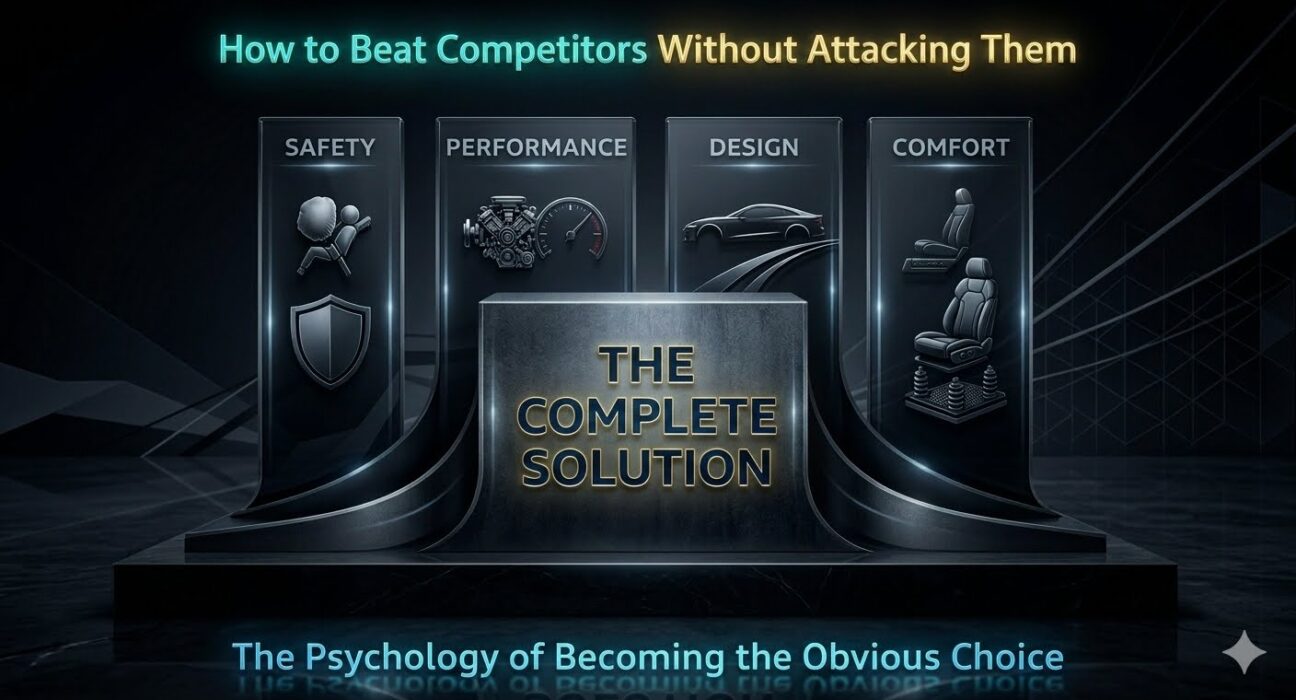
In one of the famous advertisements, Audi displayed the keys of Volvo, Mercedes-Benz, BMW, and Alfa Romeo while praising each brand for a specific strength.
Volvo represented safety.
Mercedes represented comfort.
BMW represented performance.
Alfa Romeo represented design.
As the keys lined up, their keychains formed the iconic Audi rings.
The message was subtle but powerful:
“Those brands excel in one area. Audi combines all those strengths in one vehicle.”
Audi did not diminish competitors.
Audi elevated itself.
This article explores the psychology, strategies, and practical techniques that organizations, professionals, salespeople, entrepreneurs, and job seekers can use to become the preferred choice—without attacking anyone.
The Core Psychology Behind Winning Without Fighting
At the heart of superior positioning lies a simple principle:
Never Win by Diminishing Others. Win by Expanding the Frame.
Weak positioning says:
“They are bad. We are better.”
Powerful positioning says:
“They are excellent at X. We provide X plus Y plus Z.”
The difference may appear subtle, but psychologically it is enormous.
When people feel their previous choices, beliefs, or preferences are being attacked, they instinctively defend them.
Psychologists call this the Psychological Reactance Theory, introduced by Jack Brehm.
The moment customers feel pressured to abandon something they like, resistance increases.
But when you acknowledge their wisdom and validate their previous choices, resistance disappears.
Instead of arguing with the customer, you build upon their existing beliefs.
This is exactly why Audi’s strategy worked.
The Audi Formula: Respect, Recognize, and Reframe
Whether you are a business leader, consultant, salesperson, entrepreneur, or job seeker, the same framework applies.
Acknowledge competitor strengths.
Clearly identify what they do well.
Show how your solution delivers broader or more complete value.
For example:
“Many consulting firms excel at psychometric assessments. Others are known for leadership development. Our approach combines assessment, coaching, succession planning, leadership development, and measurable business outcomes into one integrated framework.”
The conversation instantly shifts from comparison to value creation.
How to Position Yourself as Superior Without Criticizing Competitors
The strongest brands rarely fight on existing terms.
Instead, they redefine the conversation.
Create a New Category
Red Bull never tried to become a better cola.
It created the energy drink category.
Tesla never positioned itself as another car manufacturer.
It positioned itself as the future of mobility.
Apple never sold phones.
It sold a revolutionary user experience.
The lesson is simple:
Do not compete harder.
Compete differently.
Own a Single Powerful Word
The most successful brands dominate a specific mental association.
Volvo owns Safety.
FedEx owns Reliability.
Google owns Search.
Amazon owns Convenience.
Tesla owns Innovation.
The question every organization should ask is:
“What single word do we want customers to associate with us?”
Once identified, every communication should reinforce that association.
Become the Complete Solution
Customers rarely want isolated benefits.
They want integrated outcomes.
Instead of saying:
“We are better than our competitors.”
Say:
“Our competitors are excellent in specific areas. We bring those strengths together while adding capabilities that solve the broader problem.”
This immediately creates a perception of completeness.
How to Beat Competitors in Marketing
Marketing success is not about louder promotion.
It is about owning a unique position in the customer’s mind.
Educate More Than You Advertise
Modern customers trust teachers more than marketers.
Organizations that educate build authority.
Organizations that merely promote create skepticism.
Instead of asking:
“How do we sell more?”
Ask:
“How do we help customers make smarter decisions?”
The answer often becomes your strongest marketing strategy.
Challenge Industry Assumptions
Some of the most successful brands attacked outdated conventions rather than competitors.
Canva never attacked Adobe.
Instead, Canva asked:
“Why should design be difficult?”
Southwest Airlines didn’t attack other airlines.
It simplified travel.
Dollar Shave Club didn’t attack Gillette directly.
It challenged unnecessary complexity.
Customers often rally behind organizations that challenge the status quo.
Sell Emotions Before Features
People justify decisions logically.
They make decisions emotionally.
Nike rarely talks about shoe specifications.
Nike sells ambition, determination, and achievement.
The strongest brands create emotional meaning around practical products.
How to Outperform Other Candidates in Job Interviews
Most candidates focus on impressing interviewers.
The best candidates focus on reducing risk.
Hiring managers are silently asking four questions:
- Can this person do the job?
- Can we trust them?
- Will they fit into our culture?
- Will they create measurable value?
Answer these questions repeatedly throughout the interview.
Use Evidence Instead of Claims
Weak Statement:
“I am a strong leader.”
Strong Statement:
“I led a cross-functional team of 35 people, improved productivity by 22%, and reduced project delays by 30%.”
Evidence beats opinion every time.
Respect Other Candidates
If asked what differentiates you from others, avoid comparisons.
Instead say:
“Other candidates may bring exceptional technical expertise. My strength lies in combining technical capability with strategic leadership, stakeholder management, and execution.”
The Audi principle works even in interviews.
Bring Something Others Don’t
A portfolio.
A case study.
A 30-60-90-day plan.
An industry insight.
A framework.
These tangible assets make you difficult to compare with other candidates.
How to Beat Competitors While Selling Products and Services
The best salespeople do not behave like salespeople.
They behave like trusted advisors.
Diagnose Before You Prescribe
Doctors ask questions before recommending treatment.
Top sales professionals do the same.
Understand:
- The situation
- The problem
- The consequences
- The desired outcome
Only then should you recommend a solution.
Focus on the Cost of Inaction
Most buyers focus on the price of change.
Help them understand the cost of staying the same.
The question becomes:
“What is this problem costing you every month, every quarter, or every year?”
This shifts attention from price to value.
Give Value Before Asking for Business
Provide:
- Insights
- Audits
- Assessments
- Recommendations
- Useful information
People naturally trust those who help before they sell.
How to Become the Most Promising Choice Mentally
Many people enter meetings hoping to be chosen.
High performers enter meetings expecting to create value.
That difference changes everything.
Replace Anxiety with Excitement
Research by Harvard psychologist Alison Wood Brooks found that reframing anxiety as excitement improves performance.
Instead of saying:
“I am nervous.”
Say:
“I am excited.”
The physiological state is nearly identical.
The interpretation changes the outcome.
Focus on Being Useful
One of the most powerful mindset shifts is:
Stop trying to be impressive. Start trying to be useful.
People who create value naturally become impressive.
Build Confidence from Evidence
Before important meetings, presentations, interviews, or sales discussions, remind yourself of three previous successes.
Confidence built on evidence is stronger than confidence built on hope.
The Secret of Exceeding Customer Expectations
The easiest way to disappoint customers is to overpromise.
The easiest way to delight them is to create positive surprises.
Master the Expectation Gap
A simple formula explains customer satisfaction:
Satisfaction = Experience − Expectations
If expectations are unrealistic, disappointment becomes inevitable.
If expectations are realistic and delivery exceeds them, delight emerges naturally.
Promise 80%. Deliver 110%.
If a project can be completed in five days, commit to seven.
Deliver in five.
The customer experiences a pleasant surprise.
This principle applies across industries.
Deliver Unexpected Value
Promise:
- Assessment Report
- Feedback Session
Deliver:
- Assessment Report
- Feedback Session
- Development Roadmap
- Learning Resources
- Coaching Recommendations
- Follow-Up Support
Unexpected value creates memorable experiences.
Turn Problems into Loyalty Opportunities
Organizations such as Ritz-Carlton and Zappos are famous not because mistakes never happen.
They are famous because of how exceptionally they recover when mistakes occur.
A thoughtful recovery often creates stronger loyalty than a flawless transaction.
The Ultimate Competitive Advantage
The most successful organizations, professionals, consultants, salespeople, and leaders follow a surprisingly simple formula:
↓
↓
Position Yourself as More Complete
↓
↓
↓
↓
↓
↓
↓
Audi’s famous advertisement demonstrated a timeless truth.
The most effective way to win is not by making competitors look smaller.
The most effective way to win is by making your value proposition look bigger.
In a world full of criticism, comparison, and negativity, the organizations and individuals who succeed most consistently are those who practice a different philosophy:
Respect what others do well. Then show why your solution delivers even more.
That is not merely good marketing.
It is one of the most powerful competitive advantages in business and life.
The Final Word
“The Psychology of Becoming the Obvious Choice.
“The strongest competitors are rarely the loudest.
They are the ones who understand a timeless truth:
Respect creates trust.
Trust creates preference.
Preference creates loyalty.
And loyalty creates sustainable success.”
Subhashis Banerji [Author]
Leadership assessor, strategist, and writer. I help professionals and organizations make smarter decisions by learning to read patterns, not promises.
📘 Read all my articles here:
👉 https://successunlimited-mantra.net/ & https://successunlimited-mantra.com/index.php/blog PLUS on https://relationshipandhappiness.com/
💼 Connect with me on LinkedIn: https://www.linkedin.com/in/subhashis-banerji-21b1418/
Related posts:
- The Ultimate Real Leverage Blueprint: Build Wealth, Influence, Passive Income, and Freedom That Lasts
- 90° Career Growth Playbook: How to Become a Highly Sought-After, Respected & High-Impact Professional
- The Ultimate Problem-Solving Blueprint: Integrating Blue Sky Thinking, Blue Ocean Strategy, Design Thinking, Systems Thinking & Lateral Thinking for Business, Career and Personal Success
- Your Current Position Is Not Your Final Destination: How to Reinvent Your Life, Career, Business and Relationships at Any Age



– Please read our Comment Policy