


The Ultimate Problem-Solving Blueprint: Integrating Blue Sky Thinking, Blue Ocean Strategy, Design Thinking, Systems Thinking & Lateral Thinking for Business, Career and Personal Success
Reading Time: 11 minutes
Contents
hide
1
The Ultimate Problem-Solving Blueprint: Integrating Blue Sky Thinking, Blue Ocean Strategy, Design Thinking, Systems Thinking & Lateral Thinking for Business, Career and Personal Success
The Ultimate Problem-Solving Blueprint: Integrating Blue Sky Thinking, Blue Ocean Strategy, Design Thinking, Systems Thinking & Lateral Thinking for Business, Career and Personal Success
A comprehensive framework that integrates Blue Sky Thinking, Blue Ocean Strategy, Design Thinking, Systems Thinking, Lateral Thinking, Divergent Thinking and Convergent Thinking into a single methodology for solving complex business, career and life challenges.
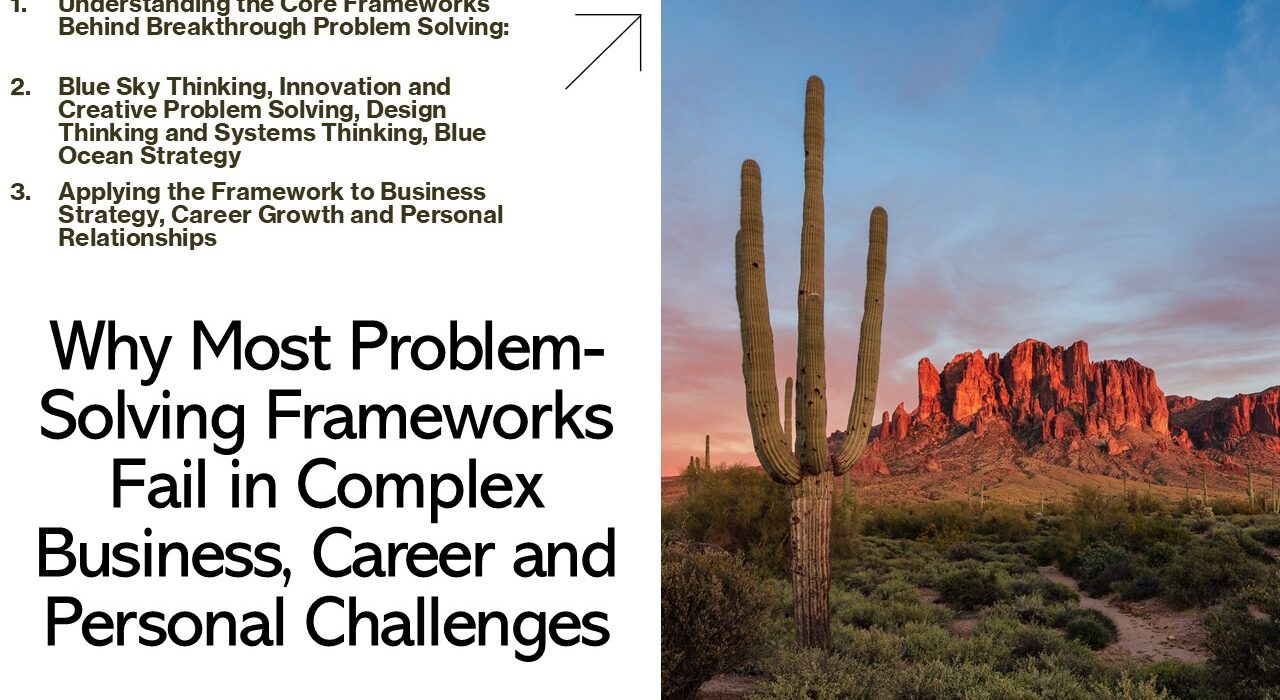
INTRODUCTION: Why Most Problem-Solving Frameworks Fail in Complex Business, Career and Personal Challenges
You are smarter than your circumstances.
You have read the books. You have attended the workshops. You know that Blue Sky Thinking frees the mind, Design Thinking humanizes the solution, and Systems Thinking reveals the hidden strings. You have heard that Blue Ocean Strategy makes competition irrelevant.
Yet, despite possessing all these weapons, why do your biggest challenges still feel like an unsolvable knot?
Because the world gave you fragments, but your problems are whole.
In one corner, you have wildly creative people who generate brilliant possibilities—but cannot execute their way out of a paper bag. In the other corner, you have rigorous strategists who optimize existing systems—but cannot see the revolutionary opportunity staring them in the face. You have been forced to choose: “Am I a dreamer or a doer? An empath or an analyst?”
This false choice is the Great Fragmentation Trap. It is why businesses launch innovative products that fail to gain traction. It is why brilliant professionals plateau in their careers. It is why relationships grow stale despite genuine love. You are fighting complex, interconnected, multi-dimensional problems with single-dimensional, siloed tools.
One insight that emerged while exploring these frameworks is that breakthrough problem solving rarely comes from a single methodology. The most powerful solutions often arise when multiple modes of thinking are combined.
Systems Thinking helps us understand reality, Design Thinking uncovers human needs, Blue Sky Thinking expands possibilities, Lateral Thinking challenges assumptions, Convergent Thinking identifies viable options, and Blue Ocean Strategy transforms those insights into uncontested value creation.
Together, they form a powerful pathway from understanding a problem to creating opportunities that others fail to see.
This document ends that fragmentation permanently.
What You Are About to Receive (The Unparalleled Value Proposition)
You are not holding another generic theory. You are not reading a recycled blog post. You are about to download a fully operational, battle-tested meta-architecture that seamlessly synthesizes seven distinct, world-class disciplines into a single, elegantly simple, 6-phase workflow:
- Blue Sky Thinking (unconstrained possibility)
- Blue Ocean Strategy (uncontested value creation)
- Design Thinking (human-centric empathy & prototyping)
- Systems Thinking (ecosystem mapping & leverage)
- Lateral Thinking (logic-breaking pattern shifts)
- Divergent Thinking (explosion of quantity)
- Convergent Thinking (analytical precision)
Why is this synthesis unparalleled?
Because until now, these methodologies lived in isolated academic silos. Consultants charged millions to apply just one of them. You had to read 20+ dense books and spend years connecting the dots.
I have done that brutal, painstaking work for you.
Within this single document, I have:
- Mined the deep structural mechanics of each discipline—not just the buzzwords, but the actual tools (Causal Loops, Stocks & Flows, How Might We statements, the Double Diamond, Abductive Reasoning, Donella Meadows’ Leverage Points, the ERRC Grid, and the Strategy Canvas).
- Woven them into a MECE (Mutually Exclusive, Collectively Exhaustive) architecture where every phase flows logically into the next—no overlap, no gaps, no contradictions.
- Operationalized them across three distinct life domains—Business, Profession/Career, and Personal/Relationships—so you can apply the same powerful engine to your boardroom strategy, your career trajectory, and your most intimate human connections.
This is not a “feel-good” inspiration piece. This is a surgical instrument.
- For the Executive: Stop wasting millions on innovation theatre. You will learn how to generate radical ideas and immediately test them against systemic feasibility and market viability—before you burn a single dollar.
- For the Professional: Stop being a replaceable cog. You will learn how to map your professional ecosystem, identify high-leverage paradigm shifts, and carve out a Blue Ocean career niche where you face zero direct competition.
- For the Seeker: Stop repeating the same relational patterns. You will learn how to map hidden feedback loops, break destructive logic with lateral provocations, and reconstruct personal blueprints that create uncontested space for joy, trust, and shared mission.
Here is the master key: You will stop asking, “How do I beat the competition?” and start asking, “What valuable, uncontested space can I create?” You will stop bouncing between chaos (too much creativity) and rigidity (too much analysis) and start operating in a state of Dynamic Harmony—where imagination fuels strategy, and strategy grounds imagination.
Why You Cannot Afford to Glance at This and Walk Away
The stakes are too high for half-measures.
The business landscape is bloodier than ever (Red Oceans). The career marketplace is being disrupted by AI and global talent. Personal connections are fraying under digital fragmentation. The old playbooks—the “either/or” trade-offs—are failing faster than ever.
This is your lifeboat, your compass, and your engine, all in one.
I invite you to read this slowly. Bookmark it. Print it. Treat it as the operating system upgrade your mind has been desperately waiting for. If you apply even 50% of what is contained here, you will never view a problem—or an opportunity—the same way again.
Let us begin your journey from the bloody waters of competition to the infinite, vast, and powerful potential of your own Infinite Ocean.
Now, turn the page and step into Phase 1.
PART 1: Understanding the Core Frameworks Behind Breakthrough Problem Solving
Before building the bridge, we anchor ourselves in the two polar forces: Unconstrained Imagination (Blue Sky) and Structured Execution (Blue Ocean Strategy).
Blue Sky Thinking Explained: The Essential Elements of Unconstrained Innovation and Creative Problem Solving
Blue Sky Thinking is unrestricted brainstorming. Its goal is to bypass cognitive biases, traditional boundaries, and practical limitations to uncover hidden potentials.
- Absolute Freedom from Constraints: Deliberately ignoring budgets, technology, laws, logistics, and current capabilities during the initial phase.
- Suspension of Judgment: Enforcing a strict “no-criticism” zone where ideas are welcomed without immediate vetting or reality-checking.
- Radical Questioning & Assumption Breaking: Challenging industry norms, social conventions, personal beliefs, and core premises using “What if?” and “Why not?”.
- Future-Back Thinking (North Star Focus): Imagining the ideal, ultimate outcome first, then working backward to the present, rather than pushing forward incrementally.
- Cognitive Playfulness & Cross-Pollination: Drawing unexpected connections between completely unrelated fields, industries, or concepts (e.g., borrowing biological models for business logistics).
- Idea Cascade & Quantity Focus: Generating 50-100 ideas where one sparks another in a non-linear flow. Quantity and originality matter more than immediate viability.
- Diverse Participation: Involving people from varied backgrounds, ages, and experiences to maximize diversity of thought.
- Key Techniques: Reverse assumptions, SCAMPER (Substitute, Combine, Adapt, Modify, Put to another use, Eliminate, Reverse), provocative questions, metaphors, and simulations.
Blue Ocean Strategy Explained: Creating Uncontested Market Space Through Value Innovation
Blue Ocean Strategy translates radical ideas into viable, uncontested spaces where competition becomes irrelevant through the simultaneous pursuit of differentiation and low cost.
- Value Innovation: The “and-and” core—breaking the traditional value-cost trade-off to pursue differentiation AND low cost simultaneously.
- The Strategy Canvas: A visual diagnostic tool plotting current industry factors against competitors’ offerings to identify opportunity gaps and create a divergent new value curve.
- The Four Actions Framework (ERRC Grid):
- Eliminate: Which factors taken for granted should be removed?
- Reduce: Which factors should be reduced well below the industry standard?
- Raise: Which factors should be raised well above the industry standard?
- Create: Which factors should be created that the industry has never offered?
- The Six Paths Framework: Systematic avenues to reconstruct boundaries—looking across alternative industries, strategic groups, buyer chains, complementary offerings, functional-emotional orientation, and time (future trends).
- Non-Customer Analysis & Buyer Utility: Focus on “Who is not buying at all?” (Three Tiers of Noncustomers). Use the Buyer Utility Map to deliver exceptional utility across the entire buyer experience cycle.
- Strategic Sequence & Price Corridor: Follow: Buyer Utility → Price (Corridor of the Mass) → Cost → Adoption to minimize risk.
- Execution Alignment: Align People, Processes, Economics, and Culture to build execution into strategy, ensuring a win-win for value, profit, and people.
Design Thinking and Systems Thinking: The Hidden Engines of Innovation and Strategic Transformation
These are the specific, mechanical elements we must weave into the blueprint to give it surgical precision.
From Design Thinking (The Human-Centric Engine):
- The Double Diamond Process: Explicitly structures how Divergent (Discover/Develop) and Convergent (Define/Deliver) thinking alternate across the workflow.
- “How Might We” (HWM) Statements: The crucial bridge between raw empathy and ideation. Reframes pain points into actionable, open-ended opportunities (e.g., “How might we make waiting feel productive?”).
- Abductive Reasoning: The unique logic of “what could be”—inferring a plausible, novel solution from an incomplete set of observations (contrasting with deductive or inductive logic).
- The Tri-Balance Test (Desirability, Feasibility, Viability):
- Desirability: Do users/partners genuinely crave this?
- Feasibility: Can we technologically/skill-wise build this?
- Viability: Does the math work (Business ROI, Career time-investment, Personal emotional budget)?
- Bias Toward Action & Co-Creation: Explicitly building physical/visual artifacts (journey maps, storyboards, low-fi prototypes) and involving stakeholders in the design process itself to generate buy-in.
From Systems Thinking (The Ecosystemic Engine):
- Causal Loop Diagrams (CLDs) & Stock-and-Flow: CLDs show interconnected variables with Reinforcing (R – growth/death spirals) and Balancing (B – stabilizing) loops. Stock-and-Flow differentiates accumulated resources (Stocks: cash, trust, skills) from rates of change (Flows: revenue, communication frequency).
- Explicit Focus on Delays: Systems have time lags (e.g., marketing today shows results in 6 months). Missing delays causes over-correction.
- Leverage Points (Donella Meadows): The hierarchy of intervention. Changing parameters (e.g., taxes) is low leverage. Changing the goals of the system or the paradigm/mindset is the highest leverage point.
- Emergence & Boundary Critique: System-level properties (e.g., team culture) cannot be predicted by analyzing individual parts. Explicitly decide what to include in/exclude from your system map, and look for internal (endogenous) causes rather than blaming external events.
PART 2: The Ultimate 6-Phase Integrated Framework for Solving Complex Problems
(Combining Blue Sky, Blue Oceane Strategy, Design, Systems, Lateral, Divergent & Convergent Thinking)
Visual Flow: PHASE 1 ➔ PHASE 2 ➔ PHASE 3 ➔ PHASE 4 ➔ PHASE 5 ➔ PHASE 6 (then loops back)
Phase 1: Diagnose the System and Define the Real Problem
Tools: Systems Thinking (CLDs, Stocks/Flows, Boundary) + Design Thinking (Empathy, Journey Maps, HMW)
- Action A (Boundary & Stock-Flow): Draw your system boundary. Map Stocks (accumulated: cash, brand equity, relationship trust) and Flows (rates: customer acquisition, hiring, communication frequency). Identify the Delays between action and outcome.
- Action B (Causal Loops & Endogenous Focus): Build a Causal Loop Diagram. Mark Reinforcing Loops (R) fueling growth/death spirals, and Balancing Loops (B) creating stabilization. Force yourself to find root causes inside the system, not externally.
- Action C (Design “Define”): Synthesize raw empathy data (interviews, observation). Create Personas and Journey Maps. Write “How Might We” (HMW) statements for every major pain point (e.g., *”HMW reduce the 6-month skill-to-promotion delay?”*). Use Abductive Reasoning to frame the problem as “what could be possible?”
OUTPUT: A bounded Causal Loop Map (with Stocks/Flows/Loops) + a prioritized list of “How Might We” statements.
Phase 2: Generate Breakthrough Ideas Through Blue Sky, Divergent and Lateral Thinking
Tools: Blue Sky + Divergent + Lateral Thinking (Structured via Double Diamond “Discover”)
- Action A (Divergent Quantity): Broaden the problem space. Generate a massive volume of diverse alternatives. Use SCAMPER systematically against your HMW statements.
- Action B (Blue Sky Ceiling Removal): Within that volume, deliberately remove all constraints. Ask: “If money, technology, and time were zero barriers, what would the absolute perfect solution look like?”
- Action C (Lateral Logic-Breaking): Disrupt linear predictability. Use Reversals (“What if the opposite were true?”), Random Stimuli, and analogies from unrelated fields to jump tracks into entirely unexpected angles.
OUTPUT: 50-100 Radical, Unfiltered, and Pattern-Breaking Possibilities.
Phase 3: Identify Leverage Points and High-Impact Opportunities
Tools: Systems Thinking (Emergence, Leverage Points) + Design Thinking (Co-creation)
- Action A (Co-creation): Bring stakeholders (non-customers, junior staff, relational partners) into the room to cluster the wild ideas. Look for Emergent Themes that were not initially obvious.
- Action B (Meadows’ Leverage Points): Cross-reference emergent clusters against the hierarchy of leverage.
- Low leverage: Tweaking numbers (prices, hours).
- High leverage: Changing the goals of the system or the underlying paradigm/mindset.
- Action C (Systemic Ripple Check): Use your CLD to predict how high-leverage clusters might affect your Stocks/Flows and Loops over time.
OUTPUT: 3-5 High-Potential “Solution Clusters” ranked by their systemic leverage point.
Phase 4: Evaluate, Prioritize and Validate the Best Solutions
Tools: Convergent Thinking + Design Thinking (Tri-Balance: Desirability/Feasibility/Viability)
- Action A (Convergent Reduction): Apply strict analytical filters (Impact, Scalability, Sustainability). Reduce 100 ideas down to the top 3–5.
- Action B (The Tri-Balance Stress Test): Force your top ideas through the three Design lenses:
- Desirability: Re-validate with empathy maps.
- Feasibility: Does our current Stock of skills/technology permit this?
- Viability: Does the math work (Business ROI, Career time-investment, Personal emotional budget)?
- Action C (Model the Delays): Map the time delays to impact. If a career pivot takes 18 months to pay off, can your “Stock” of savings and morale survive that delay? Discard options that break the delay threshold.
OUTPUT: A rigorously filtered shortlist of 1–2 concepts that pass the Tri-Balance test and account for systemic delays.
Phase 5: Create a Blue Ocean Strategy and Build Uncontested Value
Tools: Blue Ocean Strategy (ERRC Grid & Strategy Canvas)
- Action A (Strategy Canvas): Plot your top validated concept against the current industry/career curve to visualize divergence.
- Action B (Four Actions – ERRC): Ruthlessly apply the grid:
- Eliminate what nobody values (prioritize removing elements causing the longest negative delays).
- Reduce what is overdone or commoditized.
- Raise what truly matters most to users.
- Create entirely new factors the industry has never offered.
- Action C (Break the Trade-off): Ensure your final curve simultaneously pursues differentiation AND low cost (effort, time, emotional expense), making competition irrelevant.
OUTPUT: A Complete Blue Ocean Strategy with a Unique, Uncontested New Value Curve.
Phase 6: Prototype, Test and Scale Sustainable Success
Tools: Design Thinking (Prototyping) + Systems Thinking (Balancing Loops for Scaling)
- Action A (Bias to Action & Prototype): Do not write a 50-page plan. Build a physical storyboard, a role-play, or a low-fi MVP within 48 hours. Use “Show Don’t Tell” to get visceral stakeholder feedback.
- Action B (Test the High-Leverage Bet): Design your pilot specifically to test the paradigm shift or goal change you identified in Phase 3, not just surface features.
- Action C (Scaling via Balancing Loops): When scaling, proactively install new Balancing Loops (checks, quality control, boundary management) to prevent your new growth from creating unintended negative side effects. Build feedback dashboards to monitor critical Stock levels (cash, trust, morale) in real-time.
OUTPUT: A Validated, Scaled, and Self-Sustaining System that returns to Phase 1 for continuous recalibration.
PART 3: Applying the Framework to Business Strategy, Career Growth and Personal Relationships
| Domain | Phase 1-2: Map & Ignite | Phase 3-4: Connect & Focus | Phase 5-6: Execute, Create & Scale (ERRC Applied) |
How to Create a Blue Ocean Business Strategy Using the Integrated Framework |
Map industry Strategy Canvas & CLDs (Stocks: cash, IP; Flows: sales). Interview non-customers. Blue-sky: “Zero budget limits—how to solve their friction?” Write HMWs. | Co-create clusters with frontline staff. Identify high-leverage shifts (e.g., change goal from “sell product” to “enable outcome”). Converge on 3 concepts; test Desirability/Feasibility/Viability. | Eliminate legacy service steps. Reduce costly physical infrastructure. Raise real-time personalization. Create a subscription AI-advisory layer. Pilot the high-leverage shift, then scale by installing balancing quality loops. |
How to Build a Blue Ocean Career and Become Professionally Irreplaceable |
Map professional ecosystem (Stocks: skills, network; Flows: learning rate). Empathize with decision-makers’ unspoken anxieties. Blue-sky your “dream career” without self-doubt. | Cross-pollinate finance + behavioral psychology. Use Leverage Points to shift your goal from “promotion” to “building unique IP.” Converge on a niche with zero direct competition. | Eliminate low-visibility admin tasks. Reduce commoditized certifications. Raise your hybrid synthesis. Create a new role: “Cognitive Financial Strategist.” Prototype via free workshops; scale by creating a content loop that reinforces your stock of authority. |
How to Apply Strategic Thinking to Personal Growth and Relationship Success |
Map relational feedback loops (Stocks: trust; Flows: communication). Map journey of a recurring conflict. Write HMW: “How might we break the predictable defensive loop?” | Use Lateral Reversal (“What if we had a shared mission instead of shared routines?”). Identify high-leverage paradigm shift (change goal from “maintain peace” to “co-create impact”). | Eliminate historical draining arguments. Reduce transactional small talk. Raise structured deep-focus time. Create a shared weekly “life-review” ritual. Pilot for 30 days; install balancing check-ins to prevent mission-creep. |
PART 4: The Complete Implementation Checklist for Complex Problem Solving and Innovation
Use this exhaustive checklist as your rapid-execution guide for any complex problem:
✅ Phase 1: Systemic & Human Diagnostics
- Draw boundary around the system (what’s in/out?).
- Map Stocks (accumulated: cash, trust, skills) vs. Flows (rates: sales, communication, learning).
- Draw Causal Loop Diagram; mark Reinforcing (R) and Balancing (B) loops & key Delays.
- Create User/Stakeholder Empathy Maps and Journey Maps.
- Write 3-5 “How Might We” (HMW) statements using Abductive logic.
✅ Phase 2-3: Explosion & Systemic Synthesis
- Use SCAMPER & Reversal against HMWs to generate 50+ ideas.
- Co-create clusters with stakeholders; look for emergent themes.
- Map clusters to Meadows’ Leverage Points (prioritize paradigm/goal shifts).
- Check high-leverage clusters against your Causal Loops for positive systemic ripple.
✅ Phase 4: Convergent Vetting & Tri-Balance
- Apply decision matrices to reduce to top 3 ideas.
- Test top ideas rigorously against Desirability, Feasibility, Viability.
- Re-validate the time-delay to impact (can your Stocks handle the wait?).
✅ Phase 5-6: Value Creation & Scaled Execution
- Plot the chosen concept on the Strategy Canvas.
- Apply Blue Ocean ERRC rigorously (Eliminate, Reduce, Raise, Create).
- Build a low-fi prototype or run a 30-day behavioral pilot (Bias to Action).
- Design the pilot specifically to test the high-leverage assumption (paradigm/goal).
- Scale by installing new Balancing Loops (quality, compliance, boundary mechanisms).
- Set up real-time dashboards to monitor critical Stock levels (cash, morale, trust).
CONCLUSION: The Infinite Ocean Framework for Innovation, Strategy and Life Design
The journey is now crystallized into this master formula:
Understand Deeply (Systems CLDs + Design Empathy/HMW) ➔
Imagine Boldly (Blue Sky + Divergent) ➔
Challenge Assumptions (Lateral + Leverage Points) ➔
Select Wisely (Convergent + Tri-Balance) ➔
Create New Value Space (Blue Ocean ERRC) ➔
Experiment Rapidly (Prototyping + Bias to Action) ➔
Scale Systemically (Balancing Loops & Stock Monitoring).
Apply this rigorously, and you will stop asking “How do I beat the competition?” and start asking “What valuable, uncontested space can I create?” — whether you are building a global enterprise, reinventing your professional trajectory, or architecting a thriving personal life. This is your complete, unparalleled, and now fully exhaustive action plan.
Key Lessons: Combining Blue Sky Thinking, Blue Ocean Strategy and Systems Thinking for Breakthrough Results:
The greatest breakthroughs may not come from mastering a single thinking framework, but from combining Systems Thinking, Design Thinking, Blue Sky Thinking, Lateral Thinking, Convergent Thinking, and Blue Ocean Strategy into one integrated approach for solving complex challenges and discovering new opportunities.
Subhashis Banerji [Author]
Leadership assessor, strategist, and writer. I help professionals and organizations make smarter decisions by learning to read patterns, not promises.
 Read all my articles here:
 https://successunlimited-mantra.net/ & https://successunlimited-mantra.com/index.php/blog PLUS on https://relationshipandhappiness.com/
 Connect with me on LinkedIn: https://www.linkedin.com/in/subhashis-banerji-21b1418/



– Please read our Comment Policy