



When Feedback Becomes a Threat: How Leaders Can Transform Toxic Feedback into Growth, Motivation and High Performance
- BY Subhashis Banerji
- July 22, 2026
- 0 Comments
- 425 Views
Reading Time: 20 minutes
Contents
hide
1
When Feedback Becomes a Threat: How Leaders Can Transform Toxic Feedback into Growth, Motivation and High Performance
1.3
The Neuroscience of Feedback: Why Some Feedback Motivates and Other Feedback Damages Performance
When Feedback Becomes a Threat: How Leaders Can Transform Toxic Feedback into Growth, Motivation and High Performance
Why Feedback Can Make or Break Careers, Teams and Organizations
Feedback does not merely communicate performance. It shapes identity, confidence, motivation, commitment, learning, and future behavior.
The irony is that most leaders believe they are giving feedback about work, while employees often hear feedback about their worth as a human being.
“One feedback conversation almost made me walk away from a profession I would later spend decades mastering.”
Many years ago, during the early stages of my assessment career, I was given a feedback that shook my core and made me feel as if my 28+ year’s experience till then is meaningless and that I am a complete failure AND that I am not fit to be an assessor.
For a period, it was emotionally devastating and I felt completely depressed. I felt genuinely depressed.
The feedback had landed exactly as it was delivered: as a verdict, not a data point.
But over time, that painful experience became one of the most valuable turning points of my professional life. It forced me to learn, to improve, to become better.
That was one person, in one conversation.
Multiply it across an organization, and the pattern is far more costly. Millions of employees quietly lose heart, stop giving discretionary effort, or simply resign—not because they lack capability, but because the feedback they received was either ineffective or, worse, toxic.
Organizations absorb the cost in disengagement and attrition. Customers absorb it in the quality of what they receive. Almost nobody traces it back to the conversation where it started.
That experience taught me something critical: feedback can either create growth or destroy potential. The difference lies not in what is said, but in how it is delivered, how it is received, and whether it creates a threat response or a growth response.
Modern neuroscience, organizational psychology, and decades of leadership research all point toward the same conclusion: People perform their best when accountability is combined with support.
This comprehensive guide draws from your experience, the SCARF model (David Rock), Amy Edmondson’s psychological safety research, Carol Dweck’s growth mindset, and world-class organizational frameworks from Google, Netflix, Pixar, and the NeuroLeadership Institute. It is designed to be fully implementable by anyone in any type of organization.
Why Most Employee Feedback Fails: The Hidden Leadership Mistake Costing Organizations Millions
The Neuroscience of Feedback: Why Some Feedback Motivates and Other Feedback Damages Performance
Threat vs Challenge Response: How the Brain Reacts to Feedback
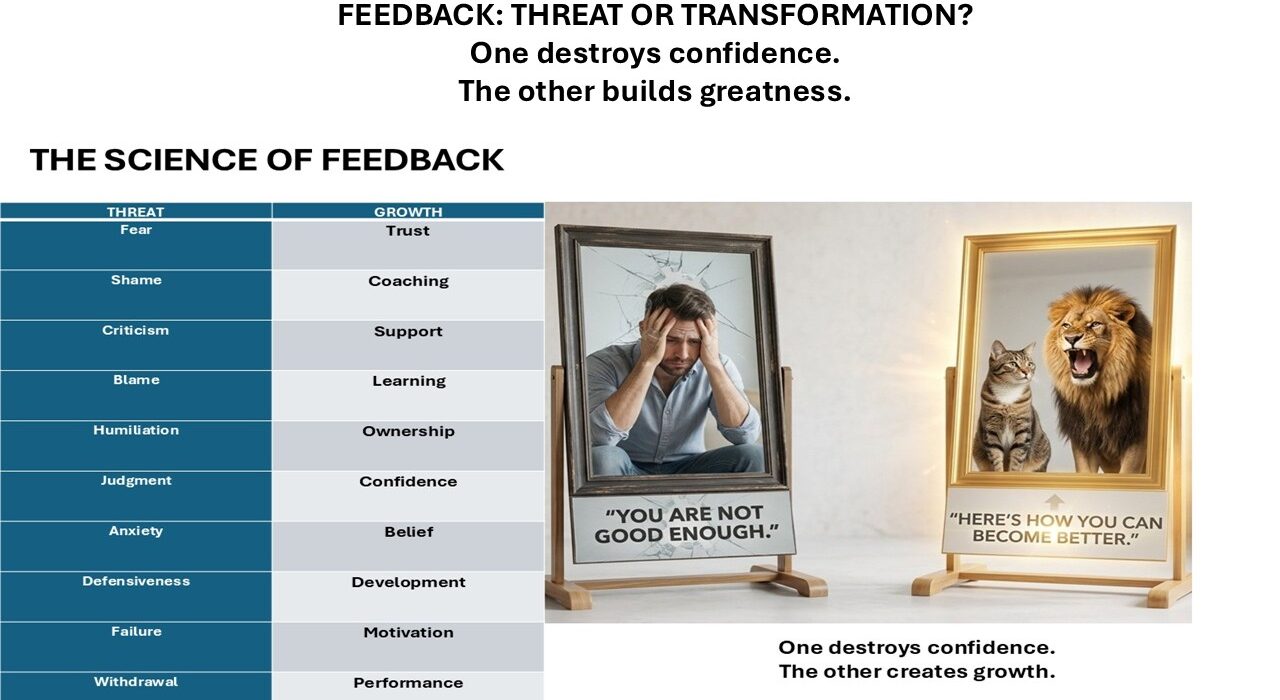
The NeuroLeadership Institute’s growth-mindset research draws a simple but powerful distinction. When the brain interprets change or criticism as a threat, it triggers a stress response that narrows thinking, increases defensiveness, and shuts down learning. When the same information is interpreted as a challenge, the brain stays engaged, curious, and able to problem-solve.
| Threat Response | Challenge Response |
| Negative stress and anxiety | Energizing and motivating |
| Reduced cognitive function | Enhanced thinking and creativity |
| Defensiveness and withdrawal | Curiosity and engagement |
| Narrowed perspective | Expanded perspective |
| Learning shuts down | Learning engages |
| Self-protection | Problem-solving |
| Fight-or-flight response | Growth-oriented response |
The same message can land in very different ways, depending on the context around it.
“You’re not meeting the standard” can feel like a threat if what the person hears is: “you are failing, you are exposed, your future is at risk.”
It can become a challenge if what they hear is: “this standard matters, you are not there yet, and there is a clear pathway to help you get there.”
The consequence hasn’t disappeared and the standard hasn’t been lowered. What’s changed is whether the person can see a way forward.
The SCARF Model Explained: Why Feedback Triggers Fear, Resistance and Defensiveness
David Rock’s SCARF model explains why performance feedback so easily tips into threat territory. People are wired to react strongly to signals around five domains:
| SCARF Domain | Threat Response | Reward Response |
| Status | Feeling diminished, judged, or exposed | Feeling valued, recognized, and respected |
| Certainty | Ambiguity, unpredictability, confusion | Clarity, clear expectations, known pathways |
| Autonomy | Feeling controlled or dictated to | Having choice, input, and ownership |
| Relatedness | Feeling isolated, attacked, or unsafe | Feeling connected, supported, and safe |
| Fairness | Perceiving bias, inconsistency, or politics | Perceiving transparency, consistency, and justice |
A single clumsy piece of feedback can hit all five at once—which is exactly what happened in that early assessor feedback: status and certainty collapsed in the same sentence.
Why This Matters: Performance feedback can threaten all five SCARF domains simultaneously. Status is threatened when someone feels exposed or judged. Certainty is threatened when they don’t know what happens next. Autonomy is threatened when something feels like it’s being done to them rather than with them. Relatedness is threatened when they feel the other person is against them. Fairness is threatened when they believe the process is biased or arbitrary.
This is why performance conversations can go wrong even when the leader’s intention is good. They may think they’re giving clear feedback, however the other person experiences it as a threat to their identity, their belonging, or their future security. Once the brain is in threat mode, learning gets harder and people become more defensive, less curious, less able to take in nuance. They nod in the meeting and disengage afterwards as a defence mechanism.
Psychological Safety at Work: The Foundation of High-Performance Teams
Google’s Project Aristotle research identified psychological safety as the #1 predictor of high-performing teams. Psychological safety is the belief that you won’t be punished or humiliated for speaking up with ideas, questions, concerns, or mistakes.
What Happens Without Psychological Safety:
- People hide mistakes rather than learning from them
- People stop speaking up with ideas and concerns
- Innovation and experimentation cease
- Teams become risk-averse
- Performance suffers across all metrics
What Happens With Psychological Safety:
- People take more risks and learn faster
- People speak up about problems early
- People innovate and experiment
- Learning accelerates
- Performance improves across all metrics
The 5 Most Destructive Types of Feedback That Damage Employee Motivation and Performance
Identity-Attacking Feedback: The Fastest Way to Destroy Confidence (Character Assassination)
This attacks the person rather than the behavior. Instead of addressing what someone did, it judges who someone is.
Examples:
- ❌ “You are incompetent.”
- ❌ “You are not leadership material.”
- ❌ “You will never succeed.”
- ❌ “You don’t have what it takes.”
- ❌ “You’re not fit for this role.”
- ❌ “Perhaps your 28 years of experience mean nothing.”
- ❌ “You’re not doing your job properly.”
Why It’s Destructive: This triggers a fight-or-flight response and attacks Status directly. The employee stops thinking about improvement and starts protecting self-worth. Erosion of self-esteem and identity follows. Self-efficacy plummets. Initiative reduces. Fear of mistakes grows. Withdrawal becomes the coping mechanism.
The Damage:
- Loss of confidence
- Reduced initiative
- Fear of mistakes
- Withdrawal and disengagement
- Identity crisis and self-doubt
Vague Feedback: Why “You Need to Improve” Never Works
Examples:
- ❌ “You need to improve.”
- ❌ “You are not meeting expectations.”
- ❌ “Your work is terrible.”
- ❌ “You always mess up.”
- ❌ “You need to be more strategic.”
- ❌ “You lack presence.”
- ❌ “Do better.”
- ❌ “Your attitude is poor.”
- ❌ “You need to step up.”
Why It’s Destructive: Without clarity there can be no improvement. Confusion creates anxiety. Anxiety reduces performance. Vague or unfalsifiable criticism with no concrete behavior attached leaves the person unable to act, only to ruminate. It destroys Certainty completely. No specifics or path forward creates anxiety and helplessness.
The Damage:
- Confusion and anxiety
- Helplessness and rumination
- Inability to take action
- Feeling stuck and trapped
- Loss of direction
Public Criticism and Humiliation: The Silent Killer of Employee Engagement
Research consistently shows that public humiliation creates lasting emotional scars.
Examples:
- ❌ Criticism in meetings
- ❌ Sarcastic comments in front of peers
- ❌ Public comparison between employees
- ❌ Shaming employees during team sessions
- ❌ Corrective feedback copied to others via email
- ❌ Public criticism in team meetings
Why It’s Destructive: Being corrected or criticized in front of peers activates Status threat far more sharply than the same words said privately. It also threatens Relatedness—our sense of safety with others. Employees may comply temporarily but disengage emotionally. The damage to psychological safety is severe and long-lasting.
The Damage:
- Lasting emotional scars
- Status threat amplified
- Relatedness destroyed
- Psychological safety shattered
- Surface compliance with deep disengagement
Unfair Feedback: How Bias and Workplace Politics Destroy Trust
Examples:
- ❌ Favoritism in evaluations
- ❌ Political retaliation disguised as feedback
- ❌ Double standards applied across teams
- ❌ Selective criticism targeting specific individuals
- ❌ Feedback delivered with sarcasm, anger, or apparent ulterior motives
- ❌ Moving goalposts—evaluating against unstated or shifting expectations
Why It’s Destructive: Nothing destroys trust faster than perceived unfairness. This threatens Fairness directly. Employees stop focusing on performance and start focusing on survival. Trust erodes completely. Resentment builds. Engagement collapses. People are highly attuned to whether feedback is genuinely for their growth or for someone else’s convenience.
The Damage:
- Trust destroyed completely
- Survival becomes the focus
- Resentment and anger build
- Disengagement and withdrawal
- Cynicism and distrust
Feedback Without Support: Why Accountability Alone Creates Fear
Examples:
- ❌ “Fix it.”
- ❌ “You need to improve.”
- ❌ “Don’t come back with excuses.”
- ❌ Pointing out a flaw and walking away with no offer of coaching or resources
- ❌ “You’re failing” without “here’s what changes it”
- ❌ No coaching, resources, guidance, or roadmap provided
Why It’s Destructive: No support creates learned helplessness and resentment. The person becomes stuck in threat mode indefinitely. Creates fear without a way out. Anxiety dominates. Critical thinking is impaired. Cognitive capacity is reduced. Avoidance of the giver becomes the default.
The Damage:
- Learned helplessness
- Resentment and frustration
- Anxiety and fear
- Reduced cognitive function
- Avoidance and withdrawal
4 More Toxic Feedback Behaviors Every Leader Must Avoid -Additional Destructive Patterns
Feedback Used to Punish Rather Than Develop:
Where the underlying intent is visible, and the recipient senses it. People are highly attuned to whether feedback is genuinely for their growth or for someone else’s convenience.
Feedback Delivered Late and Released All at Once:
Months of unspoken frustration offloaded in a single conversation. It shocks rather than informs. The person has had no opportunity to course-correct. Certainty is destroyed. Fairness is questioned.
Withholding Feedback Altogether:
Silence, followed by a sudden negative decision (a poor rating, a non-renewal, a surprise termination), is its own form of destructive feedback—it removes any chance to course-correct. The person believes they are performing adequately until they are suddenly told they are failing.
Backchannel Gossip:
Feedback delivered behind an employee’s back rather than to them directly systematically destroys Relatedness and Fairness. It creates a culture of indirect communication where problems fester rather than get resolved.
The Hidden Business Cost of Toxic Feedback
When toxic feedback becomes the norm, the damage compounds:
On Individuals:
- Reduced self-efficacy and confidence
- Emotional exhaustion and burnout
- Anger and tension
- Avoidance of the feedback giver
- Lower goal-setting and ambition
- Decreased cognitive function and learning capacity
- Silent quitting—the person remains but stops giving discretionary effort
On Organizations:
- Top performers quietly resign (visible quitting)
- Average performers become risk-averse to protect themselves
- Innovation and experimentation cease
- Speaking up and voicing concerns stop
- Customer service deteriorates because the front line operates in constant self-defense
- Higher attrition and turnover costs
- Increased absenteeism and presenteeism
- Leadership distrust
- Reduced profitability and business performance
The Ultimate Cost:
Toxic feedback never remains a people problem. It becomes a business problem. Studies consistently show it can harm cognition, affect, and behaviour more than it helps. The cost appears in every metric that matters—productivity, retention, customer experience, and the bottom line.
What Great Feedback Looks Like: How Leaders Inspire Growth, Motivation and Ownership
The High Accountability + High Support Leadership Model
Inspirational feedback balances high accountability with high support. It shifts the brain from a threat state to a growth/challenge state.
┌───────────────────────────┬───────────────────────────┐
│ HIGH ACCOUNTABILITY │ HIGH ACCOUNTABILITY │
│ + │ + │
│ LOW SUPPORT │ HIGH SUPPORT │
│ = FEAR & ANXIETY │ = HIGH PERFORMANCE │
│ (Toxic Culture) │ (Thriving Culture) │
├───────────────────────────┼───────────────────────────┤
│ LOW ACCOUNTABILITY │ LOW ACCOUNTABILITY │
│ + │ + │
│ LOW SUPPORT │ HIGH SUPPORT │
│ = APATHY │ = DRIFT / COMFORT │
│ (Neglect Culture) │ (Comfort Culture) │
└───────────────────────────┴───────────────────────────┘
The goal is always the top-right quadrant: High Accountability + High Support.
The Characteristics of Motivating Feedback
1. Make Feedback Specific, Behavioral and Actionable
Feedback that builds people separates the person from the behavior and always leaves a door open.
Instead of: ❌ “You are disorganized.”
Say: ✅ “In yesterday’s client meeting, when you interrupted twice (Situation-Behavior), it made the client feel unheard (Impact). Next time, try pausing to confirm understanding (Actionable pathway).”
The SBI Model (Situation-Behavior-Impact):
- Situation: Define the specific time and place (“In yesterday’s client review…”)
- Behavior: State the observable action (“…you spoke over the client twice…”)
- Impact: Explain the outcome (“…which caused them to shut down and withhold their feedback”)
Then Add:
- Expectation: Clarify the required benchmark (“Our 5-star standard requires active listening”)
- Development Path: Offer coaching (“Let’s practice how to handle those pauses together before the next call”)
2. Always Provide a Clear Improvement Pathway
Feedback with no pathway forward is simply a verdict. Motivating feedback always includes:
- What needs to improve
- By when the improvement should be visible
- With what support the person can achieve it
Marshall Goldsmith’s “feedforward” concept is useful here: instead of only reviewing the past, ask what could be done differently next time. It keeps the conversation future-facing and less threat-laden. Spend at least as much time on “here’s what could work next time” as on “here’s what went wrong.”
3. Use the 4:1 Positive Reinforcement Rule
Research shows the most effective ratio is 4:1 or 5:1 positive to constructive feedback. Reinforce strengths first or alongside areas for growth.
Instead of: ❌ Only pointing out problems
Say: ✅ “Your client relationships are exceptional. Let’s use that strength while improving project management follow-through.”
Examples of Positive Reinforcement:
- “The way you handled that difficult customer complaint by acknowledging their frustration lowered tension instantly.”
- “Your presentation skills are excellent—your clarity and confidence are assets. Let’s build on that by strengthening your data analysis.”
Why the 4:1 Ratio Works:
- Positive interactions build psychological safety
- Recognition reinforces what to continue
- People are more receptive to corrective feedback when they feel valued
- The brain’s threat response is lowered when safety is established
4. Deliver Feedback Early and Often
Small, frequent, close-to-the-moment feedback is far less threatening than infrequent, high-stakes verdicts. Give feedback within 24-48 hours of observing the behaviour.
Monthly or weekly touchpoints prevent the build-up that leads to a single, shock-heavy conversation.
5. Correct in Private, Recognize in Public
Give correction privately; give recognition publicly. Protecting Status even while addressing a real gap is essential. Pixar emphasizes candor with mutual respect in their Braintrust sessions. Feedback should be delivered with respect, curiosity, and genuine dialogue.
6. Communicate High Expectations with Genuine Belief
The most motivating feedback communicates: “I am holding you to a high standard because I believe you can achieve it.”
Carol Dweck’s growth-mindset research and Amy Edmondson’s work on psychological safety both point to the same conclusion: people take more risks and learn faster when they trust that a stumble won’t be used to define them.
People often rise to expectations when expectations are accompanied by belief.
7. Make Feedback a Conversation, Not a Lecture
Instead of delivering feedback at someone, invite dialogue:
- “How do you see it?”
- “What’s your perspective on this?”
- “What support do you need from me?”
Asking before telling preserves autonomy, which lowers the threat response considerably. It also surfaces information you didn’t have.
8. Use Facts, Evidence and Observable Behaviors
Grounded in observable data, clear metrics, and specific behaviors rather than emotional judgments.
Instead of: ❌ “You’re not committed enough.”
Say: ✅ “You’ve missed three team meetings this quarter. What’s getting in the way?”
9. Preserve Employee Ownership and Autonomy
It invites the employee into the problem-solving process:
- “Here is the gap. How do you think we should bridge it?”
- “What would you do differently next time?”
- “What actions would you propose?”
Where possible, let the person propose their own development actions before you propose yours—ownership sustains motivation far longer than compliance does.
10. Connect Feedback to Purpose and Individual & Business Impact
Help people see the “why” behind the feedback. Connect performance to the bigger picture.
- “When you improve this skill, it will help us serve customers better.”
- “Mastering this will position you for the next level of leadership.”
A Real-World Leadership Example: How Accountability and Support Created Lasting Change
The Investors in People story is a perfect example of this pattern in practice:
The Audit System:
- Each month, managers were scored against ten specific criteria, scored out of 100
- One criterion (worth ten points) was progress against development areas identified in the previous audit
- This measured whether they were learning, adapting, and following through—not just how they performed in the previous month
- Managers who scored poorly had to explain themselves to the General Manager, with real consequences
The Support System:
- The General Manager didn’t simply send them away to work it out—he told them to come to the L&D department for coaching and support
- That small addition changed everything
The Result:
- If the message had only been “your score is poor, go and explain yourself,” the system would almost certainly have created resistance
- Over about nine months, the pattern shifted
- The audit conversations became more honest and more practical
- The focus moved from “why am I being audited?” to “what do I need to do better?”
- Managers became active owners of development, not passive recipients of it
The Lesson:
Accountability without support creates fear; support without accountability creates drift. The two need to arrive in the same conversation. Real behavioral change rarely happens in a single conversation; it happens through a sustained pattern people learn to trust.
How Companies Like Google, Netflix, Pixar and Southwest Airlines Use Feedback to Drive Performance
How Leaders Can Build a Culture of Recognition, Trust and Continuous Improvement
The Leadership Philosophy Behind High-Performance Cultures
The greatest leaders understand a profound truth: People grow fastest when they feel challenged, supported, respected, and believed in.
Feedback should never be about making people feel smaller. Feedback should help people become bigger.
The goal of feedback is not to prove someone wrong. The goal is to help someone become better.
When accountability is combined with support, criticism becomes coaching.
When evidence is combined with empathy, feedback becomes learning.
When belief is combined with challenge, feedback becomes transformation.
The best cultures operate on a simple equation:
Clear Standards + Fair Accountability + Continuous Coaching + Genuine Care = High Performance
Remove any one element and performance suffers.
The Leadership Formula for Sustainable High Performance
Accountability Without Support = Fear
- Creates anxiety and defensiveness
- People protect themselves rather than grow
- Compliance without commitment
- Short-term results, long-term damage
Support Without Accountability = Drift
- Comfort without progress
- Good intentions without results
- Underperformance is tolerated
- Standards are lowered
Accountability + Support = High Performance
- Challenge without threat
- Growth with a safety net
- People give their best because they feel safe
- Standards are high AND achievable with support
25 Practical Leadership Actions to Build a Positive Feedback Culture
Daily Leadership Habits That Increase Motivation and Engagement
- Catch People Doing Something Right
Recognition should not be reserved for annual awards. Notice small wins. The most effective leaders actively look for positive behaviors to reinforce. - Give Immediate Recognition
Praise delayed loses impact. Praise observed behaviour quickly—within 24-48 hours. - Use Specific Appreciation
Instead of: “Good job.”
Say: “I appreciated how you handled that difficult customer calmly and professionally.” - Recognize Effort and Learning
Not only outcomes. Growth deserves recognition. Celebrate the process, not just the result. - Start Meetings with Success Stories
Create positive emotional energy. Begin team meetings by sharing wins, customer compliments, and examples of excellent work.
Weekly Leadership Rituals That Strengthen Team Performance
- Conduct Development Conversations (Not Just Performance Reviews)
These should be forward-looking, focused on growth, and not just evaluative. - Ask: “What Support Do You Need from Me?”
Make this a regular question. It signals genuine care and opens channels for support. - Share Customer Appreciation
Connect employees to impact. When customers express gratitude, share it publicly. - Encourage Peer Recognition
Recognition should not depend solely on managers. Create systems for peers to recognize each other. - Celebrate Small Improvements
Progress fuels motivation. Acknowledge the steps forward, even when the final goal isn’t yet achieved.
Organizational Systems That Reinforce Positive Feedback and Accountability
- Criticize Privately, Praise Publicly
Protect status when addressing gaps. Celebrate wins in front of peers. - Separate Person from Performance
Always focus on behaviors, not identity. Use language like “in this instance, X happened” rather than “you are X.” - Use Evidence, Not Emotion
Ground feedback in observable data, clear metrics, and specific behaviors. - Explain Expectations Clearly
Eliminate ambiguity. State the standard, the gap, and the pathway forward. - Remove Ambiguity
Use visual rubrics, scorecards, and clear criteria. Make the invisible visible. - Give Coaching Before Escalation
When gaps appear, route people toward support, not just consequence. Follow the Waldorf model. - Encourage Questions
Make it safe to ask for clarification, examples, and additional support. - Reward Learning
Celebrate people who take risks and learn from mistakes. Create a culture where “fail fast, learn faster” is practiced, not just preached. - Admit Your Own Mistakes
Build psychological safety deliberately. Leaders can build it by admitting their own mistakes first and visibly rewarding people who surface problems early. - Make Feedback Two-Way
Regularly solicit upward feedback. Ask: “What should I start, stop, or continue doing?” - Conduct Monthly Growth Reviews (Not Just Annual Reviews)
Replace or supplement annual reviews with ongoing 360s, “Start/Stop/Continue,” or monthly check-ins. - Focus on Future Behavior
Spend at least as much time on “here’s what could work next time” as on “here’s what went wrong.” - Recognize Values, Not Just Results
Celebrate behaviors that align with organizational values, not just outcomes. - Make Managers Responsible for Team Growth
Training departments don’t develop people. Managers do. Hold managers accountable for the development of their teams. - Close the Loop
When someone acts on feedback, notice it out loud. Unacknowledged improvement quietly teaches people that effort doesn’t matter.
Advanced Leadership Practices for Creating a Feedback-Rich Culture
Pair Every Standard with a Stated Pathway
Never leave “you need to improve” as a standalone sentence. Attach: improve what, by when, with what support.
Separate the Audit from the Punishment
Build a visible, evidence-based way of tracking progress (a scorecard, a review cadence, a competency framework)—but route people toward coaching and support the moment a gap shows up, rather than only toward consequence.
Ask Before You Tell
Open feedback conversations with the person’s own view of their performance. “How do you see it?” before offering a verdict.
Make Feedback Frequent and Small, Not Rare and Large
Monthly or weekly touchpoints prevent the build-up that leads to a single, shock-heavy conversation.
Protect Status in the Room
Give correction privately; give recognition publicly.
Name the Behavior, Not the Identity
Train managers explicitly to say “in this instance, X happened” rather than “you are X.”
Build Psychological Safety Deliberately
Admit mistakes first. Reward people who surface problems early. Respond to mistakes with curiosity (“What happened? What can we learn?”) not blame.
Make Fairness Visible
Use the same criteria, consistently applied, across the team—and be willing to explain the criteria when asked. Perceived unfairness is one of the fastest routes to disengagement.
Give People a Genuine Say in the “How”
Where possible, let the person propose their own development actions before you propose yours—ownership sustains motivation far longer than compliance does.
Audit Your Own Feedback Pattern
Ask: over the last quarter, was my feedback mostly evidence-based and forward-looking, or mostly reactive and after-the-fact?
Celebrate Consistently
Specific, timely praise (public for positives). Aim for 4-5 positives per corrective. Implement peer recognition, “continue” feedback, or simple thank-yous.
Create Safe Forums
Braintrust-style meetings (Pixar) for candid idea feedback. Retrospectives post-project where learning, not blame, is the focus.
Measure and Iterate
Track engagement, retention, and feedback quality via pulse surveys. Adjust based on data.
Hire and Keep for Culture Fit
Use the “Keeper Test” mindset (Netflix)—act on persistent poor fits compassionately but decisively.
Promote Autonomy, Mastery, and Purpose
Give control over how work gets done, opportunities for growth, and connect to bigger impact.
How to Handle Toxic Feedback Without Losing Confidence or Motivation
For Individuals—How to Receive Toxic Feedback and Grow
The Mindset Shift That Turns Criticism into Growth
You cannot always control the quality of feedback you receive. But you can control your response.
Feedback doesn’t get to decide how it’s used—the receiver does. Turning a threat into fuel is, in the end, a choice available to anyone, in any organization, at any stage of a career.
The feedback that changed my own trajectory wasn’t well-delivered. It was blunt, and it briefly convinced me I had failed at something I’d spent 28 years building. But I chose to use it as fuel rather than as a verdict.
You can make the same choice.
The Personal Resilience Framework: Turning Feedback into Fuel
[Receive Harsh Feedback]
↓
[Pause & Regulate – Breathe, Don’t React]
↓
[Separate Signal from Noise – Is there 5% useful?]
↓
[Convert to Growth Challenge – What can I learn?]
↓
[Take Action – Improve, Document, Build Evidence]
↓
[Respond Professionally – Thank, Show Learning]
25 Practical Strategies for Developing Personal Resilience
What to Do Immediately After Receiving Harsh Feedback
- Pause Before Reacting
Do not respond emotionally. Give yourself time. Use an internal script: “This is data, not my identity.” Take space: “Thanks, I’d like time to reflect.” This interrupts the amygdala threat response and allows you to engage your prefrontal cortex. - Separate the Message from the Messenger’s Delivery
Ask: is there a 5% kernel of useful signal inside a 95% badly delivered wrapper? Toxic delivery doesn’t automatically mean the content is worthless—nor does it mean the content is valid. Evaluate the two separately. - Give Yourself Permission to Feel It, Briefly
Suppressing the emotional hit tends to prolong it. Naming the feeling (“that felt like a threat to my competence”) reduces its grip, per basic emotional-regulation research. Allow yourself to feel the disappointment, then move to action. - Apply the SCARF Diagnostic
Ask yourself: “Which part of this feedback is threatening my Status, Certainty, or Autonomy?” Naming the threat reduces its emotional grip on your brain. - Depersonalize the Feedback
Separate feedback from identity. Feedback is information. It is not your identity. You are not your latest mistake.
How to Separate Useful Feedback from Toxic Criticism
- Evaluate Feedback Quality
Ask these questions:
- Is it specific or vague?
- Is it about a behavior or my identity?
- Is it from a credible source?
- Is it a pattern from multiple people, or one person’s opinion?
- Is it about my output, speed, or process?
- Look for the 5% Truth
Even badly delivered feedback may contain useful insight. Extract learning. Discard the poison. Ask: “Is there even a 5% truth in what was said?” - Convert Judgments into Data
Instead of: “You’re terrible.”
Ask: “What exactly should improve?”
Instead of: “Your attitude is poor.”
Ask: “What specific behavior would be better?” - Ask Clarifying Questions
“Can you give me an example of when I did X?”
“What would better look like?”
“Can you help me understand specifically what you saw?”
This turns a vague accusation into something actionable—or exposes that there was nothing concrete behind it.
- Seek External Objective Calibration
Validate the feedback with a trusted mentor or peer who knows your work. Ask: “Is this a fair assessment of my performance, or is this personal/biased?” One person’s harsh assessment is one data point.
How to Build Confidence and Grow After Negative Feedback
- Document Facts and Patterns
Keep records of feedback, incidents, and your accomplishments. Facts protect you from politics and bias. Note toxic patterns (dates, content) if you need to escalate. - Build Your Own Evidence Base
Track your actual outcomes and feedback over time, rather than letting a single toxic comment define the narrative. This is especially useful against feedback that is vague, character-based, or clearly motivated by something other than your development. - Reframe Threat as Challenge
Shift your internal narrative from “They think I’m a failure” to “This reveals a system or perception gap I need to master.”
Ask: “What would this look like if I treated it as a problem to solve rather than a verdict on who I am?”
This is the single most powerful lever available to the individual, because it’s within their control even when the feedback-giver’s behavior isn’t.
- Focus on Controllables
You cannot control a manager’s delivery or intent. You own your competence, your professional boundaries, your response, and your next move. Focus energy on what you can change. - Strengthen Your Competence
The strongest response to criticism is improvement. Use the feedback as motivation to get better, stronger, and more capable. - Create a Personal Development Plan
Build your own improvement plan with specifics, timelines, and self-tracking. Celebrate small wins. This demonstrates professionalism and ownership. - Remember Your Track Record
One conversation cannot erase decades of achievement. Remind yourself of your 28+ years of experience and past successes. Your identity is bigger than any single piece of feedback. - Build a Personal Advisory Board
Identify mentors, trusted colleagues, and coaches who tell you the truth. People who will offer perspective, support, and honest calibration.
Long-Term Strategies for Career Growth Despite Toxic Feedback
- Never Make Major Decisions Immediately
Avoid resigning in anger. Avoid emotional reactions. Give yourself time to process before making career decisions. - Use It as Fuel, Deliberately
Many successful careers were built on proving doubters wrong. People who’ve been on the receiving end of harsh, even unfair, feedback often point to that exact moment as the trigger for a step-change in performance—not because the feedback was well-delivered, but because they chose to convert it. - Keep Your Own Standard Separate from Theirs
Decide, independently, what “good” looks like for you—so a single person’s harsh judgment isn’t the only measure you’re working against. - Don’t Isolate
Talk to someone you trust. Toxic feedback thrives on being carried alone; it loses power once it’s spoken aloud to someone who can offer perspective. - Respond Productively
Thank them (“Appreciate the input”), show you’ve considered it, and share your plan where appropriate. This demonstrates professionalism and emotional maturity. - Know When to Escalate or Exit
Not all toxic feedback is a growth opportunity—some is simply a signal about a broken culture or a specific relationship that isn’t recoverable. Recognize the difference between “this stings but it’s useful” and “this is a pattern I need to address or leave.”
If vengeful or harassing, escalate via HR or consider exit strategies while performing strongly.
- Become Better, Not Bitter
This may be the most important lesson of all. Energy spent on revenge never creates growth. Energy spent on improvement often does. Use the experience to become a better giver of feedback to others.
The 5-5-5 Perspective Rule: Keeping Feedback in Context
When receiving tough feedback, ask yourself:
- Will this matter in 5 days? (Often, the sting will fade)
- Will this matter in 5 months? (If it’s a pattern, it might)
- Will this matter in 5 years? (Most feedback won’t)
This simple perspective check helps you allocate emotional energy wisely.
The Science Behind Effective Feedback: Neuroscience, Psychology and Leadership Research
The Threat vs Challenge Response: What Neuroscience Reveals About Feedback
The NeuroLeadership Institute makes a simple but useful distinction: we can experience change either as a threat or as a challenge.
| Threat Response | Challenge Response |
| Negative stress | Energizing |
| Reduced cognitive function | Enhanced thinking |
| Defensiveness | Curiosity |
| Narrowed perspective | Expanded perspective |
| Learning shuts down | Learning engages |
| Withdrawal | Engagement |
| Self-protection | Problem-solving |
| Cortisol increases | Dopamine increases |
The same message can land in very different ways, depending on the context around it.
“You’re not meeting the standard” can feel like a threat if what the person hears is: “you are failing, you are exposed, your future is at risk.”
It can become a challenge if what they hear is: “this standard matters, you are not there yet, and there is a clear pathway to help you get there.”
The consequence hasn’t disappeared and the standard hasn’t been lowered. What’s changed is whether the person can see a way forward.
Applying the SCARF Model to Performance Feedback Conversations
David Rock’s SCARF model explains why performance conversations can go wrong even when the leader’s intention is good. They may think they’re giving clear feedback, however the other person experiences it as a threat to their identity, their belonging, or their future security.
When Feedback Threatens All Five:
| SCARF Domain | How Feedback Threatens | How Feedback Rewards |
| Status | “You are incompetent” | “You are capable and valued” |
| Certainty | “You need to improve” (no specifics) | “Here’s the gap and the pathway” |
| Autonomy | “Fix it” (dictated) | “What do you think would work?” |
| Relatedness | Public criticism, isolation | Private, respectful, supportive |
| Fairness | Biased, inconsistent | Transparent, consistent, evidence-based |
What Happens When the Brain Is in Threat Mode:
- Learning gets harder
- People become more defensive
- Less curious, less able to take in nuance
- They nod in the meeting and disengage afterwards as a defense mechanism
What Happens When the Brain Is in Reward Mode:
- Engagement increases
- Creativity and problem-solving improve
- Trust builds
- Commitment deepens
- People give discretionary effort
10 Characteristics of Feedback That Inspires Growth and High Performance
1. Make Feedback Specific, Behavioral and Actionable
2. Provide a Clear Pathway Forward
3. Use the 4:1 Positive Reinforcement Rule
4. Deliver Feedback Early and Often
5. Correct Privately, Recognize Publicly
6. Communicate Belief in Capability
7. Make Feedback a Conversation
8. Use Evidence and Observable Behaviors
9. Preserve Ownership and Autonomy
10. Connect Feedback to Purpose and Impact
Why Psychological Safety Is Essential for Learning and Performance
Google’s Project Aristotle research identified psychological safety as the #1 predictor of high-performing teams. Psychological safety is the belief that you won’t be punished or humiliated for speaking up with ideas, questions, concerns, or mistakes.
Leaders Build Psychological Safety By:
- Admitting their own mistakes first
- Responding to mistakes with curiosity, not blame
- Encouraging questions and dissent
- Protecting status during corrective feedback
- Making fairness visible and transparent
The Result:
- People take more risks
- People learn faster
- People speak up about problems
- People innovate and experiment
- Performance improves across all metrics
Growth Mindset: The Key to Thriving After Criticism and Setbacks
Carol Dweck’s research on fixed vs. growth mindset shows that people who believe their abilities can be developed (growth mindset) are more resilient to failure and feedback.
Fixed Mindset: “I am what I am. Feedback is a verdict on
Subhashis Banerji [Author]
Leadership assessor, strategist, and writer. I help professionals and organizations make smarter decisions by learning to read patterns, not promises.
📘 Read all my articles here:
👉 https://successunlimited-mantra.net/ & https://successunlimited-mantra.com/index.php/blog PLUS on https://relationshipandhappiness.com/
💼 Connect with me on LinkedIn: https://www.linkedin.com/in/subhashis-banerji-21b1418/
Related posts:
- How Average Employees Become Toxic Leaders: The Hidden Link Between Insecurity, Power and Office Politics
- The Ultimate Real Leverage Blueprint: Build Wealth, Influence, Passive Income, and Freedom That Lasts
- How to Become Emotionally Strong and Mentally Resilient: An Evidence-Based Guide for Difficult Times
- The Underdog’s Blueprint: How Ordinary People Turned Adversity Into Extraordinary Success



– Please read our Comment Policy