

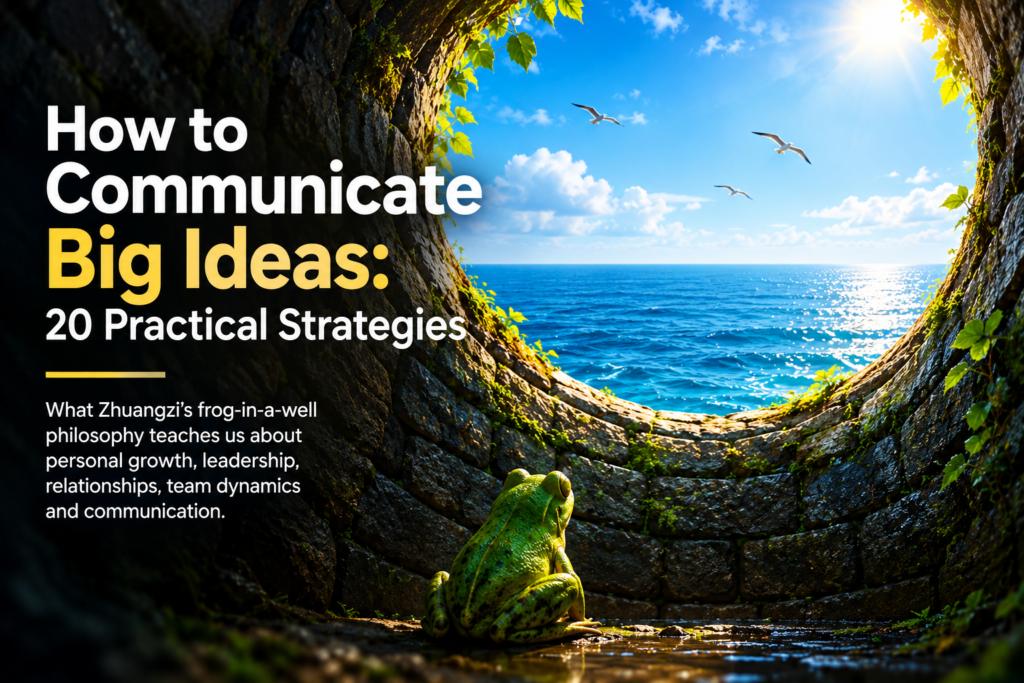
How to Communicate Big Ideas: 20 Practical Strategies
- BY Subhashis Banerji
- October 23, 2026
- 0 Comments
- 42 Views

Reading Time: 38 minutes
Contents
hide
1
How to Communicate Big Ideas: 20 Practical Strategies
1.10
20 Ways to Communicate Big Ideas to People with Limited Exposure
1.14
The 90-Day Implementation Plan: Turn Perspective into Habit
How to Communicate Big Ideas: 20 Practical Strategies
What Zhuangzi’s frog-in-a-well philosophy teaches us about personal growth, leadership, relationships, team dynamics and communication.
“You cannot discuss the ocean with a well frog, because he is limited by the space he lives in. You cannot discuss ice with a summer insect, because he is bound to a single season. You cannot discuss the Way with a cramped scholar, because he is shackled by his doctrines.”
— Zhuangzi (Chuang Tzu), “Autumn Floods”
Why Big Ideas Fail to Land
You know the conversation. You see a better way to run the project, a risk nobody is naming, or a decision whose consequences will emerge five years from now. You explain the idea, simplify it, add evidence, and explain it again. People nod. Nothing changes. Walking away, you wonder: Why can’t they see what is so obvious to me?
Now consider the uncomfortable possibility: the problem may not be only their limited perspective. It may also be the way you are trying to reach them.
More than two thousand years ago, the Taoist philosopher Zhuangzi used the image of a frog in a well to illustrate the limits of experience. A frog confined to a well cannot grasp the sea; a summer insect cannot understand ice; a scholar bound by rigid doctrines may struggle to see beyond them.
The passage is not merely a verdict on other people. Its deeper challenge is to recognize that every one of us has a well—and to ask what we cannot yet see from inside it.
This practical guide explores the frog-in-a-well philosophy through personal growth, leadership, relationships, team dynamics and the art of communicating big ideas to people with limited exposure. It explains when this perspective-taking approach is useful, what we risk when we ignore it, and how the same philosophy can become dangerous when used to dismiss valid criticism or feel superior.
You will find 20 practical communication strategies, questions to ask before difficult conversations, a worked example for a resistant team, and a 90-day action plan for turning insight into habit.
The most important question may not be whether other people can see your ocean. It may be whether you can build a bridge—and remain curious about what their well can teach you.
The Frog-in-a-Well Philosophy: Meaning in Three Images
The teaching comes from the “Autumn Floods” chapter of the Zhuangzi, where the principle is expressed through three limitations:
- A frog in a well cannot understand the sea because its world is confined to the well.
- A summer insect cannot comprehend ice because its experience is limited to a single season.
- A cramped scholar cannot grasp the Way (Tao) because established doctrines restrict what the scholar is able to consider.
Translations vary, but the central teaching remains: you cannot expect someone to understand a reality they have never encountered simply by describing it to them. Philosophers describe questions of this kind in terms of the limits of knowledge and understanding. A person’s worldview is shaped by their environment, exposure and direct experience.
Notice the setting, too. In the chapter, the words are spoken by the Lord of the North Sea to the Lord of the Yellow River, who has encountered the ocean and realised the limits of his previous perspective. The moment of learning begins when he recognises that the world extends beyond what he has known.
Four Places Limited Perspectives Show Up: Work, Family, Leadership and Teams
- A manager who has worked only in stable, traditional organisations struggles to see why a younger employee champions experimentation, remote collaboration or a radically different business model.
- A parent who built a successful career through conventional routes cannot understand a child’s decision to pursue an unconventional profession.
- A technically brilliant leader cannot fathom why a capable team resists a strategy that looks obvious from where the leader stands.
- Two people who genuinely care about each other keep disagreeing because one reads life through security and stability while the other values independence, exploration and growth.
In each case, the gap may have little to do with intelligence, commitment or character. Two people may be looking at the same reality through different windows of experience.
The Twist Most People Miss: The Frog May Be You
There is an equally important danger.
The moment we decide that we understand the ocean while everyone else is merely a frog in a well, we become prisoners of our own arrogance. We start to assume that disagreement proves ignorance, that our experience outranks everyone else’s, and that our vision is beyond question.
The philosophy must therefore be applied in both directions. Recognise the limits of other people’s perspectives, and never forget that your own perspective is also limited.
The aim is not to label people as incapable of understanding. It is to create the conditions in which greater understanding becomes possible.
What You’ll Learn: Personal Growth, Leadership, Relationships and Communication
This is not simply a meditation on perspective. It is a practical guide to applying Zhuangzi’s well-frog philosophy to every dimension of your life and work.
- A step-by-step personal growth protocol for identifying and expanding your own cognitive boundaries, so you stop mistaking your patch of sky for the whole sky.
- A leadership framework for building ramps between strategic vision and daily reality, so your big ideas land instead of bouncing off well walls.
- A relationship methodology for navigating differences in perspective with empathy, boundaries and skill, so you stop wasting energy on futile persuasion and start building genuine connection.
- A team dynamics playbook for creating a collective ocean larger than any individual well, through collective intelligence, psychological safety and adaptive capacity.
- Clear guidance on when to apply this philosophy—and when not to, because even a powerful tool becomes a restrictive doctrine when misapplied.
- A benefits-and-losses analysis showing what is at stake when we follow or ignore the teaching.
- Twenty communication strategies for translating big ideas into language that people with limited exposure can understand, evaluate and apply.
- A worked example of communicating a big idea to a resistant team.
- Five questions to ask before a difficult conversation, helping you avoid the trap of becoming the cramped scholar.
- A 90-day implementation plan that turns insight into habit.
Read it cover to cover, or use it as a reference. Each section builds on the preceding one, while also providing practical lessons that can stand alone.
By the end, you will have more than an understanding of an ancient philosophy. You will have a practical action system for expanding your perspective, communicating with greater impact, strengthening relationships and helping teams see beyond their immediate horizons.
Part 1: Four Areas Where Perspective Shapes Results
Self, leadership, relationships and teams: the same principle, applied four ways.
Personal Growth: How to Expand Your Perspective and Challenge Assumptions
Growth begins with an uncomfortable discovery: your present understanding is not the boundary of what can be understood.
Your beliefs were assembled from your upbringing, education, profession, culture, social circle, successes, failures and the people around you. That experience gave you real knowledge. It also gave you blind spots.
A person who has succeeded through discipline and hard work may conclude that discipline and hard work explain every success. Someone who has been betrayed repeatedly may decide that trusting people is always dangerous. A professional with thirty years in one industry may believe its rules are universal. These assumptions worked somewhere, once. They become obstacles the moment circumstances change.
The primary pitfall. The well frog’s problem is not merely a small perspective. It is assuming that the small view is the entire universe. Growth begins with the humility to accept that the circular patch of sky above you is not the full sky.
Step 1: Audit Your Perspective and Hidden Assumptions
Timing: Week 1
List the domains where you hold strong opinions: your industry, your methods, your beliefs about people. For each one, write down how you know it. Is it direct experience, inherited doctrine, or one data point from years ago?
Then ask yourself:
- Which beliefs do I treat as unquestionable truths?
- Which subjects do I dismiss without having studied them seriously?
- When did I last change my mind after meeting convincing evidence?
- Do I confuse personal experience with universal reality?
- What do I assume is universal simply because it is familiar?
- Do I reject an idea because it is genuinely unsound, or because it is unfamiliar?
A useful practice: choose three beliefs you hold strongly and examine the best arguments against each. The purpose is not to abandon your convictions indiscriminately. It is to find out which ones deserve to survive scrutiny.
Journal prompt. ”What is the circular patch of sky I currently mistake for the whole sky?”
Practical example. You may believe that loyalty means staying with an organization for many years. Someone else may believe that loyalty means contributing fully while continually developing. Rather than assuming the other person lacks commitment, examine the different definitions and experiences underneath each view.
Finally, ask two or three trusted people: ”Where do I sound most certain and least curious?”
Step 2: Separate Facts, Interpretations and Assumptions
Much unnecessary conflict comes from treating interpretations as facts. Consider:
- Fact: A colleague disagrees with your proposal.
- Interpretation: The colleague does not understand the business.
- Alternative interpretation: The colleague has information you lack, faces different risks, or sees an implementation problem.
Before you reach a conclusion, ask what evidence supports it and what other explanations might exist. This one discipline reduces defensiveness and improves the quality of your decisions.
Step 3: Audit Your Information Diet and Echo Chamber
Timing: Week 2
Track everything you read, watch and listen to for one week. Sort your sources by ideological diversity, not just topic diversity. Then calculate your “echo chamber ratio”: the percentage of your inputs that simply confirm what you already believe.
Set a target. At least 20% of your information diet should come from perspectives that challenge you.
Step 4: Seek Challenging Ideas and Diverse Perspectives
Timing: Weeks 3–8, then ongoing
To avoid becoming the frog, you must intentionally seek cognitive friction: systematically choosing environments that stretch your current belief system.
Weekly: Read one long-form article or essay from a viewpoint you instinctively disagree with. Aim to steelman it, not refute it. Summarize the idea in your own words, identify its strongest evidence, and decide whether it changes any of your conclusions.
Bi-weekly: Have a conversation with someone from a different generation, industry, culture or worldview. Ask questions. Resist the urge to educate.
Monthly:
- Read one book outside your primary discipline.
- Follow two thinkers you disagree with, and summarize their best argument in a form they would accept before you rebut it.
- Attend an event, class or community gathering entirely outside your normal social orbit.
- Spend time in rooms where you are the least experienced person.
- Identify one assumption you have made about another person without sufficient evidence.
Quarterly: Travel somewhere that disrupts your routines, ideally where you do not speak the language or know the customs. Or at least change your inputs: different cities, industries, age groups, cultures.
The purpose is not to accumulate more opinions. It is to become better at examining your own opinions, learning from evidence and adapting to reality.
Step 5: Ask for Feedback That Reveals Blind Spots
Ask three people who know you in different contexts:
“What is one important thing about my behavior or thinking that I may not see clearly?”
Listen without defending yourself. You may discover that what you call decisiveness is experienced as impatience, that your high standards feel like inflexibility, or that your eagerness to help stops others from taking ownership.
Feedback becomes useful when you treat it as information to investigate, not a verdict to resist.
Step 6: Practise Intellectual Humility
Treat the circular patch of sky as provisional. When you feel certainty or defensiveness rising, pause and note: ”This may be the limit of my current well.” Replace “I already know” with “What am I not seeing?”
Intellectual humility does not mean thinking less of yourself. It means recognizing that competence in one area does not make you knowledgeable in all of them:
- A senior executive may understand business strategy but know little about emerging technologies.
- A scientist may have deep technical expertise but misunderstand human motivation.
- A leadership consultant may understand assessment methodology but remain unaware of the daily constraints frontline employees face.
The more expertise we acquire, the more important it becomes to know where that expertise ends.
Step 7: Build Habits for Continuous Self-Reflection
Timing: Ongoing
- Keep a ”Things I Was Wrong About” log and add to it monthly. If it is empty after a year, you are in the well.
- Keep a ”Beliefs I’ve Revised” log and review it quarterly.
- Before major decisions, ask: ”What would I need to see to change my mind?” If nothing could change your mind, you have found a well wall.
- Say “I don’t know” and “Tell me more” more often than “Actually…”
Step 8: Build a Personal Board of People Who Challenge You
Timing: Month 2 onward
Identify three to five people you respect who see the world differently from you. Cultivate these relationships deliberately, not to convert them but to borrow their eyes. Meet each one quarterly and ask what they see that you might be missing.
Step 9: Turn New Insights into Measurable Behaviour Change
Exposure alone does not guarantee growth. Choose one belief, behavior or habit to test. Define what a better outcome would look like, try a different approach and review the results.
For example, someone who believes a difficult colleague is inherently obstructive might experiment with asking about the colleague’s concerns before presenting another argument. The result may reveal a misunderstanding, a legitimate risk or a genuine incompatibility. Each outcome is useful information.
Step 10: Stop Repeating Yourself and Choose Where to Persuade
A major milestone in personal growth is realizing that you cannot force someone to see a broader horizon if they are deeply comfortable in their limited space. Constantly explaining your long-term goals or evolved mindset to people committed to their comfort zones only drains you.
Before explaining a big idea, ask: Is this person curious, or committed to their comfort zone? Invest in the curious. Give the rest a short, respectful answer. Redirect your energy into your own expansion instead of repeated persuasion.
When you meet defensive or closed-minded skepticism, shift from debate to silent execution, or offer a gentle, neutral reply:
“I see your perspective; let’s revisit this once I have more data.”
Step 11: Conduct a Quarterly Perspective Check
Timing: Quarterly
Call it your “Frog Check.” Every 90 days, revisit your horizon audit and ask: ”What did I learn this quarter that I couldn’t have known from inside my old well?” Adjust your friction program based on what is working. Review what assumptions you have revised, and which new horizons now feel normal that once felt impossible.
Personal growth principle. The objective is not to accumulate more opinions. It is to become more capable of examining the ones you have, learning from evidence and adapting to reality. You gradually enlarge your well until the ocean becomes discussable rather than abstract.
Leadership Communication: Turn Strategic Vision into Practical Action
Leadership means asking people to act on a future they cannot yet see.
A leader may envision a new business model, a digital transformation, a cultural shift or an expansion into unfamiliar markets. The leader has had months to examine the business case, weigh alternatives and imagine the destination. Employees may meet the proposal for the first time in a thirty-minute presentation.
Expecting everyone to understand, embrace and implement the vision on the spot is unrealistic. The challenge is not simply to announce the destination. It is to help people understand why it matters and how they can reach it.
This is where friction usually starts. Leaders think in macro-systems (“the ocean”); individual contributors live in micro-tasks (“the well”). You cannot expect an employee to grasp a five-year transformation when their daily reality is judged purely on immediate operational metrics.
Step 1: Diagnose the Gap Between Strategy and Daily Work
Timing: Weeks 1–2
Before introducing a major initiative, investigate what your people currently know, believe and experience. Map where leaders operate at ocean scale (strategy, multi-year transformation) while team members live at well scale (daily metrics, immediate output). Expect friction wherever the gap is large.
Ask:
- What pressures dominate their daily work?
- Which performance measures shape their behavior?
- What does each person’s daily reality reward: speed, accuracy, safety, targets?
- What are they afraid might happen if the proposal succeeds, or fails?
- What information are they missing?
- Which assumptions that seem obvious to you are unfamiliar to them?
An employee measured on short-term delivery may read a long-term transformation as a threat to current performance. A middle manager who has lived through failed change programs may read a new announcement as another passing management fashion. These reactions do not make people resistant to progress. They reflect the incentives and experiences through which people interpret your proposal.
Step 2: Explain the Why Before the How
Timing: Week 3
Do not begin with the terminology, the technology or the implementation plan. Begin with the problem that needs solving.
Instead of saying:
“We are implementing an integrated, data-driven operating model to improve cross-functional optimization.”
Say:
“Our teams sometimes receive different information and make decisions that conflict with one another. We want everyone to work from the same reliable information, so decisions become faster and mistakes are reduced.”
Once people understand the problem, the proposed solution becomes far easier to evaluate.
Step 3: Translate Strategic Vision into Daily Benefits
A five-year transformation feels distant and abstract. Its practical consequences are much easier to grasp. Connect the big idea to:
- The customer’s experience.
- The employee’s daily work.
- The team’s performance.
- The organization’s ability to compete.
- The risks of continuing with the existing approach.
If the strategy involves automation, explain which repetitive activities will shrink, which human capabilities become more valuable, and how people will be supported through the transition. Do not present only the benefits to the organization while ignoring what the change means for the people expected to deliver it.
Tactic. Translate the strategic vision (“the ocean”) into daily contextual reality (“the well”), so the link between immediate tasks and long-term goals is unmistakable. For example: ”This transformation means your weekly report takes 20 minutes instead of two hours.”
Step 4: Use Familiar Examples to Explain New Ideas
People learn faster when new information attaches to something they already understand.
A leader explaining organizational transformation could compare it to renovating a house you are still living in. The house must keep functioning while repairs are made. Some changes are visible immediately; others quietly improve safety and reliability over time. Temporary inconvenience has to be managed without losing sight of the finished home.
The analogy is not a complete description of transformation, but it gives people an accessible starting point. Use familiar examples without oversimplifying the real complexity or misleading anyone about the risks.
Step 5: Involve Employees in Designing the Change
Leadership is not the forced transfer of your understanding into other people’s minds.
Ask employees what they see, what concerns them and what would make the initiative workable. Someone close to a production line, a customer or an operational process may spot risks that are invisible to senior management.
Involving people is not the same as surrendering strategic responsibility. It means recognizing that useful knowledge is distributed throughout the organization.
Step 6: Build Exposure Through Training, Pilots and Practical Experience
Timing: Weeks 4–12 and ongoing
If you are introducing a radical, disruptive idea, remember that your team may reject it not because it is a bad idea, but because it lies entirely outside the borders of their current imagination. Instead of getting frustrated, build a bridge: provide the exposure, training and context that lift people out of the well.
Build ramps instead of shouting from the shore:
- Progressive exposure: Provide data, case studies, small experiments, site visits or cross-functional projects that gradually enlarge the team’s view.
- Shadowing programs: Have team members spend time with customers, other departments or industry events that widen their context.
- Field trips: Take the team to see the “ocean” directly: customer sites, competitor stores, industry conferences, adjacent markets.
- Guest voices: Invite outsiders who can describe the broader landscape credibly and without threat.
- Progressive disclosure: Do not dump the full five-year vision at once. Release it in layers, each one slightly stretching the current frame.
- Small experiments: Invite people to test one piece of the idea in a safe environment. Direct experience is the most reliable way to expand a well; argument alone rarely is.
- Context, training and psychological safety: Give people what they need to leave the well without feeling attacked.
- Intermediate milestones: Translate the big idea into milestones that connect to current realities.
Invite junior team members to shadow executive meetings, join client strategy sessions or run cross-departmental pilots. A successful pilot can be more persuasive than any number of presentations about the future.
Step 7: Break Transformation into Achievable Milestones
Break the ambitious vision into manageable steps:
- Explain the problem and the desired outcome.
- Establish a shared understanding of the current situation.
- Demonstrate the proposed approach on a small scale.
- Train people in the capabilities they need.
- Test the approach and collect feedback.
- Expand it after learning from the initial experience.
Stage the vision. Break a five-year change into 90-day visible wins, so people are standing on one rung before they see the next.
Step 8: Create Psychological Safety for Questions and Learning
Timing: Ongoing
Normalize confusion out loud:
“Nobody is expected to see this fully yet. That’s my job, to help you see it.”
Reward questions over compliance, and curiosity over certainty. Never shame someone for asking a “basic” question; it is the fastest way to keep them in the well.
Amy Edmondson’s research found an association between psychological safety and learning behavior in the 51 work teams she studied. The implication for leaders is practical: people identify problems, seek feedback and learn more readily when they can take interpersonal risks without unreasonable fear. (Edmondson, Psychological Safety and Learning Behavior in Work Teams, 1999.)
A leader must therefore make it acceptable to question the implementation without treating every question as opposition.
Step 9: Align Incentives with the Bigger Picture
Make sure your evaluation systems reward broader perspective and adaptation, not just short-term well metrics. Otherwise people will rationally stay inside the familiar circle.
Step 10: Challenge Expert Bias and Outdated Business Assumptions
Timing: Ongoing
Zhuangzi warned against the “cramped scholar shackled by doctrines.” In modern leadership, that is the danger of past success. Leaders often reject innovative paradigms because of institutional dogma: ”That’s not how our industry works” or ”We tried that in 2018.” True leadership requires continuous unlearning, so the organization’s collective perspective does not calcify.
Before rejecting an idea because “that’s not how we do things,” ask: ”Am I enforcing a doctrine or applying a principle?”
Tactics:
- Assign a “devil’s advocate” role in strategy meetings, and rotate it deliberately.
- Keep a ”Sacred Cows We’ve Slaughtered” list, and celebrate each time an old doctrine is successfully challenged.
- Seek out and elevate “naive” voices (new hires, outsiders, juniors) precisely because your industry’s doctrines have not yet shackled them.
- Run a quarterly ”What are we assuming?” Ban the phrases “we tried that in 2018” and “that’s not how our industry works” unless someone can say what has changed since.
- Hold quarterly ”Kill the Sacred Cows” workshops where teams identify processes inherited from past paradigms that no longer serve the current environment.
- Create rituals for unlearning: post-mortems that question sacred cows, external speakers, or “red team” exercises that attack current assumptions.
- Conduct bi-annual unlearning audits that systematically challenge institutional dogma and past operational assumptions.
Step 11: Model Continuous Learning as a Leader
Publicly share what you are still learning and where your own earlier well was limited. This normalizes expansion for the whole organization. When a leader says ”I was wrong about that,” the whole team gets permission to leave their wells.
Share your earlier, narrower views and how exposure changed them. Vulnerability signals that leaving the well is normal and possible.
Step 12: Measure Understanding, Adoption and Learning
Timing: Quarterly
Monitor not only business results but also whether people understand the change, can perform the required tasks and feel able to raise concerns.
Track leading indicators. Are team members referencing broader context in their work? Are they proposing ideas from outside the usual playbook? Are cross-functional conversations increasing?
Then survey the one question that matters:
“Do you understand why we’re doing this, not just what we’re doing?”
Adjust your ramp-building wherever understanding lags.
Leadership principle. Your job is not merely to see further than the team. It is to help the team develop the understanding, confidence and capability to move toward a worthwhile future.
Relationship Communication: Understand Before You Try to Persuade
The same teaching is just as powerful in families, friendships, marriages and every close relationship, and it is usually where the cost of ignoring it is highest.
Many relationship conflicts begin when we assume that our understanding of a situation should be obvious to the other person.
- A parent believes that providing financial security is the greatest expression of love. The adult child values the freedom to make independent choices.
- One partner believes that discussing a problem immediately demonstrates commitment. The other needs time to reflect before talking.
- One friend regards frequent communication as a sign of affection. Another believes a strong friendship can survive long periods without contact.
Neither perspective is necessarily defective. Each was shaped by different experiences, needs and expectations.
Step 1: Separate the Person from Their Point of View
Do not rush to conclude that someone is selfish, immature, unreasonable or incapable of understanding. Begin by considering the experiences that may have shaped their viewpoint.
Notice where a partner’s, friend’s or family member’s experience set differs from yours, and map those limits without judgment. Treat differences as structural (space, season, doctrine) rather than as moral failures.
This does not mean excusing harmful behavior. It means understanding it before deciding how to respond.
Step 2: Use Perspective-Taking to Build Empathy
When conflict arises from mismatched perspectives, return to the metaphor: each person is describing the reality available to them. That reduces blame and opens curiosity.
Step 3: Don’t Confuse Disagreement with Inferiority
The frog metaphor is easily misused to feel superior. Anyone can be the frog in some domain, including you.
Step 4: Distinguish Lack of Exposure from Unwillingness to Engage
Some people are genuinely limited by exposure: they have never met the ocean. Others are willfully confined: they have seen the shore and chosen the well.
- For the first group: patience, exposure and gentle ramps.
- For the second group: acceptance that you cannot force vision, plus protected energy and firm boundaries.
Many people lack exposure, not intelligence or goodwill. Be patient with the first group and selective with the second.
Step 5: Start Conversations Where the Other Person Is
Before discussing anything big, ask yourself: ”What is this person’s well? What is their daily reality, their fears, their frame?”
Start where they are, not where you wish they were. Use their language, their metaphors, their reference points. Never begin with “You just don’t understand…” That is how you throw someone deeper into the well.
Step 6: Ask Questions Before You Explain Your Position
Instead of explaining again why you are right, ask:
- “What matters most to you in this situation?”
- “What makes you see it differently?”
- “What are you most concerned about?”
- “What experience has influenced your view?”
- “What would help you feel more comfortable with this approach?”
Listen for the underlying need, not just the stated position. A disagreement about money may really concern security. A disagreement about independence may concern trust. A disagreement about family responsibilities may concern fairness or recognition. Once you understand the need, a workable solution becomes much easier to find.
Step 7: Explain Your View Without Talking Down to Others
There is a world of difference between saying:
“You cannot understand, because you have never experienced what I have.”
and saying:
“My experience has led me to see this differently. Let me explain what I’ve learned, and I’d also like to understand your perspective.”
The first sentence closes the conversation. The second opens it. People rarely engage constructively when they feel humiliated, patronized or dismissed.
Step 8: Find Shared Goals Behind Different Opinions
Two people can disagree about the route while wanting the same destination. A parent and an adult child may both want the child to succeed yet disagree about acceptable risk. Two partners may both want financial stability yet disagree about how much to save and how much to spend.
Once the shared objective is visible, the discussion can move from proving who is right to evaluating possible solutions.
Tactic. Anchor discussions in shared values (security, family, growth) rather than abstract future concepts.
Step 9: Use a Three-Stage Conversation: Their World, Shared Ground, New Perspective
Timing: Weekly
Structure important conversations in three layers:
- Their world: ask about their reality.
- Shared world: find the common ground.
- Larger world: introduce a new perspective only if the first two layers are solid.
Never skip to layer three.
Step 10: Create New Shared Experiences to Build Understanding
Timing: Monthly
The fastest way to widen a relationship’s horizon is to do something new together: travel, try a new cuisine, attend an event, read a book side by side. Shared novel experiences build the shared vocabulary that bigger conversations need.
Do not debate abstract ideas with someone whose well you have never visited. Go and visit it.
Step 11: Know When to Stop Trying to Persuade
A key relationship skill is recognizing when further explanation drains rather than builds.
Ask yourself: ”Am I trying to connect, or am I trying to convert?” If it is conversion, stop. Connection does not require agreement; it requires mutual respect. Protect your energy for relationships where two-way horizon-stretching is possible.
Some disagreements come from limited information. Others come from incompatible priorities, deeply held values, conflicting interests or a lack of trust, and more explanation will not resolve those. You may need to negotiate, agree to disagree, set boundaries, or accept that the relationship cannot give you everything you hoped for.
Understanding someone does not require agreeing with them. Nor does it require tolerating disrespect, manipulation or repeated harm.
Step 12: Preserve Connection Without Requiring Agreement
You can love someone who has never seen your ocean. Share what is useful, then let it rest.
Step 13: Choose Relationships That Support Growth and Healthy Boundaries
Keep some relationships for comfort and some for stretch. Both are needed, but only the second grows you. Maintain the relationships that stretch you, and set boundaries with those that demand you shrink to fit their well.
Communicate your needs clearly:
“I need space to explore X; it doesn’t diminish what we share.”
Relationship principle. Seek understanding without surrendering your judgment, and communicate your convictions without making the other person feel inferior.
Team Dynamics: Build Collective Intelligence Across Different Perspectives
A team is more than the sum of its experts. It is only as wise as its ability to exchange information, challenge assumptions, coordinate action and learn together.
A team can contain excellent specialists and still make poor decisions, because each member views the problem through a different professional lens:
- Finance prioritizes cost and financial exposure.
- Sales focuses on customers and revenue.
- Operations emphasizes reliability and execution.
- Human Resources considers people, capabilities and organizational consequences.
Each function may be right within its own boundaries while missing the larger system.
Step 1: Surface Different Perspectives Across the Team
In meetings and retrospectives, explicitly ask people to describe the constraints of their daily reality, so the group can see the full range of perspectives.
Before a major decision, invite each member to explain how they see the problem from their role. Ask each person to name the objective, the principal risks and the evidence behind their conclusion. This shows the team where it genuinely agrees and where it genuinely differs.
Step 2: Align the Team Around a Shared Definition of Success
Teams often argue because members are optimizing for different outcomes. Agree on the result that matters most, the constraints that cannot be ignored and the measures by which success will be judged.
A cost-reduction initiative, for example, should not be judged on savings alone if those savings create unacceptable quality, customer or employee consequences.
Create a shared language. Teams with different horizons talk past each other. Agree on a glossary and a few common metrics.
Step 3: Build Cross-Functional Exposure and Shared Learning
Cross-training, job rotations, customer immersion and joint problem-solving outside normal roles create common reference points bigger than any single cubicle or function.
Tactics:
- Mix exposure levels deliberately. Pair people across functions, tenure and backgrounds on real work.
- Rotate perspectives. Use short rotations, “swap a day” visits and customer-contact time for back-office staff.
- Cross-pollinate. Rotate responsibilities periodically, or pair team members from contrasting functions, such as technical leads with client-facing representatives.
Step 4: Link Individual Roles to Team Outcomes
Make it clear how each person’s contribution affects the larger outcome. The objective is not to eliminate specialist knowledge but to integrate it. Team members do not need to become experts in every function, but they should understand enough about the others to appreciate the wider consequences of their own decisions.
Step 5: Translate Strategy into Operational Priorities—and Back
Leaders translate ocean-scale vision into well-scale actions. Team members surface the ground-level constraints the vision may overlook. Iterate until both sides can discuss the same reality.
Step 6: Make It Safe to Ask Questions and Admit Uncertainty
Reward questions, experiments and admissions of limited knowledge. Punish only the willful refusal to update when evidence arrives.
Establish safety for divergent thinking. Encourage people to voice non-standard ideas without fear of being shot down instantly. Normalize continuous learning, and reframe mistakes made while stepping outside the comfort zone as essential data-gathering for broader growth.
Step 7: Challenge Ideas Without Attacking People
Draw a clear line between challenging an idea and attacking the person who proposed it. A team member should be able to say, ”The assumption behind this forecast may be too optimistic,” without being labeled disloyal or negative.
Leaders must also model the ability to acknowledge errors publicly. If senior people punish inconvenient information, employees will learn to stay silent, whatever the formal values statement says.
Normalize dissent. Appoint a rotating devil’s advocate, so challenge is never mistaken for disloyalty.
Step 8: Use Four Questions to Test Important Decisions
For important decisions, ask the team to examine four questions:
- What supports our preferred option?
- What is the strongest argument against it?
- What assumptions have we not tested?
- What evidence would make us change our minds?
Assign someone to challenge the proposal constructively, and consider alternatives before settling on the favored course. This matters most when the decision is expensive, hard to reverse or consequential for many stakeholders.
Step 9: Create Feedback Channels That Surface Dissent
Create channels for dissenting views that do not require courage to use: anonymous input, structured devil’s advocacy, “red team” exercises. Reward people who bring in outside perspectives, and make that a visible part of performance evaluation.
Step 10: Review Outcomes Without Defending Old Decisions
After a project, review what happened against the original assumptions. Which proved accurate? Which failed? What early warning signs were missed? What should change next time?
A team that learns from its mistakes can improve. A team that conceals them preserves appearances at the expense of progress.
Step 11: Create Weekly, Monthly and Quarterly Team Learning Rituals
A fortnightly 30-minute ”What I learned outside our field” share-out costs little and compounds. Add a wider rhythm:
- Weekly: “What did we learn this week that surprised us?” Reward surprise, not just certainty.
- Monthly: “Steel-man a bad idea.” Take an idea the team rejected and argue for it seriously.
- Quarterly: “What are we not seeing?” Set aside time to map the team’s blind spots.
- Annually: “What would we do if we started from scratch?” The ultimate anti-doctrine exercise.
Step 12: Watch for Groupthink and Shared Blind Spots
Periodically test whether the team’s shared doctrines have become a new, larger well that still excludes necessary oceans.
Watch for the cramped-scholar pattern. Your most experienced people are the most at risk of doctrine. Respect their expertise, and ask them to defend it against new evidence.
Step 13: Model Humility and Intellectual Flexibility from the Top
Leaders must visibly change their minds, admit errors and seek outside input. When a leader says ”I was wrong about that,” the whole team gets permission to leave their wells. Celebrate unlearning as much as learning.
Team principle. The purpose of collaboration is not to make everyone think alike. It is to make the combined understanding of the team better than anything any individual could reach alone.
Part 2: When to Apply the Philosophy—and When It Can Backfire
A powerful tool needs a steady hand. Know when to reach for it, when to put it down, and what is at stake either way.
When to Use the Frog-in-a-Well Philosophy—and When Not To
The philosophy is most useful when there is a meaningful gap between what one person understands and what another has experienced.
Use This Philosophy When…
You are trying to get an idea across
- You notice repeated frustration that others “just don’t get it.” That is your signal that you need to build a ramp, not yell louder.
- You are introducing a big or unfamiliar idea. A new strategy, technology, philosophy, culture change or personal transformation may need a foundation before its implications become clear.
- You are weighing where to spend your persuasion energy. Whether you are deciding between persuasion, self-expansion and bridge-building, or deciding whether to keep investing in an unaligned partner or stakeholder, the philosophy helps you choose wisely.
- You are about to spend significant effort persuading someone who has shown no curiosity.
- You feel drained by repeatedly explaining your direction to people invested in the status quo.
You are leading people through change
- You are leading people through change. Employees may need context, training, support and evidence before they can make sense of a different direction.
- You are rolling out large-scale organizational transformations or strategic shifts.
- You are coaching or mentoring. A mentor can share experience, but the learner may need to build the judgment that makes the experience meaningful. This is especially relevant when mentoring high-potential talent moving from execution to strategy.
- You are hiring, promoting or building teams. You need people who stretch the collective horizon, not just replicate your own.
People disagree
- You are handling repeated disagreements. If two people keep repeating the same arguments without progress, they may be starting from different assumptions rather than disagreeing only about the conclusion.
- You are in conflict. Most conflicts are two people in different wells, each convinced their patch of sky is the whole sky.
- You are working across cultures, generations or professions. Different experiences and environments create different definitions, expectations and priorities. This applies in cross-functional, cross-cultural and hierarchical settings where experience bases differ sharply.
- You are managing conflict between cross-functional teams with competing priorities.
Your own certainty is the risk
- You feel certain. Certainty is the most dangerous well wall. When you are most sure you are right, you most need to check your horizon.
- You are managing your own certainty. When a subject seems obvious, familiar or beyond question, look for the assumptions underneath your confidence.
- You catch yourself saying “that can’t work” about something you have never tried or seen.
- Your success has been long and unchallenged. That is the danger zone for doctrine.
- You are in a personal plateau or organizational stagnation that feels like “we’ve tried everything.”
The stakes are high
- You are making high-consequence decisions. The broader the consequences, the more important it is to test whether the prevailing view ignores relevant perspectives.
- You are making a big decision while surrounded by agreement. Consensus in a well is not wisdom.
When Empathy, Evidence, Boundaries or Direct Action Matter More
The person needs something other than a philosophy
- The person is curious but inexperienced. That is a teaching moment, not a closed well.
- Someone is in genuine distress. Do not philosophize about their limited perspective when they need empathy, not epistemology.
- Urgent action is required. In a safety emergency there may be no time for extended discussion. Give direct instructions, then explain and learn once the danger has passed. Sometimes you do not have time to build ramps: you act, then build understanding afterward.
- Someone simply needs clear, immediate instructions on a tactical task.
- An active operational crisis demands immediate, direct command.
- You are building foundational technical skills that require repetitive focus inside a domain.
You would be using it as a weapon
- Someone is disagreeing with you on evidence. Dismissing that as “limited exposure” is itself being the frog.
- You would be using it to dismiss valid, constructive feedback as “small-mindedness.”
- You are using it to dismiss people. “They’re just well frogs” is itself a cramped doctrine. The philosophy is a tool for humility, not superiority.
- You hold power over them. Writing people off as “limited” is a leadership failure, not wisdom.
- It has become an excuse to stop explaining altogether. Over-applied, it justifies dismissing critics and feeling superior. The remedy is the inward half of the teaching: assume you may be someone else’s well frog.
The problem is you
- You are the one in the well. It is easy to diagnose others. The harder and more important work is diagnosing yourself.
The art. Knowing when to explain, when to explore, when to experiment and when to act decisively.
Benefits and Costs: What Expanding Perspective Changes
Every perspective gap you ignore has a price. Every one you bridge pays a dividend. Here is the full accounting.
Benefits of Expanding Perspective
| Area | Benefits |
| Personal Growth | Greater self-awareness and humility; steady learning and adaptability; less energy wasted on futile persuasion; continuous expansion through deliberate exposure; faster learning from disconfirming evidence; better decisions through awareness of blind spots; resilience from continuously expanding your well. |
| Leadership | Higher adoption of change, because ramps work better than demands; stronger teams that see beyond the obvious; innovation protected from expert bias and doctrine; greater trust, because people feel understood rather than judged; better retention, because people stay where they are growing; more successful adoption of big ideas through gradual ramps; leaders who stay current; fewer stalled initiatives. |
| Relationships | Deeper connection from visiting others’ wells rather than demanding they leave them; less conflict, because most disagreement is horizontal, not moral; more influence, earned by honoring existing perspectives; healthier boundaries from knowing when to stop explaining; patience, less resentment, and deeper, more honest bonds. |
| Team Dynamics | Psychological safety, where people feel safe not knowing; cognitive diversity that stretches horizons; adaptability to change; better problem-solving from diverse perspectives; cross-pollination and faster innovation; collective intelligence that exceeds any individual. |
What You Risk by Ignoring Perspective Gaps
| Area | What May Be Lost |
| Personal Growth | New learning, self-awareness and the chance to correct blind spots; overconfidence, stagnation and defensiveness; burnout from futile persuasion; the fragility of unchallenged beliefs; the arrogance of mistaking your patch of sky for the whole sky. |
| Leadership | Employee commitment, trust, execution quality and the ability to implement change; frustration, and “resistance to change” blamed on people; strategy that stays on paper; expert-bias blind spots; innovation killed by calcified doctrine; a talent drain when high-potential people feel constrained. |
| Relationships | Mutual understanding, emotional closeness and the chance to resolve recurring conflict; arguments over unbridgeable gaps; isolation, or a circle that never challenges you; chronic frustration from trying to discuss the ocean with frogs in wells. |
| Teamwork | Valuable information, cooperation, innovation and early identification of risks; silos, groupthink and a “that’s how we’ve always done it” culture; echo chambers where dissent is punished; decisions made in a well and executed in the ocean. |
| Communication | Audience attention, credibility and the opportunity to influence decisions; initiatives that fail because leaders assumed an understanding that did not exist. |
| Strategy | Alternative solutions, early warnings of failure and opportunities to adapt; missed opportunities that required a broader view than any single well could supply. |
Limited Exposure Is Not Limited Intelligence: Diagnose Before You Judge
A person may be unfamiliar with an idea because they have never had the chance to encounter it. Another may understand the idea perfectly and still reject it because of evidence, values, incentives or legitimate concerns. Treating the two as identical is a serious leadership mistake.
Before concluding that someone cannot understand, determine whether the real barrier is:
- Missing knowledge
- Lack of trust
- A competing priority
- Practical constraints
- A reasoned disagreement
The diagnosis should determine your response.
The Danger of Using the Philosophy to Dismiss Critics
The philosophy has a failure mode of its own. Over-applied, it becomes an excuse to stop explaining, dismiss critics or feel superior. If we constantly adjust our explanations to avoid disagreement, we may compromise important standards. If we assume every objection reflects limited exposure, we may dismiss valid criticism. If we spend unlimited time persuading someone with no genuine interest in dialogue, we neglect more productive priorities.
The correct goal. Not universal agreement, but better understanding, better decisions and more constructive action. The remedy is the inward half of the teaching: assume you may be someone else’s well frog.
Part 3: How to Communicate Big Ideas Clearly and Persuasively
How to make a large idea understandable to people who have never seen it.
20 Ways to Communicate Big Ideas to People with Limited Exposure
This is where the philosophy becomes a practical skill.
A major idea can be intellectually sound and strategically valuable, and still fail, because it was delivered in language the audience cannot relate to and was never connected to their needs or experience. The answer is not to make the idea smaller. It is to make the path toward understanding wider. The twenty strategies below follow the natural order of a real conversation: prepare, open, build the bridge, prove it, make it two-way, and sustain it.
Phase 1: Prepare by Understanding Your Audience
Strategy 1: Understand Your Audience Before You Speak
Ask yourself:
- What does this person already know?
- What experiences are familiar to them?
- What are they trying to achieve?
- What might they fear losing?
- What assumptions do they bring to the conversation?
Do not treat educational qualifications or professional seniority as a complete measure of understanding. Someone with little exposure to a subject may be highly intelligent and perfectly capable of grasping it when it is explained in a relevant way.
Plain-language guidance says the same: understand the audience’s existing knowledge, interests and needs before deciding what to communicate and how. (US Plain Language Guidelines: Know Your Audience.)
Strategy 2: Explain the Big Idea in One Clear Sentence
Before explaining a complex concept, identify its essential message:
- Personal growth: “Your current understanding is a starting point, not the boundary of your potential.”
- Leadership: “People need a bridge between today’s reality and tomorrow’s vision.”
- Relationships: “Understand what matters to the other person before trying to change their mind.”
- Teamwork: “Different viewpoints become valuable when the team can combine them into a better decision.”
If you cannot state the central message simply, you may need to clarify your own thinking before you try to explain it to anyone else.
Strategy 3: Respect the Person and Address the Perspective Gap
Frame the gap as structural (“our current tools and incentives only show us this part”) rather than as a personal deficiency. This reduces defensiveness.
Acknowledge the value of their current perspective before introducing a new one:
“Your view from here is real and important, and there’s also something visible from further out that I want to show you.”
Never begin with “You’re wrong.” Begin with ”You’re right about what you can see, and here’s what else is visible.”
Phase 2: Begin with the Audience’s Existing Reality
Strategy 4: Start with a Problem the Audience Already Recognises
People engage with a new idea when they can see why it matters. Begin with the language, metrics, problems and stories that already exist in their daily reality. Show how the big idea solves a felt pain or amplifies a current strength before you reveal the larger ocean.
Suppose you want to introduce a team to systems thinking. A weak opening would be:
“We need to adopt a holistic, systems-oriented approach to organizational problem-solving.”
A stronger opening would be:
“When one department reduces its costs, another department sometimes inherits additional work. We need to understand the whole process before deciding where savings should be made.”
The second statement starts with an observable problem. It creates a natural reason to introduce the bigger concept.
Strategy 5: Connect the Big Idea to an Immediate Benefit
Frame broad strategic moves in terms of how they directly resolve immediate pain points:
“This new platform will eliminate four hours of manual data entry from your weekly report.”
Strategy 6: Identify and Address the Fear Behind Resistance
Resistance to big ideas is often fear: of change, of incompetence, of loss. Name the fear explicitly and address it directly:
“I know this might feel like it threatens [specific thing]. Let’s talk about that directly.”
Naming a fear defuses it.
Phase 3: Connect Familiar Experiences to Unfamiliar Ideas
Strategy 7: Use a Familiar Analogy to Explain the Unfamiliar
Start with something the audience knows and use it to introduce something new. Compare the unfamiliar to something concrete. Zhuangzi himself taught through parables for exactly this reason.
To explain professional development, compare it with learning to drive. Reading a driving manual provides knowledge, but competence develops through observation, practice, feedback and experience. Likewise, a leadership program can introduce useful ideas, but leadership capability develops only when those ideas are applied and refined in real situations.
The analogy creates a connection before the abstract concept arrives. Choose analogies carefully: they should clarify the principle without creating misleading expectations.
Strategy 8: Use a Short Story to Make the Idea Concrete
Stories make abstract concepts concrete by showing how a principle operates in a recognizable situation.
Consider a manager who wants employees to report operational problems earlier. The manager repeatedly tells the team to communicate openly. Yet employees stay silent, because the people who raised problems before were criticized. The manager first concludes that the team lacks initiative. Eventually the manager realizes that the team’s silence reflects its experience of what speaking up costs. The solution is not another speech about initiative. It is to respond constructively when people raise genuine concerns, investigate problems fairly, and show that candor leads to learning rather than automatic blame.
The story teaches the principle more effectively than any abstract lecture on organizational culture.
Strategy 9: Move from a Concrete Example to the Big Idea and Back
Start with a concrete, familiar problem from their daily context. Introduce the big idea as the solution. Then return immediately to the concrete impact on their daily workflow.
Use the ladder structure:
Where we are → what is changing (the evidence) → what it means for you → the first small step.
Strategy 10: Explain the Big Idea in Manageable Layers
Do not try to teach the whole ocean in one conversation. Build a ladder of ideas, each rung only slightly above the last.
A practical sequence:
- Layer 1, the concept: What is the central idea?
- Layer 2, the relevance: Why should this person care?
- Layer 3, the example: Where can the idea be seen in practice?
- Layer 4, the application: What can the person do differently?
- Layer 5, the complexity: What exceptions, risks or advanced implications should come next?
This lets the audience build understanding progressively without losing sight of the main point. Map your big idea as a five-rung ladder, from what they already believe to what you want them to see. Introduce one rung at a time, and check understanding before you climb.
Phase 4: Demonstrate the Idea Instead of Merely Defending It
Strategy 11: Demonstrate the Idea, Then Explain It
A demonstration, an example or a small experiment may persuade more than another round of argument. A demo, a prototype, a visit or a photo beats a framework. One small pilot persuades more than a long presentation.
- If you are introducing a new meeting method, try it in one meeting and compare the results.
- If you are advocating a different customer-service process, pilot it with a limited group and examine the customer feedback.
- If you are explaining the value of active listening, demonstrate how restating another person’s concern can clarify a disagreement.
Let people observe, question and evaluate the evidence for themselves.
Strategy 12: Ask the Audience to Apply the Idea
Understanding becomes meaningful when people use it. Ask the individual to explain the principle in their own words, apply it to a familiar problem, or identify a situation where it might be useful.
This is not an examination. It is a way to discover whether your explanation has produced usable understanding. If they struggle, revisit your explanation rather than automatically blaming the listener.
Strategy 13: Build Trust Through Small, Low-Risk Steps
Big ideas require big commitments, and big commitments require big trust. Build that trust through a sequence of small yeses: small experiments, small exposures, small wins. Break your big idea into a series of low-stakes experiments, and ask for the smallest possible commitment first, before you ask for the big leap.
Phase 5: Invite Questions and Learn from the Audience
Strategy 14: Invite Questions Without Creating Embarrassment
Ask, ”Which part would be most useful to explore further?” rather than ”Do you understand?” The second question invites a polite yes, especially where status differences make it uncomfortable to admit confusion.
Other useful questions:
- “How does this compare with your experience?”
- “Which part seems practical, and which part seems difficult?”
- “What concerns would you want us to address?”
- “What would you need to see before accepting this approach?”
- “How would you explain this to a colleague?” (This checks understanding by having them explain it back.)
Good questions reveal understanding, uncertainty and disagreement without humiliating the listener.
Strategy 15: Ask What You May Be Missing
Communication is not a one-way transfer. Be genuinely open to what the person in the well can teach you. Sometimes the frog knows things about the water that the ocean-dweller has forgotten.
In every big-idea conversation, ask:
“What are you seeing from where you are that I might be missing?”
Strategy 16: Use Trusted Messengers Who Understand Both Worlds
Sometimes the message lands better from someone else. Find a messenger who is credible inside their well but has also seen the ocean. Identify “boundary spanners,” people respected in both worlds, and enlist them as translators.
Peers and respected insiders who have seen the ocean are more credible than outsiders.
Strategy 17: Share How Your Own Perspective Has Changed
Share your own earlier, narrower views and how exposure changed them. Say, ”This was new to me too.” Nobody learns while defending their ego. Vulnerability signals that leaving the well is normal and possible.
Phase 6: Reinforce Understanding, Adapt and Know When to Stop
Strategy 18: Revisit the Idea Through Different Formats
Big ideas rarely land the first time. Expect to repeat, reframe and revisit. Plan for at least seven exposures to any major idea, and change the format each time: story, data, example, question, experience.
Strategy 19: Ask What Landed and Refine the Explanation
After each communication attempt, ask what landed, what felt foreign and what extra context would help. Then iterate the bridge.
Strategy 20: Give People Time—and Know When to Stop Persuading
Share an article, a story or an invitation, and let people return when they are ready. Not everything needs to land in one conversation.
Communication is not an unlimited obligation to persuade everyone. Sometimes a person needs more time or experience. Sometimes the evidence is insufficient. Sometimes they have legitimate objections. Sometimes they simply have no interest in engaging.
Make a reasonable effort to explain, answer questions and understand objections. Then decide whether more discussion is likely to produce value. If curiosity does not appear after a fair attempt, move on without bitterness. You can respect another person’s right to disagree without abandoning your own judgment.
The communication principle. Make the idea accessible without making the person feel small.
Case Example: How to Build Support for Cross-Functional Change
Imagine a leader who wants a team to move from individual performance to cross-functional collaboration.
The leader believes the current culture encourages siloed behavior and weakens business results. The first message is:
“We must stop thinking in silos and adopt a collaborative, enterprise-wide mindset.”
The message may be accurate, but it is abstract. Employees may wonder what they are doing wrong, whether individual achievements will still be recognized, and whether “collaboration” means taking responsibility for everyone else’s work.
A far more effective approach unfolds in seven moves:
First, describe the problem.
“We have seen situations where one department meets its targets while the overall customer experience suffers because information was not shared.”
Second, explain the common objective.
“Our goal is to improve the complete customer experience, not just the performance of individual departments.”
Third, acknowledge the practical concern.
“We do not want to create unnecessary meetings or make accountability unclear. Each department will retain its responsibilities.”
Fourth, illustrate the desired behavior.
“When a sales commitment affects delivery capacity, the relevant teams should identify the issue and agree on a workable solution before the commitment creates a customer problem.”
Fifth, invite the team’s perspective.
“Where does our current process make collaboration difficult? What would help us share information without slowing down decisions?”
Sixth, run a limited experiment.
Choose one recurring cross-functional problem, agree on a shared outcome, test a simple coordination mechanism and measure the result.
Finally, review and improve.
Discuss whether coordination improved, what obstacles remained and which practices should be kept.
Notice what has changed. The leader has not abandoned the original vision. The vision has been translated into a problem people recognize, a goal they can share and behaviors they can practise.
The result. That is how a distant ocean becomes a navigable route.
Five Questions to Ask Before Trying to Persuade Someone
Before you try to persuade anyone, pause and ask yourself:
- Am I certain that I understand the issue better, or am I merely more experienced in my own environment?
- Does the other person lack information, have different priorities, or hold evidence I have not considered?
- Have I explained the idea in terms the person can connect to their own experience?
- Am I trying to achieve a useful outcome, or am I trying to prove that I am right?
- What would persuade me to revise my own position?
These questions protect you from turning a philosophy of understanding into a justification for intellectual superiority. They also help you tell the difference between situations where better communication can solve the problem, and situations that call for better evidence, compromise, boundaries or decisive action.
Part 4: A 90-Day Plan to Put Perspective-Taking into Practice
An idea you admire is not the same as a discipline you practise. This is how you turn one into the other.
The 90-Day Implementation Plan: Turn Perspective into Habit
This plan turns the philosophy into a regular discipline rather than an occasional insight.
Month 1 (Days 1–30): Audit Your Perspective and Practise New Habits
Days 1–7 · Explore Your Own Well
- Day 1: Write down three beliefs about yourself, your work or your relationships that you rarely question.
- Day 2: Identify the experiences that shaped each belief.
- Day 3: Find one credible argument that challenges one of those beliefs.
- Day 4: Speak to someone whose experience differs from yours and ask how they see the subject.
- Day 5: Identify one assumption you may have made about another person without sufficient evidence.
- Day 6: Ask someone you trust for feedback on a blind spot.
- Day 7: Record what surprised you, what you learned and what you still believe after reconsideration.
Days 8–14 · Improve Your Communication
Choose one important idea you want another person to understand.
- Day 8: Define your audience’s existing knowledge and needs.
- Day 9: Express the idea in one sentence.
- Day 10: Identify a problem the audience already recognizes.
- Day 11: Develop one familiar analogy and one relevant example.
- Day 12: Explain the idea without unnecessary jargon.
- Day 13: Invite questions and listen without becoming defensive.
- Day 14: Refine the explanation based on what you learned.
Days 15–21 · Strengthen a Relationship or Team
- Day 15: Identify a recurring disagreement or coordination problem.
- Day 16: Write down your interpretation and at least two plausible alternative explanations.
- Day 17: Ask the other person about their underlying concerns or objectives.
- Day 18: Identify what you both want to achieve.
- Day 19: Agree on one practical experiment that addresses the shared objective.
- Day 20: Observe what happens without rushing to defend your original position.
- Day 21: Discuss the outcome and identify what should change.
Days 22–30 · Practise Leadership and Collective Learning
- Day 22: Identify a strategic or operational challenge that would benefit from broader thinking.
- Day 23: Ask people with different responsibilities to describe the issue from their perspectives.
- Day 24: Identify assumptions that need evidence or testing.
- Day 25: Present a clear explanation of the desired outcome and why it matters.
- Day 26: Invite constructive criticism and identify potential implementation barriers.
- Day 27: Run a small, low-risk experiment where appropriate.
- Day 28: Review the evidence with the people involved.
- Day 29: Identify which beliefs, methods or assumptions should be retained or revised.
- Day 30: Record your three most important lessons and choose one habit to keep practising.
Month-by-Month Goals: Awareness, Application and Integration
- Month 1: Greater awareness of your own walls, not wholesale conversion to a different worldview.
- Month 2: The ability to translate an idea without distorting its meaning. Build one demo or pilot and test it with a receptive person.
- Month 3: Assumptions and repetitive arguments replaced by understanding and practical progress. Introduce a team learning ritual and run one “assumptions audit.”
Month 2 (Days 31–60): Test New Communication Habits
Goal: become better at translating an idea without distorting its meaning.
Key actions:
- Pick one idea you want others to adopt.
- Translate it into their language.
- Build one demo or pilot.
- Test it with a receptive person.
Month 3 (Days 61–90): Embed Team Learning and Review Progress
Goal: replace assumptions and repetitive arguments with understanding and practical progress.
Key actions:
- Introduce a team learning ritual.
- Run one “assumptions audit.”
- Review your “Beliefs I’ve Revised” log.
90-Day Review: Measure What Has Changed and What Comes Next
| Phase | Focus | Key Actions |
| Days 1–30 | Explore Your Own Well | Map your walls; get feedback from three people; start one stretch habit (a reading or cross-field conversation each week). |
| Days 31–60 | Improve Communication and Build Bridges | Pick one idea you want others to adopt; translate it into their language; build one demo or pilot; test it with a receptive person. |
| Days 61–90 | Strengthen Relationships and Teams | Introduce a team learning ritual; run one “assumptions audit”; review your “Beliefs I’ve Revised” log. |
At the end of each month, judge your progress by what you can observe: better questions, fewer avoidable misunderstandings, more thoughtful decisions, more constructive disagreement and a greater willingness to revise your assumptions.
The real objective. Not to complete a 90-day exercise and drift back to old habits, but to establish a more disciplined way of thinking and interacting.
Conclusion: The True Measure of Wisdom Is the Ability to Build Bridges
The frog-in-a-well philosophy is most useful when it changes the way you respond—not when it gives you a flattering label for someone else. When a big idea fails to land, diagnose the gap before diagnosing the person. The barrier may be missing exposure, different incentives, practical constraints, low trust, conflicting values or a reasoned disagreement. Each calls for a different response.
- For personal growth, keep questioning beliefs that your experience has made comfortable.
- For leadership, translate strategy into the language of daily work and let people test new ideas in stages.
- For relationships, listen for the need beneath the argument and protect healthy boundaries without turning disagreement into contempt.
- For teams, make dissent useful and combine expertise across functions.
- For communication, begin with a familiar problem, tell a relevant story, demonstrate the idea and invite the other person to challenge it.
You do not have to persuade everyone. Some conversations need time; some need evidence or negotiation; some need a clear decision; and some need to end. Wisdom is knowing the difference.
This week, identify one belief you may be treating as universal, one person whose perspective you have not explored, and one big idea you need to explain more clearly. Build one ramp instead of repeating one argument.
Zhuangzi’s frog-and-ocean metaphor is not a destination but a practice: expand your own horizon, respect other people’s realities and create the conditions for better understanding.
The greatest leaders do not merely see a larger ocean. They help others discover it.
Your Action Plan: Start This Week, Build This Month, Review This Quarter
Insight fades by Friday. Do these things while it is still fresh.
This Week: One Belief, One Conversation, One Communication Bridge
- Conduct your personal horizon audit. Write down three beliefs you hold strongly. For each, find one credible argument against it.
- Identify one relationship or team situation where you have been shouting from the shore. Ask yourself: ”Have I built a ramp, or have I just expected them to climb?”
- Choose one big idea you want someone to understand. Translate it into a problem they already recognize. Express it in one sentence. Find one familiar analogy.
- Ask one person this question: ”What is one important thing about my behavior or thinking that I may not see clearly?” Listen without defending.
- Before your next difficult conversation, ask yourself the five questions. Notice which one is hardest to answer honestly.
This Month: Challenge an Assumption and Test a New Approach
- Start a “Beliefs I’ve Revised” log. Add to it weekly.
- Read one book or long-form essay from a viewpoint you instinctively disagree with. Steelman it before you critique it.
- Run one small experiment with a team or relationship (a pilot, a shared experience, a structured debate) that tests whether a ramp works better than a shout.
This Quarter: Run a Perspective Audit and Challenge One Old Doctrine
- Conduct a “Frog Check.” Review your horizon audit. What assumptions have you revised? What new horizons feel normal now that once felt impossible?
- Build your personal board of horizon stretchers. Identify three to five people who see the world differently. Meet with each.
- Run a “Kill the Sacred Cows” session with your team. Identify one doctrine that no longer serves you, and test it against current evidence.
The ocean is not a place you arrive at once. It is a horizon you keep walking toward, always aware that the next step will show you how much you still cannot see.
Start walking today.
Sources and Further Reading
The original passage is attributed to Zhuangzi’s Autumn Floods in the Chinese Text Project. Its wording varies across translations.
The practical recommendations on teamwork and communication draw on the following sources:
- Amy Edmondson, Psychological Safety and Learning Behavior in Work Teams (1999): research on psychological safety and team learning.
- Stoll et al., Plain language summaries: A systematic review of theory, guidelines and empirical research (2022): a review of communicating research in ways non-specialists can understand.
- Turning change resistance into readiness: How change agents’ communication shapes recipient reactions (2021): research on how communication shapes people’s responses to organizational change.
Subhashis Banerji [Author]
Leadership assessor, strategist, and writer. I help professionals and organizations make smarter decisions by learning to read patterns, not promises.
📘 Read all my articles here:
👉 https://successunlimited-mantra.net/ & https://successunlimited-mantra.com/index.php/blog PLUS on https://relationshipandhappiness.com/
💼 Connect with me on LinkedIn: https://www.linkedin.com/in/subhashis-banerji-21b1418/
Related posts:
- How to Deal with Difficult People: The Ultimate Field Guide to Influence, Negotiation, Conflict Resolution and Relationship Success
- How to Become Emotionally Strong and Mentally Resilient: An Evidence-Based Guide for Difficult Times
- The Complete Healthy Aging Blueprint: Science-Backed Exercise, Nutrition, Tai Chi and Longevity Strategies for Every Age
- 50 Unwritten Laws of Life: Timeless Principles for Success, Relationships, Wealth and Happiness


– Please read our Comment Policy