



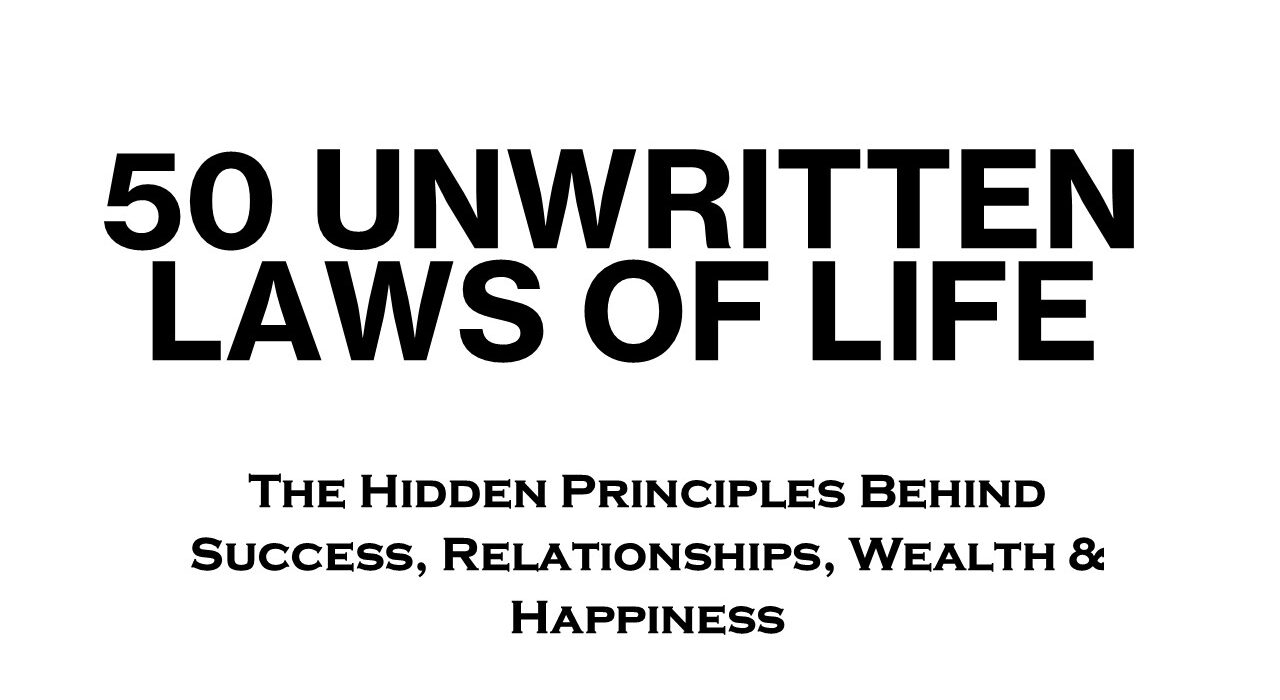
50 Unwritten Laws of Life: Timeless Principles for Success, Relationships, Wealth and Happiness
- BY Subhashis Banerji
- September 9, 2026
- 0 Comments
- 243 Views
Reading Time: 23 minutes
Contents
hide
1
50 Unwritten Laws of Life: Timeless Principles for Success, Relationships, Wealth and Happiness
50 Unwritten Laws of Life: Timeless Principles for Success, Relationships, Wealth and Happiness
INTRODUCTION
Why These Unwritten Laws of Life Matter More Than What Business School Teaches
Laws of Life Nobody Taught You in School—But They Shape Everything
Business schools teach you how to read balance sheets, optimize supply chains, and execute marketing strategies. Universities teach you theories, frameworks, and historical case studies. Corporate training programs teach you compliance, protocols, and technical skills.
But none of them teach you the laws that actually govern human experience.
Think about it. You’ve never sat in a classroom learning:
- Why the more you chase happiness, the more it eludes you
- Why the people who try hardest to control others end up losing them
- Why your boss notices your absence only when you leave early, not when you stay late
- Why the tool you drop always rolls to the least accessible corner
- Why every pay raise seems to vanish into taxes and lifestyle creep
- Why the moment you finally achieve your dream, you immediately want something else
These aren’t random observations. They’re patterns. Recurring, predictable patterns that have been observed across cultures, centuries, and contexts. They are laws of life—not in the sense of physical laws like gravity, but as reliable regularities in human behavior, relationships, success, and wellbeing.
This guide brings together four distinct streams of wisdom:
- Philosophical Insightsfrom thinkers like Wayne Dyer, Jiddu Krishnamurti, and Osho—who observed the inner workings of consciousness, relationships, and fulfillment.
- Psychological Truthsdrawn from behavioral science, cognitive psychology, and emotional intelligence research.
- Practical Observationsfrom the Murphy’s Law tradition—humorous but deadly accurate observations about how things actually work in the real world.
- Universal Principleslike the Law of Karma, the Compound Effect, and the Law of Consequences—timeless truths that transcend any single tradition.
Some of these laws will make you laugh. Some will make you uncomfortable. Some will feel like someone has been secretly watching your life.
All of them, if applied deliberately, can transform how you navigate relationships, build your career, create success, protect your health, and experience happiness.
Here’s the key distinction: These aren’t rigid formulas. They’re patterns to observe, understand, and work with—not against. The wisest people don’t fight these laws; they align with them.
This guide is organized into nine domains, each containing the most powerful and actionable laws drawn from all four wisdom streams. At the end, you’ll find a Complete Action Plan that synthesizes everything into daily practices.
Let’s begin.
PART ONE: Relationship Laws: The Hidden Principles Behind Love, Trust and Human Connection
“Research consistently shows that the quality of our relationships is the strongest predictor of happiness, resilience, health and even longevity. These laws explain why some relationships thrive while others repeatedly break down.”
The quality of your relationships determines the quality of your life. No success can compensate for failure in this domain.
Law 1: The Mirror Law: Why Relationships Reflect Your Inner World
How people treat you is their karma; how you react is yours. — Wayne Dyer
The Principle: The world is a mirror of your internal state. In relationships, you don’t attract what you want; you attract what you are. If you find yourself repeatedly encountering criticism, betrayal, or neglect, the common denominator is not “bad luck”—it’s the patterns you’re bringing to the interaction.
What It Reveals: Most people spend their energy trying to fix their partner’s behaviors, their colleague’s attitudes, or their friend’s shortcomings. This is like trying to clean a mirror by wiping the reflection. The source of the problem isn’t “out there”; it’s in how you see, interpret, and respond to what’s “out there.”
How to Use It:
- Stop attempting to fix others. Focus entirely on cultivating peace, patience, and non-defensiveness within yourself.
- When someone triggers you, ask: “What is this reaction revealing about me?”
- Clear your own resentments before addressing conflicts with others.
- Treat relationships as opportunities to practice unconditional giving rather than scorekeeping.
- Remember: You can’t give away what you don’t have. Cultivate self-love first—then you can offer genuine love, patience, and respect.
Law 2: The Self-Discovery Law: Every Relationship Reveals Something About You
Relationship is a mirror in which you discover yourself. — Jiddu Krishnamurti
The Principle: You don’t really know another person—you carry an accumulated image of them (yesterday’s arguments, old labels, projected expectations), and you relate to the image, not the person in front of you. Real relationship requires meeting each moment fresh, without the residue of past conditioning.
What It Reveals: Most relationship conflicts aren’t about the present moment. They’re about three-year-old grudges dressed up as today’s problems. Your triggers reveal more about you than about the other person. Every conflict is an opportunity for self-discovery.
How to Use It:
- In recurring conflicts, ask: “Am I reacting to today’s behavior or to a three-year-old grudge?”
- Watch your reactions (jealousy, control, neediness) without judgment or justification.
- Drop the psychological image you have constructed of your partner or colleague.
- Listen during conversations without formulating a counter-argument or defense while they are speaking.
- Self-knowledge dissolves conflict. True relatedness arises from understanding your own conditioning rather than trying to change the other person.
Law 3: The Freedom Paradox: Why Love Grows When Control Ends
Love dies when ownership begins. Give freedom; be loving rather than “in a relationship.” — Osho
The Principle: Love is a state of being, not a relationship or possession. The moment you need someone to behave a certain way for your own peace of mind, you’ve turned a relationship into a demand. Loosen the grip, and paradoxically the connection deepens because it isn’t running on obligation.
What It Reveals: Two “half” people clinging together create dependency, not intimacy. Two whole people choosing each other create relationship. Possession is the opposite of love—it’s fear disguised as affection. People who are free to leave are the ones who choose to stay.
How to Use It:
- Love without conditions or ownership.
- Celebrate the other’s happiness even if it doesn’t center on you.
- Encourage individuality, not conformity.
- Avoid controlling behavior disguised as care.
- Prefer open relatedness and friendliness over exclusive contracts that breed jealousy.
- Meditation helps you become a source of love rather than a seeker of it.
Law 4: The Emotional Bank Account
Every interaction is either a deposit or a withdrawal. — Stephen Covey
The Principle: Trust is built through consistent deposits—keeping promises, listening deeply, being reliable during difficult times. Withdrawals happen through broken promises, dismissive behavior, and unreliability. When the account is overdrawn, even small requests feel like demands.
What It Reveals: Most relationship breakdowns aren’t caused by dramatic betrayals. They’re caused by slow, steady erosion—small withdrawals that accumulate until the account is empty. People don’t leave over one thing; they leave over the thousand things that came before.
How to Use It:
- Praise publicly; criticize carefully and privately.
- Express gratitude frequently and specifically.
- Keep your promises, no matter how small.
- Listen deeply before offering solutions.
- Be reliable during difficult times—that’s when deposits count most.
- Recognize that every interaction is either building or eroding trust.
Law 5: The Reciprocity Law
People tend to return what they receive.
The Principle: Human beings are wired for reciprocity. Give respect, and people generally return it. Offer help, and people feel obligated to help in return. This isn’t manipulation; it’s the natural social glue that holds communities together.
What It Reveals: If you’re consistently not getting what you want from relationships, examine what you’re consistently giving. Are you giving criticism? You’ll get defensiveness. Are you giving indifference? You’ll get distance. Are you giving respect? You’ll get respect in return—not always, but most of the time.
How to Use It:
- Give respect first, without waiting to earn it.
- Offer help before asking for it.
- Be the person who initiates positive energy, rather than reacting to others’ moods.
- Don’t keep score, but do pay attention to patterns.
- If someone consistently fails to reciprocate, adjust your investment accordingly.
Law 6: The 90/10 Relationship Law
Most relationship problems are not about the event but about how people react to it.
The Principle: When something goes wrong in a relationship (a forgotten anniversary, a harsh word, a missed commitment), 10% is the event itself. The other 90% is how each person reacts to the event. Most relationship damage isn’t caused by what happened; it’s caused by the reactive spiral that follows.
What It Reveals: The person who can pause before reacting—who can choose their response rather than being controlled by their impulse—holds immense power in any relationship. Reactions escalate; responses de-escalate.
How to Use It:
- Respond instead of react. Pause before emotional decisions.
- When you feel triggered, take a breath (or a walk) before speaking.
- Recognize that most conflicts are about how things are said, not what’s being said.
- If you’re both reacting, call a time-out and come back when calmer.
- Practice saying: “I need a moment to think about this before I respond.”
Law 7: The Visibility Principle
The probability of meeting someone you know increases when you are with someone you don’t want to be seen with. — Ruby’s Principle
The Principle: Life has a cruel sense of humor. The moments you most want to be invisible are the moments you’re most likely to be seen. Trying to manage your image is exhausting and self-defeating.
What It Reveals: Secrecy amplifies awkwardness. The energy you spend trying to hide something is energy you could spend on being authentic. The people worth keeping don’t need the performance.
How to Use It:
- Assume total visibility at all times.
- Operate with complete integrity in public and private.
- Ensure you are never in a scenario or state you would feel compelled to hide.
- Build relationships on transparency rather than image management.
- Remember: The people who would judge you for being human aren’t your people.
Law 8: The Law of Appreciation
What grows is what is appreciated.
The Principle: People thrive where they feel seen, valued, and respected. Recognition is not a soft skill; it’s one of the most powerful motivators available to any leader, partner, or friend.
What It Reveals: Most people are starved for genuine appreciation. They can go days, weeks, even years without hearing “I see you, I value you, I’m grateful for you.” A few seconds of sincere appreciation can buy months of loyalty, effort, and goodwill.
How to Use It:
- Express gratitude frequently and specifically—”Thank you for handling that difficult client call; your patience was remarkable” is far more powerful than “Thanks.”
- Praise publicly whenever possible; the impact multiplies when others witness appreciation.
- Criticize carefully and privately—and always pair it with genuine recognition of strengths.
- Notice small efforts, not just big accomplishments.
- Ask yourself daily: “Who have I appreciated today?”
PART TWO: Career Success Laws: How High Performers Build Influence, Growth and Opportunity
Your career is not just about earning a living—it’s about expressing your unique contribution to the world.
Law 1: The Visibility Paradox: Why Hard Work Alone Doesn’t Get You Promoted
The less important you are to the corporation, the more your absence is noticed. — Kauffman’s Paradox
The Principle: Junior and operational roles get noticed the moment they’re gone (the coffee machine, the reports, the calendar invites), while senior strategic contributions are invisible until a crisis proves their absence. The CEO can take a month off and no one bats an eye; the office manager takes a day off and chaos ensues.
What It Reveals: Being “indispensable” in operational ways is often thankless work. If your absence is immediately noticed, it may mean you’re doing the work that others take for granted—not the work that advances your career. True leverage comes from making yourself systemically essential (only you know the code/password/client relationship) rather than just chronically present.
How to Use It:
- Don’t confuse “being noticed” with “being valued.”
- Focus your effort on deep-work outputs that directly drive key metrics.
- Document your contributions and impact so they’re visible even when you’re present.
- Build systems that reduce your operational indispensability while increasing your strategic value.
- Ask yourself: “If I were gone for a month, what would fall apart—and is that the right thing to be known for?”
Law 2: The Presence Fallacy
When leaving work late, you will go unnoticed. When you leave early, you will meet the boss in the parking lot. — Lampner’s Law of Employment
The Principle: Presence is mistaken for productivity. People who work long hours are assumed to be working hard, regardless of actual output. People who leave early are assumed to be slacking, regardless of their actual contribution.
What It Reveals: There is a profound visibility bias in performance evaluation. The unfairness of presence being read as productivity is one of the most persistent distortions in professional life. But complaining about it doesn’t help; managing the perception does.
How to Use It:
- Rely on documented deliverables and outcome-based metrics rather than visual presence.
- Communicate your accomplishments proactively and regularly.
- If you leave early, carry a file or laptop and look intensely focused—you’re not “leaving early,” you’re “taking the work home to solve a crisis.”
- Manage your visibility strategically: make sure your contributions are seen, not just your chair.
- Build a reputation for results, not hours.
Law 3: The Coffee Paradox
As soon as you sit down to a cup of hot coffee, your boss will ask you to do something, which will last until the coffee is cold. — Owen’s Law
The Principle: The universe has a sense of humor about personal breaks. The moment you finally sit down to rest, something urgent will arise. The moment you leave your desk, someone will come looking for you. The moment you take a personal call, an important client will call.
What It Reveals: Friction is inevitable. The question isn’t “Will interruptions happen?” but “How will you manage them?” People who expect friction are less frustrated by it. People who design for it are more effective despite it.
How to Use It:
- Plan buffers into your schedule. Don’t book back-to-back meetings.
- Communicate proactively about your availability and priorities.
- When something urgent arises mid-task, note where you left off so you can restart efficiently.
- Protect focused work time: block it on your calendar and honor it.
- Recognize that your time is yours to manage—not to be managed by whoever interrupts loudest.
Law 4: The Salary Illusion: Why More Income Doesn’t Always Create More Wealth
The pay raise is just large enough to increase your taxes and just small enough to have no effect on your take-home pay. — The Salary Axiom
The Principle: Each raise pushes you into a higher tax bracket, but lifestyle inflation consumes the rest. You feel richer briefly, but within months, your expenses rise to meet your new income, and you feel exactly the same as before.
What It Reveals: Money is a trap if you don’t structure it. Gross salary is a vanity metric; net worth and financial freedom are what matter. Most people negotiate for a bigger number without understanding how little of that number actually changes their lives.
How to Use It:
- Stop chasing gross salary. Chase benefits, flexibility, and equity.
- Negotiate for an expense account, car allowance, or professional development budget before you negotiate for a raise—these are often tax-free.
- Automatically redirect every salary increase, bonus, or raise directly into income-generating assets before it hits your liquid spending account.
- Resist lifestyle inflation: increase your investments before you increase your expenses.
- Understand your actual take-home pay and negotiate from that reality.
Law 5: The Achievement Paradox: Why Success Never Feels Like Enough
As soon as you start doing what you always wanted to be doing, you’ll want to be doing something else. — First Law of Living
The Principle: This is the biological nature of desire—the hedonic treadmill. You can’t escape it, but you can understand it. The human mind is wired to seek novelty. The moment one goal is achieved, the mind creates another.
What It Reveals: If you think the next promotion, the next job, or the next achievement will finally make you satisfied, you’re wrong. The satisfaction is temporary. The mind moves the goalpost. The only sustainable satisfaction comes from enjoying the process, not the prize.
How to Use It:
- Stop chasing the goal and start chasing the process.
- Instead of saying “I will be happy when I get the promotion,” say “I am happy because I am learning how to lead.”
- Fulfillment is in the practice, not the prize.
- Recognize that your mind will always want something else—acknowledge it, but don’t obey it.
- Fall in love with the daily work, not just the quarterly results.
Law 6: The Comparison Trap: How Comparing Yourself Destroys Career Satisfaction
Most career dissatisfaction is manufactured by comparison. — Krishnamurti’s Law of Comparison
The Principle: You don’t experience your career in isolation. You experience it in comparison to others—colleagues who got promoted faster, peers who started companies, competitors who seem to be winning. This comparison guarantees perpetual lack because there’s always a “further ahead.”
What It Reveals: Comparison is a thief of joy, but it’s also a thief of effective strategy. When you’re constantly looking sideways, you’re not looking forward at your own path. The most successful people run their own race, not benchmarking against the incumbent.
How to Use It:
- Measure yourself against your own progress, not others’ milestones.
- Recognize that everyone’s path is different—and that you only see the highlight reel, not the struggles.
- When you feel envy, ask: “What is this envy telling me about what I truly want?”
- Compete with who you were yesterday, not with who someone else is today.
- The only meaningful comparison is between your current self and your potential self.
Law 7: The Learning Curve Law
The more you learn, the more valuable you become.
The Principle: Career growth follows the Compound Effect. Small daily investments in learning compound over time into extraordinary expertise. The person who reads 20 pages a day reads 30 books a year. The person who spends 30 minutes a day on a new skill masters it in months.
What It Reveals: Most people overestimate what they can achieve in a year and underestimate what they can achieve in a decade. Career success is not about occasional heroic efforts; it’s about consistent, daily investment in skills, relationships, and reputation.
How to Use It:
- Invest in skills before chasing promotions.
- Read 20 pages daily. Learn one new thing daily.
- Network consistently, not just when you need something.
- Build your reputation one small positive interaction at a time.
- Treat learning as a non-negotiable daily habit.
Law 8: The Law of Value
Income is proportional to the value you create.
The Principle: The market pays for solutions, not effort. You can work 80 hours a week, but if you’re solving small problems, you’ll earn small rewards. If you solve bigger problems for more people, you’ll earn bigger rewards.
What It Reveals: Most career frustration comes from confusing effort with value. You feel you deserve more because you work so hard—but the market doesn’t care how hard you work; it cares what problem you solve. Shift your focus from effort to impact.
How to Use It:
- Focus on high-impact activities, not just busy work.
- Identify the biggest problems in your organization or industry and work on solving them.
- Stop selling features; solve problems.
- Ask yourself: “What problem am I solving? How many people does it affect? How much better is the solution than the alternatives?”
- Increase your impact and watch your income follow.
PART THREE: Business Success Laws: Why Great Systems Beat Great Intentions
Business success is not about avoiding failure—it’s about designing systems that make success more likely and failure less damaging.
Law 1: Murphy’s Law in Business: Why Every Success Needs a Backup Plan
Anything that can go wrong will go wrong—often at the worst possible time. — Murphy’s Law
The Principle: Murphy’s Law is not a superstition; it’s a design principle. If you plan assuming everything will go perfectly, you will be repeatedly surprised. If you plan assuming things will go wrong, you will be prepared.
What It Reveals: Successful professionals don’t avoid Murphy’s Law; they prepare for it. The person who expects friction is less frustrated by it. The person who designs for failure is more resilient to it.
How to Use It:
- Always have backups—for files, for key employees, for critical systems.
- Build contingencies into every plan. Add time buffers. Add budget reserves.
- Communicate proactively about potential risks.
- Test your systems under pressure before they matter.
- Recognize that failure is inevitable; the question is how quickly you recover.
Law 2: The Queue Paradox
If you change queues, the one you have left will start to move faster than the one you are in now. — O’Brien’s Variation Law
The Principle: The grass is always greener on the other side—and the moment you move to the other side, your old side suddenly looks better. This applies to business strategy, career moves, and investment decisions.
What It Reveals: If you pivot your business model to chase a new trend, your old model will suddenly become profitable again. If you change jobs, your old company will suddenly offer the promotion they wouldn’t give you. This is a psychological trap, not a market reality.
How to Use It:
- Stop constantly optimizing every minor micro-decision in search of a quick advantage.
- Pick a sound strategy, commit to it, and stay the course through temporary delays.
- Diversify your bets. Never fully abandon your “old queue” until the new one has proven itself over a 6-month period.
- Recognize that hindsight makes all decisions look obvious—but you don’t get the benefit of hindsight in the moment.
Law 3: The Demo Effect
When attempting to prove to someone that a machine doesn’t work, it will function perfectly. — Willoughby’s Law
The Principle: In business, this is the “Demo Effect.” Never rely on impromptu, live demonstrations to prove a failure—or a success. The universe seems to reserve failure for the moments you can least afford it.
What It Reveals: High-stakes demonstrations (pitch meetings, product launches, executive presentations) are high-risk. The pressure changes performance. The audience’s skepticism can become a self-fulfilling prophecy. The only safe demonstration is one with redundancy and rehearsal.
How to Use It:
- Never give a live demo of new software to a client without a backup plan.
- Always underpromise and overdeliver in demonstrations.
- Capture systematic diagnostic data, hard logs, and video proof asynchronously before presenting operational issues.
- Build in redundancy and rehearsal precisely because the universe seems to reserve failure for the moments you can least afford it.
- If you tell the client “This might crash,” it will run perfectly. If you say “This is bulletproof,” it will crash.
Law 4: The Tool Gravity Law
Any essential tool, when dropped, will roll to the least accessible corner. — Anthony’s Law of the Workshop
The Principle: The more urgently you need a tool, file, or person, the harder it will be to find. Friction is never convenient. The worst time to look for something is when you need it most.
What It Reveals: Design for accessibility. The systems that work best are the ones that make the right tools easy to find and the wrong tools hard to reach. This applies to files, people, decisions, and processes.
How to Use It:
- Build redundancy and fail-safes into critical workflows.
- Never design a process where a single point of failure (or one lost asset/file) brings the entire operation to a standstill.
- Organize your workspace, digital files, and processes so that the most important things are the easiest to access.
- Anticipate friction and prepare for it.
- The best system is the one that works when you’re stressed and rushing.
Law 5: The Flawed Input Paradox
When you dial a wrong number, you never get an engaged tone—it connects seamlessly to the wrong destination. — Kovac’s Conundrum
The Principle: Flawed inputs execute just as smoothly as correct ones. A wrong number connects instantly; a wrong assumption leads to confident action; a flawed strategy can be followed with full commitment.
What It Reveals: Error-ridden processes run to completion just as fast as correct ones. The damage from bad assumptions often doesn’t show up until much later. Validation is not optional; it’s essential.
How to Use It:
- Validate assumptions thoroughly before launching an initiative.
- Treat data with skepticism: where did it come from? Is it accurate? Is it still relevant?
- Test contract terms carefully before signing.
- Build validation checkpoints into your processes.
- Recognize that speed without accuracy is just speed toward the wrong destination.
Law 6: The Law of Value (Business Version)
The market pays for solutions, not effort.
The Principle: This bears repeating in the business context. Customers don’t care how hard you worked on a product; they care whether it solves their problem. Investors don’t care how passionate you are; they care whether the numbers work. The market is ruthlessly focused on value delivered.
What It Reveals: Many businesses fail because they build products they love, not products the market needs. The distinction between “what I want to build” and “what people will pay for” is the difference between a hobby and a business.
How to Use It:
- Focus on customer pain points, not your preferred features.
- Stop selling features; solve problems.
- Test your value proposition before you build: ask customers what they’d pay for, then build it.
- Measure what matters: revenue, retention, referrals—not just activity, engagement, or “interest.”
Law 7: The Trust Equation: The Hidden Formula Behind Business and Leadership Success
Trust = Competence + Character + Consistency.
The Principle: Trust is not abstract; it’s calculable. People trust you when they believe you can deliver (competence), when they believe you have good intentions (character), and when you deliver the same quality every time (consistency).
What It Reveals: The most common trust breach isn’t a scandal; it’s a pattern of small inconsistencies. When you promise and don’t deliver, when your quality fluctuates, when you say one thing and do another—trust erodes. It’s not the big betrayals that kill relationships; it’s the slow erosion.
How to Use It:
- Deliver results repeatedly. Consistency builds trust faster than occasional brilliance.
- Protect your reputation obsessively. It’s the most valuable asset you own.
- Be reliable—show up on time, keep your promises, do what you say you’ll do.
- When you make a mistake, own it immediately and transparently.
- Trust takes years to build and moments to destroy.
Law 8: The Adaptation Imperative
What worked yesterday eventually stops working.
The Principle: Every successful strategy has an expiration date. The market changes. Technology advances. Competitors adapt. Customer preferences shift. What was a competitive advantage last year is table stakes this year and irrelevant next year.
What It Reveals: The graveyard of business is filled with companies that did what worked—until it didn’t. Adaptation isn’t optional; it’s survival. The best time to reinvent is before necessity forces it.
How to Use It:
- Reinvent before necessity forces it.
- Stay curious about what’s changing in your industry.
- Treat your current success as temporary unless you keep evolving.
- Build a culture of experimentation and learning.
- Recognize that disruption comes from outside the industry as often as inside—look beyond your competitors.
PART FOUR: Wealth-Building Laws: Timeless Principles for Financial Freedom
Money is not the goal—it’s a tool. But mastering the tool allows you to focus on the goal.
Law 1: The Compound Effect: The Most Powerful Wealth-Creation Law Ever Discovered
Small gains accumulate exponentially.
The Principle: This is the most powerful force in wealth creation. A small investment today compounds into a large sum over time. A small improvement daily compounds into extraordinary results. The key variable is not the size of the investment; it’s the time horizon.
What It Reveals: Most people underestimate the power of small, consistent actions. They look for shortcuts, get-rich-quick schemes, or the one big break. But wealth (and most achievements) is built on the Compound Effect—small actions repeated daily that become invisible until they suddenly become undeniable.
How to Use It:
- Invest early and consistently. Time in the market beats timing the market.
- Automate your savings and investments so you can’t spend what you don’t see.
- Improve continuously, not heroically. 1% better every day is 37x better in a year.
- Build habits, not occasional efforts.
- Recognize that the most powerful force in wealth creation is patience.
Law 2: The Wealth Retention Law: Why Keeping Money Is Harder Than Making It
Making money and keeping money require different skills.
The Principle: Many people make money quickly and lose it just as quickly. The skills that create wealth—risk-taking, innovation, hustle—are not the same skills that preserve wealth—discipline, patience, risk management.
What It Reveals: The most common wealth mistake isn’t not earning enough; it’s not keeping what you earn. Lifestyle inflation, bad investments, unnecessary debt, and lack of financial discipline drain more wealth than market downturns ever could.
How to Use It:
- Automatically redirect every salary increase, bonus, or raise directly into income-generating assets.
- Control spending aggressively. The question isn’t “Can I afford this?” but “Does this align with my wealth-building goals?”
- Avoid unnecessary debt. Borrow only for appreciating assets, not depreciating ones.
- Learn the skills of wealth preservation: budgeting, investing, tax optimization, risk management.
- Understand that financial freedom is about freedom from the need to earn—not about having a bigger number.
Law 3: The Delayed Gratification Law
People willing to wait often achieve more.
The Principle: The ability to delay gratification—to trade a smaller reward now for a larger reward later—is one of the strongest predictors of life success, according to decades of research. This applies to money, relationships, and career.
What It Reveals: Most people are prisoners of the present. They want what they want right now. The people who can pause, evaluate, and choose long-term benefit over short-term pleasure—those are the ones who build wealth, health, and meaningful relationships.
How to Use It:
- Prioritize long-term gains over immediate pleasure.
- Before every spending decision, ask: “Will this matter in five years?”
- Build systems that make delayed gratification easier (automated savings, scheduled investments).
- Celebrate progress on long-term goals, not just immediate achievements.
- Recognize that your future self is depending on your current choices.
Law 4: The Lifestyle Creep Warning
Raises often feel smaller than expected because lifestyle inflation consumes income growth.
The Principle: Each time you earn more, your spending tends to rise to meet your new income. The result: you feel richer briefly, but within months, your expenses have grown and you feel exactly the same as before.
What It Reveals: The trap of lifestyle inflation is that it’s almost invisible. You don’t buy a yacht overnight; you buy slightly nicer coffee, slightly better meals, slightly bigger homes, slightly fancier cars. Each decision seems harmless; collectively, they consume your raises and keep you stuck.
How to Use It:
- Increase your investments before you increase your expenses.
- Treat every raise as an opportunity to build wealth, not to upgrade lifestyle.
- Create a “one-up, one-down” rule: for every lifestyle upgrade, increase your investments by the same amount.
- Recognize that lifestyle inflation is the enemy of financial freedom.
- The goal isn’t to earn more; it’s to keep more of what you earn.
PART FIVE: Happiness Laws: The Psychology of Joy, Meaning and Fulfillment
Happiness is not something you find; it’s something you bring.
Law 1: The Law of Attraction of Character
You don’t attract what you want; you attract what you are. — Wayne Dyer
The Principle: The world is a mirror of your internal state. If you’re always stressed, you’ll attract stressed situations. If you’re always expecting disappointment, you’ll find it. If you’re at peace, you’ll see opportunities for peace. Your dominant inner state—not your stated goals—is what your outer circumstances tend to mirror back.
What It Reveals: Most people focus on changing their circumstances to change their feelings. But circumstances change all the time, and feelings follow. The reverse is also true: change your feelings, and your circumstances will shift to match. Not magically—but because your perception, decisions, and interactions change.
How to Use It:
- Focus on becoming the person capable of sustaining success.
- Cultivate an inner state of abundance—gratitude, generosity, trust—and watch opportunities align.
- Don’t chase happiness; bring it. Happiness is something you are, not something you get.
- Practice gratitude intentionally. It shifts your internal baseline.
- Remember: Chronic scarcity-thinking attracts scarcity-shaped decisions; a genuine sense of abundance changes the risks you’re willing to take.
Law 2: The Present Moment Law: Why Most Anxiety Lives in the Future
Psychological time—reliving the past, rehearsing the future—is the primary source of suffering. — Krishnamurti
The Principle: Happiness isn’t found later, after the achievement. It’s only ever available now, and most people postpone it indefinitely while chasing “later.” The mind that lives in the past suffers regret; the mind that lives in the future suffers anxiety. Peace exists only in the present.
What It Reveals: Your mind is a time machine that’s almost always broken. It’s either replaying old wounds or rehearsing future disasters. Neither is real. The only reality is this moment—and this moment contains everything you need for peace, if you would just be here.
How to Use It:
- Stop postponing happiness. It’s not waiting at the finish line; it’s available in the journey.
- Practice presence: when you eat, just eat. When you walk, just walk. When you’re with someone, be with them completely.
- When you notice your mind racing to the future or the past, gently bring it back to now.
- Recognize that achievement doesn’t create happiness; happiness creates the conditions for better achievement.
- The future is just a thought; the past is just a memory. This moment is your life.
Law 3: The Law of Non-Resistance
Suffering is the gap between what is happening and your refusal to accept that it’s happening. — Wayne Dyer, echoing Taoist thought
The Principle: Acceptance is not passivity—it’s the fastest route to clear-headed action. The energy you waste resisting reality isn’t available for changing it. When you accept what is, you free your energy to respond intelligently.
What It Reveals: Most suffering isn’t caused by what happened; it’s caused by your refusal to accept what happened. You can’t change the past. You can’t control other people. You can’t control the market, the weather, or luck. What you can control is your response—but only if you stop fighting what is.
How to Use It:
- Stop burning emotional energy resisting reality.
- Accept the exact circumstances of the present moment immediately.
- From acceptance, take calm, deliberate action.
- Ask: “What is within my control right now?” Focus there.
- Recognize that acceptance and action are not opposites; acceptance enables effective action.
Law 4: The Hedonic Adaptation Law: Why Achievements Stop Making Us Happy
Humans quickly get used to improvements.
The Principle: After a brief burst of pleasure, you return to your baseline. A new car, a promotion, a bigger house—the thrill fades. This is biological and unavoidable. You can’t escape it, but you can understand it.
What It Reveals: If you think the next achievement will finally make you satisfied, you’re wrong. Satisfaction is a skill, not a destination. The most consistently happy people don’t chase bigger and better; they practice gratitude for what they have.
How to Use It:
- Practice gratitude intentionally. It’s the antidote to hedonic adaptation.
- Avoid constant comparison—it’s the thief of joy and the fuel of dissatisfaction.
- Recognize that the thrill of achievement is temporary; the meaning of the achievement is what lasts.
- Celebrate progress, not just completion.
- Ask daily: “What am I grateful for right now?”
Law 5: The Law of Celebration
Most people treat happiness as a reward to be earned through achievement, when it should be treated as background music. — Osho
The Principle: Osho argued that happiness is not a goal to be achieved but a way of being. It’s not the price of admission for success; it’s the way you do the work. Celebrate the small things, the daily things, the ordinary things. This is not a technique; it’s a choice.
What It Reveals: You’re waiting for the “big day” to celebrate—the promotion, the sale, the milestone. But life is mostly ordinary days. If you can’t celebrate the ordinary, you’ll spend most of your life unhappy. Celebration isn’t about the event; it’s about the attitude you bring to the event.
How to Use It:
- Celebrate the mundane—the morning coffee, the walk to the car, the small win.
- Treat success as a byproduct of celebration, not the price of admission for it.
- Cultivate gratitude as a daily practice, not just when things go well.
- Ask
PART SIX: Emotional & Mental Health Laws
Law of Resistance – What you resist persists.
Law of Attention – Energy flows where attention goes.
Emotional Contagion Law – You become the emotional average of your environment.
Law of Observation (Krishnamurti) – Observation without judgment creates transformation.
PART SEVEN: Health & Wellbeing Laws
Law of Use and Disuse – Use it or lose it.
Recovery Law – Growth happens during recovery.
Consistency Law – Health is built by habits, not heroic efforts.
Stress-Recovery Cycle – Health habits + Wellness + Healthy lifestyle => Longevity
PART EIGHT: Leadership Laws
Law of Example – People do what leaders do.
Law of Influence – Leadership is influence, not position.
Law of Trust
Law of Responsibility – Leadership skills + Leadership development + Influence
PART NINE: Fulfillment & Meaning Laws
Osho’s Law of Authenticity – The greatest suffering comes from being someone else.
Krishnamurti’s Freedom Law – Freedom begins where dependence ends.
Law of Contribution – Fulfillment comes from contribution more than consumption.
Law of Purpose – Meaning sustains what motivation cannot.
The Grand Unified Law of Life
The Law of Consequences – Thoughts become actions. Actions become habits. Habits become character. Character becomes destiny.
All The following are Consequences: Consequence of adhering to all the laws given in tis article
- Relationships are consequences.
- Careers are consequences.
- Wealth is a consequence.
- Happiness is a consequence.
- Health is a consequence.
Before You Go: One Final Thought
The most powerful law in this entire guide is also the simplest:
The Law of Application
Knowledge without action is just entertainment. Wisdom without practice is just trivia.
You now have access to decades of distilled wisdom—from Dyer, Krishnamurti, Osho, Murphy, and countless others. You have the what and the how.
The only remaining question is:
What will you do with it starting today?
Your Quick-Start Action Plan
If you feel overwhelmed by the volume, here’s a simple 30-day entry point:
| Week | Focus Area | One Daily Practice |
| 1 | Relationships | Pause before reacting. Ask: “Am I reacting to today or to a 3-year-old grudge?” |
| 2 | Career | Document one visible win daily. Make your contributions seen, not just your chair. |
| 3 | Happiness | Practice gratitude: write down 3 things you’re grateful for every morning. |
| 4 | Health | Prioritize recovery: 7+ hours of sleep and one 20-minute movement break daily. |
The Grand Master Law (Recap)
Sow a thought, reap an action.
Sow an action, reap a habit.
Sow a habit, reap a character.
Sow a character, reap a destiny.
Most people spend their lives trying to change outcomes.
The most successful, healthy, fulfilled, and happy people focus on changing the causes.
Final Call to Action
Pick ONE law from this guide.
Just one.
Apply it deliberately for the next 30 days.
Observe what changes.
Then pick another.
That’s how you build a life—not by reading about transformation, but by living it, one small shift at a time.
What You Can Do Next
✅ Bookmark this guide – Return to it whenever life feels chaotic or uncertain.
✅ Share it with someone – The people who need this wisdom are often the ones who never learned it.
✅ Print it out – Keep it on your desk, by your bed, or in your journal.
✅ Revisit it quarterly – Your life changes; so should your application of these laws.
You now hold one of the most comprehensive life guides available anywhere.
The question isn’t whether you know these laws anymore.
It’s whether you’ll live them.
Life Is Not Random
Relationships are not random.
Career success is not random.
Wealth is not random.
Happiness is not random.
Fulfillment is not random.
While luck and circumstance matter, much of life follows recognizable patterns.
The people who flourish are not necessarily the smartest, richest, or most talented.
They are often the people who learn to recognize these patterns and align their actions with them.
The laws of life do not guarantee success.
But understanding them dramatically improves the odds of building a life that is meaningful, prosperous, healthy, connected, and deeply fulfilling.
With gratitude for the journey we’ve shared in building this,
Your Partner in Wisdom
P.S. – If there’s ever a specific area (a relationship challenge, a career crossroads, a health goal) where you’d like a customized implementation plan using these laws, just ask. This guide is alive—it grows with your needs. 🙌
Subhashis Banerji [Author]
Leadership assessor, strategist, and writer. I help professionals and organizations make smarter decisions by learning to read patterns, not promises.
📘 Read all my articles here:
👉 https://successunlimited-mantra.net/ & https://successunlimited-mantra.com/index.php/blog PLUS on https://relationshipandhappiness.com/
💼 Connect with me on LinkedIn: https://www.linkedin.com/in/subhashis-banerji-21b1418/
Related posts:
- How to Become Emotionally Strong and Mentally Resilient: An Evidence-Based Guide for Difficult Times
- Your Current Position Is Not Your Final Destination: How to Reinvent Your Life, Career, Business and Relationships at Any Age
- How to Beat Competitors Without Attacking Them: The Psychology of Becoming the Obvious Choice
- The Unbearable Anxiety of Being Ordinary: How FOMO, Comparison and the Exceptionalism Trap Are Stealing Our Happiness


– Please read our Comment Policy