

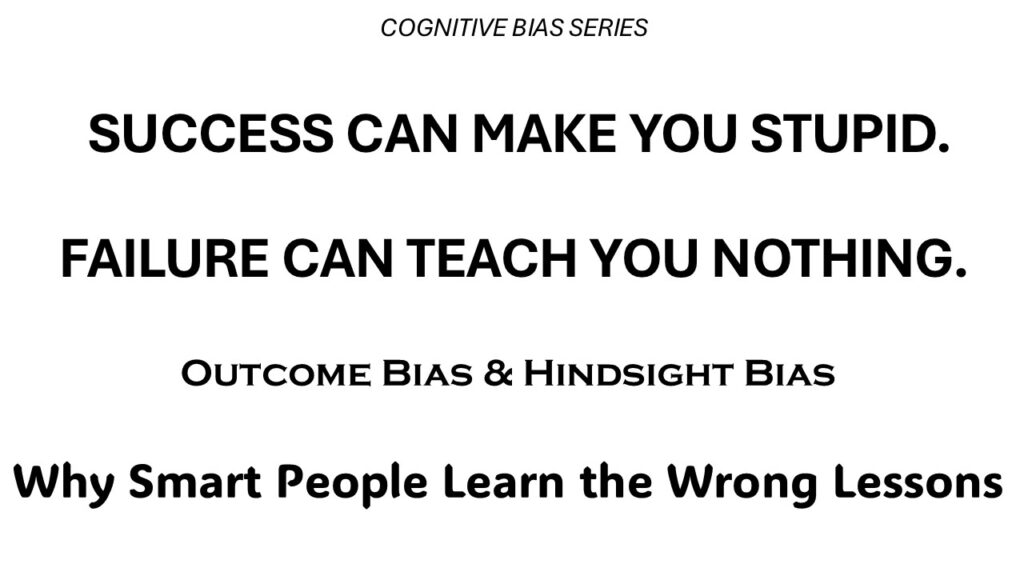
Outcome Bias & Hindsight Bias: Why Smart People Learn the Wrong Lessons from Success and Failure
- BY Subhashis Banerji
- September 16, 2026
- 0 Comments
- 48 Views
Reading Time: 28 minutes
The Two Thinking Errors That Make Smart People Repeat the Same Mistakes
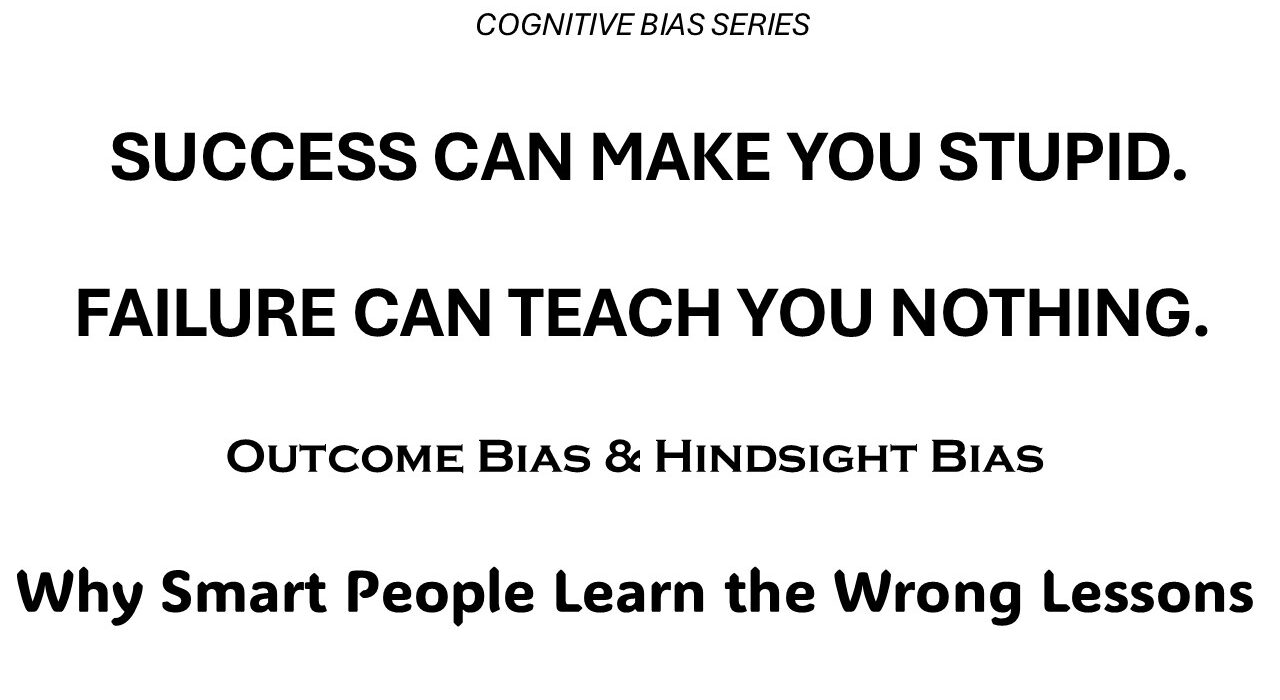
Outcome Bias & Hindsight Bias: Why Success Can Mislead You and Failure Can Teach You Nothing
OUTCOME BIAS & HINDSIGHT BIAS: The Complete Guide to Recognition, Prevention, and Mastery
A Comprehensive Action Plan for Unparalleled Learning, Decision-Making, and Problem-Solving
Most people do not learn from experience; they learn from their interpretation of experience, and Outcome Bias and Hindsight Bias often cause them to learn exactly the wrong lessons.
Introduction
Have you ever made a terrible decision that somehow worked out brilliantly?
Or made a thoughtful, carefully researched decision that failed miserably?
If so, you have encountered one of the most dangerous traps in human thinking.
Most people believe they learn from experience.
They don’t.
They learn from their interpretation of experience.
And that interpretation is often distorted by two invisible psychological forces: Outcome Bias and Hindsight Bias.
These biases quietly influence how leaders evaluate employees, how investors judge markets, how organizations conduct post-mortems, how parents assess their choices, how couples interpret relationships, and how individuals make sense of success and failure.
They reward luck and punish sound judgment.
They create false confidence after success and unnecessary regret after failure.
They convince us that events were predictable when they were not and that results prove wisdom when they often prove nothing more than chance.
The consequence is profound.
Organizations repeat preventable mistakes.
Leaders reward the wrong behaviors.
Investors confuse luck with skill.
Relationships learn the wrong lessons.
And individuals become trapped in cycles of poor judgment while believing they are becoming wiser.
This comprehensive guide explores Outcome Bias and Hindsight Bias through the lenses of psychology, behavioral economics, decision science, leadership, investing, relationships, and problem-solving.
More importantly, it provides practical frameworks to recognize these biases, prevent them from corrupting learning, and build a process-focused mindset capable of making better decisions under uncertainty.
Because the quality of your future depends far less on what happened—and far more on how you think about what happened.
What Is Outcome Bias? The Hidden Mistake That Rewards Luck
Outcome Bias is the cognitive tendency to judge the quality of a decision based solely on its eventual result, rather than the logic, process, information, and probabilities available at the time the decision was made.
First formally documented by Jonathan Baron and John Hershey (1988) in their landmark study, where participants judged an identical decision-making process as “better” when a coin-flip-style outcome happened to turn out well—even though the reasoning behind the decision hadn’t changed at all. This is the core finding: same process, same information, same logic—but a different outcome completely flipped people’s judgment of whether the decision itself was sound.
In simple terms:
- “Good outcome = Good decision”
- “Bad outcome = Bad decision”
This is often completely wrong.
A decision can produce any combination:
| Decision Quality | Outcome |
| Good | Good |
| Good | Bad |
| Bad | Good |
| Bad | Bad |
Outcome bias assumes only the first and last combinations exist.
The Core Principle
The quality of a decision should be judged by:
- Information available at the time
- Logic used
- Risks considered
- Alternatives evaluated
- Probability assessment
- Decision process
—not by what happened afterward.
Poker player and decision scientist Annie Duke calls this phenomenon “resulting” —mistaking the quality of a decision for the quality of its outcome. Her key metaphor: you cannot judge a poker player’s skill by a single hand. A brilliant fold can lose money; a terrible call can win the pot. Judging skill requires looking at the decision process across many trials, not one result.
What Is Hindsight Bias? Why Everything Looks Obvious After It Happens
Hindsight Bias (the “I-knew-it-all-along” phenomenon) is the psychological inclination to view past events as having been predictable or inevitable after the outcome is already known. It causes individuals to retroactively alter their memory of what they originally believed or knew.
First empirically demonstrated by Baruch Fischhoff (1975) , often called the father of hindsight-bias research. Fischhoff found that once people learned the actual outcome of a historical event, they systematically overestimated the probability they (or others) would have assigned to that outcome beforehand—a phenomenon he termed “creeping determinism.”
Core Mechanism
Before event:
“Maybe.”
After event:
“Obviously.”
The uncertainty disappears from memory.
Three Components Researchers Distinguish
(Blank, Musch & Pohl, 2007; Roese & Vohs, 2012):
- Memory distortion—misremembering your own prior prediction as closer to the actual outcome than it was
- Foreseeability—believing the outcome was foreseeable, even if you personally didn’t foresee it
- Inevitability—believing the outcome was bound to happen, given the antecedent conditions
Why Outcome Bias and Hindsight Bias Destroy Learning
These biases are psychological cousins that function as a closed loop, corrupting feedback mechanisms:
text
[Uncertain Decision Made]
↓
[Outcome Occurs]
↓
[Hindsight Bias] ← Falsely claims outcome was “obvious” all along
↓
[Outcome Bias] ← Judges decision quality based on that “obvious” result
↓
[SYSTEMIC LEARNING BLOCKED]
How They Work Together
Hindsight bias distorts memory and perception of predictability—it convinces you (after the fact) that the result was obvious, that the “signs were all there.”
Outcome bias then uses that manufactured predictability as a moral/competence judgment—”since it was so obviously going to fail, choosing it was foolish” or “since it obviously would work, choosing it was brilliant.”
The Result
Hindsight bias erases the genuine uncertainty, noise, and incomplete information present when the choice was made. Outcome bias assigns moral or intellectual weight to that rewritten history, rewarding reckless gambles that hit and penalizing sound, probabilistic reasoning that suffered bad luck.
Together they create a feedback loop that erases uncertainty from history. The person doing the judging (or the original decision-maker looking back at themselves) reconstructs the past as though the fog of uncertainty never existed—and then punishes or rewards based on that false clarity. This is why organizations, teams, and individuals often fail to learn the right lessons from experience: they learn from the scoreboard instead of from the process.
Why Outcome Bias and Hindsight Bias Destroy Learning
Learning requires asking:
“What was the quality of the process?”
Bias asks:
“Did it work?”
These are completely different questions.
The Destruction Mechanism
| What Happens | Why It Destroys Learning |
| Good processes that suffer bad luck are discarded | People conclude the approach “doesn’t work” |
| Bad processes that get lucky are reinforced | People adopt dangerous methods that happened to succeed |
| The role of chance, incomplete information, and variance is erased | Feedback loops are contaminated with noise instead of signal |
| People optimize for luck rather than skill | Repeatable, high-probability decision systems are never built |
| Mistakes are hidden rather than analyzed | Organizations develop learned helplessness around unpredictable variables |
- The “Juvenile” Nature of Outcome Bias (Why It Is Intellectually Immature)
Outcome bias is not just a cognitive error; at its core, it is an intellectually juvenile way of processing the world. It represents a failure to mature beyond simple cause-and-effect thinking.
- It Ignores Process and Causality: Maturity requires understanding how things happen. Judging a choice purely by its result is the intellectual equivalent of believing that because it rained after you did a rain dance, the dance caused the rain.
- It Confuses Luck with Competence: A child evaluates success by whether they got the prize; an adult evaluates whether the strategy to get the prize was repeatable. Attributing a positive outcome from a terrible decision to “genius” ignores the role of random variance and sheer luck.
- It Destroys Accountability and Learning: When outcomes dictate validity, bad behavior is rewarded as long as it works out once, and good practices are punished when they encounter bad luck. This prevents systemic improvement and creates a culture built on gambling rather than sound principles.
- It Relies on Hindsight Bias: It assumes that because an event did happen, it was predictable and inevitable all along. Evaluating past decisions using information that was impossible to know at the time is the hallmark of intellectual laziness.
- The Slow Accumulation of Hidden Risk (The “Normalization of Deviance”)
One of the most dangerous consequences of these biases is how they silently erode safety and soundness over time. This is formally known in safety science as the “Normalization of Deviance.”
- The Mechanism: When a team skips a safety protocol, cuts a corner, or ignores a red flag, and nothing bad happens, outcome bias rewards this behavior. The deviation from the standard process is “normalized.”
- The Slow Accumulation: This isn’t a one-time crash; it is a slow, invisible buildup of risk. Each lucky success reinforces the dangerous shortcut. The team drifts further and further from best practices.
- The Inevitable Catastrophe: Because the process is now riddled with hidden vulnerabilities that were never investigated (because “nothing went wrong”), a single, unpredictable external shock finally triggers a catastrophic failure. This is precisely what happens in financial crises, industrial accidents, and corporate blow-ups. The risk was always there—it just got lucky for a while.
- The Complete “Master Distinction” (Weak vs. Strong Thinkers) – Presented Verbatim from Your Set 3
To truly embody the principles of this action plan, you must internalize this direct contrast. A mature learner, investor, leader, or professional eventually reaches this critical insight:
| Weak Thinker | Strong Thinker |
| Judges outcomes | Judges processes |
| Seeks certainty | Understands probabilities |
| Learns from results | Learns from decision quality |
| Confuses luck with skill | Separates luck from skill |
| Rewrites history | Preserves uncertainty |
- The Meta-Cognition Check: The Final Layer of Prevention
To ensure you are never caught by these biases, add this final “meta-cognitive” step to your review process. When you catch yourself using the language of these biases, stop and apply this immediate corrective framework:
| If you hear yourself saying… | Immediately Stop and Ask Yourself… |
| “It worked, therefore it was right.” | “If the exact same process had failed due to bad luck, would I still defend this approach?” |
| “It failed, therefore it was wrong.” | “If the exact same process had succeeded due to good luck, would I still criticize this approach?” |
| “I knew it all along.” | “Can I find a contemporaneous record (email, journal, notes) proving I held this belief before the outcome?” |
| “The signs were obvious.” | “Were these signs genuinely clear, or did I only connect them after seeing the final result?” |
| “Anyone could have predicted that.” | “If it was that predictable, why weren’t bets overwhelmingly placed on this specific outcome beforehand?” |
- The Ultimate Implementation Summary (The 5 Non-Negotiable Rules)
To tie everything together into a fully implementable action plan, here are the 5 Non-Negotiable Rules that serve as your daily defense against Outcome and Hindsight Bias:
- Write Before You Know:Never trust your memory of a decision. Write down your probabilities, assumptions, and reasoning before the outcome occurs. Your memory will lie to you; your journal will not.
- Score the Decision, Not the Result:When reviewing performance, generate two completely separate scores. Score A = Process Quality. Score B = Outcome Quality. Never average them. A bad outcome does not lower Process Score A.
- Treat Lucky Wins as Near-Misses:When a bad process yields a good outcome, do not celebrate. Treat it as a warning. Investigate it with the same rigor as a failure, because you just got lucky, and luck runs out.
- Assume Failure Before Start (Pre-Mortem):Before any major initiative, force your team to write down why it will This injects the “fog of uncertainty” back into the room, immunizing you against the “obviousness” of hindsight later.
- Ask the “Inverse Outcome” Question:For any major decision, ask: “If the opposite outcome occurred, would I still believe my decision process was sound?” If your answer changes depending on the outcome, you are not thinking clearly—you are biased.
How it Impacts Problem solving and decision Making
The Dual-Bias Corruption Framework
| IMPACT ON DECISION-MAKING | IMPACT ON PROBLEM-SOLVING |
| Encourages Reckless Risk-Taking | Misdiagnoses Root Causes |
| Induces Risk Aversion / Stagnation | Creates Scapegoating Cultures |
| Inhibits Probabilistic Thinking | Suppresses Early Warning Signals |
| Erodes Psychological Safety | Weakened Feedback Loops |
| Miscalibrates Risk Appetite | Narrowed Solution Space |
How These Biases Sabotage Decision Making
Encourages Reckless Risk-Taking
When a low-probability gamble succeeds, outcome bias labels the decision-maker a “visionary.” This reinforces dangerous behaviors, encouraging larger, uncalculated risks until a catastrophic failure occurs. This is a documented driver of financial crises and corporate blow-ups.
Induces Severe Risk Aversion
If a well-reasoned, high-probability initiative fails due to an unpredictable outlier event, outcome bias severely punishes the team. Decision-makers learn that taking smart, calculated risks carries career threat, leading to defensive decision-making (choosing safe, sub-optimal paths).
Destroys Probabilistic Thinking
Quality decision-making under uncertainty requires evaluating choices across a distribution of potential outcomes (e.g., an 80% chance of success is still a 20% chance of failure). These biases collapse probabilistic distributions into binary certainty after the fact.
Erosion of Psychological Safety
When decisions are judged by results rather than process, people stop taking calculated risks or being transparent about uncertainty, because they fear outcome-based blame—this directly damages a team’s or organization’s capacity for innovation.
Miscalibrated Risk Appetite
Outcome bias rewards risky decisions that got lucky, encouraging decision-makers (and organizations around them) to repeat high-variance, poorly-reasoned choices—a slow accumulation of “hidden risk” that eventually catches up.
Punishment of Good Judgment
Sound, well-reasoned decisions that suffer bad luck get punished, teaching people (consciously or not) to avoid well-reasoned but uncertain bets—pushing decision-makers toward safe, unimaginative choices or, paradoxically, toward reckless ones that “worked before.”
Overconfidence in Prediction
Hindsight bias makes people believe they are better forecasters than they actually are (“I called it”), which compounds over time into excessive confidence in future predictions—a well-documented contributor to overconfident, poorly-hedged decisions.
Why Smart People Misdiagnose Problems
Misdiagnoses Root Cause
In post-mortem analysis, hindsight bias convinces evaluators that the failure mechanism was obvious. Consequently, teams address surface-level symptoms or scapegoat individuals rather than fixing systemic process flaws. This is a well-known issue in aviation and medical-error investigations, where “obvious in hindsight” causes are frequently found to be far more ambiguous when examined with pre-event data.
Faulty Root-Cause Analysis
Hindsight bias causes problem-solvers to converge too quickly on an “obvious” cause, because the failure now feels inevitable—this shortcuts genuine diagnostic exploration and often misses the real, more probabilistic or systemic causes.
Prevents Accurate Counterfactual Analysis
To solve complex problems, one must analyze what else could have happened. Hindsight bias makes alternative outcomes feel impossible or irrelevant, blinding teams to hidden vulnerabilities that didn’t materialize this time, but will next time.
Suppresses Early Warning Signals
When outcomes are positive, teams overlook process defects, near-misses, and protocol breaches (“We won, so the process works”). This dynamic, known as the normalization of deviance, leads directly to major operational crises.
Narrowed Solution Space
Once a narrative of inevitability sets in, problem-solvers stop considering alternative explanations or contributing factors, because the dominant hindsight narrative feels complete—reducing the diversity of hypotheses generated.
Weakened Feedback Loops
True problem-solving depends on accurately identifying what worked and what didn’t across iterations. Outcome bias breaks this loop by mislabeling lucky failures as “good approaches proven wrong” and lucky successes as “validated methods,” so the wrong lessons get carried into the next problem.
Repeated Errors from Unlearned Near-Misses
Because outcome bias only flags failures as worthy of scrutiny, “near-miss” problems that turned out fine by luck are not investigated—a phenomenon well-documented in safety science (e.g., aviation, healthcare), where near-misses are actually the richest source of preventive learning but are systematically ignored because “nothing went wrong.”
Suppresses Early Warning Signals
When outcomes are positive, teams overlook process defects, near-misses, and protocol breaches (“We won, so the process works”). This dynamic, known as the normalization of deviance, leads directly to major operational crises.
Both biases replace probabilistic, process-based thinking with deterministic, results-based thinking. Since real-world decisions and problems are made under uncertainty, this substitution is the single most reliable way to guarantee that an individual or organization keeps making the same mistakes—or fails to repeat the same successes—indefinitely.
79 Real-World Examples from Business, Careers, Investing & Relationships
Outcome Bias Examples
BUSINESS (20 Examples)
- The Flawed Product Launch: A company launches a feature without market validation. A viral trend completely unrelated to the core value proposition drives massive user adoption. Management praises the product team’s “market intuition” and codifies a process that skips validation for future products.gnoring Near-Miss Safety Protocols: An industrial plant systematically skips mandatory equipment checks to meet production deadlines. Production runs without incident for six months. Leadership commends the plant manager for operational efficiency, ignoring the severe safety risks being run.
- M&A Due Diligence Bypass: A CEO rushes an acquisition, failing to conduct proper financial due diligence. Unbeknownst to anyone, a macro market shift occurs two months later that makes the acquired company extremely profitable. Board members applaud the CEO’s bold acquisition strategy.
- The Risky Acquisition That Worked: A CEO greenlights a highly leveraged acquisition based on thin diligence; it happens to pay off due to an unrelated market boom—the board hails it as “visionary,” ignoring that the underlying process was reckless.
- Skipping User Testing: A product team ships a feature with no user testing; it goes viral by chance (a celebrity tweets about it)—leadership concludes “skip the testing phase, it slows us down.”
- Punishing a Sound Market Entry: A well-researched market entry, built on sound data, fails because a competitor unexpectedly slashes prices—the strategy team is blamed and the analysts who built the plan are seen as incompetent.
- Nepotistic Hiring That Works: A manager who ignored HR red flags and hired a friend gets lucky with a high performer—this reinforces nepotistic hiring as a “good instinct,” not a lucky draw.
- Gut-Feeling Pivot: A startup pivots on a gut feeling with no market validation and succeeds—investors later cite this as proof that “data slows founders down,” ignoring the graveyard of identical pivots that failed.
- Rewarding the Unprepared Pitch: An executive presents a high-stakes proposal to a client with zero preparation or market research, relying purely on charm. The client signs because of an external requirement they had that morning. The executive concludes that thorough preparation is a waste of time.
- Punishing the Methodical Developer: A software engineer designs an architecture following best-in-class redundancy standards. A third-party cloud provider suffers an unprecedented global outage, taking down the application anyway. Management reprimands the developer for building an “over-engineered, failing architecture.”
- Toxic Micromanagement Success: A manager uses hostile, high-pressure micromanagement tactics on a team during a tight deadline. The team delivers on time solely because they worked 80-hour weeks to escape scrutiny. HR promotes the manager for “driving high performance.”
- Failure of a Well-Reasoned Acquisition: CEO pursues a well-reasoned acquisition with positive expected value that later fails due to unforeseeable market shift → fired. Identical process that succeeds → hailed as visionary.
- High-Upside Experiment Fails: Manager allows a high-upside experiment with clear downside controls. It fails → performance review penalizes “poor judgment.” Success → promoted.
- Market Expansion with External Shock: Company expands into a new market after thorough analysis. External shock causes losses → strategy called reckless; growth occurs → genius move.
- Lucky Supplier Choice: Manager chooses cheapest supplier. Nothing goes wrong. Everyone applauds. Decision remains poor because risk exposure was ignored.
- Impulsive Crisis Management: Leader makes impulsive decision. Problem resolves itself. Leader gains reputation. Bad process gets rewarded.
- Start-Up Success Bias: Founder becomes billionaire. Observers assume every decision was brilliant. Survivorship bias plus outcome bias.
- Failed Innovation Too Early: Company invests heavily in AI. Market not ready. Project fails. Board concludes “Terrible decision.” Decision may have been strategically correct but too early.
- Marketing Campaign with Random Influencer: Campaign goes viral. Team assumes strategy worked. Random influencer may have created most of the impact.
- Sales Strategy with Pre-Decided Client: Salesperson closes a huge account. Manager assumes process was excellent. Client may already have decided to buy.
CAREER / PROFESSION (15 Examples)
- The Unprepared Presenter: An employee who cut corners on a report gets lucky—no one checks the numbers, and the report is praised—the shortcut becomes their normal “efficient” working style.
- Gut-Instinct Hiring: A candidate is hired based on a single strong interview and turns out to be brilliant; the interviewer credits their “gut instinct,” ignoring the structured assessment data that was actually weak.
- Taking Credit for Lucky Success: An employee takes credit for a project that succeeded despite ignoring their manager’s process guidance—the deviation is seen as “initiative” rather than risk that happened to pay off.
- Impulsive Industry Switch: A professional switches industries impulsively with no research, and it works out due to a hot job market—they advise others to “just leap,” discounting labor-market luck.
- Performance Reviews Based on Outcomes: In performance reviews, an assessor rates a candidate’s decision-making competency high simply because their project succeeded, regardless of whether their reasoning process was actually sound (a documented issue in Assessment/Development Centre calibration).
- Surgeon’s Procedure Choice: Surgeon chooses a procedure with known 70% success odds based on patient data. Patient dies → decision harshly criticized; patient recovers → decision praised.
- Calculated Stretch Assignment: Employee takes a calculated stretch assignment with solid preparation. Project hits external delays → seen as poor choice; succeeds → career-enhancing “bold move.”
- Declining High-Risk Client: Professional declines a high-risk client after weighing ethics and capacity. Client later thrives elsewhere → second-guessed as overly cautious; client fails → validated.
- Pilot Weather Decision: Pilot continues a flight under deteriorating but still acceptable weather conditions per protocol. Safe landing → competent; incident occurs → reckless.
- Poor Presentation That Leads to Promotion: Poor presentation leads to promotion anyway. Bad preparation gets reinforced.
- One Networking Event Leads to Opportunity: One event leads to major opportunity. Person overestimates event’s value.
- Career Change Failure: Career shift fails. Decision judged negatively. Process was rational. Outcome was unlucky.
- MBA Success Attribution: MBA graduate succeeds. People credit MBA. Maybe personality and ambition drove success.
- Interview Success by Luck: Candidate performs poorly but gets selected. Wrong lesson learned.
- Entrepreneurial Leap Success: Business succeeds. Risk-taking becomes romanticized. Dangerous lessons emerge.
FINANCIAL / INVESTMENT (16 Examples)
- The Meme-Stock Gamble: An investor puts their life savings into a speculative, financially distressed stock based on a social media thread. The stock short-squeezes, yielding a 400% return. The investor concludes they possess superior equity analysis skills and continues high-leverage speculation.
- Penalizing a Sound Portfolio Strategy: A financial advisor constructs a globally diversified portfolio matched to a client’s risk profile. A single, highly concentrated sector outperforms everything else that year. The client fires the advisor for a “bad strategy” because the portfolio didn’t beat the single concentrated sector.
- Real Estate Speculation in a Boom: An investor buys property in a flood-prone zone without title verification or structural inspections. Property values surge across the entire region, and they sell at a massive profit. They attribute the financial gain to their real estate acumen.
- Ignoring Stop-Losses: A trader who ignores stop-losses and happens to recover a losing position is praised for “conviction,” reinforcing an objectively risky habit.
- Aggressive Portfolio Outperformance: A financial advisor who recommended an aggressive, undiversified portfolio that happened to outperform in a bull market is judged as skilled, even though the underlying risk management was poor.
- Excessive Debt for Appreciating Asset: Someone who takes on excessive personal debt to buy an asset that appreciates (e.g., a property bought at the peak of hype) is admired for “smart leverage,” even though the same move a year earlier or later would have been ruinous.
- Ignoring Insurance: A person who ignored insurance/emergency-fund planning and never had a crisis concludes that “insurance is a waste of money”—the absence of bad luck is misread as evidence of good planning.
- Stock Purchase Success: Stock doubles. Investor concludes “I am a great investor.” Could be luck.
- Crypto Speculation Success: Speculative coin rises 500%. Recklessness gets rewarded.
- Real Estate Appreciation: Property appreciates. Owner attributes gain to expertise. Market cycle may deserve credit.
- Market Timing Success: Investor exits before crash. Assumes superior skill.
- Concentrated Portfolio Success: Single stock performs well. Dangerous strategy gets reinforced.
- Diversified Portfolio Underperformance: Diversified portfolio underperforms temporarily. Investor abandons good principles.
- Risky Borrower Repays: Risky borrower repays. Bad lending standards survive.
- Sound Venture Fails: Sound venture fails. Investor stops making good investments.
- One Winner Masks Ten Bad Decisions: Angel investing—one winner masks ten bad decisions.
RELATIONSHIP (15 Examples)
- Ignoring Red Flags That Work Out: A person ignores clear compatibility red flags but the relationship happens to work out (for unrelated reasons, like shared circumstances)—they conclude “trust your heart, not the checklist,” discounting the real risk they took.
- Brutal Advice That Succeeds: Someone gives a friend brutally blunt, unsolicited advice that happens to help—this reinforces “just be blunt” as a communication style, regardless of the relational risk it usually carries.
- Quick Marriage That Succeeds: A couple that married quickly after a short courtship stays happily married, and this is cited by others as proof that “you don’t need time to know,” ignoring base rates of quick marriages that fail.
- Harsh Parenting That Works: A parent who used a harsh, high-pressure parenting approach has a child who succeeds academically—this becomes “the process that works,” discounting the child’s individual resilience or other contributing factors.
- Avoidance That Works by Chance: A person who avoided a difficult conversation about a conflict finds it resolves itself by chance—they conclude “avoidance works,” even though it more often lets resentment fester.
- Sensitive Discussion Timing: Partner decides to discuss a sensitive issue after careful timing and framing. Conversation goes poorly due to the other’s mood → decision labeled a mistake; goes well → wise.
- Ending a Relationship: Person ends a relationship after weighing patterns and values. Later loneliness → “I should have stayed”; later thriving → “best decision ever.”
- Living Together Decision: Couple chooses to live together after joint financial and lifestyle analysis. External stressors cause conflict → decision second-guessed; harmony continues → validated.
- Relationship Survives Despite Red Flags: Relationship survives. Person concludes “The red flags were unimportant.” Wrong lesson.
- Quick Marriage Works: Marriage works. Impulsive decision gets validated.
- Honest Conversation Causes Conflict: Conversation causes conflict. Person concludes honesty was a mistake. Actually honesty may have been necessary.
- Avoiding Conflict Works Temporarily: Problem disappears temporarily. Avoidance gets rewarded.
- Child Succeeds: Child succeeds. Parents assume methods were perfect.
- Friend Betrays Trust: Friend betrays trust. You conclude trusting people is wrong. Overgeneralization follows.
- Dating Choice Idealizes: Partner seems ideal initially. People rewrite history later.
Hindsight Bias Examples
BUSINESS (16 Examples)
- Post-Bankruptcy Retrospective: After a company collapses (e.g., a well-known corporate failure), commentators say “the signs were everywhere”—ignoring that at the time, credit ratings, analysts, and employees mostly rated it favorably.
- “Obvious” Market Disruption: Executives look back at the shift to remote work tools after a global event and claim: “We always saw the cloud transition coming; it was inevitable,” despite having underfunded cloud initiatives for years prior.
- Failed Marketing Campaign Analysis: A creative campaign fails to resonate with consumers due to a subtle, unpredictable cultural sentiment shift. The strategy board claims: “The messaging was clearly tone-deaf from day one; anyone could see it wouldn’t work.”
- Product Flop Retrospective: A product that flops gets retroactively declared as having “obviously” targeted the wrong customer segment, even though multiple experienced teams internally approved the target segment beforehand.
- Merger Failure Claim: After a merger fails, executives claim “we knew the cultures wouldn’t mesh”—despite pre-merger reports and townhalls that were largely positive.
- Market Crash “Prediction”: A market crash is described post-hoc as inevitable (“the bubble was obvious”) even though very few professional forecasters predicted the timing or scale beforehand.
- Competitor’s Success: When a competitor’s product succeeds, internal teams say “we always knew that feature would be a hit”—despite having deprioritized or rejected a similar internal proposal earlier.
- Project Timeline Slip: Project misses deadline due to changing regulatory mandates. Leadership states: “We should have planned for this exact timeline; the schedule was unrealistic from the start.”
- Kodak/Nokia Narratives: “Kodak should have seen digital coming.” “Nokia should have known.” Reality: Thousands of smart people faced enormous uncertainty.
- Post-Acquisition Integration: Post-acquisition integration problems emerge → executives insist the cultural clash “was obvious from day one.”
- Competitor Disruption: Competitor disrupts the industry → leadership rewrites memory to claim they foresaw the threat all along.
- Project Failure Claims: After a project fails, team members claim “we all knew the market wasn’t ready,” even though pre-launch forecasts showed mixed probabilities.
- Sales Campaign Failure: Sales campaign fails. Team claims “we all knew the messaging was off,” despite initial enthusiasm.
- Strategic Initiative Failure: Strategic initiative fails. Board claims “the risks were obvious from the start,” despite unanimous approval.
- Partnership Failure: Partnership fails. Leaders claim “we always knew they were unreliable,” despite glowing due diligence.
- Regulatory Change: Regulation changes unexpectedly. Company claims “we anticipated this,” despite having no contingency plan.
CAREER / PROFESSION (12 Examples)
- The Rejected Job Offer: A professional turns down a job offer at a stable company to join an early-stage startup, which unexpectedly shuts down eight months later due to investor pullback. The professional berates themselves: “I knew deep down that startup was a trainwreck; I shouldn’t have been so naive.”
- Hiring Committee Remorse: A hiring committee selects Candidate A based on exceptional credentials and interviews. Candidate A underperforms after six months. The committee members claim: “I had a bad feeling about them during the second interview; we shouldn’t have hired them.”
- Project Scope Creep: A project misses its deadline due to changing regulatory mandates mid-way through execution. The leadership team states: “We should have planned for this exact timeline; the schedule was unrealistic from the start.”
- Passed Over for Promotion: After being passed over for promotion, the person recalls “I knew the politics wouldn’t favor me,” minimizing earlier optimism.
- Career Switch Success: A career switch succeeds → individual claims “I always knew this was the right field,” forgetting prior doubts.
- Medical Misdiagnosis: Medical misdiagnosis later revealed → colleagues or self claim the correct diagnosis “should have been obvious.”
- Professional Setback: After a professional setback, the person reconstructs prior warnings as stronger and more certain than they were.
- Former Colleague Success: When a former colleague becomes a star performer elsewhere, people say “you could always tell they were going places”—a memory reconstruction rarely supported by contemporaneous notes.
- Project Failure Attribution: After a project fails, a manager insists “I said this wouldn’t work from day one”—a claim that often does not match emails or minutes from the planning phase.
- Promotion Decision Regret: A promotion decision that later looks wrong (“obviously the wrong person”) is judged with full knowledge of subsequent performance, not with the information available at promotion time.
- Career Path Narrative: Career counselors and mentors often say in hindsight “your path to success was clear,” discounting the genuine uncertainty and multiple viable paths that existed for the person at each juncture.
- Employee Termination: After an employee is let go for underperformance, colleagues say “we always knew they weren’t a fit,” despite having given them strong reviews for two years prior.
FINANCIAL / INVESTMENT (12 Examples)
- The Market Crash “Prediction”: Following a sudden market correction triggered by a macro shock, an investor remarks: “I knew the market was a bubble ready to burst this week,” despite having maintained 100% long equity exposure through the drop.
- Startup Exit Regret: An angel investor sells their stake in an early-stage company after a 3x return. Three years later, the company IPOs at a $10B valuation. The investor laments: “I always knew that company would be a unicorn; selling early was an obvious blunder.”
- Interest Rate Hikes: After a central bank raises interest rates unexpectedly, a real estate investor claims: “It was completely obvious rates were going to spike now; anyone keeping floating-rate debt was foolish.”
- Stock Crash Recall: Stock crashes → investors insist “the warning signs were clear” and overestimate how strongly they previously predicted the drop.
- Investment Soars: Investment soars → person claims “I knew it would go up,” even though they hesitated or assigned only moderate probability.
- Market Rally/Crash: Market rally or crash → “Monday-morning quarterbacks” rewrite their earlier forecasts to match the actual path.
- Real Estate Boom/Bust: After a real-estate boom or bust, people assert the direction “was inevitable” given the data available earlier.
- Speculative Stock Success: A specific stock’s meteoric rise (e.g., a well-known tech stock) gets reframed after the fact as “an obvious buy,” ignoring the widespread skepticism that existed about it at the time.
- Housing Market Correction: After a housing-market correction, buyers and analysts alike claim the bubble was “clearly unsustainable,” despite near-universal institutional endorsement of the market beforehand.
- Portfolio Loss Shame: Someone who lost money on a well-diversified, textbook-sound portfolio during a downturn later feels foolish, believing “obviously” cash or gold was the better call, even though that was far from consensus beforehand.
- Crypto Success Attribution: Cryptocurrency early adopters who profited are often credited (by themselves and others) with foreseeing an outcome that was, at the time of their purchase, highly uncertain and speculative even to experts.
- Market Timing “Skill”: After a market movement, investor claims “I knew exactly when to get in/out,” despite having no contemporaneous record of that timing.
RELATIONSHIP (16 Examples)
- Divorce Retrospectives: After a divorce, friends and family often say “we always knew they weren’t right for each other,” despite having previously described the couple as a great match.
- Friendship Breakup: When a friendship ends badly, a person reconstructs the friendship’s history to fit the ending—remembering early warning signs that, at the time, they didn’t actually register as concerning.
- Partner’s Hidden Issue: After a romantic partner is revealed to have been dishonest, the other person feels foolish, believing the deception was “obvious,” even though deception is specifically designed to be hard to detect.
- Parenting Predictions: Parents looking back at a child’s difficult teenage phase often say “we knew this would happen,” even though their contemporaneous worry and confusion suggest otherwise.
- Reconciliation Success: After a reconciliation between estranged family members succeeds, relatives say “we always knew they’d patch things up eventually,” even if for years there was genuine uncertainty and open conflict.
- Breakup “Prediction”: Breakup occurs → both parties and friends claim “I/we always knew it wouldn’t last,” rewriting earlier hope and uncertainty.
- Partner’s Hidden Issue: Partner’s hidden issue surfaces → “the red flags were obvious all along,” even if signals were ambiguous or discounted at the time.
- Relationship Thrives: Relationship thrives long-term → individuals recall early doubts as weaker and their confidence as higher than contemporaneous feelings indicated.
- Conflict Escalation: After conflict escalates, one party insists “I saw this coming from the beginning.”
- Dating Choice Regret: After dating someone who turns out problematic, person claims “I knew they were trouble from the first date.”
- Friend’s Divorce: Friend’s marriage ends. You claim “I always knew they weren’t compatible,” despite having praised the match.
- Child’s Career Choice: Child’s career succeeds. Parents claim “we always knew they’d excel in this field.”
- Moving Decision: Family moves to a new city and thrives. Members claim “we always knew this was the right move.”
- Friend’s Betrayal: Friend betrays trust. You claim “I always knew they were untrustworthy.”
- Reconciliation Success: Reconciliation succeeds. Relatives say “we knew they’d work it out.”
- Parenting Outcome: Child succeeds. Parents say “we knew they had it in them all along.”
How To Recognize Outcome Bias and Hindsight Bias in Yourself
Recognition Signals
| Signal | Outcome Bias | Hindsight Bias |
| Language pattern | “It worked out, so it was the right call” / “It failed, so it was a bad call” | “I knew it all along” / “It was obvious” / “Anyone could have seen that” |
| Timing of judgment | Evaluation happens only after the result is known, with no reference to pre-decision reasoning | Prediction or belief is “recalled” only after the event, not verified against a prior record |
| What’s ignored | The probability distribution of possible outcomes at decision time | The genuine uncertainty and range of live possibilities that existed pre-outcome |
| Emotional tell | Excessive praise/blame concentrated on a single event rather than a pattern | A feeling of surprise at your own past uncertainty when shown your prior written prediction |
| Institutional tell | Post-mortems that ask “who’s to blame for the result” rather than “was the process sound” | Root-cause analyses that assume the failure was structurally inevitable, foreclosing on “was this genuinely a low-probability event” |
Red-Flag Behaviors
Watch for These Indicators in Reviews, Post-Mortems, and Personal Reflection:
Language Signals:
- “It was obvious that…”
- “Anyone could have seen…”
- “I knew all along…”
- “At the end of the day, all that matters is the result.”
- “We all knew…”
- “The signs were everywhere…”
- “How could they not have seen…”
Behavioral Signals:
- Evaluating a decision’s validity only after revealing the final metric
- Punishing teams for failed experiments that followed rigorous hypotheses and safety protocols
- Celebrating high-risk, unvalidated gambles that happened to succeed
- Changing meeting notes or historical records after an outcome is known
- Post-mortems that feel like blame sessions rather than process reviews
- Inability to reconstruct the genuine uncertainty or alternative possibilities that existed before the outcome was known
The Single Most Reliable Diagnostic
Ask: “Would I have judged this decision the same way before knowing the outcome, using only the information available at the time?”
If the answer changes once you know the result, you are likely in the grip of one or both biases.
Proven Strategies To Prevent Outcome Bias and Hindsight Bias
The Prevention Toolkit Overview
| TOOL | PRIMARY BIAS COMBATED | MECHANISM |
| Decision Journaling | Hindsight Bias | Records pre-outcome reasoning, preventing memory reconstruction |
| Process-Based Evaluation | Outcome Bias | Separates decision quality from result quality |
| Pre-Mortems | Both | Documents uncertainty and risks before outcomes are known |
| 2×2 Decision Matrix | Both | Explicitly distinguishes luck from skill in post-mortems |
| Blinded Evaluations | Both | Removes outcome knowledge from process assessment |
| Probability Calibration | Both | Creates falsifiable predictions immune to hindsight |
| Counterfactual Thinking | Both | Forces consideration of alternative possibilities |
| Outside View/Base Rates | Both | Reframes single outcomes within distribution of possibilities |
Tactic 1: Enforce Decision Journals (Combats Hindsight Bias)
Before executing any high-stakes decision, document the following in an immutable record:
The Information Base
- What facts are known right now?
- What is explicitly unknown?
- What data is available and what is missing?
The Probabilities
- What are the estimated odds of Success / Failure / Edge Cases?
- Assign explicit numeric probabilities (e.g., 70% chance of success)
The Reasoning
- Why is Option A chosen over Options B and C?
- What alternatives were considered and rejected?
- What was the logic connecting information to choice?
The Expected Failure Modes
- Under what circumstances could this sound decision still fail?
- What are the key assumptions that, if wrong, would break the decision?
Review Protocol
When reviewing the decision 6 months later, evaluate the choice against the Journal Entry, not against the present outcome.
This single practice—popularized in decision science by Annie Duke, Michael Mauboussin, and Ray Dalio’s “principles” journaling—directly neutralizes hindsight bias because it removes memory reconstruction from the equation.
Tactic 2: Decouple Process Evaluation from Outcome (Combats Outcome Bias)
The 2×2 Decision Matrix
During performance and strategy reviews, use this matrix:
text
OUTCOME: SUCCESS OUTCOME: FAILURE
+—————————-+—————————-+
PROCESS: GOOD | 1. DESERVED SUCCESS | 2. BAD LUCK |
| (Reward & Standardize) | (Analyze & Repeat) |
+—————————-+—————————-+
PROCESS: BAD | 3. DUMB LUCK | 4. DESERVED FAILURE |
| (Penalize Risk / Fix) | (Penalize Process) |
+—————————-+—————————-+
Application Rules
| Quadrant | Action Required |
| Quadrant 1: Deserved Success | Reward the team; standardize the process; document what worked |
| Quadrant 2: Bad Luck | Reward the team for sound reasoning; do NOT punish bad luck; analyze what can be learned from the process despite the failure |
| Quadrant 3: Dumb Luck | Identify the breach in methodology; treat this as a near-miss, not a victory; penalize the process, not the outcome |
| Quadrant 4: Deserved Failure | Penalize the process; identify specific reasoning errors; implement safeguards |
Separate “decision quality” reviews from “outcome” reviews. In business post-mortems, explicitly score two things independently:
(a) Was the process/logic sound given the information available at the time?
(b) What was the actual result?
A good process can produce a bad outcome (bad luck) and a bad process can produce a good outcome (good luck)—both should be flagged, not conflated.
Tactic 3: Conduct Prospective Hindsight (The Pre-Mortem)
Gary Klein’s “pre-mortem” technique—imagining a decision has already failed and working backward to identify why—forces articulation of risks before the outcome is known, creating a documented baseline immune to later distortion.
Protocol
- Before launching an initiative, gather the entire team.
- Assume you are 12 months in the future, and the project has failed catastrophically.
- Have every team member independently writea list of why it failed.
- Share and aggregateall reasons.
- Develop mitigation strategiesfor the most plausible failure modes.
Why It Works
This neutralizes hindsight bias ahead of time by making potential failure modes visible and actionable before capital or effort is committed. It also documents the uncertainty that existed at the time of decision, providing a record that cannot be rewritten later.
Tactic 4: Evaluate Decisions “Blinded”
Protocol
During post-mortems or incident reviews:
- Present the scenario, available data, constraints, and choices to an independent review panel without disclosing what actually happened.
- Ask the panel:“Based on this information, was this a sound decision?”
- Once they give their assessment, reveal the final outcome.
Why It Works
This isolates process quality from outcome noise. It reveals whether the decision itself was sound, independent of whether it got lucky or unlucky.
In HR/assessment contexts specifically (directly relevant to structured evaluation and competency frameworks): score competencies and decision-making capability based on the process demonstrated in exercises (reasoning, information-gathering, risk assessment)—not retrofit the score to whatever the case-study outcome or business result implies, since case simulations often reward or punish participants for outcomes engineered by the exercise design rather than genuine judgment quality.
Tactic 5: Use Base Rates and Reference Classes
Principle
Before judging any decision, ask: “What typically happens when someone makes this type of decision, across many trials?” —not just this one instance.
Why It Works
This reframes a single outcome as one data point in a distribution, not the whole story. This is the core of Kahneman’s “outside view.”
Application
- When evaluating an investment strategy, look at the performance of similar strategies over decades, not just one year.
- When judging a hiring decision, consider the base rate of successful hires from similar candidate profiles.
- When assessing a product launch, examine the success rates of similar products in similar markets.
Tactic 6: Calibrate Forecasts with Explicit Probabilities
Principle
Teams and individuals who habitually attach numeric probabilities to predictions (e.g., “I’m 70% confident this will succeed”)—and later track calibration—build an evidence trail that hindsight bias cannot rewrite, because the prediction is on record in falsifiable form.
Protocol
- Replace “Will succeed” with “60% chance of success.”
- Track predictions over timeto see if you are calibrated (e.g., are you right 70% of the time when you predict 70%?).
- Review calibration quarterlyto identify systematic overconfidence or underconfidence.
Why It Works
Explicit probabilities create accountability and prevent the mental rewriting of predictions after outcomes are known.
Tactic 7: Institutionalize Red-Team / Devil’s-Advocate Review
Principle
At the time of decision-making, document dissenting views and risks—giving future reviewers real information about what was actually known and debated, rather than a reconstructed narrative.
Protocol
- Assign a formal devil’s advocaterole for major decisions.
- Document all dissenting opinionsand the reasoning behind them.
- Include these in the decision recordfor future reference.
Why It Works
When outcomes are known, there will always be people who claim they “knew” the outcome. This tactic creates contemporaneous evidence of what people actually believed, preventing the rewriting of history.
Tactic 8: Treat “Single Data Point” Outcomes with Humility
Principle
One success or one failure is rarely enough to judge a strategy, a hire, or a habit. Judgment should be reserved for patterns across repeated decisions.
Application
- Before changing a strategy based on one outcome, ask: “Would I change this strategy if the outcome had been different?”
- When evaluating performance, look at the decision-maker’s track record across many decisions, not just the last one.
- When learning from experience, ask: “What would I learn if the outcome had been the opposite?”
Tactic 9: Ask the Master Question
The Question
“Would I make the same decision again using the same information?”
Application
- If yes, it may have been a good decision despite a poor outcome.
- If no, it may have been a poor decision despite a good outcome.
- This question forces you to evaluate the decision itself, not its result.
Tactic 10: Create a Learning Culture
Organizational Principles
Organizations should ask:
Not: “What happened?”
But: “How did we think?”
Cultural Elements
- Reward good thinking even when outcomes disappoint.
- Analyze near misses—a disaster avoided by luck remains a bad process.
- Analyze lucky wins—a success achieved by luck remains a weak process.
- Conduct process-focused after-action reviews structured around: “What did we know? What did we decide and why? What was the quality of the reasoning?” before or while bracketing the outcome.
- Blind or delay outcome knowledge when feasible. In evaluations or peer reviews, assess the decision quality first without revealing results.
- Foster psychological safety so people can be transparent about uncertainty without fear of outcome-based blame.
- Leaders model this behavior—they explicitly discuss their own decision processes and acknowledge when good processes led to bad outcomes due to luck.
The Difference Between Weak Thinkers and Strong Thinkers
Weak vs. Strong Thinkers
| Weak Thinker | Strong Thinker |
| Judges outcomes | Judges processes |
| Seeks certainty | Understands probabilities |
| Learns from results | Learns from decision quality |
| Confuses luck with skill | Separates luck from skill |
| Rewrites history | Preserves uncertainty |
| Optimizes for single outcomes | Optimizes for expected value |
| Makes deterministic judgments | Makes probabilistic judgments |
| Punishes good processes with bad luck | Rewards good processes regardless of luck |
| Rewards bad processes with good luck | Penalizes bad processes regardless of luck |
The Deepest Lesson
A mature learner, investor, leader, parent, spouse, manager, or professional eventually reaches a critical insight:
A good decision can produce a bad outcome, and a bad decision can produce a good outcome.
The quality of your future depends less on the outcome you got and more on the quality of the thinking process that produced it.
The Principle That Sits at the Heart
This principle sits at the heart of:
- Decision science
- Behavioral economics
- Military after-action reviews
- Aviation safety systems
- Professional investing
- Elite sports coaching
- High-reliability organizations
The most effective learners focus on improving the process because outcomes are influenced by both skill and luck, while process is the part that can be intentionally improved and repeated.
The Practical Action Plan for Better Decisions
Immediate Actions (Next 24 Hours)
- Start a Decision Journal: Open a document or notebook and record the reasoning, probabilities, and assumptions for your next significant decision.
- Identify One Recent Decision: Pick a recent decision (good or bad outcome) and evaluate it using the 2×2 matrix. Was it good process/bad outcome, or bad process/good outcome?
- Practice the Master Question: For a decision you’re currently facing, ask: “Would I make this decision if I knew it would have the opposite outcome?”
Weekly Practices
- Review Your Decision Journal: Review entries from 1-3 months ago. Compare your contemporaneous reasoning with what actually happened. Notice the gap between your memory and your recorded thinking.
- Conduct a Mini-Pre-Mortem: For any upcoming project, spend 15 minutes imagining it has failed and listing why.
- Practice Counterfactual Thinking: For any significant outcome, ask: “What are three other ways this could have gone, and what would I have learned then?”
Organizational Implementation
- Adopt Process-Focused Post-Mortems: Structure all after-action reviews around: “What did we know? What did we decide? What was the quality of the reasoning?” not just “What happened?”
- Create a 2×2 Review Culture: In all performance and strategy reviews, explicitly use the 2×2 matrix to distinguish luck from skill.
- Require Decision Journals for Major Initiatives: Make it standard practice to document reasoning, probabilities, and assumptions before major decisions.
- Reward Good Processes, Not Just Good Outcomes: Adjust incentive structures to reward sound reasoning and thoughtful risk-taking, even when outcomes are unfavorable.
- Critique Poor Processes, Even When Outcomes Are Favorable: Treat lucky successes as near-misses, not victories, and investigate what could have gone wrong.
Personal Accountability Checklist
| Practice | Frequency | Status |
| Decision Journaling | Every major decision | ☐ |
| 2×2 Matrix Review | Weekly review of decisions | ☐ |
| Pre-Mortems | Before every project | ☐ |
| Counterfactual Analysis | After every significant outcome | ☐ |
| Probability Calibration | Monthly calibration review | ☐ |
| Blinded Self-Evaluation | For major decisions | ☐ |
CONCLUSION: THE PATH TO MASTERY
These biases do not eliminate the biases (they are deeply rooted cognitive tendencies), but they substantially reduce their distorting effect on learning, accountability, and future decisions.
The core principle is to evaluate the quality of thinking under uncertainty rather than the noise of any single realization.
By doing so, individuals and organizations:
- Improve calibration
- Encourage prudent experimentation
- Extract genuine lessons
- Stop reinforcing luck
- Stop punishing sound judgment
- Build repeatable, high-probability decision systems
- Create cultures of learning rather than blame
This is one of the most important subjects in learning, leadership, management, investing, relationships, and personal growth because most people do not learn from experience—they learn from their interpretation of experience.
And that interpretation is often distorted by Outcome Bias and Hindsight Bias.
The person who masters these biases masters the art of learning from experience. The person who doesn’t remains trapped in the illusion that outcomes speak for themselves—while the quality of their future decisions suffers indefinitely.
Subhashis Banerji [Author]
Leadership assessor, strategist, and writer. I help professionals and organizations make smarter decisions by learning to read patterns, not promises.
📘 Read all my articles here:
👉 https://successunlimited-mantra.net/ & https://successunlimited-mantra.com/index.php/blog PLUS on https://relationshipandhappiness.com/
💼 Connect with me on LinkedIn: https://www.linkedin.com/in/subhashis-banerji-21b1418/
Related posts:
- The Ultimate Problem-Solving Blueprint: Integrating Blue Sky Thinking, Blue Ocean Strategy, Design Thinking, Systems Thinking & Lateral Thinking for Business, Career and Personal Success
- 50 Unwritten Laws of Life: Timeless Principles for Success, Relationships, Wealth and Happiness
- The Strategy Blind Spot That Killed Blockbuster — And Is Repeating Right Now in the AI Era
- How to Beat Competitors Without Attacking Them: The Psychology of Becoming the Obvious Choice

– Please read our Comment Policy