


Even Monkeys Fall From Trees: Why Even Experts Make Mistakes — And How to Turn Failure Into Growth
- BY Subhashis Banerji
- August 12, 2026
- 0 Comments
- 337 Views
Reading Time: 8 minutes
Contents
hide
1
Even Monkeys Fall From Trees: Why Even Experts Make Mistakes — And How to Turn Failure Into Growth
Even Monkeys Fall From Trees: Why Even Experts Make Mistakes — And How to Turn Failure Into Growth
The Counterintuitive Truth Most High Performers Learn Too Late
Introduction: The Dangerous Myth That Keeps Brilliant People Stuck
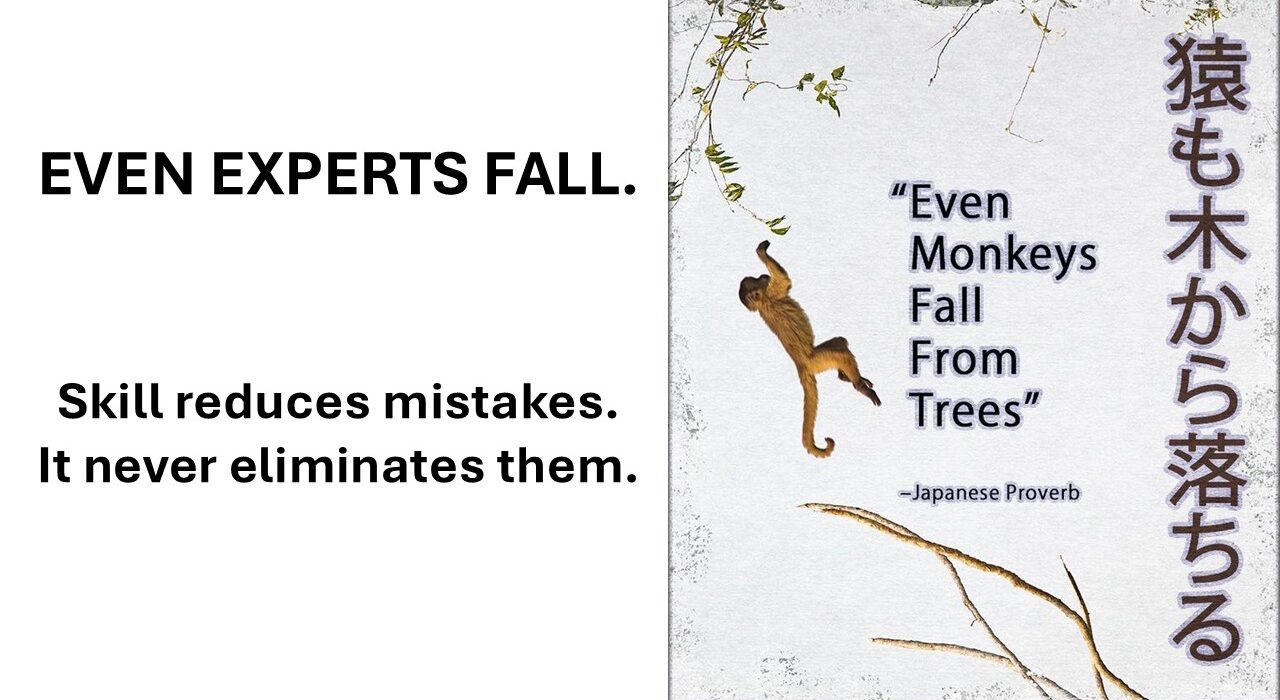
There is a Japanese proverb that has survived for centuries because it captures a truth most of us spend our lives trying to avoid:
“Even monkeys fall from trees.”
At first glance, it sounds almost humorous.
Of course monkeys fall occasionally.
But the deeper message is far more unsettling.
The proverb is not talking about inexperienced monkeys.
It is talking about monkeys that spend their entire lives climbing.
The very creatures most skilled at navigating trees are still capable of losing their balance.
The lesson is profound.
Skill does not eliminate mistakes.
Experience does not guarantee perfect judgment.
Success does not make anyone immune to blind spots.
And expertise does not prevent failure.
In fact, some of the most painful mistakes in life are made not by beginners, but by highly capable people who believed they had mastered the terrain.
History is filled with examples.
Brilliant executives who destroyed successful companies.
Experienced investors who ignored obvious risks.
Talented professionals who damaged careers through a single poor decision.
Loving partners who unintentionally hurt the people they cared about most.
None of them lacked intelligence.
Most lacked something far more important:
The humility to remember that they could still fall.
Unfortunately, modern culture teaches the opposite lesson.
We are encouraged to appear flawless, confident, certain and always in control. Mistakes are often treated as evidence of incompetence. Failure is seen as weakness. Admitting an error is viewed as a threat to credibility.
The result?
People hide mistakes.
Relationships accumulate resentment.
Organizations create cultures of blame.
Leaders become defensive.
And growth slows precisely when learning is needed most.
Yet the most resilient people, strongest relationships, most admired leaders and most enduring organizations all share a different philosophy.
They do not expect perfection.
They expect occasional falls.
More importantly, they know how to recover from them.
This article is a practical blueprint for doing exactly that.
You will discover how to apply the wisdom of “Even Monkeys Fall From Trees” to your personal life, relationships, career, leadership and business so that every setback becomes a source of wisdom, credibility, resilience and growth.
Because the goal of life is not to avoid falling.
The goal is to learn how to rise stronger every time you do.
Before diving into the domains, internalize this foundational mindset: Skill and mistakes are not opposites; they coexist.
Mastery is not the absence of mistakes; it is the capacity to absorb them, learn rapidly, and adapt without losing self-worth. The tree doesn’t stop being right for a monkey because one fell; the fall simply tells you where to strengthen your grip.
Personal Life: How to Stop One Mistake From Defining Your Identity
The Core Shift: Separate the event (“I made a mistake”) from the identity claim (“I am a failure”). Decouple your self-worth from your errors.
What To Do In The First 90 Seconds After Failure
- The 90-Second Rule: When you slip up, give yourself exactly 90 seconds to feel the emotional sting (physiologically, this is how long a wave of emotion lasts if you don’t feed it with a story). After the timer, do not ask, “What does this say about me?” Ask, “What is the next right action?”
- The “Fascinating!” Anchor: Replace self-chastisement with radical curiosity. Say out loud, “That’s fascinating. What caused my balance to slip?” This shifts you from judgment (high cortisol) to problem-solving (rational brain).
- The 24-Hour Rule: After a setback, give yourself 24 hours to feel the disappointment and analyze the lesson. After that, refuse to relive it endlessly. Regret teaches once; rumination teaches nothing.
The Invisible Conversation That Determines Recovery
- Replace “I failed” with “That failed”: Language precedes identity. “That approach failed” keeps you as the observer, not the object. Say, “I experienced a failure,” rather than “I am a failure.”
- The “Monkey Account” Expectation: Accept in advance that a fixed percentage of your decisions will be wrong. Aiming for 100% precision leads to decision paralysis. Aim for an 80% success rate; this frees you to take calculated risks without self-destruction.
Turn Every Mistake Into Future Wisdom
- The Daily “Fall Log” (2 Minutes): At the end of each day, write: “Today’s mistake taught me ______.” Over time, this rewires your brain to see falling as data, not a verdict (a practice used by elite surgeons and athletes).
- The Weekly Learning Review (Sunday Ritual): Spend 10 minutes asking: What went well? What went wrong? What did I learn? What will I do differently?
- The “Post-Mortem, Not Execution” Rule: After a misstep, give yourself a strict 10-minute window to dissect what went wrong (environment, energy, lack of clarity) without attacking who you are.
Why Self-Criticism Slows Growth And What Works Better
- The Friend Test: Speak to yourself the way you would speak to a respected friend. (Backed by Dr. Kristin Neff’s research showing self-compassion builds resilience better than self-criticism).
- Deliberate Recovery Rituals: Within 24 hours of any setback, do one restorative action (a walk, a meditation, or complete one tiny related task). This builds antifragility.
- Celebrate Competence AND Fallibility: At the end of the week, note both your wins and your honest falls. This balances self-esteem with a realistic self-view.
Relationships: The Hidden Skill That Prevents Resentment From Growing
The Core Shift: The proverb applied to another person is the seed of forgiveness; applied to yourself mid-conflict, it is the seed of de-escalation. Healthy relationships are not conflict-free; they are repair-rich.
What To Say When Someone Falls — Including Yourself
- The “Monkey Sentence”: When you (or your partner/friend) mess up, say calmly: “Even monkeys fall from trees—we just did. Let’s fix it.” This de-escalates shame and defensiveness instantly.
- Replace Judgment with Curiosity: Before reacting to someone else’s mistake, ask: “What else could explain this behavior?” Recognize that a blunder usually comes from fatigue, stress, or misjudgment—not malice.
- Grant the “Right to Fall”: Avoid the temptation to say “I told you so.” Instead, validate their humanity first: “You’re human. We’ve all misread a situation before.”
The Three-Step Apology That Rebuilds Trust Faster
- The “Tree Root” Apology (3 Steps): Apologize for impact, not intention.
- Acknowledge:“I messed up. I said/did [X].”
- Name the impact:“That must have made you feel disrespected/hurt.” (Do not say “but”).
- Ask for a redo:“What can I do right now to help you feel safe with me again?”
- Separate the Apology from Self-Flagellation: A good apology is short and forward-looking (“I missed that, here’s what I’ll do differently”). Long, self-punishing apologies force the other person to manage your emotions instead of feeling heard.
- Practice Micro-Apologies Without Defensiveness: Own the slip quickly and cleanly (“I lost my temper. That was my slip”) without adding conditional excuses (“…but I was tired”).
How Strong Relationships Recover From Human Imperfection
- Don’t Turn One Mistake into a Character Verdict: Avoid absolutist language like “You always do this” or “You never care.” Focus on the specific incident.
- The Empathy Mirror: When someone disappoints you, ask: “If I had made this mistake, how would I want to be treated?” Then begin there.
- The Monthly “Falls” Review (15 Minutes): With your partner or close friend, briefly review what went wrong, what each learned, and one adjustment. This prevents resentment accumulation and deepens intimacy.
Why Careers Are Damaged More By Cover-Ups Than Mistakes
The Core Shift: Competence is not zero-defect performance; it is fast recovery and honest signaling. People lose confidence when mistakes are hidden or repeated, not when they are acknowledged and corrected.
The First 24 Hours After A Professional Mistake
- The “Transparent Triage” Email: The moment you make an error, send this template within 1 hour:
“I spotted an error in [X]. I own this fully. The root cause was [one sentence]. I have already done [Y] to correct it, and will have the revision by [Time]. I’ll implement [Z] to ensure this doesn’t trip me again.”
- The 24-Hour Recovery Protocol: Address the fix, document the root cause, and share the lesson within 24 hours. Presenting a solution alongside the admission transforms a mistake into a display of professional integrity.
- Confident Disclosure: Be the first to name your error. People trust competence more when it comes with visible self-correction, because it signals you catch your own errors before others do.
How Top Performers Convert Errors Into Expertise
- The “After Action Review” (AAR) Habit: Borrowed from the military and high-performing teams. After any project, mistake, or missed target, spend 10 minutes answering:
- What was supposed to happen?
- What actually happened?
- Why the gap?
- What will I do differently?
(This is the single most evidence-backed practice for compounding expertise).
- Document “Near-Misses”: Don’t just analyze actual failures; track moments where you almost slipped. Examining near-misses reveals blind spots before they result in a public fall.
- Build “Fail-Safe” Friction Filters: Experts don’t rely on memory; they build systems. Implement simple checklists for high-stakes tasks (just as pilots and surgeons do).
Building A Reputation For Reliability Instead Of Perfection
- The “Fall Feedback” Loop: In 1:1s or reviews, proactively ask: “Where did I lose balance recently, and what would help next time?” Offer the same to others. This normalizes learning.
- Track Recovery Speed, Not Just Output: Measure not only your output but how quickly and cleanly you recover from errors. Recovery ability is a high-value professional skill.
- Create a “Mistake-Tolerant” Network: Cultivate 2–3 colleagues or mentors with whom you can discuss near-misses without fear of permanent judgment.
- Beware of “Expert Brittleness”: The more senior you become, the higher the hidden cost of admitting error feels. Deliberately model fallibility; it gives your team permission to surface problems early.
What Great Leaders Understand About Failure That Others Don’t
The Core Shift: In business, this proverb becomes a systems principle. Build for recoverable failure, not zero failure. A culture that punishes all mistakes creates cover-ups, slow decisions, and zero innovation.
Design Systems That Expect Human Error (The “Pre-Fall” Design)
- Run “Pre-Mortems,” Not Just Post-Mortems: Before a launch, ask: “Imagine this failed a year from now—what most likely caused it?” (Used at Amazon). This surfaces risks that optimism bias hides, without needing an actual failure first.
- Cap the Downside, Not the Attempts: Structure failures to be small and reversible (small pilots, capped budgets, staged bets). Falling from the tree shouldn’t mean falling off the mountain.
- Design Redundancy & Margin: Never run operations at 100% capacity. Build operational buffers (extra time, cash reserves, cross-trained staff) so that when a “fall” occurs, the system absorbs the impact smoothly.
- Maintain Decision Checklists: Experience is valuable, but checklists protect experience from overconfidence. Use them for high-stakes strategic decisions.
Why Blame Kills Learning And Improvement
- Separate “Who” from “What”: When an operational failure occurs, focus the inquiry on the process, not the person. Ask: “What system flaw allowed a skilled team member to fall?” rather than “Who made this mistake?” (The moment blame enters the room, information stops flowing).
- Normalize Blameless Reviews: After any project miss, product issue, or lost deal, run a short structured review focused solely on: Facts → Lessons → Specific process/decision changes. Keep it forward-looking.
- Institutionalize After-Action Reviews: The military uses this for decades. After every project, discuss: What was expected? What happened? Why? What should change?
Creating A Culture Where Problems Surface Early
- Lead with Vulnerable Transparency: When leaders openly share their own strategic miscalculations and lessons learned, it grants implicit permission for the entire organization to innovate without paralyzing fear.
- Reward Problem Reporting: People should never fear reporting errors. Organizations fail when bad news travels slowly. Explicitly reward the reporting of issues.
- Beware the “Success Trap”: Many businesses fail after long periods of success because leaders believe “We know what works.” At every leadership meeting, ask: “What assumptions are we treating as facts?” This single question can prevent costly strategic mistakes.
- Treat Customer/Market “Falls” as Feedback Loops: When a strategy underperforms, extract the insight, iterate visibly, and communicate the learning to customers where appropriate. Transparency often increases loyalty.
The 3-Minute Habit That Turns Setbacks Into Growth
To make this stick, complete this Three-Line Recovery Template whenever a “fall” occurs (in any domain):
- What happened?(Facts only, no emotion).
- What the monkey (me/us) learned?(The insight).
- One small adjustment or recovery action I will take NOW.(The immediate fix).
The Humility Advantage: The Real Meaning Of The Proverb
The real message of “Even monkeys fall from trees” is not about failure; it is about humility.
Humility does not mean thinking less of yourself. It means remembering that:
- You can be talented and still be wrong.
- You can be experienced and still overlook something.
- You can be successful and still need feedback.
- You can fail and still be worthy of respect.
The most dangerous moment is not when we make mistakes. The most dangerous moment is when we become so confident that we believe we no longer can.
The monkey that remembers it can fall, climbs more carefully. The monkey that believes it cannot fall, is already in danger.
Final Reflection: The Fall Is Not The Story
Most people spend their lives trying to avoid falling.
The wisest people spend their lives learning how to recover.
That is the deeper lesson hidden inside the Japanese proverb.
The monkey does not become skilled because it never falls.
It becomes skilled because every fall teaches it something about balance, awareness and adaptation.
The same is true for us.
Every failed project.
Every poor decision.
Every damaged relationship.
Every missed opportunity.
Every professional setback.
Every business disappointment.
Each one contains information that success can never teach.
The question is not whether you will fall.
You will.
I will.
Every leader, entrepreneur, professional, parent, partner and organization eventually will.
The only question is what meaning you assign to the fall.
Will it become evidence that you are inadequate?
Or evidence that you are still learning?
Remember:
You can be talented and still be wrong.
You can be experienced and still overlook something.
You can be successful and still need feedback.
You can fail and still deserve respect.
In many ways, humility is not thinking less of yourself.
It is thinking more accurately about yourself.
The people who rise highest are rarely those who never stumble.
They are those who refuse to let a stumble become an identity.
So the next time you fall from the tree, resist the temptation to ask:
“Why did this happen to me?”
Instead ask:
“What is this fall trying to teach me?”
That single question has the power to transform mistakes into wisdom, setbacks into resilience, and ordinary failures into extraordinary growth.
Because the monkey that remembers it can fall climbs more carefully.
But the monkey that learns from every fall eventually climbs farther than the one who never risked climbing at all.
Subhashis Banerji [Author]
Leadership assessor, strategist, and writer. I help professionals and organizations make smarter decisions by learning to read patterns, not promises.
📘 Read all my articles here:
👉 https://successunlimited-mantra.net/ & https://successunlimited-mantra.com/index.php/blog PLUS on https://relationshipandhappiness.com/
💼 Connect with me on LinkedIn: https://www.linkedin.com/in/subhashis-banerji-21b1418/
Related posts:
- When Feedback Becomes a Threat: How Leaders Can Transform Toxic Feedback into Growth, Motivation and High Performance
- Why Your Work Won’t Speak for Itself: How to Build Credibility, Get Recognized & Stand Out at Work
- How Average Employees Become Toxic Leaders: The Hidden Link Between Insecurity, Power and Office Politics
- The Underdog’s Blueprint: How Ordinary People Turned Adversity Into Extraordinary Success



– Please read our Comment Policy