


How to Find the Right Fit in Relationships, Work and Life
- BY Subhashis Banerji
- November 13, 2026
- 0 Comments
- 39 Views
Reading Time: 21 minutes
Contents
hide
1
How to Find the Right Fit in Relationships, Work and Life
How to Find the Right Fit in Relationships, Work and Life
The Long Journey Principle: A practical framework for evaluating relationships, leadership approaches, business paths, personal priorities and careers for long-term fit.
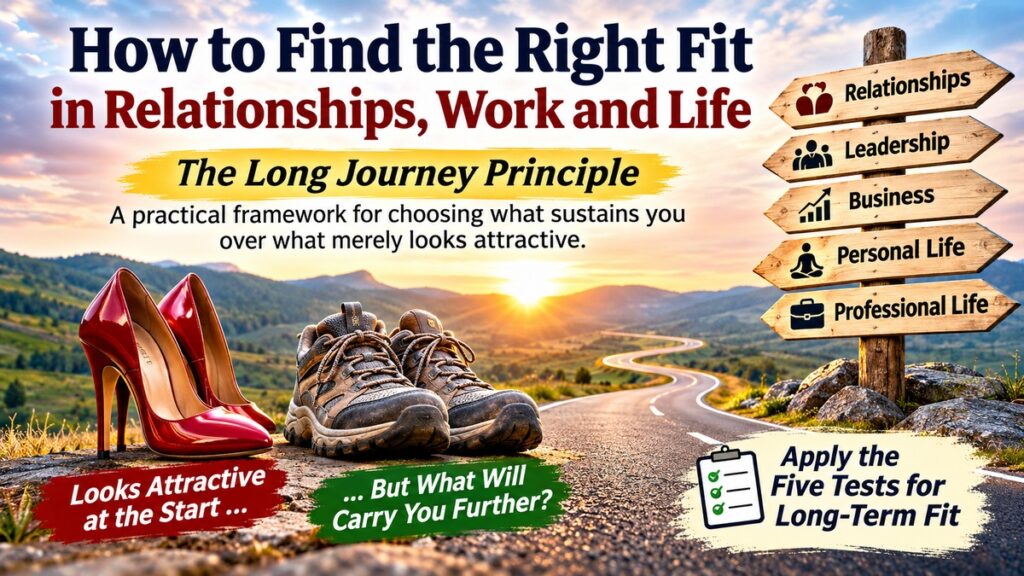
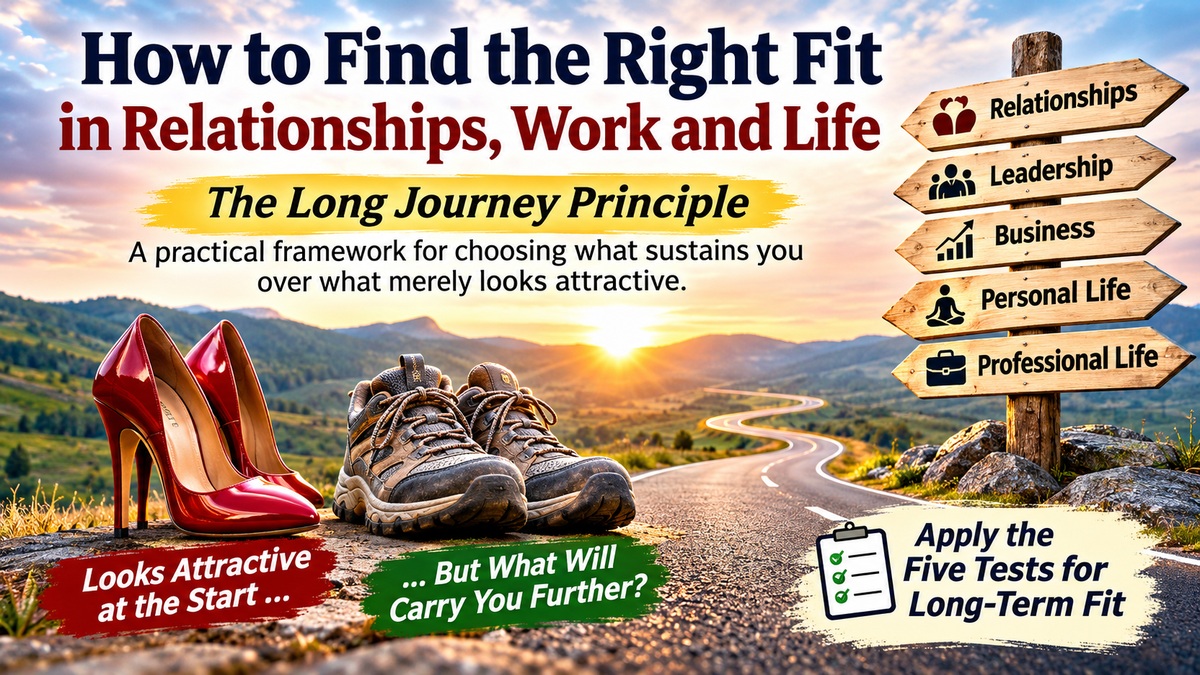
“If the journey is long, choose shoes that are comfortable, not merely beautiful. But it is never about shoes.”
Have you ever made a choice that looked perfect at the beginning—only to discover, months or years later, that living with it was far more difficult than you imagined? The relationship everyone admired became emotionally exhausting.
A relationship, role, business strategy or lifestyle can look impressive at first and still be the wrong fit. Explore the Long Journey Principle and five tests for choosing what can sustain you over time.
The prestigious role began to drain your energy. The promising business partnership turned out to be misaligned. The lifestyle that looked successful created pressure instead of freedom.
The problem may not have been the destination. It may have been what you chose to carry you there.
What Looks Good May Not Last: The Long-Term Fit Principle.
That is the deeper meaning of the Long Journey Principle: when a commitment is going to shape your life for years, choose what fits and sustains you—not merely what attracts attention at the starting line.
The journey represents your goals, responsibilities, relationships and aspirations. The shoes represent the choices that carry you through them: people, partners, leaders, values, careers, organisations, systems, strategies and habits. Beautiful shoes symbolise status, glamour, prestige, charm and social approval. Comfortable shoes represent compatibility, reliability, integrity, capability and long-term well-being.
This principle is not anti-beauty, ambition or success. Beauty and function can coexist. The warning is against short-sightedness: visible appeal can hide an invisible mismatch. What looks impressive in a photograph may prove unsustainable in everyday life.
Across relationships, leadership, business, personal life and professional life, the same question keeps returning: will this choice help me travel the distance—or will I spend the journey paying for the first impression?
| The central idea
For a long journey, judge a choice by fit, reliability and sustainability—not by appearance alone. Choose for the life you will live, not only for the impression you will make. |
What You Will Learn
- Seven universal lessons for recognising long-term fit hidden inside the proverb.
- How the principle applies to relationships, leadership, business, personal life and professional life.
- The hidden costs of choosing image over suitability—and why sunk costs keep people stuck.
- The difference between productive discomfort and destructive discomfort.
- A practical Five Tests framework and an action plan for reviewing important commitments.
PART I — What the Long Journey Principle Really Means
Before applying the proverb, understand its five moving parts.
- The journey. Every long commitment has a length, a terrain, a load, and a destination. A weekend hike and a decade-long marriage demand different footwear. Define the journey first — how far, over what ground, carrying what weight, toward what end — before you judge any choice.
- The shoes. The shoes stand for anything we choose to carry us through a long road: habits, partners, strategies, roles, commitments, systems, tools, values, people. They are the instrument of travel, not the purpose of it.
- The beautiful shoes. Choices optimised for optics: status, charm, charisma, prestige, hype, luxury, vanity metrics, brand logos, curb appeal, curated validation. They create short-term admiration.
- The comfortable shoes. Choices optimised for endurance: fit, reliability, shared values, unit economics, health, integrity, psychological safety, sustainable pace. They create a journey you can actually finish.
- It is never about shoes. The real subject is the destination and your ability to reach it — the quality of the path you are still able to walk years later. The proverb’s deepest warning is this: do not let visible appeal override invisible fit.
The Common Thread
| If you choose… | You get… |
| Comfort, fit, sustainability | Endurance, clarity, and a journey you can finish |
| Beauty, image, approval | Short-term admiration, long-term pain |
PART II — Seven Universal Lessons for Choosing What Lasts
These seven principles apply regardless of domain. They are the operating system beneath every specific application.
- Define the journey first — length, terrain, load, destination. You cannot judge fit without knowing the road.
- Fit beats flash — what looks good may not carry you far.
- Test under realistic conditions — not just in the shop mirror. What works in a demo may fail under load.
- Count hidden costs — maintenance, pain, replacement, resentment, burnout. The purchase price is never the full price.
- Beauty can coexist with function — but it should never be the deciding proof. Aesthetics matter; they must serve usability, trust, and truth.
- Reassess over time — feet change, terrain changes, and loyalty to a bad fit is not a virtue.
- It is never about shoes — the deeper issue is self-awareness, values, trade-offs, and long-term thinking.
The Rapid Three-Question Test
Before any major choice, ask:
- How far am I going?
- Can I sustain this for that distance?
- Am I choosing this for me — or for how it looks?
Note carefully: comfort here does not mean laziness. It means choosing what lets you keep going with strength and peace until you arrive.
PART III — How to Apply the Principle in Five Areas of Life and Work
1. Relationships — Choose Compatibility Over Attraction
Relationships are among the longest journeys we undertake. Yet people often choose them based on appearance, attraction, social standing, financial status, or the excitement of the moment. These create initial attraction — but they do not create enduring relationships.
A good relationship is not merely one that looks wonderful to the world. It is one in which both people can live, grow, disagree, adapt, and remain themselves without constantly feeling emotionally exhausted. It feels calm, grounded, and effortless to walk in — not like a constant performance.
And remember: fit matters. Two people can both be good and still not be right for the same long road.
How to Apply This Principle
- Choose emotional safety over social appearance. Choose people with whom you can be yourself, rather than people before whom you must constantly perform.
- Choose compatibility over temporary chemistry. Attraction may bring two people together; shared values, mutual respect, and emotional maturity help them stay together.
- Choose respect and character over charm. Someone may be articulate, attractive, and socially impressive — but how they treat you when they are disappointed, angry, or unable to get their way reveals far more about their character.
- Choose consistency over grand gestures. A person who repeatedly demonstrates care, reliability, and consideration is often worth more than someone who occasionally makes spectacular gestures.
- Choose acceptance over the need to impress. A healthy relationship lets you be appreciated without constantly proving your worth.
- Choose ordinary comfort. Honest talk, humour, patience, and simply being easy to be around. Invest in relationships that feel steady and restorative over time — not those that sparkle but drain you.
- Choose mutual growth over emotional dependency. The right relationship encourages both people to become stronger, wiser, and more fulfilled.
- Choose honest communication and sustainable conflict habits over artificial harmony. A relationship in which difficult conversations are possible is healthier than one where disagreement is suppressed to maintain appearances. Build repair habits — apology, boundaries, and follow-through — not just dramatic or impressive communication.
- Choose peace over the constant need to win. Not every disagreement needs a winner. Preserving mutual respect often matters more than establishing who is right.
- Choose people who are present during difficult times. It is easy to celebrate success with someone; their reliability during setbacks reveals the depth of the relationship.
- Choose sustainability over mere excitement. A relationship should enrich your life, not continuously drain your emotional energy.
- Choose the person as they are — not the version you hope to renovate. Do not fall in love with potential. Attraction matters, but it cannot carry a long journey alone.
- Invest in maintenance. Time, attention, honesty, apology, and boundaries are the upkeep that keeps good shoes wearable for decades.
What Happens When This Principle Is Ignored
- Emotional exhaustion and chronic friction: constantly managing expectations, insecurities, conflicts, and disappointments.
- Loneliness inside the relationship: performing for others instead of being known by them; being with someone physically but feeling emotionally disconnected.
- Loss of authenticity and self-respect: pretending to be someone you are not; sacrificing identity, boundaries, and values to keep someone happy.
- Normalised pain: telling yourself “it looks good, so I’ll endure it” — which breeds resentment, emotional burnout, or a painful breakup far down the road.
- Unhealthy dependency: staying out of fear, convenience, status, or social pressure rather than genuine compatibility.
- Repeated disappointment and heartbreak: confusing promises, charm, and occasional affection with enduring commitment. Loneliness masked by serial short-term intensity.
- Erosion of self-worth and wasted years on connections that could not withstand real-life pressure — marriages and friendships built on looks, image, or social approval that crack under routine stress.
- Regret: spending years trying to make an unsuitable relationship work.
The relationship lesson: Don’t choose someone simply because they make your life look beautiful. Choose someone with whom life becomes more meaningful, peaceful, and fulfilling.
2. Leadership — Choose Credibility Over Charisma
Leadership is a long journey of influencing people, building trust, developing capability, and delivering results. A leader may look impressive through titles, authority, communication skills, personal branding, and public visibility — but none of these automatically makes someone a good leader.
The real test of leadership is not how impressive a leader appears when everything is going well. It is how people experience that leader over time.
How to Apply This Principle
- Choose credibility over charisma. A charismatic leader attracts followers; a credible leader earns their trust.
- Choose character and quiet competence over personality and pedigree. Personality creates an impression; character determines whether that impression can be trusted.
- Choose listening over merely speaking. Leadership is not being the loudest voice in the room. It is understanding what others are saying — including what they hesitate to express.
- Choose consistency over occasional inspiration. People need dependable behaviour, not leaders who alternate between inspiration and unpredictability.
- Choose psychological safety over fear-based control. People perform better when they can raise concerns, admit mistakes, ask questions, and challenge assumptions without humiliation or retaliation.
- Choose developing people over displaying personal superiority. A leader’s real legacy is not how indispensable they become, but how capable they make others.
- Choose accountability over blame. Own decisions, acknowledge mistakes, take responsibility for outcomes.
- Choose long-term capability over short-term performance theatre. Build systems, people, and processes that keep delivering beyond your personal presence.
- Choose humility over positional authority. A designation gives power; humility and fairness earn genuine respect.
- Choose principled decisions over popular decisions. Sometimes the right call is difficult in the short term and necessary for long-term health.
- Choose empowerment over micromanagement. People need clarity, resources, and appropriate autonomy — not constant interference.
- Choose a leadership style you can actually sustain. A borrowed, flashy style wears you out and rings false.
- Set a pace people can keep. Sprinting a marathon burns out the team. A team has to walk the whole journey with you.
- Choose succession over personal indispensability. A leader who fails to prepare others creates dependency, not strength.
- Communicate the terrain — what is hard, what is changing, what is non-negotiable — and adapt roles and structures as conditions change. Good leaders change shoes when the ground changes.
What Happens When This Principle Is Ignored
- A culture of fear: employees hide problems, avoid disagreement, and tell leaders what they want to hear.
- Declining trust: people stop believing what leaders say because actions contradict words — and the gap becomes undeniable the moment pressure exposes it.
- Talent attrition and silent dissent: capable people leave or quietly disengage from environments where they feel undervalued, controlled, or disrespected; teams comply publicly while disengaging privately.
- Poor decision-making: leaders surrounded by agreeable people rather than people who challenge their thinking.
- Organisational dependency and weak succession: everything depends on one individual; institutional knowledge walks out the door.
- Organisational fragility: the team collapses under real pressure because the foundation was never built for distance — and high turnover from “star” hires or flashy styles that burn out or clash fractures the culture.
- Burnout: leaders exhaust themselves controlling everything instead of developing capable teams; teams become exhausted and cynical.
- Short-termism: decisions made to look good now rather than to take the group where it needs to go.
- Reputational damage and scandal: an impressive public image cannot indefinitely conceal poor internal leadership. In crisis, the leader is left isolated with sycophants.
The leadership lesson: Don’t choose the leadership style that makes you look powerful. Choose the one that makes people, teams, and organisations stronger.
3. Business — Choose Sustainability Over Glamour
Business is not a beauty contest. It is a long-term exercise in creating value, serving customers, managing resources, building trust, and remaining relevant. A business can look impressive through its office, branding, technology, publicity, valuation, revenue growth, or aggressive expansion — but underneath, it must have sound economics, capable people, satisfied customers, reliable processes, and the ability to withstand uncertainty.
Substance compounds; flash burns cash.
How to Apply This Principle
- Choose customer value over vanity metrics. Followers, website visitors, and media mentions mean little unless the business genuinely creates value. Always ask what the business is really about: serving a purpose, not showing off.
- Choose profitability, cash flow, and unit economics over superficial growth. Revenue growth may look attractive while actual business health deteriorates. Prioritize cash flow and fundamentals over branding, big offices, and vanity metrics.
- Choose the right customers over every available customer. Not every customer is profitable, aligned, or worth pursuing; some relationships consume more than they generate.
- Choose strong fundamentals over impressive presentation. A beautiful office, sophisticated website, and expensive branding cannot compensate for an unsustainable business model.
- Choose ethical partnerships and aligned incentives over convenient or prestigious ones. A partner offering quick access to markets or money becomes a liability if integrity and expectations are misaligned. Choose vendors, suppliers, and investors for fit, dependability, and total cost of ownership — not brand prestige or immediate wow factor.
- Choose long-term reputation over short-term gains. One unethical decision may generate temporary profit and destroy years of customer trust.
- Choose capable employees over impressive CVs alone. Qualifications and presentation matter; competence, ownership, adaptability, and integrity matter enormously over the long run.
- Choose strategic focus over uncontrolled expansion. Doing fewer things exceptionally well beats pursuing multiple opportunities without the capability to deliver.
- Choose adaptability over attachment to past success. Markets, expectations, and technology change. Be prepared to reconsider even your most successful practices.
- Choose financial discipline over the appearance of success. Manage debt, expenses, working capital, reserves, and investments carefully. Growth without discipline creates fragility.
- Choose systems over individual heroics. A business should not collapse when one person leaves. Institutionalise processes, knowledge, and accountability.
- Choose trust over aggressive selling. A customer who trusts you may stay for years; one who feels manipulated may leave permanently. Build sustainable customer relationships, not transactions.
- Choose operational resilience over excessive dependence. Diversify critical suppliers, customers, revenue streams, and capabilities.
- Choose products that are genuinely useful and comfortable to use — not merely attractive. Beauty in design matters, but it must serve usability and trust.
- Test pilots before scaling. What works in a demo may fail under load.
- Budget for maintenance — support, compliance, ethics, supply chain, and employee wellbeing are part of the total cost of the journey.
What Happens When This Principle Is Ignored
- Cash-flow crises: overspending on appearance — launches, offices, hype, debt-fuelled expansion — drains the runway before the journey is half done.
- Unprofitable growth: revenue rises while business health deteriorates; operations cannot support the pace, leading to collapse.
- Customer dissatisfaction and churn: customers try the beautiful product once, then leave when it does not actually serve them; marketing promises more than the organisation can consistently deliver.
- Poor partnerships: attractive commercial offers conceal mismatched values, risks, or expectations — hidden blisters that slow you down until you cannot continue.
- Operational fragility: over-dependence on a few people, customers, or suppliers; structural brittleness that blisters and stalls the moment market conditions tighten.
- Loss of reputation and legal risk: short-term ethical compromises damage stakeholder confidence.
- Strategic confusion: chasing fashionable opportunities without understanding your competitive advantage; wasted capital and opportunity cost on fads that collapse.
- Competitive disadvantage: grounded rivals who simply keep delivering quietly overtake you.
- Culture rot hidden by polish: a beautiful brand with no durable business or healthy culture underneath.
- Business failure: eventually, appearances cannot compensate for weak fundamentals.
The business lesson: Don’t build a business that merely looks successful. Build one that can remain valuable, trusted, and financially sustainable.
4. Personal Life — Choose Fulfilment Over Display
Personal life is a journey measured not only by what we accumulate but by the quality of the life we actually experience. Unfortunately, many people spend a considerable part of their lives pursuing what looks impressive to others. A bigger house, expensive possessions, luxury holidays, prestigious social circles, visible achievements, and external recognition may provide satisfaction — but they do not automatically create happiness or fulfilment.
A life that photographs well and feels exhausting is not a life well chosen.
How to Apply This Principle
- Choose a life that suits you, not one designed to impress others. Your definition of success does not have to match society’s expectations — and you should define your own journey rather than copying someone else’s lifestyle.
- Choose health over appearance. Protect physical and mental well-being as your most essential gear rather than sacrificing them to maintain an image.
- Choose financial security over lifestyle inflation. Manageable expenses and adequate reserves — including real liquidity — provide more freedom than an impressive lifestyle financed by pressure.
- Choose meaningful experiences over constant accumulation. Relationships, memories, learning, and contribution create deeper fulfilment than possessions.
- Choose time over unnecessary possessions. Money can sometimes replace what we lack; lost time and neglected relationships cannot always be recovered.
- Choose simplicity over unnecessary complexity. Simplicity creates space for health, relationships, creativity, and meaningful pursuits.
- Choose self-respect over social approval. Not every expectation deserves fulfilment; not every invitation needs accepting.
- Choose realistic goals over borrowed ambitions. Don’t chase milestones merely because others consider them desirable.
- Choose emotional well-being over constant comparison. Comparing your journey with someone else’s can make even a good life feel inadequate.
- Choose lifelong learning over intellectual complacency. Stay curious, develop new capabilities, remain open to changing your opinions.
- Choose contentment without abandoning ambition. Contentment is not giving up; it is pursuing progress without letting every achievement become a new source of dissatisfaction.
- Choose purpose over mere activity. Being busy is not the same as living meaningfully.
- Build habits you can keep for decades — sleep, movement, sensible eating, rest, genuine solitude. Extreme routines look impressive and rarely last. Choose environments, routines, and commitments that fit your actual temperament and capacity.
- Set boundaries. Real comfort includes dignity, health, and peace — not unlimited availability to others.
- Reassess as you change. A path that fit at twenty may not fit at forty. Avoid accumulating obligations and identities that no longer fit, which make course-correction harder.
- Maintain what matters — body, mind, relationships, home, and money. These are the gear you rely on every single day.
What Happens When This Principle Is Ignored
- Chronic dissatisfaction: always wanting what someone else has; living on a hedonic treadmill.
- Financial stress and entrapment: debt, anxiety, and comparison from spending to maintain an image — working jobs you dislike to fund possessions you don’t enjoy.
- Neglected health: burnout, injury, or illness from sacrificing rest, exercise, and well-being for status or achievement; unsustainable routines that collapse after initial motivation fades.
- Lost relationships: giving more time to external recognition than to people who matter; reaching the destination having lost health, peace, or relationships along the way.
- Identity confusion and eroded sense of self: measuring worth through possessions, titles, and social approval; living for others’ opinions until you no longer know your own.
- Emotional exhaustion: living according to other people’s expectations rather than your own values.
- Unfulfilled potential: spending years on goals that were never genuinely meaningful to you.
- Regret and quiet dissatisfaction: a life that photographs well but feels hollow; resentment toward yourself for promises made to an idealised version of you.
- Harder course-correction: an accumulation of obligations and identities that no longer fit, making change progressively more painful.
The personal-life lesson: Don’t spend your life creating an image others admire while neglecting a life you yourself would enjoy living.
5. Professional Life — Choose Role Fit Over Prestige
Professional life is a particularly revealing application of this principle, because people frequently confuse career appearance with career satisfaction. A prestigious organisation, impressive designation, high salary, international exposure, or glamorous profile can look like the perfect opportunity. But the real question is whether the role fits your abilities, values, interests, circumstances, and long-term aspirations.
A job may look beautiful on your CV but feel uncomfortable every day. Prestige is a beautiful shoe — and it can still cripple you.
How to Apply This Principle
- Choose role fit over designation. A senior title is not necessarily better than a role offering meaningful work, autonomy, and satisfaction.
- Choose learning over merely earning. Compensation matters, but growth depends on developing relevant capabilities and expanding your understanding.
- Choose a healthy work environment over organisational prestige. An impressive company name cannot compensate for a toxic manager or unsustainable conditions.
- Choose meaningful work over the appearance of being important. The value of your work should not depend entirely on how impressive it sounds to others.
- Choose competence and deep mastery over self-promotion alone. Personal branding opens doors; demonstrated capability sustains credibility. Build deep, transferable skills rather than trendy credentials alone.
- Choose good leadership over impressive corporate infrastructure. Your immediate manager shapes your experience, confidence, and development more than the lobby does.
- Choose professional integrity over career shortcuts. Never compromise principles for a promotion, contract, client, or opportunity.
- Choose continuous development and specialisation over stagnation. Upgrade knowledge, skills, and judgement to stay relevant.
- Choose professional relationships over transactional networking. Build through mutual contribution, trust, and respect — relationships that compound — rather than approaching people only when you need something.
- Choose sustainable work over constant overcommitment. Protect energy with boundaries, rest, and a realistic workload; an impressive workload demonstrates commitment temporarily and cannot be maintained indefinitely.
- Choose long-term employability over short-term security alone. Develop capabilities that remain valuable when organisations, industries, and job structures change.
- Choose work aligned with your life stage. Priorities evolve; the choice that was right ten years ago may not be right today.
- Choose tools, workflows, and mentors that reduce friction and support long-term effectiveness — not the newest or flashiest options. Pick mentors and workplaces that are good for you over time, not just good on a CV.
- Measure success by progress toward your goals — not by how your job looks from the outside.
- Reassess when the role stops fitting. Golden handcuffs are still handcuffs.
What Happens When This Principle Is Ignored
- Career dissatisfaction and the prestige trap: holding an impressive title while feeling disconnected from the work — an impressive title, a miserable life.
- Professional burnout: working in an environment that continuously conflicts with your needs and values; quiet burnout behind a polished profile.
- Stagnation: remaining in a prestigious role offering little meaningful learning or growth.
- Loss of confidence: repeatedly operating in roles that do not fit your strengths.
- Ethical compromise: shortcuts that damage long-term credibility.
- Poor work-life balance: professional ambition consuming every other dimension of life; overwork for appearances damaging health and performance.
- Reduced employability and weak networks: relying on an existing designation or reputation while skill gaps widen and surface credentials replace real capability. Chasing titles over skills leaves you exposed when markets or roles change.
- Repeated job-hopping or mid-career crisis: the “beautiful” path proves unsustainable or misaligned with your actual strengths and values — decades spent on work that drains your energy or violates your temperament, producing cynicism and the realisation that you climbed the wrong ladder.
- Missed opportunities: rejecting less glamorous but more meaningful paths because they do not appear impressive enough.
- Reaching the “top” and discovering it was the wrong mountain.
The professional-life lesson: Don’t build a career that impresses people when they read your CV but disappoints you when you live it.
PART IV — Five Hidden Traps: How Attractive Choices Become Long-Term Burdens
There is something deeper in this proverb.
The problem is not beauty, ambition, prestige, money, attraction, or recognition. These are not inherently wrong. The problem begins when we allow appearance to become more important than suitability. We choose what will impress others rather than what will serve us. We prioritise immediate gratification over lasting value. We become so invested in maintaining an attractive image that we ignore the discomfort building underneath.
Over time, this produces five dangerous patterns.
| Dangerous pattern | What happens |
| Impression over reality | We become more concerned with how things look than how they actually work. |
| Short-term pleasure over long-term well-being | We make choices that feel rewarding today but become costly tomorrow. |
| Social approval over self-awareness | We allow other people’s expectations to determine our decisions. |
| Ego over judgement | We continue with unsuitable choices because admitting a mistake feels uncomfortable. |
| Attachment over adaptability | We remain committed to people, roles, and systems even after they stop serving their purpose. |
Perhaps the greatest danger is the sunk-cost trap: we recognise the discomfort but refuse to change because we have already invested too much in the beautiful shoes. We don’t want to admit our choice was wrong. So we keep walking, even when every step hurts.
This is how a poor decision becomes a long-term burden.
The escape is not shame — it is honesty. The moment you can say “these shoes no longer fit the road I am on” is the moment the journey becomes survivable again. Changing course is not failure; persisting in a known bad fit is.
PART V — Comfortable Does Not Mean Easy: Productive vs. Destructive Discomfort
The proverb must not be misread.
The most comfortable choice is not necessarily the easiest choice. A good pair of shoes may need to be broken in. A good relationship may require difficult conversations. Good leadership may require uncomfortable decisions. A successful business may require painful restructuring. Professional growth may require learning skills that initially feel awkward and slow.
A good “shoe” can hurt briefly while breaking in. The point is sustainable fit, not the avoidance of all difficulty.
There is a decisive difference between productive discomfort and destructive discomfort.
| Productive discomfort | Destructive discomfort |
| Learning something difficult | Repeatedly being humiliated |
| Receiving constructive feedback | Being constantly undermined |
| Having an honest disagreement | Living in persistent hostility |
| Taking a calculated business risk | Ignoring serious financial risks |
| Accepting a challenging assignment | Remaining in an exploitative role |
| Working toward a meaningful goal | Sacrificing health for external approval |
| Breaking in new shoes on a known road | Walking on broken glass and calling it loyalty |
The right shoes should support the journey, not remove every challenge from it. Comfort is about sustainable alignment — not the absence of effort.
PART VI — The Five Tests for Evaluating Long-Term Fit
Before any important decision in any of these five areas, run this test.
The Five Tests for Long-Term Fit
- The Fit Test
Does this choice genuinely fit who I am, what I value, and what I need? Am I choosing it because it suits me — or because it impresses others? - The Sustainability Test
Can I continue with this over the long term without damaging my well-being, integrity, or important relationships? Will it remain workable when the initial excitement disappears? - The Values Test
Does this choice reflect my principles and the person I want to become? Will I be comfortable explaining this decision to the people whose judgement I respect? - The Reality Test
Am I seeing this choice clearly, or am I influenced by appearance, emotion, status, fear, or social pressure? What am I overlooking because I want this decision to work? - The Destination Test
Will this choice take me closer to the life, relationships, leadership, business, or career I genuinely want? Am I focused on how attractive the beginning looks — or on where the journey is likely to take me?
The Rapid Version: Three Questions
When you have no time for the full test:
How far am I going?
Can I sustain this for that distance?
Am I choosing this for me, or for how it looks?
PART VII — Choose for the Journey, Not for the Photograph
There is a powerful distinction between the life we display and the life we experience.
A beautiful photograph captures a moment. A meaningful life is experienced over years.
An impressive designation captures a professional identity. A fulfilling career is experienced every working day.
A grand business announcement captures attention. A sustainable business creates value repeatedly.
An attractive relationship creates an impression. A healthy relationship provides companionship, trust, and support through life’s uncertainties.
A prestigious achievement earns applause. A meaningful achievement contributes to something that matters.
This is why the proverb is so relevant. The real quality of a decision is not determined by how attractive it appears at the beginning, but by how well it serves us throughout the journey.
PART VIII — Quick Reference Tables: Optics vs. Endurance
Table 1 — The Five Domains at a Glance
| Area | Don’t choose merely… | Choose instead… | The price of getting it wrong |
| Relationships | Attraction, charm, social status | Compatibility, trust, respect, emotional security | Emotional exhaustion and loss of self |
| Leadership | Charisma, power, visibility | Credibility, consistency, humility, accountability | Fear, distrust, declining performance |
| Business | Glamour, rapid growth, market attention | Customer value, sound economics, sustainability | Financial instability, reputational damage |
| Personal Life | Luxury, comparison, social approval | Health, contentment, purpose, freedom | Stress, dissatisfaction, regret |
| Professional Life | Titles, prestige, impressive CVs | Role fit, learning, integrity, meaningful contribution | Burnout, stagnation, lost opportunities |
Table 2 — Optics vs. Endurance: The Precise Contrast
| Domain | “Beautiful Shoes” (Optics) | “Comfortable Shoes” (Endurance) | Core consequence of disobeying |
| Relationships | Status, charm, intensity | Emotional safety, shared values | Resentment and quiet loneliness |
| Leadership | Charisma, control, optics | Integrity, trust, steadiness | Brittle culture and talent exodus |
| Business | Vanity metrics, hype, PR | Unit economics, retention, systems | Structural fragility during downturns |
| Personal Life | Luxury goods, lifestyle flex | Health, liquidity, peace of mind | Burnout and financial entrapment |
| Professional Life | Prestigious titles, brand logos | Deep mastery, autonomy, fit | Golden handcuffs and mid-career regret |
PART IX — The Long Journey Law: Never Confuse Attraction with Suitability
Perhaps the greatest wisdom in this proverb is that a choice should not be judged only by how attractive it is when we make it, but by how much it supports us as we live with its consequences.
We often spend too much time asking:
- How impressive will this look?
- What will people think?
- Will this give me recognition?
- Does this make me appear successful?
- Will others envy what I have?
But perhaps we should be asking:
- Will this give me peace?
- Can I sustain this?
- Does this align with my values?
- Will this make me stronger?
- Will I still be grateful for this decision five or ten years from now?
The journey of life is long. We cannot constantly change direction simply because something more attractive catches our attention — nor should we persist with a choice merely because it once looked beautiful.
We need the wisdom to distinguish between appearance and substance, excitement and fulfilment, popularity and credibility, and what we desire momentarily versus what we genuinely need over time.
The right relationship is not necessarily the one that looks perfect. It is the one in which you can grow without losing yourself.
The right leader is not necessarily the one who commands the most attention. It is the one who creates the greatest positive impact.
The right business is not necessarily the one that grows fastest. It is the one that creates sustainable value.
The right life is not necessarily the one others admire. It is the one you are grateful to live.
The right career is not necessarily the one with the most impressive title. It is the one that lets you contribute, develop, and retain your dignity.
The Long Journey Law
Never confuse what attracts you with what is right for you.
Attraction may influence your first choice. Appearance may influence other people’s opinions. Status may influence your confidence.
But over time, it is compatibility, character, credibility, purpose, and sustainability that determine the quality of your journey.
Don’t make a lifelong journey uncomfortable just to make a temporary impression.
Conclusion: Make the Journey Worth Walking
When the journey is long, the real question is not whether your shoes look beautiful to the world. It is whether they help you walk the distance without losing your health, integrity, relationships or sense of self. And that is why it was never about shoes.
The same mistake appears in different forms: a performative relationship, a brittle leadership culture, a fragile business model, a hollow lifestyle or a prestigious career that quietly becomes a trap. Each begins with visible appeal and reveals its hidden cost over time.
The Long Journey Principle asks us to look beyond the starting line. Choose compatibility over display, credibility over charisma, sound fundamentals over glamour, fulfilment over comparison and role fit over status. Reassess when the terrain changes. Changing what no longer serves the journey is not failure; it is judgement.
| The Long Journey Law
Never confuse what attracts you with what is right for you. Do not make a lifelong journey uncomfortable just to create a temporary impression. |
Put the Long Journey Principle into Practice: An Eight-Step Audit
- Name your long journeys. Write down five major commitments currently shaping your life: one relationship, one leadership responsibility, one business or venture, one personal-life pattern and one professional path.
- Audit each commitment with the Five Tests: Fit, Sustainability, Values, Reality and Destination. Score each honestly from 1 to 10. Start with the lowest score.
- Separate the beautiful from the comfortable. Complete this sentence for each commitment: “I chose ______ because it looked ______; what I actually needed was ______.”
- Identify one sunk cost you are still paying. Name the choice you keep carrying despite the pain. Decide whether it needs repair, renegotiation or replacement.
- Distinguish productive discomfort from destructive discomfort. Is the challenge helping you grow, or is it steadily damaging your dignity, health or integrity?
- Do one maintenance act in each domain this week: one honest conversation, one boundary, one cash-flow review, one night of proper rest and one investment in a relevant skill.
- Run the Five Tests again every quarter. Your needs, abilities and circumstances change; your choices may need to change too.
- Share the principle with someone facing a major decision. Clear thinking becomes more useful when it is discussed and applied.
A Final Thought
Choose people who make the journey worthwhile, not merely those who make the photograph beautiful.
Choose decisions that support your future, not merely those that satisfy your present.
Choose values that sustain you, not appearances that impress others.
And then—walk.
Frequently Asked Questions
What does the Long Journey Principle mean?
It means choosing people, roles, systems, habits and strategies that fit your values and can sustain you over time, rather than choosing primarily for appearance, status or short-term excitement.
Does choosing comfortable shoes mean choosing the easiest option?
No. It means choosing sustainable fit, not avoiding effort. Learning, honest feedback and difficult conversations can be productive discomfort; repeated humiliation, coercion and damage to well-being are destructive.
How does the principle apply to relationships?
It encourages compatibility, emotional safety, mutual respect, consistency and shared responsibility over attraction or social appearance alone.
What are the Five Tests for evaluating long-term fit?
Fit, Sustainability, Values, Reality and Destination. Together, they help you assess whether a choice suits you, can be maintained, reflects your principles, accounts for reality and moves you toward a meaningful outcome.
Subhashis Banerji [Author]
Leadership assessor, strategist, and writer. I help professionals and organizations make smarter decisions by learning to read patterns, not promises.
📘 Read all my articles here:
👉 https://successunlimited-mantra.net/ & https://successunlimited-mantra.com/index.php/blog PLUS on https://relationshipandhappiness.com/
💼 Connect with me on LinkedIn: https://www.linkedin.com/in/subhashis-banerji-21b1418/
Related posts:
- How to Communicate Big Ideas: 20 Practical Strategies
- The Inevitable Entrepreneur: 100+ Practical Business Ideas to Build the Future Starting Today
- 90° Career Growth Playbook: How to Become a Highly Sought-After, Respected & High-Impact Professional
- Even Monkeys Fall From Trees: Why Even Experts Make Mistakes — And How to Turn Failure Into Growth

– Please read our Comment Policy