




How to Disagree with Someone More Powerful: 8 Proven Ways
- BY Subhashis Banerji
- November 21, 2026
- 0 Comments
- 46 Views
Reading Time: 28 minutes
Contents
hide
1
How to Disagree with Someone More Powerful—Without Losing Your Integrity or the Relationship
How to Disagree with Someone More Powerful—Without Losing Your Integrity or the Relationship
Protect your professional integrity, refuse inappropriate instructions and preserve important relationships—without turning disagreement into a personal confrontation.
Practical scripts to challenge decisions, refuse inappropriate instructions, protect your professional integrity and preserve relationships—without turning disagreement into a personal confrontation.
Introduction: The moment when silence feels safer—but costs you something
A senior leader tells you to change a report. A powerful client expects you to endorse a conclusion you do not believe the evidence supports. A government official asks you to bypass a procedure. A politically influential person expects a favour. Or someone who can damage your career, reputation, business or personal safety makes it clear that disagreement will not be welcome.
You know something is wrong—or at least that something deserves to be questioned. Yet the person across the table has more authority, influence, money, connections or power than you do.
What do you say?
Do you remain silent and protect the relationship at the cost of your professional judgment? Do you disagree openly and risk turning a decision into a personal confrontation? Do you comply, hoping that the consequences will never surface? Or is there a more intelligent way to protect your integrity without unnecessarily destroying the relationship?
There is a better way—but it requires more than courage. It requires preparation, judgment, emotional regulation, negotiation skill and an understanding of power.
The central skill is to challenge the instruction, decision or behaviour without unnecessarily attacking the person who holds the authority. You can respect a person’s position without accepting every request. You can preserve a professional relationship without surrendering your judgment. You can be tactful without becoming submissive—and firm without becoming aggressive.
This guide brings together practical approaches from psychological-safety research, employee-voice research, negotiation, values-based leadership, healthcare safety communication and aviation crew-resource management. It also provides ready-to-use language for powerful bosses, political figures, government officials and people who may harm you physically, socially, financially or professionally.
The goal is not to win an argument. It is to reach the best defensible outcome while protecting your safety, integrity, reputation and relationships.
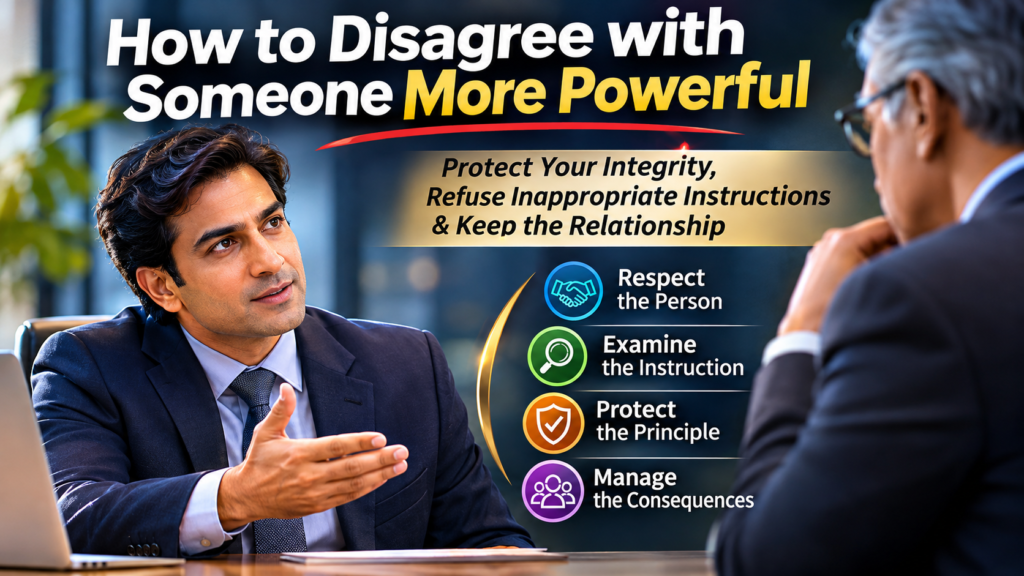
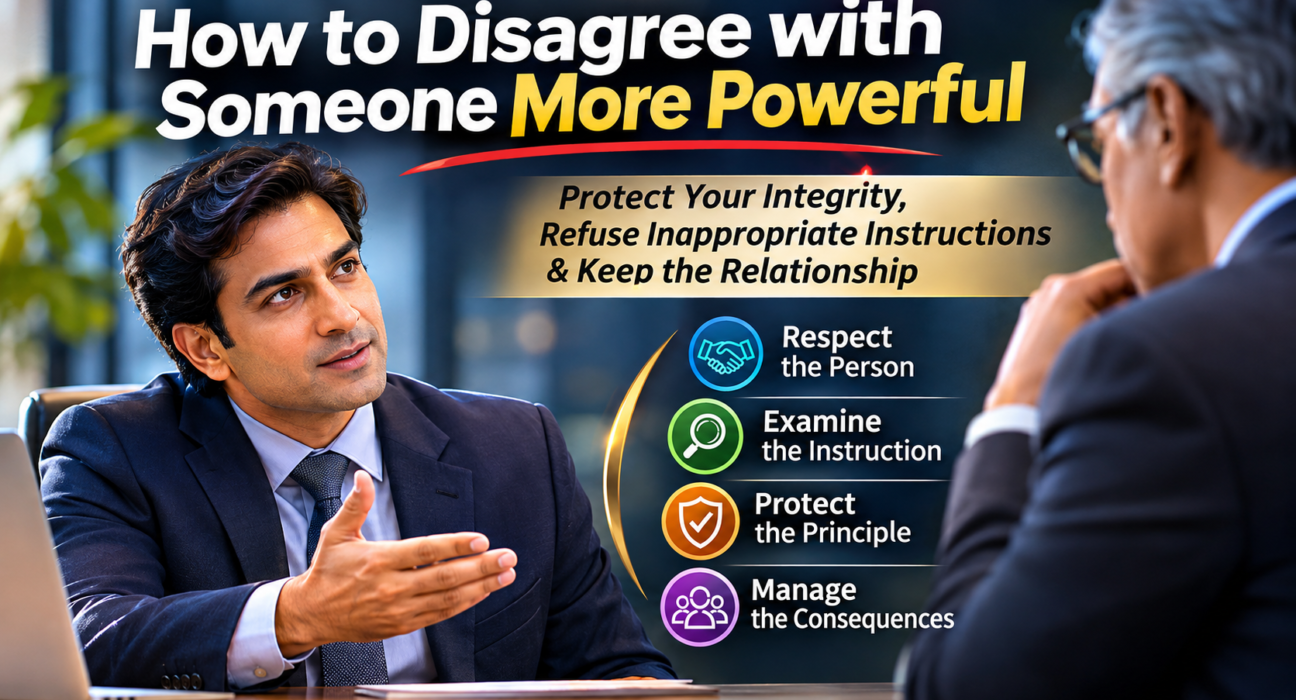
**Respect the person. Examine the instruction. Protect the principle. Manage the consequences.**
1. The core distinction: disagree with the request, not the person’s worth
A disagreement becomes personal when the other person hears: “You are incompetent,” “You are corrupt,” “You have no judgment,” or “You have no authority.” Even when you did not intend to say these things, your wording, timing or tone may communicate them.
A more constructive disagreement says: “I understand the objective. I have a concern about this particular approach. Here is the evidence or risk. Could we consider an alternative?”
This distinction matters because a person with power may be protecting more than a decision. They may be protecting a deadline, reputation, budget, political commitment, relationship with another stakeholder or their own sense of authority. Understanding those interests does not mean accepting an improper demand. It helps you choose language that is more likely to be heard.
Four shifts make a difficult conversation more productive:
- From person versus person to principle versus problem.
- From accusation versus defence to evidence versus assumption.
- From impulse versus pressure to process versus risk.
- From short-term victory to long-term interests and consequences.
The most useful sentence to remember is:
“I respect your position. My concern is with the implications of this particular action, not with you personally.”
This is not a magic formula. It is a way to separate the human relationship from the issue being discussed.
2. What research tells us about speaking up to power
Psychological safety and employee voice
Amy Edmondson’s 1999 study of 51 work teams introduced and examined the concept of team psychological safety: a shared belief that the team is safe for interpersonal risk-taking. The study associated psychological safety with team learning behaviour [1]. Later research reviews have examined why employees speak up or remain silent, and the individual and organisational consequences of voice and silence [2].
The practical lesson is not that every workplace is safe, or that speaking up is always rewarded. It is that people need ways to raise relevant information, questions and concerns without being automatically labelled disloyal or difficult. When you disagree with someone more powerful, frame your concern as information that may improve the decision—not as a test of their authority.
Interest-based negotiation
The negotiation approach associated with Fisher and Ury recommends separating the people from the problem, focusing on interests rather than fixed positions, and using objective criteria where possible [4, 5]. Instead of arguing only about what the other person wants, try to understand what they are trying to achieve.
For example, a boss who insists on a Friday deadline may really need a board-ready summary before a Monday meeting. You may be able to meet that interest with a concise Friday brief and a fully validated report on Monday. You have not simply said no; you have helped solve the underlying problem.
The Positive No
William Ury’s Positive No is commonly expressed as Yes–No–Yes [4, 5]. First, affirm what you need to protect or what you support. Second, state a clear and respectful no. Third, offer a constructive alternative or a route toward a better outcome.
For example:
“I want to support the organisation’s objective and protect the credibility of this report. I cannot change a finding that is not supported by the evidence. What I can do is explain the limitations, validate the underlying data and present the conclusion accurately.”
Giving Voice to Values
Mary Gentile’s Giving Voice to Values approach focuses on how people can act on values they already recognise as important [3]. It encourages people to anticipate pressure, prepare language, rehearse possible responses and learn from peers. Its practical contribution is especially useful when you know what you believe is right but are unsure how to say it under pressure.
Safety communication: CUS, DESC and the Two-Challenge Rule
The Agency for Healthcare Research and Quality’s TeamSTEPPS programme provides practical tools for healthcare teams and other high-risk teamwork contexts [6]. CUS uses the phrases “I am Concerned,” “I am Uncomfortable,” and “This is a Safety issue.” The Two-Challenge Rule encourages a team member to restate a serious concern if the first assertion is ignored and to move to a stronger course of action when a safety concern remains unresolved [7]. DESC provides a structure for describing a situation, expressing concern, suggesting alternatives and explaining consequences [8, 9].
These tools were developed for team and safety contexts. They should not be presented as universal scripts for every political, workplace or personal conflict. Their central lesson is transferable: a serious risk deserves clear language, persistence and an appropriate escalation route.
Aviation crew resource management
Aviation safety investigations and crew-resource-management practice describe graded ways for a less senior crew member to raise concerns with a more senior colleague [10]. One model, PACE, stands for Probe, Alert, Challenge and Emergency warning. The level of directness should reflect the seriousness and immediacy of the risk; escalation need not be slow or sequential when danger is imminent.
What the research does—and does not—prove
Classic obedience and conformity studies, including Milgram’s and Asch’s, help explain why people may defer to authority or group pressure. They do not prove that one particular sentence will stop compliance. Likewise, negotiation and communication frameworks increase structure and may improve the quality of interaction, but none can guarantee that a powerful or abusive person will respond fairly.
The scripts in this article are practical applications of research-informed principles, not scientifically guaranteed formulas. In situations involving coercion or physical danger, safety takes priority over relationship preservation.
3. Before you respond: is the instruction unwise, unclear or unethical?
One of the most important judgment calls is deciding what kind of disagreement you are facing. Do not treat every decision you dislike as misconduct. Equally, do not treat an improper instruction as an ordinary difference of opinion.
A. Unwise but permissible
The decision may be commercially unattractive, inefficient or different from your recommendation, but it is lawful, authorised and does not require you to breach a professional obligation.
Your response: Explain the evidence, outline the risks, offer alternatives and document your recommendation where appropriate. If the authorised decision-maker still chooses the option, you may generally implement it professionally—provided implementation itself remains lawful and within your duties.
Script: “I have shared my assessment and the risks I see. I understand that you have considered the options and made the decision. I will support the implementation and work to make it successful.”
B. Unclear or potentially risky
The facts, authority, policy, scope or implications are uncertain. The instruction may be legitimate, but you need clarification before acting.
Your response: Ask questions, verify facts, consult a qualified colleague or specialist, check the relevant policy and request clarity on the decision and accountability.
Script: “Before I proceed, could we clarify the authority, the expected outcome and the safeguards? I want to ensure that I implement the instruction correctly.”
C. Unethical, unlawful, falsifying or seriously harmful
The request may require you to fabricate information, falsify records, conceal material facts, misrepresent evidence, make an improper payment, violate a professional standard or knowingly expose someone to serious harm.
Your response: Do not participate in the improper act. State the specific concern, preserve a factual record, seek independent professional or legal advice where appropriate, and use a suitable reporting or escalation channel. If immediate danger is involved, disengage and seek help.
Script: “I understand what is being requested, but I cannot certify or present information that I know to be inaccurate. I can help with a factual correction, independent verification or another appropriate route.”
A vital distinction: A senior person’s authority to make a decision does not automatically give them authority to require you to falsify, conceal or certify something you cannot support. Equally, an unpopular decision is not automatically unethical. Examine the facts, the applicable rules and your own responsibilities.
4. How to Disagree with Someone More Powerful: Eight Practical Techniques
Technique 1: Respect–Purpose–Concern–Alternative
Acknowledge the person’s intention or responsibility, connect to the shared objective, state your concern and offer an alternative.
Script: “I appreciate the thinking behind this decision, and I understand the outcome you want. My concern is that the proposed approach could create [specific risk]. May I suggest an alternative that achieves the same objective while addressing that risk?”
Technique 2: The contrasting statement
Make clear what you are not challenging and what you are trying to protect.
Scripts:
- “I am not questioning your authority; I am trying to ensure that we do not expose the organisation to avoidable risk.”
- “I am not disagreeing with the objective. My concern is with the proposed method.”
- “This is not about refusing responsibility. It is about discharging that responsibility correctly.”
Technique 3: Ask a question before you object
Questions can create room for reflection without immediately triggering a contest of positions.
Scripts:
- “May I understand what considerations led to this decision?”
- “Have we examined what happens if the underlying assumption proves incorrect?”
- “Would it be useful to consider one alternative before we finalise this?”
- “What safeguard would prevent the risk I am describing?”
Do not use endless questions to avoid a necessary refusal. When the instruction is clearly improper, state the boundary.
Technique 4: Describe consequences, not motives
Avoid assuming that the other person intends harm. Explain what the proposed action could cause.
Instead of: “You are putting me in a difficult position.”
Say: “This would put me in a position where I may not be able to discharge my professional responsibility appropriately.”
Instead of: “This is corrupt.”
Say: “I am concerned that this may conflict with the applicable rules and approval process.”
If facts establish misconduct, use accurate terms. Diplomatic wording must not become euphemism that hides serious wrongdoing.
Technique 5: Offer an alternative, not just an objection
Scripts:
- “I cannot change the data, but I can explain the limitations and provide a more complete interpretation.”
- “I cannot certify an unverified conclusion, but I can arrange an independent review.”
- “I cannot bypass the procedure, but I can help identify the fastest authorised route.”
Technique 6: Calm repetition—the broken-record technique
If the person keeps insisting, do not invent new explanations each time. Repeat the essential boundary calmly.
Scripts:
- “I understand the urgency. My concern remains unchanged.”
- “I am happy to discuss alternatives, but I cannot undertake that particular action.”
- “I have explained why I cannot certify it. I can help with verification or a documented review.”
Technique 7: The Positive No—Yes, No, Yes
- Yes: State the value or legitimate objective you support.
- No: Clearly refuse the specific action.
- Yes: Offer a constructive alternative.
Script: “I want to help resolve this quickly and protect the credibility of the work. I cannot alter the conclusion without evidence. I can arrange a fresh review and present any verified correction promptly.”
Technique 8: Close by protecting the relationship
Scripts:
- “I value our working relationship. I hope we can keep this disagreement focused on the issue.”
- “We may see this particular matter differently, but I remain committed to working constructively.”
- “Thank you for hearing my concern. Let us agree on the next step and move forward.”
5. Twelve useful communication frameworks and tools
These tools have different origins and levels of evidence. Some are established in research or formal safety programmes; others are practitioner frameworks. Use them according to context rather than claiming that all are equally validated or universally effective.
| Framework or tool | Core idea | Best use |
| Interest-based negotiation | Separate people from the problem; explore interests, options and objective criteria. | Business, leadership and stakeholder disagreements. |
| Positive No | Affirm what matters, state a firm no, offer a constructive yes. | Refusing an inappropriate request while preserving a relationship. |
| Giving Voice to Values | Anticipate pressure, script and rehearse how to act on values. | Ethical pressure and professional integrity. |
| Psychological safety | Create conditions in which interpersonal risk-taking and speaking up are possible. | Team culture and leadership behaviour. |
| OARS | Open questions, affirmations, reflective listening and summaries. | Listening before offering a different view. |
| STATE | Share facts, tell your interpretation, ask for others’ views, talk tentatively and encourage testing. | High-stakes conversations with differing views. |
| DESC | Describe, express concern, suggest alternatives and explain consequences. | Structured conflict conversations; AHRQ TeamSTEPPS context. |
| CUS | “Concerned, Uncomfortable, Safety issue.” | Signalling escalating safety concerns in teams. |
| Two-Challenge Rule | Restate a serious concern if it is ignored; escalate if risk remains unresolved. | Safety-critical teamwork, especially healthcare. |
| PACE | Probe, Alert, Challenge, Emergency warning. | Graded assertion in aviation and other high-risk contexts. |
| OFNR | Observation, Feeling, Need, Request. | Separating facts, impact and needs from blame. |
| BATNA / WATNA | Know your best and worst alternatives if no agreement is reached. | Negotiation, commercial commitments and exit planning. |
6. Five levels of response: calibrate your firmness to the risk
| Level | When to use it | What to say |
| 1. Clarification | The instruction may be misunderstood. | “Could I clarify one aspect before we proceed?” |
| 2. Respectful disagreement | You have a different professional opinion. | “I understand the objective, although I have a different assessment.” |
| 3. Firm boundary | A material ethical, legal, safety or professional concern exists. | “I cannot undertake that particular action because it would conflict with my responsibilities.” |
| 4. Documentation and escalation | Pressure continues, retaliation occurs or an accountable decision is needed. | “I would prefer to refer this through the appropriate channel and document the issue accurately.” |
| 5. Disengagement and protection | There is credible threat, coercion, intimidation or immediate danger. | “I think we should pause this discussion. I will address the matter through a safe and appropriate channel.” |
Do not assume you must climb this ladder one step at a time. If danger is immediate, disengage immediately. If an instruction plainly requires falsification or unlawful conduct, a clear refusal may be necessary at once.
7. How to disagree with a powerful boss or super-boss: 12 situations and scripts
Situation 1: Your boss makes a decision you believe is wrong
“I understand the rationale. May I share a different perspective before we finalise this?”
“I am aligned with the outcome we want. My concern is whether this particular approach will deliver it.”
“I respect your assessment. Having examined the practical implications, I believe another option is worth considering.”
Situation 2: Your boss gives you an unrealistic deadline
“I understand the urgency. Completing everything by that date may compromise validation. I can deliver the essential elements by Friday and the complete verified report by Monday. Which should I prioritise?”
“I would rather give you a realistic commitment and meet it than make an ambitious commitment that I cannot responsibly honour.”
Situation 3: Your boss wants you to support a decision you consider professionally unsound
“Based on the information available to me, my professional assessment is different. I would be comfortable supporting this option if we could address two specific concerns first.”
“I would prefer to keep my recommendation aligned with the evidence. That protects the credibility of the decision and the organisation.”
Situation 4: You are instructed to manipulate, suppress or misrepresent information
“I am happy to review the information and correct factual inaccuracies. I cannot change a conclusion unless the evidence justifies that change.”
“I would not want to dilute the objectivity of my assessment to arrive at a predetermined conclusion.”
“I cannot participate in presenting information that I know to be inaccurate. I can help find an appropriate alternative.”
Situation 5: Your boss says, “I am telling you to do it. Why are you questioning me?”
“I am not questioning your authority. I am trying to ensure that we have considered the implications before proceeding.”
“I understand that you have the authority to make the decision. I also have a responsibility to bring material professional concerns to your attention.”
Situation 6: Your boss asks, “Are you refusing to follow instructions?”
“I am not refusing to contribute to the objective. I am raising a concern about the proposed method. I am happy to discuss an appropriate way forward.”
If it is improper: “I am willing to carry out my responsibilities, but I cannot undertake this particular action because it conflicts with my professional obligations.”
Situation 7: Your boss humiliates you publicly
“I appreciate the feedback. I would welcome the opportunity to discuss the specific concerns separately so that I can address them objectively.”
If a factual correction is essential immediately: “May I clarify one factual point? The records available to me show a slightly different position.”
Later, in private: “I am comfortable receiving critical feedback. I believe we can resolve issues more productively when we examine them privately and against specific facts.”
Situation 8: Your boss threatens your career
“I value the professional relationship and the opportunities I have received. I would hope that differences of professional opinion can be addressed separately from an objective assessment of my performance.”
“I remain committed to delivering results. I would appreciate clear expectations and feedback against agreed criteria.”
Repeated threats or retaliation should be documented and considered for appropriate independent advice or escalation.
Situation 9: Your boss insists on a questionable verbal instruction
“To ensure that I implement your guidance accurately, may I summarise my understanding in an email?”
“Since this has important implications, I would prefer to document the agreed procedure, responsibilities and next steps for clarity.”
This is a request for an accurate record—not an accusation. Do not create a misleading record or imply that the other person approved words they did not approve.
Situation 10: You disagree, but the boss has the final decision
“I have placed my professional assessment before you. I understand that you have considered the alternatives and made your decision. I will support implementation, provided it remains within the applicable rules and my professional responsibilities.”
You can accept a legitimate decision without pretending that you originally agreed with it. This does not apply where implementation would require misconduct or an unacceptable safety violation.
Situation 11: You want to disagree without appearing disloyal
“I consider it part of my responsibility to offer a different perspective when I believe it may improve the decision.”
“I value our working relationship, which is precisely why I would rather raise a concern directly than remain silent.”
Situation 12: You have already had a heated disagreement and want to repair the relationship
“I have reflected on our earlier discussion. I hope my strong expression of concern did not come across as questioning your intentions or authority. That was not my intention. My concern was about the implications of the proposed approach. I value our professional relationship and look forward to working constructively.”
You may apologise for your tone without withdrawing a valid professional concern.
8. How to say no to powerful political figures without making the matter personal
Political influence can affect access, reputation, business relationships and institutional decisions. The most effective posture is often courteous neutrality: respect the individual, remain independent and keep the matter within legitimate processes.
Situation 1: A political figure asks you to do something inappropriate
“I understand why this matter is important to you. I would prefer to handle it through the established process so that the outcome remains fair and transparent.”
Situation 2: They ask for a favour that compromises your independence
“I appreciate your confidence in approaching me. I can assist within my professional responsibilities, but I would not be comfortable making an exception that compromises my independence.”
Situation 3: They expect you to publicly endorse their political position
“I respect your perspective. I prefer to keep my professional work independent of political positions.”
Situation 4: They become offended by your refusal
“I hope you will not interpret my position as a lack of respect. It is based on the professional boundaries I need to maintain, not on any personal consideration.”
Situation 5: They say, “You know who I am, don’t you?”
“Of course, I understand the importance of your position and have every respect for it. I am simply trying to ensure that we handle this matter appropriately.”
Situation 6: They pressure you to bypass an institutional process
“Is there an expedited procedure available within the applicable rules? I would be glad to help identify the quickest appropriate route.”
Situation 7: They use influence to threaten your professional or commercial interests
“I would prefer to resolve this through discussion and the appropriate institutional process. I have no desire to create an unnecessary disagreement.”
If the threat is credible or coercive, do not rely on private negotiation alone. Preserve evidence and seek suitable independent advice and protection.
Situation 8: They ask you to associate your credentials with an activity you cannot support
“I would prefer not to associate my professional credentials with an activity unless I am satisfied that it meets the necessary standards.”
Important: Do not volunteer confidential information, make promises on behalf of public authorities, facilitate unofficial payments, manipulate procurement or imply that you can deliver influence you do not legitimately possess.
9. How to deal with government officials, regulators and inspectors
The most constructive approach is institutional, not personal. Respect the office, understand the authority, follow due process and protect your own legal and professional responsibilities.
Situation 1: An official gives an instruction you do not understand
“Could you please clarify the specific action expected from my side? I want to ensure that I understand the requirement correctly.”
Situation 2: You are asked to bypass a formal procedure
“I understand the urgency. I would prefer to follow the prescribed procedure. Is there an expedited route available under the applicable rules?”
Situation 3: You are asked to sign a document containing inaccurate information
“I am happy to sign once the factual discrepancies have been corrected.”
“I cannot certify information that I have not verified. Could we please revisit these entries?”
Situation 4: You are asked to provide information you have not verified
“I would prefer to provide verified information rather than an answer that may subsequently prove inaccurate. May I check the records and respond formally?”
Situation 5: An official demands something outside their apparent authority
“May I request clarification about the applicable authority for this requirement? I would like to ensure that we proceed correctly.”
Situation 6: An official becomes aggressive or raises their voice
“I am here to cooperate and resolve the matter. May we go through the specific requirements one by one?”
If the interaction becomes intimidating or unsafe, do not insist on continuing. Seek assistance and use an appropriate channel.
Situation 7: An unofficial payment or personal benefit is requested
“I would prefer to make any payment through the prescribed official channel against the appropriate receipt.”
“Could you please guide me through the established procedure?”
Do not offer, pay or facilitate an improper benefit. Do not attempt to investigate or entrap the person yourself. Preserve relevant information lawfully and consider independent legal advice.
Situation 8: You are pressured to destroy, conceal or alter records
“I would not be comfortable changing official records without a documented and authorised basis. Could we first establish the appropriate correction and record-retention procedure?”
Situation 9: You are asked to act against someone without adequate evidence
“I understand the concern. I would prefer to establish the relevant facts and follow the appropriate process before taking action against an individual.”
Situation 10: You are threatened with administrative consequences
“Could you please clarify the specific requirement or provision involved so that I can respond through the appropriate formal channel?”
Do not ignore a formal notice, order or deadline. Obtain independent advice when the consequences are material.
India-specific safety and reporting note
India’s Ministry of Home Affairs describes 112 as the nationwide unified emergency number for reporting emergencies [11]. Use emergency services when there is an immediate threat or urgent need for assistance.
The Public Interest Disclosure and Protection of Informers (PIDPI) process is not a general-purpose route for every workplace dispute or every government authority [12]. It is a specific vigilance-related mechanism concerning certain allegations of corruption or misuse of office involving Central Government employees and specified Central Government-controlled entities. State Government matters and ordinary personal grievance issues may fall outside its scope. Check the current Central Vigilance Commission guidance and obtain advice before relying on it.
10. When someone can harm you: physical, social, financial or career threats
This is the most sensitive category. It includes people who may threaten your physical safety, family, social reputation, livelihood, business, finances, employment or professional opportunities. The goal changes: safety and freedom of action come first. You are not required to preserve a relationship with someone who uses it to intimidate or coerce you.
A. Physical intimidation
Use short, non-provocative language. Do not trade threats or try to prove that you are fearless.
- “I don’t want this conversation to become unpleasant. Let’s pause for now.”
- “I understand that you are upset. I would prefer to discuss this when things are calmer.”
- “I think it would be better if we continued with another person present.”
If danger is credible, move to a safer place, contact trusted support or emergency services, and avoid isolated meetings. Do not prioritise finishing the argument.
B. Aggressive language or verbal abuse
- “I am willing to hear your concern, but I think we will understand each other better if we speak calmly.”
- “I don’t think continuing in this tone will help either of us.”
- “I would prefer to continue this discussion when it can be constructive.”
If the aggression continues, disengage.
C. Threats to destroy your reputation
- “I would prefer that any concerns about my work or conduct are addressed through verifiable facts and appropriate channels.”
- “I have no desire to make this personal. I am willing to address the actual issue.”
Preserve relevant messages, contracts, work records and evidence of completed assignments. Avoid retaliatory public posts.
D. Threats to your business or finances
- “I value the commercial relationship, but I would prefer that our obligations remain clearly documented.”
- “I am willing to discuss a reasonable solution, but I would not want to make a commitment under pressure.”
- “I would prefer to take independent advice before making a decision with significant financial implications.”
Do not sign, transfer money, accept liabilities or waive rights simply to end an uncomfortable conversation.
E. Threats to your career
- “I remain committed to a constructive professional relationship. I would prefer that concerns about my work are addressed against clear expectations and objective criteria.”
- “I am happy to receive feedback and address legitimate concerns. Please let me know the specific expectations.”
Document repeated threats or retaliation and consider independent professional or legal advice.
F. Social pressure and emotional blackmail
- “I genuinely appreciate what you have done for me. I hope you will understand that appreciation and agreement are two different things.”
- “I value our relationship, but I cannot make a decision that I am professionally or personally uncomfortable with.”
- “I am grateful for your support, and I also need to remain responsible for my own decisions.”
Gratitude does not create an unlimited obligation.
G. Attempts to isolate you
- “I would prefer to have the relevant people involved so that there is clarity about what has been discussed.”
- “Since this matter has important implications, I would be more comfortable handling it through the appropriate communication channel.”
Avoid isolated meetings if intimidation or harm is possible. Tell a trusted person where you are going and arrange a safe way to leave.
H. Threats against your family
Do not negotiate away a physical threat through an ordinary relationship conversation. Prioritise safety, inform trusted people, preserve threatening communications and seek appropriate help. Avoid disclosing family routines or location details unnecessarily.
I. Blackmail or extortion
When safe to communicate, a concise boundary may be: “I am not prepared to make a decision under pressure. Any further discussion will need to take place through an appropriate and documented channel.”
Do not threaten retaliation, attempt to entrap the person or disclose further compromising information. Seek independent legal advice and appropriate protective support.
Remember: De-escalation is not submission. Leaving an unsafe situation is not weakness. Preserving your safety is a legitimate and necessary objective.
11. The CLEAR refusal model
Use CLEAR as a practical sequence for ordinary and high-stakes professional refusals. It is a teaching framework for this article, not a validated clinical or legal protocol.
- C — Clarify: “May I ensure that I have understood exactly what is being requested?”
- L — Listen: “I understand the objective and the urgency behind this requirement.”
- E — Explain the concern: “My concern is that this approach could create a compliance or professional-integrity issue.”
- A — Alternative: “Could we consider a route that achieves the objective within the appropriate framework?”
- R — Refuse when necessary: “I am afraid I cannot undertake that particular action.”
For clear misconduct or immediate danger, do not delay a refusal or protective action merely to complete all five stages.
12. Ready-to-use refusal language: diplomatic, firm and formal
Diplomatic refusal
- “I am not entirely comfortable with this approach.”
- “I would prefer not to proceed in that manner.”
- “Could we explore a more appropriate way of achieving the same outcome?”
- “I would like to consider the implications before committing myself.”
Firm refusal
- “I understand the request, but I cannot undertake that particular action.”
- “I cannot endorse something that I do not believe is supported by the evidence.”
- “I would be uncomfortable proceeding without the necessary authorisation.”
- “I cannot compromise my professional obligations in this matter.”
When the person insists
- “I appreciate your position. Unfortunately, my concern remains unchanged.”
- “I understand that you would like me to proceed. I cannot agree to this particular action.”
- “I am available to discuss alternatives, but I cannot undertake the proposed action.”
When a written record is needed
- “Given the implications, I would prefer to document the issue and seek the appropriate guidance before proceeding.”
- “May I request that we refer this matter to the relevant compliance or administrative authority?”
13. How to preserve the relationship after disagreement
1. Avoid unnecessary public humiliation
Where possible, raise sensitive disagreement privately. Public correction may make a person defend their status instead of examining the issue. An urgent safety concern, however, must be raised immediately even if others are present.
2. Acknowledge the legitimate objective
“I appreciate what you are trying to accomplish.”
“I understand why you are keen to move this forward.”
“I recognise the constraints under which you are making this decision.”
3. Keep the issue separate from personality
Replace “You never listen” with “I think there is one consideration we have not yet examined.” Replace “You are unreasonable” with “I believe we have different assessments of the situation.”
4. Allow the other person to change their mind without losing face
If the person later accepts your suggestion, do not say, “As I told you earlier.” Say: “I am glad we have arrived at an approach that addresses both the objective and the concerns we discussed.”
5. Demonstrate that disagreement has not reduced your commitment
Deliver what you promised. Continue to respond professionally. Do not become sarcastic, withdrawn or obstructive.
6. Apologise for tone—not for a legitimate concern
“I am sorry if my tone sounded sharper than I intended. I nevertheless believe the underlying issue deserved consideration, and I hope we can continue discussing such matters constructively.”
7. Recognise that relationship preservation is mutual
You can contribute respect, honesty and maturity. You cannot single-handedly make an abusive or coercive relationship healthy. A relationship worth preserving must allow both people to maintain reasonable boundaries.
14. Body language, voice and emotional regulation
The same words can sound respectful or provocative depending on delivery. Aim for composed assertiveness—not a performance of dominance.
- Face: Maintain a composed expression. Avoid eye-rolling, contemptuous smiles or visible scorn.
- Eye contact: Use natural eye contact; do not stare aggressively.
- Posture: Keep a relaxed, upright posture and appropriate physical distance.
- Voice: Speak clearly and at a measured pace. Do not compete with the other person’s volume.
- Listening: Let the person finish and reflect the concern accurately before responding.
- Gestures: Use natural, restrained movements. Avoid pointing, invading space or clenched fists.
- Pause: After making an important point, stop speaking. Silence can give the other person time to consider it.
The pause before the response
When someone makes an aggressive statement or gives you an uncomfortable instruction:
- Pause briefly rather than answering impulsively.
- Take a normal, controlled breath.
- Identify the outcome you need.
- Choose the least confrontational response that still protects the boundary.
- Speak in a measured tone.
Do not use deliberate eye contact, close proximity or dominant gestures to demonstrate confidence to someone who may be violent. Safety-oriented de-escalation takes priority.
15. What not to say—and what to say instead
| Avoid | Prefer |
| “You are wrong.” | “I see one aspect differently and would like to explain why.” |
| “That will never work.” | “I see a practical risk we may need to address.” |
| “This is unethical.” | “I am concerned that this may conflict with the applicable ethical or compliance standard.” |
| “You cannot tell me what to do.” | “Could we clarify the authority, responsibilities and expected outcome?” |
| “You are threatening me.” | “I would prefer to keep this discussion constructive and use the appropriate channel.” |
| “Do whatever you want.” | “I have shared my concern and remain available to discuss an appropriate alternative.” |
| “I will take this to the highest authority.” | “It may be appropriate to seek guidance through the relevant institutional channel.” |
| “Everyone knows what you are doing.” | “I would prefer to focus on the documented facts.” |
| “This is stupid.” | “I have a concern about the practical implications.” |
| “You cannot make me.” | “I am not able to undertake that particular action.” |
Two mistakes deserve special attention:
Overexplaining: Give one clear reason and a workable alternative. Repeatedly defending the same boundary can turn the conversation into a debate over minor details.
Trying to prove fearlessness: You do not need to win a contest of courage. You need to make a sound decision and protect your interests.
16. Document, escalate and protect yourself
A respectful conversation may not be enough when instructions are contested, threats are made or retaliation is possible.
Keep a factual record
Record the date, time, place, people present, exact instruction or request, concern raised, response received, agreed next steps and relevant documents. Preserve original emails, messages, contracts and work records in accordance with confidentiality, privacy and record-retention rules.
Keep facts separate from interpretation. Do not exaggerate, speculate about motive or create a retrospective note that appears to have been written contemporaneously.
Send a neutral follow-up email
Subject: Follow-up and confirmation of our discussion
Dear [Name],
Thank you for taking the time to discuss the matter earlier.
For clarity, my understanding of the discussion is as follows:
- The intended objective is [state objective].
- The proposed course of action is [state approach].
- The points requiring clarification or further consideration are [state specific points].
- The agreed next steps are [state responsibilities and timelines].
As discussed, I had raised certain professional or operational considerations regarding [briefly identify the concern]. My intention was to ensure that these were considered before proceeding.
I remain committed to supporting an appropriate way forward and ensuring that the matter is handled responsibly.
Please let me know if I have misunderstood any aspect of our discussion.
Regards,
[Your Name]
Choose the right escalation route
Depending on the nature of the matter, a suitable route may include a higher reporting authority who is independent of the decision, HR or a grievance mechanism, an ethics or compliance office, a professional regulator, an appropriate statutory body, independent legal counsel or emergency services.
Not every disagreement belongs with HR, and not every serious concern should be handled only internally. Check the scope, confidentiality and safeguards of a reporting channel before relying on it. Do not assume that an internal process guarantees protection from retaliation.
Build professional independence
Do not allow one individual to become the sole gatekeeper of your professional future. Maintain multiple credible relationships, a documented track record, independent sources of opportunity, current qualifications, financial flexibility where possible and a reputation for fairness, reliability and objectivity.
The more legitimate professional independence you have, the less vulnerable you may be to inappropriate pressure from one person.
17. Prepare before the difficult conversation
Ask yourself five questions:
- What outcome am I trying to achieve? Change a decision, clarify an instruction, refuse an improper request, protect myself or simply register a different professional view?
- What is non-negotiable? Identify what can be adjusted and what cannot be compromised.
- What might the other person be trying to protect? A deadline, reputation, budget, political commitment, relationship or institutional objective?
- What is the least confrontational way to achieve my objective? A private meeting, written note, clarifying question, alternative, second opinion or formal route?
- What will I do if the person refuses to reconsider? Accept a permissible decision, seek advice, document, escalate or disengage?
The seven-point preparation card
- My objective is clear.
- My facts are verified.
- My boundary is clear.
- I understand the other person’s interests.
- I have an alternative.
- I have assessed retaliation and safety risks.
- I have a follow-up or escalation plan.
Rehearse your response
Write down the exact words you may need. Practise saying them aloud. Ask a trusted colleague to role-play the other person’s likely responses. Try a calm version, a firm version and a short version for a pressured moment. Rehearsal does not guarantee a particular outcome, but it can make your intended response easier to retrieve when emotion and time pressure are high.
18. A case study: a professional under political pressure
Consider a pathologist whose director is being pressed by a politically influential person to endorse a conclusion that the available findings do not support. The director may also be under pressure. The professional’s objective is not to challenge the director’s authority. It is to protect the accuracy and defensibility of the report and offer a legitimate alternative.
Stage 1—Clarify the request
“Sir, may I understand the specific outcome being requested and the basis on which this action has been proposed? I would like to examine the technical and professional implications before proceeding.”
Stage 2—State the evidence-based concern
“I understand the objective and appreciate the urgency. However, based on the findings available to me, I have a professional concern about proceeding in this manner. The proposed conclusion may not be supported by the evidence and could compromise the reliability of the diagnostic outcome.”
Stage 3—Offer a defensible alternative
“I suggest an independent pathology review, repeat or validation of the relevant investigation where appropriate, or referral to the technical or quality-review process. This would allow us to address the underlying requirement without compromising professional standards.”
Stage 4—State the boundary
“I respect your position and understand the pressures involved. However, as the pathologist responsible for the professional opinion or report, I cannot certify a conclusion that is not supported by the available findings. I would be happy to facilitate an alternative review or escalate the technical concern through the appropriate institutional process.”
If the director says, “This is coming from above—please cooperate,” the pathologist could respond:
“I understand that the instruction originates higher up, and I am not asking you to absorb that pressure alone. My concern is about what I can professionally certify. If the instruction requires me to sign something the evidence does not support, I need a legitimate technical route—an independent review, a documented professional concern or a formal escalation—so that the risks are visible and the decision is defensible.”
The lesson is important: the fact that an instruction comes from a powerful person is neither a reason automatically to comply nor a reason automatically to confront. Examine the professional merits, evidence, applicable standards and consequences.
19. Twenty sentences worth remembering
- “I understand your perspective, although I see one aspect somewhat differently.”
- “May I share one consideration before we finalise this?”
- “I agree with the objective; my concern is with the proposed approach.”
- “I would rather raise the concern now than allow it to become a problem later.”
- “I hope you will see this as a professional observation rather than a personal disagreement.”
- “I appreciate the confidence you have placed in me.”
- “I would prefer to proceed in a manner that protects everyone’s interests.”
- “Could we explore another way of achieving the same outcome?”
- “I am happy to cooperate, but I need to remain within the appropriate professional boundaries.”
- “I would not be comfortable endorsing something that I cannot substantiate.”
- “I respect your authority, and I also have a responsibility to communicate my professional concerns.”
- “I would prefer that we resolve this through facts rather than assumptions.”
- “I understand the urgency, but I would not want speed to compromise accuracy.”
- “I would appreciate some time to examine the implications before committing myself.”
- “I have no personal disagreement. My concern is entirely about the issue.”
- “I value the relationship and hope we can find a mutually acceptable way forward.”
- “I would rather be candid now than create a misunderstanding later.”
- “I am willing to discuss alternatives, although I cannot agree to that particular action.”
- “I hope our difference of opinion will not affect the mutual respect we have for each other.”
- “I remain committed to a constructive relationship, even where we may not always agree.”
20. Frequently asked questions about disagreeing with someone more powerful
How do you disagree with your boss without getting into trouble?
Choose the right setting, state your shared objective, present a specific concern and offer an alternative. Keep the discussion focused on evidence and outcomes. No script can guarantee that a boss will respond fairly, so assess the culture and risks before raising a sensitive matter.
What is a Positive No?
William Ury’s Positive No is a three-part approach: affirm the value or interest you need to protect, state a clear no to the request, and offer a constructive alternative. It helps balance self-respect and the relationship.
What should you say when your boss says, “Just do it”?
If the instruction is unclear: “I want to implement your guidance correctly. Could we clarify the expected outcome and the relevant procedure?” If it is improper: “I understand the instruction, but I cannot undertake an action that conflicts with my professional obligations. I can help with an appropriate alternative.”
When should you refuse an instruction outright?
When the request clearly requires unlawful conduct, falsification, fraud, improper payment, concealment of material facts or a serious breach of safety or professional obligations. Seek advice and use the relevant reporting route as appropriate.
What if someone could physically harm you?
Do not prioritise winning the disagreement. Use short, non-provocative language, create distance, leave when safe, contact trusted support and use emergency services when necessary. In India, 112 is the nationwide emergency number.
Should you apologise after disagreeing?
Apologise if your tone, timing or behaviour was inappropriate. Do not apologise for having a legitimate professional concern merely to restore comfort. You can say, “I regret that my tone was sharper than necessary. I still believe the underlying concern deserved consideration.”
What if the powerful person makes the final decision?
If the decision is lawful, ethical and within their legitimate authority, you may accept and implement it while retaining your professional assessment. If implementation requires you to participate in misconduct or violate your responsibilities, do not treat the final-decision principle as permission to comply.
Should you put a verbal instruction in writing?
For material decisions, a neutral written summary can clarify the request, facts, responsibilities and next steps. Keep the record accurate and proportionate; do not use email as a threat or imply approval that was not given.
Conclusion: Respect the person. Refuse the request. Protect your integrity.
Disagreeing with someone more powerful than you is rarely comfortable. The power imbalance is real. A boss may influence your career; a government official may control an administrative process; a political figure may influence access or reputation; an intimidating individual may create risks that no communication technique can neutralise.
That is precisely why the answer cannot be blind courage, automatic compliance or clever wording alone. It must combine judgment, preparation, emotional control, evidence, boundaries and an honest assessment of risk.
Start by understanding what kind of instruction you are facing. If it is merely unwise, explain your view and offer a better route. If it is unclear, ask, verify and seek advice. If it is unlawful, dishonest or seriously harmful, do not knowingly participate. If there is a credible threat, prioritise safety and disengage.
When it is safe to speak, challenge the action rather than attacking the individual. Acknowledge the legitimate objective, describe the concern, offer an alternative and state your boundary calmly. Allow the other person to reconsider without humiliation. After the discussion, continue to act professionally—but do not mistake relationship preservation for surrender.
The ultimate test of professional maturity is not whether you can disagree with someone who has less power than you. It is whether you can exercise sound judgment when the person across the table has more.
Be soft on the relationship, clear on the issue, firm on the boundary and uncompromising on integrity. And when safety is at stake, remember that walking away is not weakness; it is judgment.
RESEARCH AND REFERENCE LINKS
The article uses the following research, formal tools and official guidance. The communication frameworks do not all have the same evidence base; the source list distinguishes academic research, structured practice tools and practitioner frameworks.
- Amy Edmondson (1999), “Psychological Safety and Learning Behavior in Work Teams,” Administrative Science Quarterly. Study of 51 manufacturing teams examining psychological safety and learning behaviour. https://journals.sagepub.com/doi/10.2307/2666999
- Elizabeth Wolfe Morrison (2023), “Employee Voice and Silence: Taking Stock a Decade Later,” Annual Review of Organizational Psychology and Organizational Behavior. https://doi.org/10.1146/annurev-orgpsych-120920-054654
- University of Virginia Darden School of Business, Giving Voice to Values. Overview of scripting, preparation and rehearsal for acting on values. https://www.darden.virginia.edu/ibis/initiatives/gvv
- William Ury, The Power of a Positive No. Three-part approach to affirming interests, stating a no and moving toward a constructive yes. https://www.williamury.com/the-power-of-a-positive-no/
- Harvard Program on Negotiation, The Power of a Positive No. https://www.pon.harvard.edu/resources/book-reviews/the-power-of-a-positive-no/
- Agency for Healthcare Research and Quality (AHRQ), TeamSTEPPS tools. https://www.ahrq.gov/teamstepps-program/resources/modules/index.html
- AHRQ, Two-Challenge Rule. https://www.ahrq.gov/teamstepps-program/curriculum/mutual/tools/rule.html
- AHRQ, CUS tool. https://www.ahrq.gov/teamstepps-program/curriculum/mutual/tools/cus.html
- AHRQ, DESC script. https://www.ahrq.gov/teamstepps-program/curriculum/mutual/tools/desc.html
- Transportation Safety Board of Canada, aviation investigation material describing the PACE model. https://tsb-bst.gc.ca/eng/rapports-reports/aviation/2011/a11h0002/a11h0002.html
- Ministry of Home Affairs, Government of India, Emergency Response Support System (112). https://www.mha.gov.in/emergency-response-support-system-erss
- Central Vigilance Commission, Government of India. Review current complaints and whistle-blower guidance before using any PIDPI route. https://www.cvc.gov.in/?q=citizens-corner/whistle-blower-complaints
- LinkedIn (12 March 2026), How LinkedIn Is Improving the Feed to Show More Relevant, Authentic Professional Content. https://news.linkedin.com/2026/ImprovingTheFeed
- LinkedIn Help, Upload and Share Documents. https://www.linkedin.com/help/linkedin/answer/a519831
- Meta (2026), Rewarding Original Creators on Facebook. https://about.fb.com/news/2026/03/rewarding-original-creators-on-facebook/
- Meta (24 April 2025), Cracking Down on Spammy Content on Facebook. https://about.fb.com/news/2025/04/cracking-down-spammy-content-facebook/
- Instagram hashtag guidance reported at the December 2025 rollout of the five-hashtag limit. https://www.socialmediatoday.com/news/instagram-implements-new-limits-on-hashtag-use/808309/
- Google Search Central, SEO Starter Guide. https://developers.google.com/search/docs/fundamentals/seo-starter-guide
- Google Search Central, Title Links. https://developers.google.com/search/docs/appearance/title-link
- Google Search Central, Snippets and Meta Descriptions. https://developers.google.com/search/docs/appearance/snippet
- Google Business Profile Help, Create and Manage Posts. https://support.google.com/business/answer/7342169
- Google Business Profile Help, Posts Content Policy. https://support.google.com/business/answer/7213077
Editorial note: The scripts, the CLEAR mnemonic and the five-level response ladder are practical synthesis for this article. They are not clinical protocols, legal advice or guarantees of a particular outcome. Readers facing possible criminal conduct, immediate physical danger, complex employment consequences or regulatory exposure should seek qualified, independent advice.
Subhashis Banerji [Author]
Leadership assessor, strategist, and writer. I help professionals and organizations make smarter decisions by learning to read patterns, not promises.
📘 Read all my articles here:
👉 https://successunlimited-mantra.net/ & https://successunlimited-mantra.com/index.php/blog PLUS on https://relationshipandhappiness.com/
💼 Connect with me on LinkedIn: https://www.linkedin.com/in/subhashis-banerji-21b1418/


– Please read our Comment Policy