




The 8R Hierarchy: The Ultimate Framework to Cut Waste, Reduce Costs & Build a Sustainable Business
- BY Subhashis Banerji
- March 19, 2026
- 0 Comments
- 512 Views
Reading Time: 21 minutes
The 8R Hierarchy:
Contents
hide
The 8R Hierarchy is a proven framework to reduce waste, cut costs, and build sustainable systems.
Introduction: Why Most Sustainability Efforts Fail (And How the 8R Fixes It)
The Proven Order to Eliminate Waste Before It Starts
A Step-by-Step System to Reduce Waste, Costs, and Complexity
Most sustainability efforts fail because they start at the wrong place. They begin with recycling—the last resort—when true impact begins with re-evaluation. This comprehensive playbook presents the 8R hierarchy as a strategic framework, not just environmental slogans. Each step builds upon the previous, creating a systematic approach to resource management that delivers unparalleled value across all domains.
The 8R Hierarchy:
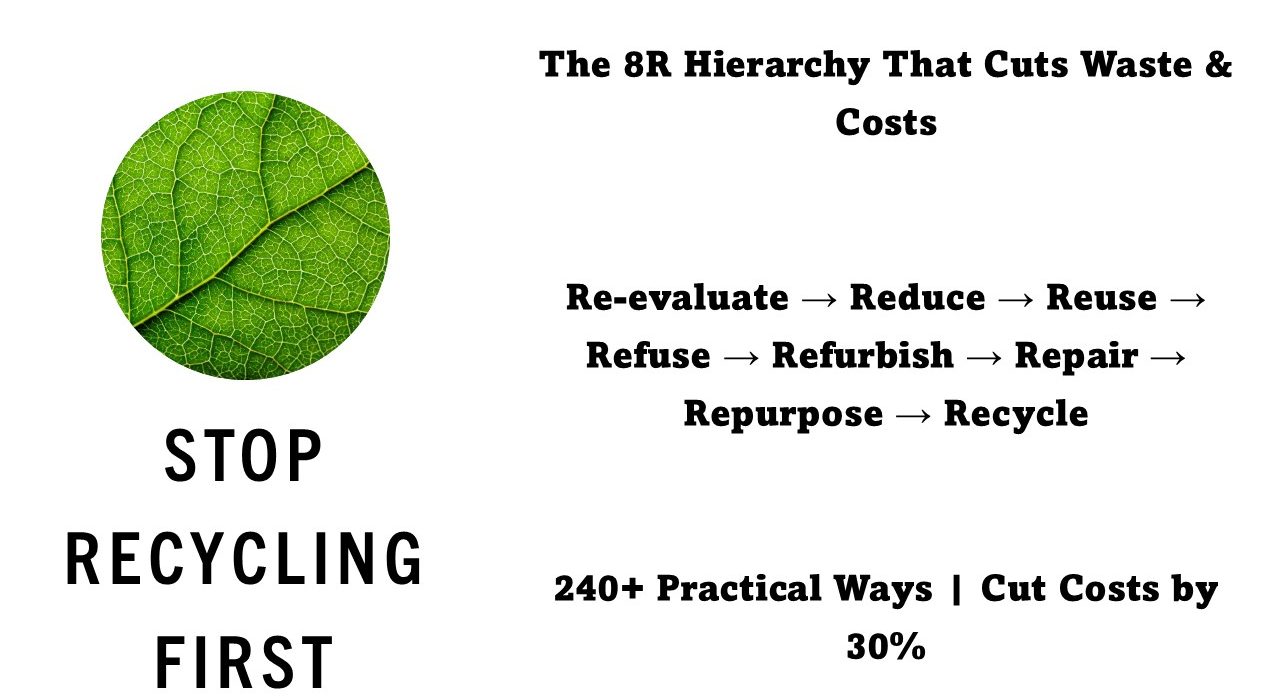
Re-evaluate → Reduce → Reuse → Refuse → Refurbish → Repair → Repurpose → Recycle
The higher you operate on this hierarchy, the greater your impact on both sustainability AND cost-effectiveness. Let’s transform this framework into an actionable reality.
Re-evaluate Your Choices: The #1 Step to Eliminate Waste Before It Starts
The most powerful recycling action happens before anything exists.
35+ Practical Ways to Re-evaluate Purchases at Home (Save Money & Reduce Waste)
- Implement a 30-day “cooling-off” period for non-essential purchases
- Ask “Do I already own something that does this?” before buying anything new
- Compare durability, not just price, when making purchases
- Choose timeless designs over trendy items that quickly become dated
- Evaluate repairability ratings (like iFixit scores for electronics) before purchase
- Track how often you’ll realistically use an item with a 30-day usage diary
- Prefer local products with a lower transport footprint
- Question upgrades driven by status rather than functional need
- Audit your weekly grocery list to prioritize local, seasonal produce
- Review your wardrobe and commit to buying only second-hand clothing for a year
- Evaluate energy usage by tracking bills and switching to renewable providers
- Assess transportation options, opting for biking or public transit instead of driving alone
- Reconsider packaging by choosing products with minimal or recyclable wrapping
- Examine your tech gadgets and delay upgrades until truly necessary
- Analyze water consumption with a home audit and install low-flow fixtures
- Reflect on meal planning to avoid food waste through portion control
- Scrutinize beauty products for eco-friendly certifications
- Re-evaluate subscriptions and go digital to reduce paper
- Assess cleaning supplies, switching to natural alternatives
- Review toy purchases for kids, favoring durable, multi-use items
- Evaluate furniture buys, preferring timeless pieces over trendy ones
- Examine book habits, using libraries instead of buying new books
- Reconsider gift-giving, opting for experiences over physical items
- Audit pet supplies, choosing biodegradable waste bags
- Assess office supplies, reusing paper, and buying recycled products
- Reflect on holiday decorations, using natural or reusable ones
- Evaluate kitchen appliances, repairing old ones before buying new ones
- Scrutinize travel plans, choosing eco-tourism options
- Re-evaluate investments, directing funds to green companies
- Examine daily routines, like coffee habits, by using reusable mugs
- Assess gardening choices using native plants to reduce water needs
- Review entertainment, streaming instead of buying physical media
- Calculate “cost-per-wear” for clothing purchases
- Read ingredient labels for microplastics in personal care products
- Question if you need to own an item or if you can rent/borrow it
25+ Business Strategies to Re-evaluate Procurement & Cut Wasteful Spending
- Re-evaluate procurement policies for lifecycle cost, not just purchase price
- Challenge “new vendor = better” bias with objective sustainability criteria
- Include sustainability score (20% weighting) in vendor selection matrices
- Buy fewer SKUs but of higher quality and quantity
- Standardize materials across product lines to reduce waste and complexity
- Evaluate ROI, including end-of-life disposal and recycling costs
- Ask, “Can we lease instead of owning?” for equipment with rapid obsolescence
- Audit underutilized assets annually through department-wide inventories
- Review supply chain ethics and environmental practices
- Switch to “Digital First” document policies with executive enforcement
- Evaluate the necessity of business travel vs. advanced video conferencing
- Analyze long-term ROI of sustainability investments
- Conduct comprehensive “waste stream audits” for all facilities
- Assess the environmental impact of corporate gifts and promotional swag
- Re-evaluate vending machine contracts for plastic-free options
- Centralize printing to reduce paper/toner use
- Implement a “bring your own mug” policy with enforcement
- Use cloud storage instead of physical servers where possible
- Reduce office space through optimized hybrid work models
- Eliminate single-serve coffee pods in favor of bulk systems
- Implement demand-based purchasing triggered by actual usage
- Digitize contracts, approvals, and workflows completely
- Reduce over-procurement buffers through just-in-time systems
- Optimize logistics routes with AI-powered route planning
- Reduce energy per transaction through process optimization
20+ Smart Workplace Habits to Re-evaluate Work, Tools & Productivity
- Re-evaluate software subscriptions quarterly with usage analytics
- Avoid tool duplication across teams through centralized asset management
- Choose platforms that integrate functions instead of multiplying applications
- Question: unnecessary documentation creation with “value-add” criteria
- Re-evaluate meeting frequency and necessity with strict agenda requirements
- Choose learning depth over certificate hoarding for skill development
- Reduce information clutter before adding new inputs or systems
- Re-evaluate commute options, including carpooling and public transit
- Replace status meetings with real-time dashboards
- Reduce email overload through disciplined communication protocols
- Use fewer but deeper learning resources for professional development
- Reduce tool switching through standardization
- Reduce multitasking, which wastes attention and increases errors
- Reduce unnecessary reports through automated executive summaries
- Reduce rework through crystal-clear briefs and requirements
- Repair broken processes before creating new ones
- Repair communication gaps proactively
- Repair trust before escalation becomes necessary
- Repair habits through structured reflection and adjustment
- Repair skill gaps through targeted training
30+ Industrial Strategies to Re-evaluate Design, Materials & Production Efficiency
- Re-evaluate material selection at the design stage for sustainability
- Question tolerance levels that create excess scrap without adding value
- Design for disassembly from the initial concept phase
- Choose recyclable mono-materials where possible instead of composites
- Evaluate energy-intensive steps for optimization or elimination
- Replace “overengineering” with fit-for-purpose design principles
- Re-evaluate packaging as integral to product design, not an afterthought
- Perform Life Cycle Assessments (LCA) for all products
- Audit raw material extraction methods for environmental impact
- Evaluate “Right to Repair” principles in product design
- Assess the carbon footprint of all logistics routes and alternatives
- Re-evaluate energy sources, switching to renewables where feasible
- Analyze water consumption in cooling and cleaning systems
- Investigate biodegradable alternatives to synthetic resins and materials
- Conduct “Design for Disassembly” audits on existing products
- Evaluate the toxicity of dyes, solvents, and chemical inputs
- Implement “Lean Manufacturing” to systematically eliminate waste
- Use precision cutting tools and nesting software to reduce scrap material
- Optimize packaging size to maximize pallet and container utilization
- Use lightweight materials to reduce transport fuel consumption
- Implement closed-loop water systems for cooling and processing
- Reduce “over-processing” that adds cost without customer value
- Standardize parts across different product lines
- Use additive manufacturing (3D printing) to use only the necessary material
- Minimize chemical usage through high-pressure cleaning systems
- Reduce raw material over-ordering through predictive analytics
- Reduce scrap through statistical process control
- Reduce water consumption per unit through efficiency measures
- Reduce energy intensity per batch through optimization
- Reduce defect rates at source through quality-at-source programs
Reduce Consumption: Proven Ways to Cut Waste, Costs & Resource Use
Using less of everything—materials, energy, water—from the outset.
35+ Proven Ways to Reduce Household Consumption & Daily Waste
- Buy fewer clothes but of higher quality (capsule wardrobe approach)
- Reduce food waste via systematic meal planning and proper storage
- Shift to refillable essentials (soap, detergent, etc.)
- Cut electricity through smart usage habits and monitoring
- Share rarely used tools with neighbors through tool libraries
- Reduce paper usage by going completely digital where possible
- Avoid bulk buying that leads to expiry and waste
- Use multi-purpose items (all-in-one cleaners, convertible furniture)
- Implement the “one in, one out” rule for clothing and other categories
- Downsize living space to encourage minimalism and reduce energy use
- Buy bulk foods using your own containers to cut packaging
- Use shopping lists religiously to avoid impulse buys
- Switch to energy-efficient LED bulbs throughout the home
- Install programmable thermostats to optimize heating/cooling
- Eat smaller portions to reduce food intake and associated waste
- Grow your own herbs to cut the store-bought produce needs
- Use public libraries extensively for books and media
- Carpool or use ride-sharing apps to reduce solo driving
- Practice “Meatless Mondays” to reduce resource-intensive meat consumption
- Use natural light strategically to cut artificial lighting needs
- Limit toy accumulation through rotation systems
- Reduce chemical use with DIY natural cleaners
- Opt for walking short distances instead of driving
- Limit beauty product variety to essentials
- Reduce packaging by shopping at zero-waste stores
- Use cloths instead of paper towels
- Limit hobby supplies to what’s immediately needed
- Wash clothes in cold water and only run full loads
- Cancel junk mail catalogs through opt-out services
- Reduce lawn size with native ground cover or gardens
- Reduce phantom load with smart power strips
- Take shorter showers with timer awareness
- Reduce impulse buying by unsubscribing from retail emails
- Use a rain barrel to reduce garden hose usage
- Reduce single-serving snacks by buying in bulk and portioning
25+ Business Strategies to Reduce Operational Waste & Costs
- Reduce over-procurement buffers through data-driven forecasting
- Implement demand-based purchasing triggered by minimum stock levels
- Digitize contracts and approvals completely with e-signatures
- Reduce office supply consumption via controlled distribution systems
- Optimize logistics routes with route optimization software
- Cut marketing print waste through digital-first strategies
- Reduce energy per transaction through process automation
- Encourage remote/hybrid work to cut infrastructure load
- Implement double-sided printing as the default on all devices
- Reduce energy use with LED lighting and automatic shut-offs
- Promote “virtual file cabinets” to eliminate paper storage
- Offer tap water in glasses instead of bottled water
- Reduce promotional merchandise; choose only useful items
- Implement “right-sizing” policy for packaging
- Reduce office supply stocks with just-in-time ordering
- Optimize server utilization through virtualization
- Reduce water use with sensor-activated taps
- Consolidate shipments to customers
- Reduce the need for office space through space optimization
- Implement a strict “lights-off” policy after hours
- Reduce unnecessary meetings; keep them short and focused
- Choose durable, long-life equipment over cheap alternatives
- Reduce packaging complexity by design
- Offer digital receipts and invoices exclusively
- Reduce sample waste at trade shows with digital catalogs
15+ Workplace Productivity Habits to Reduce Waste & Improve Efficiency
- Reduce unnecessary reports through value analysis
- Replace status meetings with real-time dashboards
- Reduce email overload through structured communication
- Use fewer but deeper learning resources
- Reduce tool switching through standardization
- Reduce multitasking to improve focus and quality
- Cut rework through clarity in instructions and briefs
- Reduce printing by going completely digital
- Reduce commuting through remote work options
- Reduce paper documentation through digital workflows
- Reduce meeting times through strict agendas
- Reduce resource duplication through sharing systems
- Reduce energy use through responsible equipment use
- Reduce waste through mindful consumption
- Reduce stress through sustainable work practices
25+ Manufacturing Techniques to Reduce Material Waste & Energy Use
- Reduce raw material over-ordering through precise forecasting
- Reduce scrap through advanced process control systems
- Reduce water consumption per unit through recycling systems
- Reduce energy intensity per batch through optimized scheduling
- Optimize batch sizes to match demand and minimize waste
- Reduce packaging layers through minimalist design
- Reduce defect rates at source through quality systems
- Implement lean manufacturing principles systematically
- Use precision cutting to minimize material waste
- Optimize batch scheduling for energy efficiency
- Reduce water use with counter-current rinsing
- Use variable speed drives on motors
- Reduce solvent use with ultrasonic cleaning
- Implement statistical process control
- Reduce packaging material weight through optimization
- Capture and reuse waste heat
- Reduce fossil fuel use through electrification
- Use closed-loop systems in plating/painting
- Reduce air compressor leaks
- Down-gauge materials where possible
- Reduce material variability through quality sourcing
- Implement predictive maintenance
- Reduce process variability through standardization
- Reduce energy through optimized machine schedules
- Reduce waste through total productive maintenance
Reuse Everything: Extend Product Life & Maximize Value
Finding another use for an item in its current form, extending its life.
35+ Creative Ways to Reuse Everyday Items at Home
- Use glass jars for food storage, organizers, or drinking glasses
- Turn old t-shirts into cleaning rags or quilting material
- Reuse gift bags, bows, and wrapping paper for future gifts
- Use the back side of printed paper for scratch paper
- Reuse bread bags and produce bags for storage or pet waste
- Turn old bed sheets into picnic blankets, drop cloths, or fabric for crafts
- Use wine corks for crafts, bulletin boards, or garden markers
- Reuse coffee grounds as garden fertilizer or odor neutralizer
- Turn broken ceramic mugs into pen holders or succulent planters
- Use empty toilet paper rolls for cable organizers or seedling starters
- Reuse shipping boxes for storage or future shipments
- Turn old ladders into bookshelves or blanket racks
- Use mismatched socks as dusting mitts
- Reuse plastic containers from takeout for leftovers (if food-safe)
- Turn wooden pallets into garden furniture or vertical planters
- Use old newspapers for packing, window cleaning, or pet cage liner
- Reuse glass bottles as vases or containers for homemade products
- Turn suitcases into unique pet beds or side tables
- Use cardboard egg cartons as seed starters or small item organizers
- Reuse vegetable rinse water for plant watering
- Turn old doors into headboards or desk tops
- Use old credit cards as scrapers or guitar picks
- Reuse yogurt cups as measuring cups for gardening
- Turn broken instruments into wall shelves or art
- Use soap bar stubs by sticking them to new bars
- Reuse pickle juice for marinating or salad dressing
- Turn colanders into hanging planters
- Use old magazines for collage art
- Reuse shoeboxes for organizing
- Turn picture frames into serving trays
- Carry a reusable water bottle and coffee mug everywhere
- Use cloth napkins instead of paper
- Use beeswax wraps instead of cling film
- Shop at thrift stores regularly
- Use rechargeable cleaning cloths
25+ Smart Business Practices to Reuse Resources & Cut Costs
- Reuse office supply shipping boxes for internal mail
- Implement a “stationery reuse station” for supplies that are functionally used
- Reuse conference name badge holders and lanyards
- Turn outdated banners into tote bags or aprons
- Use retired uniforms for cleaning rags
- Reuse packing materials from incoming shipments
- Implement “book swap” shelves in break rooms
- Reuse single-sided documents as notepads
- Turn old product samples into display pieces
- Use old filing cabinets as tool storage
- Reuse pallets for in-warehouse storage
- Refurbish and redeploy old computers
- Reuse catering trays and serving dishes
- Turn scrap wood into signage or planters
- Use old towels as industrial rags
- Reuse water cooler drainage for plants
- Implement “waste exchange” with local businesses
- Reuse retired servers for testing environments
- Turn outdated catalogs into notepads
- Use old uniforms in safety training
- Use refillable whiteboard markers
- Implement reusable crate systems
- Use rechargeable batteries for peripherals
- Set up “free shelves” for unwanted supplies
- Reuse folders and binders completely
15+ Professional Strategies to Reuse Knowledge, Tools & Work Outputs
- Reuse research insights across multiple projects
- Reuse proven frameworks with appropriate adaptation
- Reuse slides with strategic updates
- Reuse effective email templates and messages
- Reuse content in multiple formats (article → presentation → social)
- Reuse learning notes for future reference
- Reuse successful workflows across teams
- Reuse expertise across different domains
- Reuse case studies for multiple purposes
- Reuse presentations as article foundations
- Reuse failures as teaching examples
- Reuse downtime for learning opportunities
- Reuse feedback for continuous improvement
- Reuse routine tasks through automation
- Reuse knowledge across different roles
25+ Industrial Reuse Systems to Maximize Material Efficiency
- Reuse wooden pallets and plastic totes in closed-loop systems
- Wash and reuse gloves, rags, and protective clothing
- Reuse cutting fluids and lubricants with proper filtration
- Capture and reuse rinse water in pre-rinse stages
- Reuse sand from casting processes after reconditioning
- Return and refill chemical drums with suppliers
- Reuse off-spec products for internal use
- Use scrap material for smaller products
- Reuse heat to warm workspaces
- Implement “core charge” return systems
- Reuse shipping containers multiple times
- Use waste steam for sterilization
- Reuse mold release agents after separation
- Reuse foundry sand with construction firms
- Reuse machinery parts for training
- Implement pallet return programs
- Reuse industrial solvents through distillation
- Reuse greywater for non-critical processes
- Use reusable shipping blankets
- Capture and reuse waste heat
- Reuse metal shavings in smelting
- Use refillable chemical tanks
- Design modular reusable components
- Reuse packaging dunnage
- Reuse water via closed loops
Refuse Single-Use: Eliminate Waste at the Source
Saying “no” to items designed to be used once and thrown away.
30+ Simple Ways to Refuse Single-Use Items in Daily Life
- Refuse plastic bags at all stores
- Say no to disposable cutlery with takeout orders
- Avoid single-serve coffee pods completely
- Refuse hotel toiletries by bringing your own
- Say no to junk mail through unsubscribe services
- Avoid bottled water; use refillable bottles
- Refuse free promotional items you won’t use
- Say no to plastic wrap; use beeswax or silicone wraps
- Avoid disposable razors; use safety razors
- Refuse paper receipts; opt for digital
- Say no to single-use gloves; use washable ones
- Avoid K-cups; use a French press or a drip
- Refuse unnecessary airline amenities
- Say no to plastic produce bags
- Avoid disposable plates at events
- Refuse single-pack snacks
- Say no to plastic stir sticks
- Avoid cotton swabs; use reusable alternatives
- Refuse free samples in plastic packaging
- Say no to balloon releases
- Avoid single-use masks when reusable available
- Refuse disposable wipes
- Avoid single-serve condiments
- Refuse plastic lids when drinking in-house
- Say no to flyers at events
- Avoid disposable batteries
- Refuse single-use tea bags
- Say no to plastic hangers
- Refuse excess packaging at stores
- Say no to fast fashion purchases
25+ Business Policies to Eliminate Single-Use Waste Completely
- Refuse to provide disposable cups/plates/cutlery
- Implement a policy refusing single-use office supplies
- Refuse individually packaged condiments for catering
- Provide branded reusable water bottles and mugs
- Refuse excessive packaging from suppliers
- Choose washable cloth towels for restrooms
- Refuse printed materials at trade shows
- Implement refillable ink/toner programs
- Refuse plastic laminating
- Choose digital or durable business cards
- Refuse single-use desk calendars
- Provide reusable dishware for all events
- Refuse Styrofoam coolers for shipping
- Choose rechargeable batteries exclusively
- Refuse air-freight when ground viable
- Refuse non-essential printed documents
- Refuse cheap promotional swag
- Use water filtration systems with glasses
- Refuse disposable name tags
- Choose reusable shipping box services
- Refuse to print meeting agendas
- Ban single-use plastics in cafeterias
- Refuse non-recyclable conference badges
- Refuse paper invoices from vendors
- Refuse throwaway marketing formats
15+ Workplace Mindset Shifts to Refuse Low-Value & Wasteful Practices
- Refuse shallow learning opportunities
- Refuse over-documentation without purpose
- Refuse meeting-heavy cultures
- Refuse burnout as productivity
- Refuse skill obsolescence through continuous learning
- Refuse rework due to poor briefs
- Refuse low-value tasks through prioritization
- Refuse unnecessary business travel
- Refuse inefficient work processes
- Refuse digital clutter
- Refuse context switching
- Refuse unsustainable work hours
- Refuse outdated methodologies
- Refuse poor communication norms
- Refuse resource waste in projects
25+ Industrial Strategies to Eliminate Single-Use Materials & Processes
- Refuse non-recyclable raw materials
- Refuse single-use tooling where alternatives exist
- Refuse disposable packaging in supply chains
- Refuse inefficient machinery in new purchases
- Refuse toxic additives with safer alternatives
- Refuse planned obsolescence in design
- Refuse non-traceable suppliers
- Refuse raw materials in non-recyclable packaging
- Eliminate single-use PPE where washable exists
- Refuse single-use plastic spacers
- Refuse hazardous chemicals with safer options
- Eliminate disposable floor mats
- Refuse non-reusable pallets
- Stop using adhesive tapes that prevent recycling
- Refuse non-separable composites
- Refuse inefficient energy sources
- Refuse wasteful water practices
- Refuse non-recyclable additives
- Refuse suppliers without sustainability policies
- Refuse outdated environmental practices
- Refuse linear production models
- Refuse waste-to-landfill as default
- Refuse unsustainable sourcing
- Refuse energy-intensive processes unnecessarily
- Refuse water pollution practices
Refurbish Old Assets: Restore Value Instead of Replacing
Upgrading and restoring items to like-new condition.
30+ Ways to Refurbish Household Items & Save Money
- Repaint furniture instead of replacing it
- Upgrade phone batteries to extend life
- Refinish wooden items with new stain/varnish
- Tailor old clothes for better fit or updated style
- Recondition appliances with professional service
- Upgrade lighting to energy-efficient LED
- Restore old bicycles with new components
- Refurbish shoes and bags with professional repair
- Polish and repaint old furniture pieces
- Reupholster worn chairs and sofas
- Sand and varnish wooden furniture
- Clean and reseal leather goods
- Replace zippers on bags and clothing
- Buff scratches on metal appliances
- Re-stain faded wood decks and furniture
- Clean and oil rusty tools
- Replace screens on windows and doors
- Repaint faded walls with eco-friendly paint
- Restore vintage bikes with new parts
- Clean and reline old pots and pans
- Refinish hardwood floors
- Replace bulbs in old lamps with LEDs
- Clean grout in tiles for like-new appearance
- Re-glue loose book bindings
- Polish silverware and metal items
- Replace handles on cabinets and drawers
- Clean and recalibrate old scales
- Re-string jewelry and accessories
- Buff car paint scratches
- Clean and resew curtains
25+ Business Strategies to Refurbish Assets & Extend Lifecycles
- Refurbish workstations with new surfaces and components
- Upgrade old laptops with SSDs and additional RAM
- Refurbish meeting rooms with updated technology
- Update signage instead of complete replacement
- Refresh branding through digital updates rather than physical
- Reconfigure old office layouts for better utilization
- Refurbish storage systems with new organization
- Refurbish HVAC systems for improved efficiency
- Reupholster office chairs instead of replacing
- Update hardware in old servers
- Professional deep cleaning of carpets and furniture
- Repaint office walls for renewed appearance
- Refurbish company vehicles instead of buying new
- Update firmware on old equipment
- Refurbish shared kitchen appliances
- Re-laminate worn desks and surfaces
- Refurbish conference room technology
- Update old display systems
- Refurbish reception areas
- Refresh break room facilities
- Update outdated decor elements
- Refurbish outdoor spaces
- Renew signage with new faces
- Update lighting systems
- Refresh common areas
15+ Ways to Refresh Skills, Knowledge & Professional Effectiveness
- Refurbish skills through targeted upskilling
- Refresh old content with current data and insights
- Update methodologies with latest best practices
- Upgrade communication styles for effectiveness
- Refresh professional networks regularly
- Reframe old failures as learning assets
- Renew daily routines for better productivity
- Update professional profiles and portfolios
- Refresh knowledge bases
- Update tool proficiency
- Renew certifications and qualifications
- Refresh presentation skills
- Update professional image
- Renew work-life balance approaches
- Refresh problem-solving techniques
25+ Industrial Refurbishment Strategies to Extend Equipment Life
- Refurbish machines instead of replacing
- Retrofit energy-efficient motors on existing equipment
- Refurbish tooling with new surfaces and components
- Upgrade control systems on old machinery
- Refurbish buildings and facilities
- Refurbish waste treatment units
- Refurbish conveyors and handling systems
- Implement “remanufacturing” divisions
- Refurbish industrial motors
- Resurface molding dies
- Update control software on robots
- Refurbish forklift batteries
- Retrofit old machinery with IoT sensors
- Refurbish air compressors
- Re-calibrate precision tools
- Offer “factory refurbished” product lines
- Refurbish production lines
- Update safety systems
- Refurbish material handling equipment
- Renew process control systems
- Update environmental controls
- Refurbish testing equipment
- Renew quality control systems
- Update maintenance systems
- Refurbish warehouse systems
Repair Before You Replace: Cut Costs & Extend Product Life
Fixing what is broken rather than discarding it.
35+ Practical Ways to Repair Household Items Instead of Replacing
- Sew tears in clothing instead of discarding
- Glue broken ceramics with food-safe epoxy
- Patch holes in walls properly
- Fix leaky faucets immediately
- Replace phone screens instead of buying new phones
- Solder loose wires in electronics
- Mend bicycle tires with patches
- Reattach loose buttons on clothing
- Fix jammed zippers with proper tools
- Replace laptop batteries
- Patch roof leaks professionally
- Repair shoe heels and soles
- Fix squeaky doors with lubrication
- Replace vacuum belts and filters
- Sew ripped backpacks and bags
- Fix cracked glasses frames
- Re-thread stripped screws
- Repair garden hoses
- Fix loose table legs
- Replace watch batteries
- Mend torn book bindings
- Fix dripping shower heads
- Repair umbrella spokes and mechanisms
- Replace blender blades and parts
- Fix keyboard keys and mechanisms
- Patch inflatable items
- Repair fan motors
- Sew pillow seams
- Fix curtain rods
- Replace toaster elements
- Mend tent zippers
- Repair headphone jacks
- Fix drawer tracks
- Learn basic sewing for clothing repairs
- Keep a comprehensive home repair toolkit
25+ Business Practices to Repair Assets & Reduce Replacement Costs
- Repair IT hardware instead of immediate replacement
- Repair furniture joints and structures
- Repair HVAC systems professionally
- Maintain equipment with proactive schedules
- Repair tools rather than replacing
- Extend asset life through maintenance contracts
- Repair signage instead of complete replacement
- Maintain office interiors systematically
- Repair office printers and copiers
- Fix broken cabinetry
- Repair damaged flooring sections
- Fix malfunctioning lighting
- Repair tears in cubicle fabric
- Fix broken AV cables and connections
- Repair leaky AC units immediately
- Maintain kitchen appliances
- Repair office electronics
- Fix plumbing issues promptly
- Repair window mechanisms
- Maintain exterior elements
- Repair security systems
- Fix network infrastructure
- Repair furniture upholstery
- Maintain climate control systems
- Repair communication systems
15+ Ways to Repair Work Processes, Skills & Professional Relationships
- Repair broken processes before creating new ones
- Repair communication gaps proactively
- Repair trust before escalation becomes necessary
- Repair habits through structured reflection
- Repair skill gaps through targeted training
- Repair work relationships systematically
- Repair workflows for better efficiency
- Repair team dynamics
- Repair project plans
- Repair stakeholder relationships
- Repair reputation through action
- Repair work-life balance
- Repair professional networks
- Repair time management systems
- Repair decision-making processes
25+ Industrial Maintenance & Repair Strategies to Reduce Downtime
- Implement predictive maintenance programs
- Repair tooling instead of replacing
- Replace worn parts systematically
- Repair leaks and losses immediately
- Repair conveyors and transport systems
- Repair sensors and controls
- Repair insulation systems
- Maintain on-site machine shops
- Solder connections on circuit boards
- Weld cracked metal frames
- Replace specific gears rather than assemblies
- Fix leaks in hydraulic systems
- Re-thread stripped bolts
- Repair conveyor belts professionally
- Maintain comprehensive spare parts inventories
- Repair production machinery
- Fix material handling equipment
- Repair safety systems
- Fix quality control equipment
- Repair environmental controls
- Maintain processing equipment
- Repair packaging machinery
- Fix testing equipment
- Repair automation systems
- Maintain all systems proactively
Repurpose: Turn Waste into Value Through Creative Reuse
Giving items a new function when their original purpose ends.
35+ Creative Ways to Repurpose Household Items
- Turn old jars into storage containers
- Make old clothes into cleaning rags or quilts
- Convert old furniture into shelves or storage
- Turn bottles into planters or vases
- Use boxes as organizers or storage
- Convert tires into garden seating
- Make old ladders into racks or shelves
- Use old phones as security cameras or remotes
- Turn old t-shirts into reusable shopping bags
- Use pallets for garden beds or furniture
- Convert jars into terrariums
- Make bird feeders from plastic bottles
- Turn ladders into bookshelves
- Use cans as pencil holders
- Convert t-shirts into quilts
- Make rugs from old towels
- Turn crates into coffee tables
- Use wine racks for towel storage
- Convert drawers into planters
- Make lamps from bottles
- Turn maps into lampshades
- Use CDs as decorative elements
- Convert suitcases into pet beds
- Make art from scrap materials
- Turn bottles into soap dispensers
- Use old doors as headboards
- Convert tires into ottomans
- Make key holders from frames
- Turn colanders into planters
- Use teacups as candle holders
- Convert bikes into planters
- Make wallets from unconventional materials
- Turn scarves into curtains
- Use jars as light fixtures
- Convert pipes into shelves
25+ Business Ideas to Repurpose Resources & Unlock Hidden Value
- Turn old banners into tote bags or aprons
- Convert old furniture into partitions or storage
- Use old laptops for training labs or kiosks
- Repurpose old content into microlearning
- Convert old spaces into collaboration zones
- Use old inventory for CSR initiatives
- Repurpose old packaging for internal use
- Use old equipment for spare parts
- Turn marketing materials into new formats
- Convert obsolete equipment for training
- Repurpose office supplies creatively
- Use outdated materials for prototyping
- Convert storage areas into workspaces
- Repurpose shipping materials internally
- Use old displays for internal communications
- Convert meeting rooms for multiple uses
- Repurpose furniture for different functions
- Use old technology for backup systems
- Convert documentation into knowledge bases
- Repurpose events materials
- Use surplus materials for employee projects
- Convert unused spaces for employee use
- Repurpose branding materials
- Use old systems for testing
- Convert waste into resources
15+ Ways to Repurpose Skills, Knowledge & Work Outputs
- Repurpose expertise across different domains
- Repurpose case studies for multiple audiences
- Repurpose presentations into articles or blogs
- Repurpose failures into teaching examples
- Repurpose downtime for skill development
- Repurpose feedback into improvement plans
- Repurpose routine tasks through automation
- Repurpose knowledge for different applications
- Repurpose experience into mentoring
- Repurpose skills for new challenges
- Repurpose networks for different purposes
- Repurpose learning for multiple contexts
- Repurpose time for maximum productivity
- Repurpose tools for different functions
- Repurpose insights for strategic advantage
25+ Industrial Repurposing Strategies to Turn Waste into Resources
- Repurpose scrap into by-products
- Repurpose waste heat for other processes
- Repurpose rejected parts for different uses
- Repurpose old production lines for new products
- Repurpose wastewater for non-critical uses
- Repurpose packaging waste internally
- Repurpose by-products for other industries
- Use waste fabric as insulation
- Turn metal slag into aggregate
- Use defective products for training
- Use sawdust for particleboard
- Turn plastic scrap into filament
- Use waste steam for pre-heating
- Repurpose shipping containers as offices
- Use old belts as bumpers
- Turn byproducts into fertilizers
- Repurpose chemical byproducts
- Use waste materials in construction
- Repurpose process water
- Use scrap for prototyping
- Repurpose energy waste
- Use byproducts in other products
- Repurpose manufacturing waste
- Use excess materials creatively
- Repurpose everything possible
Recycle as the Last Resort: Responsible Waste Management Strategies
Only when an item is truly at the end of its life and cannot be reused/repaired.
35+ Smart Recycling Practices for Households
- Segregate waste properly by material type
- Clean recyclables to prevent contamination
- Compost organic waste systematically
- Recycle e-waste through certified programs
- Recycle metals and glass properly
- Avoid contamination in recycling streams
- Support community recycling initiatives
- Educate family members on proper recycling
- Sort plastics by resin codes
- Take electronics to certified e-waste centers
- Recycle glass at proper facilities
- Drop off paper at recycling bins
- Use apps to find recycling locations
- Recycle cardboard properly
- Take batteries to specialized recyclers
- Recycle textiles through proper channels
- Drop off cans at redemption centers
- Use mail-back programs for cartridges
- Recycle appliances at proper facilities
- Take oil to auto shops for recycling
- Recycle wood scraps properly
- Drop off Styrofoam at specialized locations
- Use community tire recycling events
- Recycle paint at hardware stores
- Take cork to wine shops
- Recycle books through libraries
- Drop off hangers at dry cleaners
- Use phone recycling programs
- Recycle holiday lights properly
- Take aerosols to hazardous waste sites
- Recycle foil properly
- Drop off CDs at media recyclers
- Use compostable plastics programs
- Recycle shoes through take-back
- Take bulbs to proper facilities
25+ Business Recycling Systems to Improve Sustainability Metrics
- Implement segregation at source systems
- Partner with certified recycling companies
- Track recycling metrics systematically
- Train all staff on proper recycling
- Recycle packaging materials properly
- Recycle paper through certified programs
- Report sustainability data transparently
- Close loops with vendors and suppliers
- Implement “Zero Waste to Landfill” goals
- Use separate bins for all streams
- Recycle IT assets through recovery programs
- Use secure paper recycling services
- Recycle ink and toner cartridges
- Compost office organic waste
- Donate usable items before recycling
- Train staff on local regulations
- Implement comprehensive recycling
- Use specialized recycling services
- Recycle all possible materials
- Track recycling performance
- Optimize recycling systems
- Use certified recyclers exclusively
- Implement take-back programs
- Recycle everything possible
- Measure recycling efficiency
15+ Ways to Recycle Knowledge, Systems & Professional Insights
- Recycle knowledge into systems and processes
- Reuse lessons learned systematically
- Archive information instead of deleting
- Create knowledge repositories
- Convert experience into mentoring programs
- Recycle insights across roles and teams
- Institutionalize learning and knowledge
- Recycle professional materials
- Use knowledge management systems
- Recycle skills through teaching
- Archive best practices
- Recycle successful approaches
- Use lessons learned databases
- Recycle expertise through documentation
- Institutionalize recycling mindset
25+ Industrial Recycling Systems to Close Material Loops
- Implement closed-loop recycling systems
- Recycle scrap metal through proper channels
- Recycle plastics in-house where possible
- Recycle solvents and chemicals properly
- Partner with industrial recycling specialists
- Design for recyclability from beginning
- Measure recycling efficiency metrics
- Implement material recovery facilities
- Use closed-loop plastic recycling
- Send metal to foundries for melting
- Recycle industrial oils through filtration
- Use recycled-content materials
- Partner with waste-to-resource companies
- Recycle coolants and lubricants
- Implement product take-back programs
- Pelletize plastic waste for resale
- Recycle manufacturing byproducts
- Use industrial symbiosis networks
- Recycle process materials
- Implement comprehensive recycling
- Use specialized industrial recyclers
- Recycle everything possible
- Measure recycling rates
- Optimize recycling processes
- Close all material loops
8R Implementation Framework: A Step-by-Step Green Office Strategy
Phase 1: Assess Current Waste & Build Your Sustainability Foundation
- Form a Cross-Functional Green Team with representatives from Operations, IT, HR, and Facilities
- Conduct Comprehensive Waste Audits across all departments for one week
- Establish North Star Goals (e.g., “50% paper reduction in Year 1,” “Zero single-use plastics by Q3”)
- Benchmark Current Performance against industry standards and best practices
- Secure Executive Sponsorship with clear commitment and resources
Phase 2: The 8R Action Plan to Reduce Waste & Costs
- Re-evaluate: Implement Green Procurement Policy with sustainability weighting (20% of vendor score)
- Reduce: Enforce Digital-First Policy with executive-level compliance monitoring
- Reuse: Launch “Reuse Center” requiring staff check inventory before new orders
- Refuse: Eliminate all single-use plastics from cafeterias and meeting rooms
- Refurbish: Extend IT lifecycle from 3 to 5-6 years through strategic upgrades
- Repair: Shift from “replace on failure” to predictive maintenance contracts
- Repurpose: Creative upcycling program turning waste materials into useful items
- Recycle: Centralized sorting stations replacing individual desk bins
Phase 3: Integrating the 8R Framework into Daily Operations
- Infrastructure Upgrades:
- Motion-sensor lighting in all low-traffic areas
- Faucet aerators reducing flow by 30-50%
- Printer defaults set to “Draft Mode” and “Double-Sided” at server level
- Process Re-engineering:
- Digital workflow automation for approvals and documentation
- Just-in-time inventory systems reducing storage needs
- Cloud-based collaboration reducing travel requirements
Phase 4: Building a Sustainable Culture Across Teams
- Monthly Sustainability Dashboard showing progress metrics in common areas
- Gamified Challenges like “Plastic-Free Month” with department competitions
- Green Onboarding integrating sustainability into new employee orientation
- Regular Training Sessions on specific 8R implementation techniques
- Recognition Programs for outstanding sustainability contributions
Phase 5: Measure, Optimize & Scale Your Sustainability Impact
Key Performance Indicators:
- Monthly waste volume (landfill vs. recycling/compost)
- Procurement cost savings from reduced consumption
- Energy intensity (kWh per employee)
- Employee participation rates in sustainability programs
- Material recovery rates across all streams
- Cost avoidance from repair vs. replacement
- Innovation metrics from repurposing initiatives
Why the 8R Hierarchy Matters: Business, Cost & Sustainability Impact
The Business Case: How the 8R Framework Cuts Costs & Boosts Profits
Companies implementing the 8R hierarchy typically achieve:
- 15-30% reduction in procurement costs within first year
- 20-40% decrease in waste disposal expenses
- 10-25% energy savings through optimized consumption
- Extended asset lifecycles reducing capital expenditure
- Enhanced brand value and customer loyalty
The Environmental Benefits: Reducing Carbon, Waste & Resource Use
Proper implementation delivers:
- 50-75% reduction in landfill contributions
- 30-60% decrease in carbon footprint
- Significant water conservation through reuse systems
- Reduced resource extraction through circular approaches
- Biodiversity protection through reduced pollution
The Cultural Shift: Building a Sustainability-Driven Organization
This framework creates organizations where:
- Every employee thinks critically about resource use
- Innovation is driven by constraint and creativity
- Sustainability becomes embedded in daily operations
- Continuous improvement is everyone’s responsibility
- Purpose aligns with profit through responsible practices
Your 30-Day Action Plan to Start Reducing Waste Immediately
Week 1: Audit Waste & Build Your Core Team
- Conduct quick waste audit
- Form Green Team with executive sponsor
- Set three initial priority areas
Week 2: Implement Quick Wins for Immediate Impact
- Eliminate obvious single-use items
- Set up basic recycling stations
- Launch “one change” campaign
Week 3: Integrate Sustainable Processes into Daily Work
- Update procurement guidelines
- Implement digital defaults
- Train team leaders
Week 4: Measure Results & Scale What Works
- Track initial results
- Share successes
- Plan next quarter’s initiatives
Conclusion: From Linear Waste to a Profitable Circular System
The 8R Framework shifts thinking from “take–make–waste” to circular, value-driven systems. By starting with Re-evaluation and moving up the hierarchy, individuals and organizations can cut costs, boost efficiency, and reduce environmental impact—simultaneously.
This isn’t about recycling more—it’s about eliminating waste by design. It’s about building systems that are lean, resilient, and future-ready in a resource-constrained world.
The most sustainable product is the one never bought. The most efficient process creates no waste. And the most innovative organizations treat waste as a design flaw—and resources as untapped value.
Start at the top. Think circular. Create value at every step.
The future belongs to those who master the 8Rs.
META TITLE
8R Hierarchy Explained: Cut Waste, Reduce Costs & Build a Sustainable Business
META DESCRIPTION
Most sustainability efforts start at the wrong place. Discover the 8R Hierarchy—240+ practical ways to cut waste, reduce costs by 30%, and build a truly sustainable system.
Stop Recycling First: The 8R Hierarchy That Cuts Waste, Costs & Complexity by 30%
8R Hierarchy Explained: The Complete Playbook to Achieve Zero Waste, Lower Costs & Sustainable Growth
From Waste to Wealth: How the 8R Hierarchy Turns Sustainability into Cost Savings & Profit
Subhashis Banerji [Author]
Leadership assessor, strategist, and writer. I help professionals and organizations make smarter decisions by learning to read patterns, not promises.
📘 Read all my articles here:
👉 https://successunlimited-mantra.net/ & https://successunlimited-mantra.com/index.php/blog PLUS on https://relationshipandhappiness.com/
💼 Connect with me on LinkedIn:
👉 https://www.linkedin.com/in/subhashis-banerji-21b1418/



– Please read our Comment Policy