

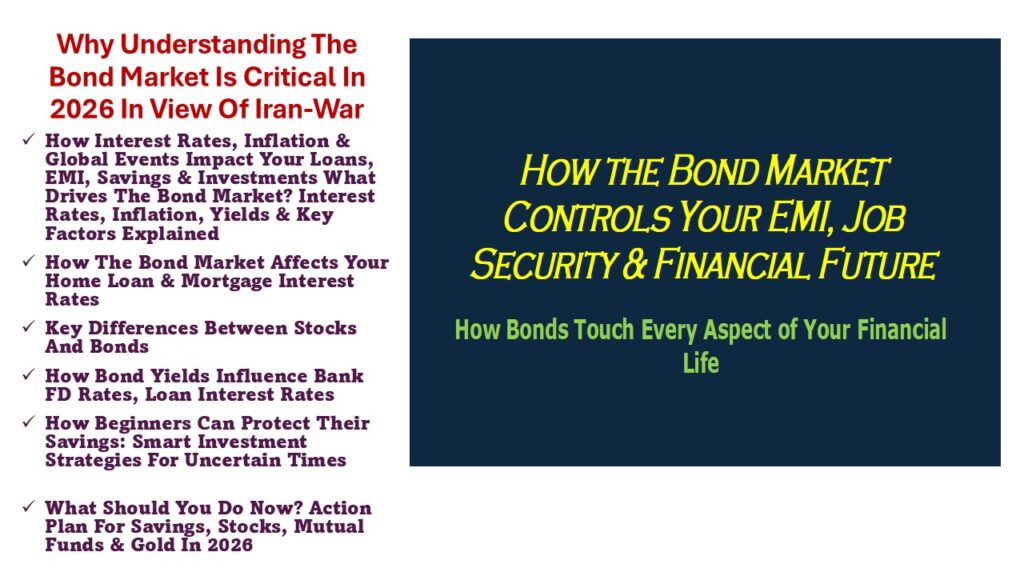


Bond Market Explained (India 2026): How Interest Rates, Inflation & Global Events Impact Your Loans, EMI, Savings & Investments
An Investor Education & Awareness Initiative: Why the Bond Market Matters More Than You Think – Especially Right Now
“Read this before your next financial decision.”
Picture this: you’re trying to buy your first home, save for your kids’ education, or just keep your retirement nest egg growing safely. But this quiet giant is pulling the strings on your mortgage rate, your bank FD interest, your job stability, and even the price of everyday goods – and almost nobody talks about it. It’s the bond market.
As Robert Kiyosaki puts it so powerfully: “If you don’t know how bonds work, you don’t understand money!” Most people have never heard of it, yet it’s bigger than the stock market, bigger than crypto, bigger than real estate. It controls your cost of living, your retirement, and your livelihood.
And right now, with the ongoing Iran war (the U.S.‑Iran conflict that escalated in early 2026), it’s sending shockwaves through every economy – spiking oil prices, stoking inflation fears, and making borrowing costlier for governments, businesses, and ordinary families like yours in India and around the world.
The U.S. national debt sits at around $39 trillion, with interest payments alone projected near $1 trillion this fiscal year – roughly $2.7–3 billion every single day. That money has to come from somewhere: taxes, more borrowing, or cuts elsewhere. When investors lose trust (as they have amid war‑driven energy chaos), bond yields rise, prices fall, and the ripple hits you – higher home loans, costlier business loans, slower job creation.
Fact-checked equivalent of the US national debt scenario for INDIA => Indian Central Government Debt: ₹190+ Lakh Crore, with Interest Payments at ₹14.04 Lakh Crore This Year – Over ₹38,000 Crore Every Single Day.
India’s public finances tell a story of scale and pressure. The central government’s debt-to-GDP ratio is estimated at 55.6% of GDP in 2026-27 (BE), down from 56.1% in RE 2025-26, with a medium-term anchor of 50% (±1%) targeted by 2030-31. Including states, the general government debt-to-GDP ratio is estimated to be over 85% in 2025.
The most revealing number in the budget arithmetic is this: interest payments are budgeted at ₹14.04 lakh crore in FY26-27 (BE) – crossing the ₹14 lakh crore mark for the first time. This single expenditure absorbs 20% of the total budget outlay and a staggering 26% of total expenditure (or nearly 40% of total revenue receipts of ₹35.33 lakh crore). To put that in daily terms: the Government of India pays approximately ₹38.5 billion (over ₹3,800 crore) every single day just to service its past borrowings.
That money has to come from somewhere: taxes, more borrowing, or cuts elsewhere. The government’s gross market borrowing is budgeted at ₹17.2 lakh crore for 2026-27, up from ₹14.8 lakh crore in FY26. When investors lose confidence (as they have amid war-driven energy chaos), bond yields rise. India’s 10-year government bond yields have already surged to near two-year highs, hitting 7.03% at the close of FY25, and have since traded in the 7.0–7.2% range, with HDFC Bank projecting a near-term range of 6.90–7.20%. Higher yields mean the government pays more to borrow, which crowds out spending on roads, hospitals, and welfare. For you, it translates to higher home loan rates (fresh loans have eased only modestly to 8.28% despite RBI rate cuts), costlier business loans, and slower job creation at a time when India needs to create around 8 million non-farm jobs annually.
*(Note: The Indian government does not publicly report a single “total debt” figure comparable to the US’s $39 trillion. The above is derived from the most authoritative sources: Budget 2026-27 documents, PRS India analysis, and RBI public debt statistics.)*
The bond market tells the truth before the headlines do.
Let’s break it down simply, with practical tips you can use today, whether you’re a finance newbie or someone with some market savvy.
Foreword: How the Bond Market Controls Your EMI, Job Security & Financial Future
Most people have never heard of the bond market, yet it quietly controls your mortgage rate, your job security, your cost of living, and your retirement account. As Robert Kiyosaki famously noted, “If you don’t know how bonds work—you don’t understand money!” By watching this market, you can often see the truth about the economy before it hits the headlines.
Think of bonds as the pulse of the global economy. In times of war or geopolitical tension:
- Governments borrow more → issue more bonds
- Investors demand higher returns → bond yields rise
- Borrowing becomes expensive → economy slows
Example (real‑world pattern):
Oil prices rise → inflation rises → investors lose confidence → sell bonds → bond yields rise → loans, EMIs, business borrowing all become costly.
Bottom line: If you don’t understand bonds, you won’t understand:
- Why your home loan suddenly became expensive
- Why stock markets crash even when companies are doing okay
- Why your savings are losing value
This document is designed as a practical, action‑oriented guide. Whether you are a seasoned investor or someone who has never bought a single share in your life, you will find simple steps you can take – starting today – to understand what is happening to your money and how to protect it.
Let us begin.
1. Why Understanding the Bond Market Is Critical in 2026 (War, Inflation & Rising Interest Rates Explained)
When war breaks out in a major oil‑producing region, most people think about petrol prices. That is fair – petrol affects your daily commute. But what is happening beneath the surface is far more consequential for your financial well‑being.
The ongoing US‑Israeli‑Iran conflict has already disrupted global energy supplies, sending oil prices surging. Brent crude jumped from around $70 to over $100+ at peaks, triggering stagflation fears – higher inflation and slower growth. This isn’t abstract: it means costlier fuel, transport, and goods for Indian households (we import most of our oil), pressure on the rupee, and central banks (like the RBI) staying cautious on rate cuts.
Bond yields have risen sharply worldwide:
- U.S. 10‑year Treasury around 4.3%
- Indian 10‑year G‑sec hitting 7.1%+
Why? Because investors demand higher returns to lend amid uncertainty. Higher yields mean governments and companies pay more to borrow, which crowds out spending on roads, jobs, and welfare. For you? It translates to pricier mortgages, lower business hiring, and eroding purchasing power.
The Debt Trap in Plain Sight
The US government currently owes $39 trillion in debt. The interest payments on that debt? $3 billion per day. Every single day. Whether the economy is growing or contracting, whether there’s war or peace. That money has to come from taxes – and when taxes aren’t enough, they borrow more, which adds more debt, creates more interest, and requires more borrowing. This is the debt trap. When investors lose trust in a government’s ability to manage its debt, bond yields rise sharply – and that affects everyone.
The practical impact on you (at a glance):
| If you are… | Here is how the bond market’s reaction to the war affects you |
| A home loan borrower | Higher bond yields mean higher mortgage rates. Your EMI could increase. |
| A salaried employee | Businesses facing higher borrowing costs may freeze hiring or even lay off. |
| A retiree | Your fixed deposit returns might look attractive, but inflation could erode their value. |
| An investor | Your stock portfolio may fall as money moves out of equities. |
Learning bonds helps you see these links early, protect your savings, and even spot opportunities (like safer fixed‑income plays) before the next headline hits.
2. Bond Market Basics: Simple Explanation & How It Impacts Your Daily Financial Life
Let us strip away all the complexity.
What is a bond? A simple IOU.
A bond is simply a loan. When a government or company needs money, they borrow it from the public by issuing bonds.
- You give them ₹1,000 (or $1,000).
- They promise to pay you back by a specific date – that’s the maturity.
- While they have your money, they pay you regular interest – that’s the coupon.
Think of it like an FD, but instead of a bank, you are lending to the government or a company. No ownership – just a loan.
How bonds touch every aspect of your life
| Aspect of your life | How the bond market touches it |
| Your home loan | Mortgage rates are priced directly off government bond yields. When bond yields rise, your home loan EMI goes up. |
| Your job security | When bond yields rise, businesses borrow less. They hire less. They invest less. That affects employment. |
| Your FD and savings account returns | Bank interest rates follow the bond market’s lead. |
| Your retirement savings | Your EPF, PPF, and pension funds are heavily invested in bonds. |
| Your stock portfolio | Rising bond yields make stocks less attractive. Why take risks in the stock market when the government offers a guaranteed 5%+ return? |
| The cost of your car loan and credit card | All borrowing costs in the economy trace back, ultimately, to the bond market. |
| Your pension or mutual funds | Many hold bonds for steady income. |
| Even the price of vegetables | Higher bond yields → costlier transport → higher food prices. |
One market. Every corner of your financial life.
Practical tip: Check the 10‑year G‑sec yield daily on the RBI or Moneycontrol apps – it’s your free “economic pulse check.” Start small: park emergency cash in short‑term Treasury bills or liquid funds tied to bonds.
3. What Drives the Bond Market? Interest Rates, Inflation, Yields & Key Factors Explained
Bond prices and yields move like a seesaw: prices up = yields down (and vice versa). Understanding what drives this is key to making smart moves.
The Most Important Factor: Interest Rates
When interest rates rise, bond prices fall. When interest rates fall, bond prices rise. This is the single most important rule in bond investing. It is called an inverse relationship.
Why? Imagine you bought a bond that pays 8% interest. Then, new bonds are issued paying 10%. Why would anyone buy your old 8% bond when they can get 10% from a new one? To make your bond attractive, you would have to sell it at a lower price – so that the buyer’s effective return matches the new market rate.
Other Factors That Move Bond Prices
| Factor | Effect on Bond Prices |
| Inflation | High inflation erodes the purchasing power of fixed interest payments. Investors demand higher yields → bond prices fall. |
| Economic growth | Strong growth can lead to higher interest rates (as inflation increases), hurting bond prices. Weak growth does the opposite. |
| Credit rating | A downgrade in credit rating increases perceived risk → bond price falls. An upgrade → bond price rises. |
| Supply and demand | More bonds issued without corresponding demand → lower prices. More buyers → higher prices. |
| Duration / maturity | Longer‑term bonds are more sensitive to interest rate changes. Their prices swing more (higher “duration risk”). |
War Adds a “Risk Premium”
The Iran war has added a geopolitical risk premium. Oil shocks raise inflation fears, which pushes yields up (prices down) – even though bonds are normally considered “safe havens.” This time is different because the shock is coming through energy prices and inflation, not through a collapse in demand.
Practical tip: Longer‑maturity bonds swing more. If you’re nervous about further rate hikes, stick to 3–7 year bonds or short‑duration debt funds.
4. How the Bond Market Affects Your Home Loan & Mortgage Interest Rates
This is where the bond market hits closest to home – literally.
Mortgage rates are directly tied to the bond market. When bond prices fall, yields rise, and mortgage rates increase. When bond prices rise, mortgage rates typically fall.
- The 10‑year Treasury / G‑sec benchmark: Mortgage rates generally follow the yield on the 10‑year government bond. When this yield rises, lenders increase mortgage rates to maintain their profit margins.
- Mortgage‑backed securities (MBS): Lenders bundle mortgages into bonds (called MBS) and sell them to investors. If investors demand higher yields to buy these bonds, mortgage rates go up.
- Inverse price relationship: Bond prices move opposite to yields. When investors sell off bonds due to economic uncertainty or inflation, bond prices drop, yields increase, and mortgage rates spike.
The 2026 Reality for Homebuyers
The big question facing bond markets in 2026 – and thus anyone hoping to buy a home – is whether long‑term rates will stay high even as central banks cut short‑term rates.
Here is what has actually happened: The US Federal Reserve cut short‑term rates by 175 basis points since September 2024. Yet the yield on the 10‑year US Treasury has risen from around 3.70% in September 2024 to around 4.15%. This is called the “easing paradox” – central banks cut rates, but the bond market refuses to comply and drives long‑term rates higher.
Practical takeaway for you: If you are planning to buy a home or have a floating‑rate home loan, do not assume that central bank rate cuts will automatically lower your EMI. The bond market has its own logic. When yields are high, consider shorter loan tenures or wait for cooling; refinance when yields drop.
5. Bond Market vs Stock Market: Key Differences, Relationship & Investor Impact
Think of the bond market and stock market as two giant magnets – when one pulls, the other often moves away.
Generally, they have an inverse relationship: When bond yields rise, stocks often fall, and vice versa. They compete for the same investor money.
| Scenario | What happens |
| Investors are optimistic | They favor stocks, driving prices up. |
| Economic uncertainty rises | Money moves into the relative safety of bonds, raising bond prices and lowering yields. |
| Interest rates / bond yields rise | Stocks become less attractive. Why take risks in stocks when you can get a guaranteed high return from bonds? |
| Inflation and interest rates rise | Often negatively affects both markets simultaneously. |
War Example
During the Iran war escalation, stocks sold off globally (5%+ drops), while bonds initially suffered from inflation fears but later offered safety. Rising bond yields make “safe” government bonds more attractive than risky stocks – so investors sell stocks, prices fall. Companies also face higher borrowing costs, which hurts their profits.
Key Differences Between Stocks and Bonds
| Feature | Stocks (Equity) | Bonds (Debt) |
| What you own | A tiny ownership stake in a company | A loan to a government or corporation |
| Return type | Capital appreciation + possible dividends | Fixed interest payments |
| Risk level | Higher | Low to moderate |
| Volatility | High | Low |
| Income certainty | Uncertain | Fixed |
| What happens if issuer fails | You may lose everything | Bondholders get paid before shareholders |
| Trading location | Centralized exchanges (NSE, BSE) | Mostly over‑the‑counter (OTC) |
Smart strategy: Mix both to balance growth + safety. A typical rule: diversify 40–60% bonds/stocks depending on your age and risk tolerance. When yields spike, stocks often dip – that can be a signal to buy quality equities on sale.
6. How Bond Yields Influence Bank FD Rates, Loan Interest Rates & RBI Policy
Banks do not set interest rates in a vacuum. They look at the bond market – specifically, government bond yields – to decide what to offer you.
The Chain of Influence
- Government bonds (G‑secs) set the benchmark “risk‑free” rate in the economy.
- Banks need to offer returns that are competitive with G‑secs, or depositors will simply buy government bonds directly.
- When G‑sec yields rise, banks raise FD rates to retain deposits.
- When G‑sec yields fall, banks lower FD rates (and loan rates).
The RBI’s Role
The Reserve Bank of India sets the repo rate – the rate at which it lends to commercial banks. This influences short‑term rates. But long‑term rates (like your home loan rate for 10–30 years) are set by the bond market.
What happened in India recently: Despite the RBI cutting rates by 125 basis points in 2025, bond yields did not fall as expected. In fact, the 10‑year government bond yield moved up by 30 basis points, especially after a 50 bps rate cut in June 2025. Why? Global factors. US Treasury yields remained elevated, and for global investors, that played a major role.
Practical implication: Your FD rates and loan rates are influenced by forces far beyond what the RBI alone can control. High G‑sec yields push up FD rates (good for savers) and loan rates (bad for borrowers). In India right now, with yields elevated, expect sticky deposit rates but caution on new loans.
7. How Interest Rates, Inflation & Credit Ratings Impact Bond Prices and Returns
Let’s go deeper into the three most powerful forces.
Interest Rates (Inverse Relationship)
When interest rates rise, bond prices fall. When interest rates fall, bond prices rise. This is because new bonds become more (or less) attractive compared to existing ones.
Inflation is the bond investor’s enemy. Why? Because bonds pay a fixed interest rate. If inflation rises unexpectedly, the real value of those interest payments shrinks.
Example: If a bond pays 7% but inflation is 6%, your real return is only 1%. If inflation jumps to 9%, you actually lose purchasing power. That’s why investors demand higher yields when inflation fears rise – which pushes bond prices down.
Bonds are rated by agencies like CRISIL, ICRA, CARE (in India) or Moody’s, S&P (globally). The rating tells you the issuer’s ability to repay.
| Rating grade | What it means | Typical return range (India, 2025–26) |
| AAA | Highest safety, lowest risk | 6–7% |
| AA to A | High quality, very low risk | 7–8.5% |
| BBB | Medium risk | 8–12% |
| BB and below (high‑yield / junk) | High risk, potentially high reward | 13–14.5%+ |
Important: A downgrade in a bond’s rating will almost always cause its price to drop. An upgrade does the opposite.
Crucial warning from experts: “When assessing bond investment opportunities on an app, investors should carefully review the credit rating of the issuer, the quoted yield to maturity (YTM), and the coupon rate. Any advertised yield above 12 percent warrants caution, as it may signal either elevated risk or unrealistic projections.”
Practical tip: Track RBI repo rates and inflation data monthly. If inflation > coupon, you are getting a real loss.
8. What Are Interest Rates? How They Affect Bond Prices, Yields & Investment Value
What are interest rates? (Simple view)
Interest rates are the “cost of money.” When you borrow, interest is what you pay. When you save, interest is what you earn. Central banks (like the RBI in India, the Fed in the US) set benchmark rates to control inflation and promote economic growth.
How Interest Rates Affect Bond Prices: A Practical Example
Let’s say ABC Ltd issued bonds of ₹100 face value at a 10% coupon one year ago. Interest rates have since declined, and ABC Ltd now issues fresh bonds at 9%.
- Your old bond still pays ₹10 per year.
- New bonds pay only ₹9 per year.
- Investors will happily pay a premium (say, ₹105) for your old bond because it gives them higher income.
Now reverse it. If interest rates rise to 11%, your old 10% bond becomes less attractive. Its price would fall below ₹100.
How Much Do Bond Prices Change? (Duration explained)
The extent of impact depends on two things:
| Factor | Effect on price sensitivity |
| Coupon rate | Lower coupon bonds are MORE impacted by interest rate changes than higher coupon bonds. |
| Residual maturity | Longer‑maturity bonds are MORE impacted than shorter‑maturity bonds. |
Duration measures a bond’s sensitivity to interest rate changes. A bond with a duration of 5 years will fall approximately 5% in price if interest rates rise by 1%. The longer the duration, the higher the risk.
9. When Should You Buy Bonds? Best Time Based on Interest Rate Cycles Explained
In general, you will make more money buying bonds when interest rates are HIGH.
Here is why: When interest rates rise, new bonds must pay higher yields to attract investors. Your investment return will be higher than it would be when rates are low.
But There Is a Catch (and an Opportunity)
If you buy a bond when rates are high, and then rates fall later, something wonderful happens: Your bond’s price will rise because its high coupon becomes more valuable in a low‑rate environment. You can sell it at a premium before maturity.
- High rates = buy now! You lock in higher coupons/yields for the long haul. When rates later fall, your bond’s price rises too (sell at profit if needed).
- Low rates? Existing bonds are already expensive; new ones pay less.
Current Environment (elevated yields from war)
The current environment – with elevated yields from the Iran war – favours locking in now for income‑focused investors. India’s 10‑year bond yield is expected to remain elevated in the 6.9–7.1% range amid ongoing uncertainty.
Practical Strategy for Indian Investors
| If you are… | Consider this |
| A conservative investor | Lock in current high yields with AAA‑rated bonds or G‑secs. |
| Someone with short‑term goals (under 1 year) | Stick to liquid funds or very short‑duration bonds. |
| Building a retirement portfolio | Create a bond ladder – buy bonds with staggered maturities so some mature each year. |
| Worried about further rate hikes | Stick to shorter‑duration bonds (less price sensitivity). |
Pro tip from experts: Manage reinvestment risk through staggered maturities. Do not put all your money into bonds of the same maturity year.
10. Stocks vs Bonds: Key Risks, Returns & Which Is Safer for Investors
Both stocks and bonds carry risks – just different kinds. Understanding these will help you sleep better at night.
Risks of Stocks (Equity)
| Risk | What it means | How it affects you |
| Market risk | Stock prices can fall sharply due to economic downturns, geopolitical events, or company‑specific issues. | You could lose a significant portion of your investment. |
| Volatility risk | Prices swing wildly in short periods. | You may be tempted to panic‑sell at the worst time. |
| Company risk | The company could perform poorly or go bankrupt. | You could lose your entire investment. |
| Liquidity risk | Some stocks may be hard to sell quickly without taking a loss. | More relevant for small‑cap stocks. |
Risks of Bonds
| Risk | What it means | How it affects you |
| Interest rate risk | When rates rise, bond prices fall. | If you sell before maturity, you may get less than you paid. |
| Credit / default risk | The issuer may fail to pay interest or return principal. | More relevant for corporate and high‑yield bonds. |
| Inflation risk | Rising prices erode the purchasing power of fixed interest payments. | Your real returns could be negative even if nominal returns are positive. |
| Reinvestment risk | When bonds mature, you may have to reinvest at lower rates. | More relevant in falling interest rate environments. |
Stocks are generally riskier than government bonds. But high‑yield corporate bonds (rated BB or below) can be just as risky as stocks, if not more.
War amplifies both risks – but bonds act as a ballast (stabiliser) in a diversified portfolio. Bonds generally preserve capital better – that’s the “return of capital” principle.
11. How Beginners Can Protect Savings: Smart Investment Strategies for Uncertain Times
Remember the old adage: Return OF capital is as important as return ON capital.
Don’t chase high returns if it risks losing your principal. Here are practical, actionable steps anyone can take – starting today.
Step 1: Build an Emergency Fund FIRST
Before you invest a single rupee in stocks or bonds, build an emergency fund covering 6–12 months of expenses (conservative, given the uncertainty). Keep this in a liquid fund or high‑interest savings account. This prevents you from breaking long‑term investments during a crisis.
Step 2: Diversify Across Asset Classes – Not Just Within Equities
“When equities correct, fixed income continues to deliver steady returns, and hedge assets can provide balance. This is not about maximising returns in one phase, but about ensuring consistency across cycles.”
A simple, effective portfolio structure is the 65-10-10-15 “boring thali” (or adjust based on your age/risk tolerance):
| Asset | Allocation | Role |
| Equity | 65% | Long‑term growth engine |
| Gold | 10% | Hedge against uncertainty |
| Silver | 10% | Additional hedge |
| Fixed income (bonds / FDs) | 15% | Stability and predictable income |
This structure has been tested during volatile phases, where weakness in one asset class is often balanced by stability or gains in another.
Step 3: If You Are Investing in Bonds Directly – Do These Checks
| Check | What to look for |
| Regulated platform | “When investing in a bond on a platform, make sure it is a regulated platform.” Always verify SEBI registration. |
| Listed bonds only | “Buy only listed bonds. If something were to go wrong, you will get added coverage.” Unlisted bonds are for super HNIs with specialised knowledge. |
| Credit rating | Check the rating. AAA‑rated bonds offer safety (6–7% returns). BBB+‑rated bonds offer higher returns (13–14.5%) but with higher risk. |
| Match to your goal | “Match it to your investment goals. See what the maturity of the bond is. Are you saving up for education? To buy a house?” |
| Return sanity check | “Any advertised yield above 12 percent warrants caution. If the app shows extremely high returns, such as twenty or twenty‑five percent, that is a clear warning sign.” |
Step 4: Ladder Your Investments
Bond laddering means buying bonds with different maturities (e.g., 1 year, 3 years, 5 years, 10 years). This way:
- Some money frees up regularly.
- You reduce reinvestment risk.
- You are not locked into a single interest rate environment.
Step 5: Avoid Panic Selling
“One of the worst things investors can do is leave the market when it goes down.” Panic selling turns temporary losses into permanent ones. People who sell in a panic often lose money and cannot take part in the next rise.
Step 6: Keep Your SIPs Running During Downturns
“If you stop SIPs during downturns, it can mess up long‑term compounding. Instead, step up your SIPs during these times.”
Step 7: Rebalance Periodically
Rebalancing your portfolio (every 6–12 months) helps restore the proper mix and ensures your investment choices remain aligned with your long‑term goals.
Step 8: For Beginners – Start Small
You can start your bond investment journey with as little as ₹10,000 through online bond platforms (like Bondbazaar, Groww, IndiaBonds). The minimum investment in these bonds is generally ₹10,000, making it an ideal choice for beginners seeking stable, diversified financial growth.
Summary Checklist for the Common Investor
- Build 6–12 months emergency fund in liquid savings / short‑term debt funds.
- Diversify: 30–50% in G‑secs or high‑quality corporate bonds via ETFs/mutual funds.
- Avoid timing: use laddering.
- Ignore hype: gold or FDs for safety; bonds for steady income.
- Review quarterly, not daily.
- Consult a SEBI‑registered advisor for your risk profile.
12. What Should You Do Now? Action Plan for Savings, Stocks, Mutual Funds & Gold in 2026
The current environment (Iran war, rising oil prices, inflation concerns, market volatility) requires a thoughtful approach. Here is actionable advice for each asset class.
For Your Bank Savings and FDs
| Action | Why |
| Keep 6–12 months of expenses in an emergency fund | Prevents forced selling of other assets during crises. |
| Consider locking in some long‑term FDs now | Current rates are elevated. If rates fall later, you will have locked in higher returns. |
| If rates are rising, prefer shorter‑term FDs | Shorter maturities allow you to reinvest at higher rates sooner. |
| Move idle cash into tax‑efficient yield strategies | Debt, arbitrage, and multi‑asset strategies yield superior post‑tax returns while providing liquidity buffer. |
For Your Stocks
| Action | Why |
| Do NOT panic sell | Knee‑jerk reactions often lock in losses. |
| Keep your SIPs running | Regular investments benefit from rupee‑cost averaging. You buy more units when prices are low. |
| Focus on quality companies | Look for strong fundamentals, not just cheap stocks. Shift from index‑led momentum to quality‑biased stock selection. |
| Reassess your equity allocation | For goals under 1 year → 100% debt. For 1–3 years → 70% equity / 30% debt. For beyond 3 years → 80% equity / 20% debt (with gold as a substitute). |
| Rising bond yields = pressure on stocks | Shift partially to safer assets if you are over‑exposed. |
For Your Mutual Funds
| Action | Why |
| Do not stop SIPs during downturns | This messes up long‑term compounding. Instead, increase SIPs when markets are down. |
| Review your fund categories | Consider shifting some allocation to gilt funds or arbitrage funds for tax efficiency. |
| Stick to your asset allocation | If your original plan was 60% equity / 40% debt, maintain it through rebalancing. |
| Prioritise high‑quality diversified funds | Avoid chasing fast‑moving trends (defence stocks, cryptocurrencies, etc.) entered late in the rally. |
| Debt funds → good when rates stabilize. Avoid long‑duration funds during rising rates. | Long‑duration funds suffer the most when yields rise. |
For Your Gold
| Action | Why |
| Maintain 10–15% allocation | Gold serves as an effective hedge against uncertainty, inflation, and currency volatility. |
| Consider Sovereign Gold Bonds (SGBs) | They offer additional interest income alongside gold price appreciation. |
| Do NOT increase gold weightage after a 70% price surge | This is a common mistake – buying after a huge rally. |
| Use gold as a stabilizer, not a return driver | “Gold and silver should be seen as portfolio stabilizers, not return drivers.” |
For Your Bonds and Debt Investments (if you already hold them)
| Action | Why |
| Manage reinvestment risk through staggered maturities | Do not put all your money into bonds of the same maturity year. |
| Stick to shorter duration if worried about further rate hikes | Short‑duration bonds are less sensitive to interest rate changes. |
| If you have a long horizon, lock in current high yields | India’s 10‑year yields are elevated in the 6.9–7.1% range. |
| Avoid unlisted bonds | “Buy only listed bonds. If something were to go wrong, you will get added coverage.” |
| Consider inflation‑linked bonds | These protect your real returns if inflation stays high. |
Overall Strategy for Existing Investors
- Rebalance portfolio every 6–12 months – trim winners if over‑allocated; add to debt funds when yields are attractive.
- Increase safety during uncertainty – hold quality; war volatility creates dips to buy, but don’t try to time the bottom.
- Stay calm – the bond market’s message right now is “caution + opportunity in quality debt.”
The Single Most Important Principle for 2026
“Volatility is the new normal. Investors must shift focus from maximizing returns to building resilient portfolios that can endure uncertainty.”
A Simple Checklist for Right Now
- Check your emergency fund (6–12 months of expenses)
- Review your asset allocation – are you over‑concentrated in any one area?
- Continue all existing SIPs (consider increasing them)
- Do not make any panic‑driven changes
- If you have cash to deploy, consider quality bonds offering 8–10% returns
- Gold at 10–15% is fine. Do not go above that.
- Stay diversified across equities, bonds, and gold
- Focus on the long term. Patience wins over reaction.
Final Takeaway: Why Understanding the Bond Market Is Essential for Financial Success
The bond market is not just for experts.
It is:
- The foundation of all financial decisions.
- The early warning system of the economy.
- The hidden force behind your daily money life.
If you understand bonds, you stop reacting to news – you start anticipating what comes next.
Bonds aren’t flashy, but they are the foundation of financial peace. Start small, learn one concept a week, and you will sleep better knowing you understand the market that truly runs the world.
“If this changed how you think about money, share it with someone who needs it.”
Sources & References: Verified Data on Bond Markets, Interest Rates & Global Economic Trends
The information presented in this document has been compiled from multiple authoritative sources, including:
- Robert Kiyosaki’s foundational explanations of bonds and the debt trap.
- Core educational content from Investopedia on bond‑stock relationships, interest‑rate dynamics, mortgages, and risks.
- Details on the Indian bond market (G‑secs, corporate bonds, RBI linkages) from Groww, Bondbazaar, and Moneycontrol.
- U.S. Treasury Fiscal Data and Congressional Budget Office projections on national debt (~$39 trillion) and interest costs as of April 2026.
- Real‑time yield data from FRED / Trading Economics.
- Validated reporting on the 2026 Iran war’s economic fallout (oil spikes, bond sell‑offs, inflation/stagflation risks) from The New York Times, Reuters, CNBC, Al Jazeera, and Seeking Alpha.
- RBI policy context and geopolitical market analysis from IMF / JPMorgan insights.
- CNBC reporting on the Iran war’s impact on government bonds and safe‑haven assets (March 2026).
- Bloomberg and Financial Post analysis of global bond market reactions to Middle East conflict.
- Reserve Bank of India (RBI) directions and regulatory frameworks (2025–2026).
- Securities and Exchange Board of India (SEBI) investor advisories and regulatory updates.
- Economic Times and Mint reporting on India’s bond market performance and 10‑year yield trends.
- Bank of Baroda economic analysis on India’s bond yield trajectory.
- Jiraaf’s Saurav Ghosh on bond vs equity performance in 2025–2026.
- IndiaBonds’ Vishal Goenka on practical bond investing safety checks.
- Moneycontrol and CNBC TV18 expert insights on market volatility and investor protection strategies.
- Edelweiss Mutual Fund’s Radhika Gupta on the 65-10-10-15 “boring thali” portfolio strategy.
- Times of India expert panel on portfolio allocation amid the US‑Iran war.
- Standard & Poor’s, Moody’s, and CRISIL bond rating frameworks.
- PIMCO on interest rate and bond market dynamics.
All facts cross‑checked for accuracy as of April 2026.
“If this helped you understand your money better, share it with someone who is still guessing what drives their EMI, FD returns, or stock portfolio.”
“Want a personalized asset allocation strategy? Reach out for a consultation.”
Disclaimer: This document is for educational and awareness purposes only. It does not constitute investment advice. Readers should consult with a SEBI‑registered financial advisor before making any investment decisions.
Subhashis Banerji [Author]
Leadership assessor, strategist, and writer. I help professionals and organizations make smarter decisions by learning to read patterns, not promises.
Read all my articles here:
https://successunlimited-mantra.net/ & https://successunlimited-mantra.com/index.php/blog PLUS on https://relationshipandhappiness.com/
Connect with me on LinkedIn:
https://www.linkedin.com/in/subhashis-banerji-21b1418/


– Please read our Comment Policy